
A Study of Biochar Application in Various Fields
Ⓒ The Korean Environmental Sciences Society. All rights reserved.
This is an Open-Access article distributed under the terms of the Creative Commons Attribution Non-Commercial License (http://creativecommons.org/licenses/by-nc/3.0) which permits unrestricted non-commercial use, distribution, and reproduction in any medium, provided the original work is properly cited.
Abstract
Biochar has gained attention for its eco-friendly properties, which can mitigate climate change and global warming. Biochar sequesters carbon in the soil and serve as a carbon negative solution. It offers a promising alternative to fossil fuel oil and traditional energy sources. It is sustainable and eco-friendly energy source and that is also more economical than other energy sources. It is cheaper than other carbon black materials and can be easily produced at industrial scale. Biochar has diverse applications, such as soil enhancement, gas remediation, construction materials, medicine, feed supplements, and electrochemical fields. Research shows that biochar’s special properties can be advantageous in various fields, and its usage is being explored until economic factors meet the standards. The advantages of biochar should be considered and its hazards should be studied in the future.
Keywords:
Biochar, Climate change, Soil enhancer, Feed supplement, Biochar application1. Introduction
Climate change mitigation not only requires reductions of greenhouse gas emissions, but also withdrawal of carbon dioxide (CO2) from the atmosphere. Biochar plays a big role in reducing greenhouse gases. Half of the emission reductions and the majority of CO2 removal result from the one to two orders of magnitude longer persistence of biochar than the biomass it is made from (Lehmann et al., 2021). Annual net emissions of carbon dioxide (CO2), methane and nitrous oxide could be reduced by a maximum of 1.8 Pg CO2-C equivalent (CO2-Ce) per year (12% of current anthropogenic CO2-Ce emissions; 1 Pg=1 Gt), and total net emissions over the course of a century could be reduced by 130 Pg CO2-Ce, without endangering food security, habitat or soil conservation (Woolf et al., 2010). Being rich in carbon and having greater stability, biochar has several benefiting properties such as surface area, porosity, water holding capacity, adsorption capacity, and cation exchange capacity that may persist in soil for decades or even centuries. Also, biochar has been proven to have great carbon sequestration capacity. Biochar in its original form and after physical or chemical activation have been found to be an excellent CO2 adsorbents with stable recyclability and regeneration. Furthermore, biochar also increases soil aeration, hence decreasing the activities of methanogens and consequently reducing methane emission, one of the greenhouse gas emissions. Biochar increases the C:N ratio of the soil which according to several researchers may help reduce nitrous oxide emissions from the soil, which is another one of greenhouse gases emissions (Ighalo et al., 2025). Biochar is a suitable alternative to fossil fuel driven energy production in the near future (Arif et al., 2020). Global warming will likely enhance greenhouse gas emissions from soils. Due to its slow decomposability, biochar is widely recognized as effective material in long-term soil carbon sequestration and in mitigation of soil greenhouse gas emissions. It was found that the incorporation of biochar into soil was estimated to offset warming-induced elevated greenhouse gas emissions for 25 years (Bamminger et al., 2017). Not only biochar is benefiting to the environment, but also biochar can be applied in various fields. Biochar has been shown great potential in several different fields as followed in the below. In this study, it will demnostrate how biochar can be applied in various fields of study.
2. Related Research
2.1. Biochar as soil enhancer
Biochar can be a soil amendment for remediation. There are several benefits when using biochar into soil. Biochar showed adsorbed cations, pathogens control, moderate organic and inorganic contaminants, increase soil nutrients, soil amendment, good adsorption site for NOx, nutrient adsorber, improved soil fertility, and enhanced soil capacity (Oni et al., 2019).
Biochar, carbon-rich material, offsets negative effects of drought and salt stress on plants. After applying biochar into soil, plant growth, biomass, and yield increased. Also, photosynthesis, nutrient uptake, and modified gas exchange characteristics increased. Furthermore, biochar increased water holding capacity under drought condition. Under salt stress, biochar decreased Na+ uptake, while increased K+ uptake by plants (Ali et al., 2017).
When applying biochar into the soil, Biochar have synergistic benefits with compost. First, biochar can increase microbial activity and reduce nutrient losses during composting Second, the biochar becomes charged with nutrients, covered with microbes, and pH-balanced (Hunt et al., 2010).
Several properties were demonstrated when using biochar into soil. Significant changes happen in soil quality including increases in pH, organic carbon, and exchangeable cations and reduction in tensile strength. After all, biochar has been proven to be an excellent soil enhancer (Chan et al., 2007).
2.2. Biochar application for gas remediation
Biochar becomes very active when remediating poisonous substance from gas. Biochar from camphor, rice hull, bamboo, sludge, hardwood chip and manure from pig effectively eliminates H2S from biogas, which has efficiency removal of over 96% (Oni et al., 2019).
The main cause of changes in the climate is the increase in greenhouse gases and global warming, while carbon dioxide (CO2) emission contributes above 77%. In addition, it is important to decrease carbon dioxide contaminants from agricultural soil to moderate climate change. Biochar is newly used to increase soil carbon sequestration and reduces nitrous oxide (N2O) emission and (CH4) emission (Oni et al., 2019).
Regarding many researches, biochar can change the physicochemical properties of soil and compost in different environments, which further shapes the microbial community in a specific environment. Having a closer look into microbial community, biochar addition affects CO2 emissions by influencing oligotrophic and copiotrophic bacteria, affects CH4 emissions by regulating the abundance of functional genes, such as mcrA (a methanogen) and pmoA (a methanotroph), and affects N2O emissions by controlling N-cycling functional genes, including amoA, nirS, nirK, nosZ (Zhang et al., 2019).
Besides, biochar produced from crop residues and woody biomass has a greater effect on mitigating CH4, N2O, and NH3 emissions during composting. Greenhouse gas emissions can be reduced significantly after adding about 10% (w/w) biochar. Biochar produced by high temperature pyrolysis (500–900°C) has a better effect on mitigating CH4 and N2O emissions, whereas biochar produced by low temperature pyrolysis (200–500°C) is more effective at reducing NH3 emissions (Yin et al., 2021; Lyu et al., 2022).
2.3. Biochar as construction material
Biochar can be applied in construction material due to their porous nature and highly functionalized surface. Biochar easily becomes composites such as biochar-cement composites, biochar-asphalt composites, biochar-plastic composites, etc (Zhang et al., 2022).
Using biochar-containing construction material is to capture and then lock atmospheric carbon dioxide in buildings and structures. These biochar-containing construction material can potentially reduce greenhouse gas emissions by 25% (Gupta and Kua, 2017).
Capability of capturing CO2 from the air was detected when using biochar mixed with building material (0.033 mmol CO2 gbiochar−1 to 0.138 mmol CO2 gbiochar−1). Some studies mentioned biochar-containing building materials have a great potential for carbon footprint reduction (Legan et al., 2022).
Biochar showed better performance when exploiting as construction material. Biochar properties such as chemical stability, flammability, and low thermal conductivity are important factors in manufacturing construction material. Also, insulating materials, biochar-based clays and lime plasters, building bricks, concretes and roof tiles showed engineered biochar as a carbon-negative material (Pandey et al., 2022).
2.4. Biochar application in medical fields
In medical field, the utilization of biochar as a biosensor has already been documented. Basically, the compounds to be detected first bond to biochar, then electronic signals are sent to the computer and accurate measurement is made. One scientist observed the detection of 17 β-estradiol in water using biochar nanoparticles. The scientist revealed that BCNP800 (BCNPs produced under the temperature of 800°C) displayed the best absorption and conductivity as a biosensor. In addition to adsorbent, biochar also acts as a catalyst. The morphology of biochar may be a crucial element in enhancing the catalytic performance. Utilizing the catalytic property of biochar, a non-enzymatic biosensor capable of detecting glucose levels in human saliva was devised (Zhou et al., 2023).
When it comes to drug delivery, nanoparticle is undoubtedly the most popular material in the past 10 years. Nanomaterials that can react to certain stimuli and achieve regulated drug release are ideal drug delivery carriers. Therefore, using nanocarriers for controlled and targeted drug delivery has gained increasing attention. At present, common nanocarriers in controlled drug delivery include: liposomes, dendrimers, nanosphere or nanocapsule, solid lipid nanoparticles, nanofibers, polymers, self-assembled polymeric micelles, exosomes and carbon nanotube, etc. Among these nanocarriers, biochar stands out for its simple synthesis process, low cost, long-term stability and easy tailorability of various properties (Patra et al, 2018).
Ag–Cu/biochar was synthesized and the potential of this novel nanocomposite in the removal of doxycycline (DOX) was evident as it reached nearly 100% under the optimum reaction conditions. Antibiotics have been extensively used to treat infectious diseases in humans, animals, and crops against both gram-positive and gram-negative bacteria. Doxycycline (DOX), a common broad-spectrum antibiotic, is frequently employed in treating various diseases. In this context, green synthesized nanomaterials including biochar could be a potent antioxidant (Hosny et al., 2022).
2.5. Biochar as feed supplement
Biochar can be applied as feed additive for ruminants (cattle and goats), pigs, poultry (chickens and ducks) and fish. Animal showed improved growth performance, better blood profiles, better egg yield, ability to resist pathogens including gut pathogenic bacteria and reduction of methane production by ruminant animals (Man et al., 2020).
One scientist explained various mechanisms by which biochar can eliminate toxins from the body. First of all, biochar can interrupt the so-called enterohepatic circulation of toxic substances between the intestine, liver and bile. Biochar can prevent compounds such as estrogens and progestagens, digitoxin, organic mercury, arsenic compounds and indomethacin from being absorbed in bile. Second, compounds such as digoxin, which are actively secreted into the intestine, can be adsorbed there. Third, compounds such as pethidines can be adsorbed to the biochar, and then passively diffuse into the intestine. Fourth, the biochar can take up compounds being a mixture that diffuses along a concentration gradient between intestinal blood and primary urine (Schmidt et al., 2019).
Using biochar as feed supplement has several benefits. It increases in feed intake, increases weight gain, increases feed efficiency, increases higher egg production and quality in poultry, Strengthens the immune system, improves meat quality, improves stable hygiene and odor pollution, reduces claw and feet diseases, and reduces veterinary costs (Prasai et al., 2017).
Effects of biochar regarding egg yield was also experimented. Improved egg production was also noted under commercial certified organic production conditions trialling 2% biochar feed supplementation compared with the control. Therefore, feed supplementation with biochar, zeolite and bentonite improved production performance traits of egg yield, and improved feed conversion ratio. In addition, and biochar feed additives potentially act as detoxifiers or inhibit growth of microbial pathogens, slowing digestion or altering the gut anatomy and microbiota to improve feed conversion ratio (Dadhich, 2022).
It has been proven that biochar has several benefits on digestibility, immunity, feed efficiency, as well as the quality of the products received from animals. It has also been reported to mitigate the notorious greenhouse gas emissions produced by ruminants. Biochar as feed supplements is being used in a wide range of animals from cattle to pigs, poultry, and even fish. Lastly, when combined with other good farmer practices, biochar has the potential to improve the overall sustainability of animal husbandry (Dadhich, 2022).
2.6. Biochar application in electrochemical fields
Biochar is being used as an electrocatalyst and photocatalyst for hydrogen and oxygen production via water-splitting. However, it is not used in every catalytic process but only used in catalyst material for hydrogen and oxygen productions (Rahman et al., 2020).
Compared to conventional graphite materials used in various kinds of rechargeable batteries, biochar showed high specific charge storing capacity due to their cost effective and sustainable synthesis process. It is essential to mention that further research is deemed necessary to increase the specific capacity through design of high-voltage cathode, and possibly low-potential anodes out of biochar, making state-of-the-art better batteries (Kane et al., 2022).
Biochar can be applied to make supercapacitors. Modern supercapacitors are endowed with excellent reliability, high power density, and fast charging–discharging characteristics. Recent studies showed that biochar-based materials have excellent potential to substitute the conventional activated carbon. High conductive and microporous biochar are demonstrated as candidate materials for high specific capacitance supercapacitors (Kalinke et al., 2021).
Biochar has prominent application in direct carbon fuel cells and microbial fuel cells as an oxygen reduction reaction catalyst. In direct carbon fuel cells, oxidation of carbon into CO2 and CO on the anode liberates electrons, and contributes electric production at the cathode (Kalinke et al., 2021).
One study demonstrated that lignin-derived biochar was prepared and characterized toward potential applications as a conductive electrode additive. Also the biochar can be an active lithium host material within lithium-ion batteries. This biochar was specifically selected for its high electrical conductivity, which is comparable to that of common conductive carbon black standards. Compared with carbon black, due to its high electrical conductivity, the biochar serves as an effective conductive additive within electrodes, demonstrating slightly improved cell efficiency and rate capability over those of electrodes using carbon black as the additive (Kane et al., 2022).
The search for eco-friendly and low-cost materials is becoming more urgent to sustain the earth and human lives. We have issued the use of biochar, a low-cost material obtained from renewable resources for electrochemical devices. Mainly, biochar has a highly functionalized surface, promoting high sorptive or interaction capacity. This characteristic makes biochar use more attractive, and cause spontaneous preconcentration or the incorporation of species (Cheng et al., 2017).
As electrochemical double-layer capacitors, high specific surface area and fine pore structures dominate the capacitance of the capacitors. The high specific surface area can improve the adsorption and desorption capacity between electrode materials and electrolyte ions, while the pore structures affect the transportation of ions. Hierarchical pore structures, which contain micropores (<2 nm), mesopores (2–50 nm), and macropores (>50 nm), are effective in enhancing capacitance performance in electrochemical double-layer capcitorss. Micropores provide high specific suface area, while mesopores and macropores can minimize the ion diffusion distances and facilitate ion transportation. In this way, biochar can act as an easily available carbon material to fabricate hierarchical porous carbon capacitors with high specific surface area after the necessary activation process (Cheng et al., 2017).
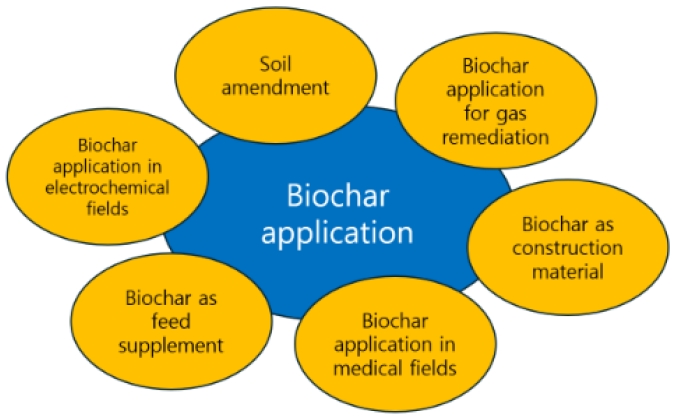
Biochar application in various fields.
3. Results and Discussion
Biochar is increasingly being recognized by scientists and policy makers for its essential role in carbon sequestration, reducing greenhouse gas emissions, renewable energy, waste mitigation, and as a soil amendment. The use of biochar as a soil enhancer has been proposed to simultaneously mitigate anthropogenic climate change while improving soil fertility and enhancing crop production. In the past, adding charcoal to soil to enhance soil fertility was an age-old practice in many cultures, perhaps best exemplified by Terra Preta de Indio soils discovered in Amazonia, associated with native American settlements. A number of reviews and studies have covered issues such as mitigation of global warming through application of stable C into soil, waste management, production of bioenergy, soil health, and productivity benefits.
Due to their special properties, biochar has proven itself as an economical and eco-friendly alternative material in many fields of study. In a nutshell, biochar can be used as soil amendment, used in gas remediation, used as construction material, used in medical fields, used as feed supplement, and used in electrochemical fields. Furthermore, biochar can be used in various another fields such as catalyst, additive in gasolin, etc.
Biochar has been known for their advantageous properties and has been shown their environmental benefits. However, biochar can pose potential environmental risks to soil, water, and atmosphere owing to its harmful components, adverse surface properties or structure, and chemical characteristics at micro-/nano-dimensions. Biochar can have drawbacks during the wide application of biochar. There could be wide variety of possible negative outcomes. To sum up, the following points should be considered in future research (Xiang et al., 2021).
- 1) Biochar impact in the environment such as in agronomic field, aquatic media, and atmospheric field should be assessed in the long term and scientists should consider about the solution after the potential risks of biochar have been detected.
- 2) Not only ecological and environmental aspects of biochar should be investigated, but also economical benefits of economical sustainability of biochar should be outlined while scientists should find a suitable application field for different kinds of biochar.
- 3) Different feedstocks, different pyrolysis temperatures, different manufacturing conditions, etc. make different kinds of biochar used in different fields of study. Therefore, standard process of manufacturing biochar in a consistent manner would be of great significance for sustainable application of biochar.
4. Conclusion
Several Biochar application has been well performed in various fields of study. With state-of-the-art technology, Biochar has been shown prominent performance in soil amendment, in gas remediation, in construction material, in medical fields, in feed supplement, and in electrochemical fields. Precautionary measures should be considered about the long term effect of biochar in the environment. Negative outcomes of biochar should be studied more as well as positive results of applying biochar. Furthermore, biochar can also be applied in ongoing different fields besides the fields outlined in this paper. Better quantitative and qualitative application of biochar will be researched in the future.
REFERENCES
-
Ali, S., Rizwan, M., Qayyum, M. F., Ok, Y. S., Ibrahim, M., Riaz, M., Arif, M. S., Hafeez, F., Al-Wabel, M., Shahzad, A. N., 2017, Biochar soil amendment on alleviation of drought and salt stress in plants: A Critical review, Environ. Sci. Pollut. Res., 24(14), 12700-12712.
[https://doi.org/10.1007/s11356-017-8904-x]

-
Arif, M., Jan, T., Riaz, M., Fahad, S., Adnan, M., Amanullah, Ali, K., Mian, I. A., Khan, B., Rasul, F., 2020, Biochar; A Remedy for climate change, environment, climate, plant and vegetation growth, Springer International Publishing, Switzerland, 151-171.
[https://doi.org/10.1007/978-3-030-49732-3_8]
-
Bamminger, C., Poll, C., Marhan, S., 2017, Offsetting global warming-induced elevated greenhouse gas emissions from an arable soil by biochar application, Glob. Chang. Biol., 24(1), 318-334.
[https://doi.org/10.1111/gcb.13871]
-
Chan, K. Y., Van Zwieten, L., Meszaros, I., Downie, A., Joseph, S. K., 2007, Agronomic values of greenwaste biochar as a soil amendment, Aust. J. of Soil Res., 45(8), 629-634.
[https://doi.org/10.1071/SR07109]
-
Cheng, B., Zeng, R. J., Jiang, H., 2017, Recent developments of post-modification of biochar for electrochemical energy storage, Bioresour. Technol., 246, 224-233.
[https://doi.org/10.1016/j.biortech.2017.07.060]
-
Dadhich, A., 2022, Engineered biochar as feed supplement and other husbandry applications, engineered biochar: Fundamentals, preparation, characterization and applications, Springer Nature Singapore, Singapore, 319-329.
[https://doi.org/10.1007/978-981-19-2488-0_17]
-
Gupta, S., Kua, H. W., 2017, Factors determining the potential of biochar as a carbon capturing and sequestering construction material: Critical review, J. Mater. Civ. Eng., 29(9), 1-14.
[https://doi.org/10.1061/(ASCE)MT.1943-5533.0001924]
-
Hosny, M., Fawzy, M., Eltaweil, A. S., 2022, Phytofabrication of bimetallic silver-copper/biochar nanocomposite for environmental and medical applications, J. Environ. Manage., 316, 115238.
[https://doi.org/10.1016/j.jenvman.2022.115238]
- Hunt, J., DuPonte, M., Sato, D., Kawabata, A., 2010, The basics of biochar: A Natural soil amendment, Soil and Crop Management, 1-6.
-
Ighalo, J. O., Ohoro, C. R., Ojukwu, V. E., Mohan, G. B. M., Chandran, S. A., Rangabhashiyam, S. R., 2025, Biochar for ameliorating soil fertility and microbial diversity: From production to action of the black gold, iScience, 28(1), 111524.
[https://doi.org/10.1016/j.isci.2024.111524]
-
Kalinke, C., Oliveira, P. R., Bonacin, J. A., Janegitz, B. C., Mangrich, A. S., Marcolino-Junior, L. H., Bergamini, M., 2021, State-of-the-art and perspectives in the use of biochar for electrochemical and electroanalytical applications, Green chem., 15.
[https://doi.org/10.1039/D1GC00843A]
-
Kane, S., Storer, A., Xu, W., Ryan, C., Stadie, N. P., 2022, Biochar as a renewable substitute for carbon black in lithium-ion battery electrodes, ACS Sustain. Chem. Eng., 10(37), 12226-12233.
[https://doi.org/10.1021/acssuschemeng.2c02974]
-
Lehmann, J., Cowie, A., Masiello, C. A., Kammann, C., Woolf, D., Amonette, J. E., Cayuela, M. L., Camps-Arbestain, M., Whitman, T., 2021, Biochar in climate change mitigation, Nat. Geosci., 14, 883-892.
[https://doi.org/10.1038/s41561-021-00852-8]
-
Legan, M., Gotvajn, A. J., Zupan, K., 2022, Potential of biochar use in building materials, J. Environ. Manage., 309, 114704.
[https://doi.org/10.1016/j.jenvman.2022.114704]
-
Lyu, H., Zhang, H., Chu, M., Zhang, C., Tang, J., Chang, S. X., Masek, O., Ok, Y. S., 2022, Biochar affects greenhouse gas emissions in various environments: A Critical review, Land Degrad. Dev., 33(17), 3327-3342.
[https://doi.org/10.1002/ldr.4405]
-
Man, K. Y., Chow, K. L., Man, Y. B., Mo, W. Y., Wong, M. H., 2020, Use of biochar as feed supplements for animal farming, Crit. Rev. Sci. Tec., 51(2), 187-217.
[https://doi.org/10.1080/10643389.2020.1721980]
-
Oni, B. A., Oziegbe, O., Olawole, O. O., 2019, Significance of biochar application to the environment and economy, Ann. Agric. Sci., 64(2), 222-236.
[https://doi.org/10.1016/j.aoas.2019.12.006]
-
Pandey, D., Chhimwal, M., Srivastava, R. K., 2022, Engineered biochar as construction material, Engineered Biochar : Fundamentals, preparation, characterization and applications, Springer Nature Singapore, Singapore, 303-318.
[https://doi.org/10.1007/978-981-19-2488-0_16]
-
Patra, J. K., Das, G., Fraceto, L. F., Campos, E. V. R., Rodriguez-Torres, M. d. P. R., Acosta-Torres, L. S., Diaz-Torres, L. A., Grillo, R., Swamy, M. K., Sharma, S., Habtemariam, S., Shin, H., 2018, Nano based drug delivery systems: Recent developments and future prospects, J. Nanobiotechnol., 16(71), 1-33.
[https://doi.org/10.1186/s12951-018-0392-8]
-
Prasai, T. P., Walsh, K. B., Midmore, D. J., Bhattarai, S. P., 2017, Effect of biochar, zeolite and bentonite feed supplements on egg yield and excreta attributes, Anim. Prod. Sci., 58(9), 1632-1641.
[https://doi.org/10.1071/AN16290]
-
Rahman, M. J., Edvinsson, T., Kwong, P., 2020, Biochar for electrochemical applications, Curr. Opin. in Green Sustain. Chem., 23, 25-30.
[https://doi.org/10.1016/j.cogsc.2020.04.007]
-
Schmidt, H., Hagemann, N., Draper, K., Kammann, C., 2019, The use of biochar in animal feeding, Zool. Sci., 7, 7373.
[https://doi.org/10.7717/peerj.7373]
-
Woolf, D., Amonette, J. E.,, Street-Perrott, F. A., Lehmann, J., Joseph, S., 2010, Sustainable biochar to mitigate global climate change, Nat. Commun., 1(56), 1-9.
[https://doi.org/10.1038/ncomms1053]
-
Xiang, L., Liu, S., Ye, S., Yang, H., Song, B., Qin, F., Shen, M., Tan, C., Zeng, G., Tan, X., 2021, Potential hazards of biochar: The negative environmental impacts of biochar applications, J. Hazard. Mater., 420, 126611.
[https://doi.org/10.1016/j.jhazmat.2021.126611]
-
Yin, Y., Yang, C., Li, M., Zheng, Y., Ge, C., Gu, J., Li, H., Duan, M., Wang, X., Chen, R., 2021, Research progress and prospects for using biochar to mitigate greenhouse gas emissions during composting: A Review, Sci. Total Environ., 798, 149294.
[https://doi.org/10.1016/j.scitotenv.2021.149294]
-
Zhang, C., Zeng, G., Huang, D., Lai, C., Chen, M., Cheng, M., Tang, W., Tang, L., Dong, H., Huang, B., Tan, X., Wang, R., 2019, Biochar for environmental management: Mitigating greenhouse gas emissions, contaminant treatment, and potential negative impacts, Chem. Eng. J., 373, 902-922.
[https://doi.org/10.1016/j.cej.2019.05.139]
-
Zhang, Y., He, M., Wang, L., Yan, J., Ma, B., Zhu, X., Ok, Y. S., Mechtcherine, V., Tsang, D. C. W., 2022, Biochar as construction materials for achieving carbon neutrality, Biochar, 4(1), 1-25.
[https://doi.org/10.1007/s42773-022-00182-x]
-
Zhuo, Q., Liang, Y., Hu, Y., Shi, M., Zhao, C., Zhang, S., 2023, Applications of biochar in medical and related environmental fields: Current status and future perspectives, Carbon Res., 2(32), 1-23.
[https://doi.org/10.1007/s44246-023-00066-0]
Dept. of Energy, Climate, Environment Fusion Technology, Hoseo Universityjjh4356@naver.com