
Transcriptomic Analysis Reveals the Molecular Events in Aspergillus niger under High Aspect Ratio Vessel Simulated Microgravity
Ⓒ The Korean Environmental Sciences Society. All rights reserved.
This is an Open-Access article distributed under the terms of the Creative Commons Attribution Non-Commercial License (http://creativecommons.org/licenses/by-nc/3.0) which permits unrestricted non-commercial use, distribution, and reproduction in any medium, provided the original work is properly cited.
Abstract
Aspergillus niger is known as a common contaminant in space station environments. It has been used as a model fungus for studying enzyme production in eukaryotes. In this study, a reference-based RNA-sequencing transcriptomic analysis was conducted to examine the biological response of A. niger under simulated microgravity conditions. Assuming that microgravity represents a distinctive environmental stimulus, understanding its effects on fungal behavior is crucial, predominantly in the context of astronaut health and biotechnological applications. Environmental factors such as low pressure and low temperature are known to influence enzyme production in A. niger. Therefore, genes encoding industrially relevant enzymes were screened for differential expression to assess the impact of simulated microgravity. Remarkably, a significant upregulation of enzyme-coding genes was observed at 12 h of incubation under microgravity, with sustained expression through 48 h. Annotation against a reference database and differential expression analysis using DESeq revealed an increase in secondary metabolite genes expression under simulated microgravity compared to normal gravity conditions. However, our result showed that A. niger did not exhibit upregulation of genes associated with pathogenicity. These results suggested that A. niger responded to microgravity by enhancing metabolite synthesis while maintaining a reduced virulence profile. Finally, these findings of fungal adaptation can give some insight for both space health management and industrial enzyme production in extraterrestrial environments.
Keywords:
Aspergilus niger, Transcriptomic analysis, RNA-sequencing, Simulated microgravity, High aspect ratio vessel1. Introduction
The space environment imposes unique physical stresses on microorganisms, influencing their physiology, metabolite production, and virulence properties (Yesupatham, 2015; Zhang et al., 2015). Various microbial groups-including green algae (Scalzi et al., 2012), cyanobacteria (Stöffler et al., 2007), lichens (Onofri et al., 2008), and fungi (Makimura et al., 2001) have demonstrated survival in microgravity (Yesupatham, 2015). Among them, fungi are of specific concern due to their supremacy in spacecraft microbial populations and their potential to damage hardware materials (Novikova, 2004). Furthermore, fungi can express stress-related proteins that enhance their survivability under extreme conditions (Tesei et al., 2012).
Filamentous fungi, including Aspergillus niger, are known to grow and produce secondary metabolites under microgravity (Sathishkumar et al., 2014; Kumar, 2015). This has significant implications for space missions, especially considering the role of microbes in bioregenerative life support systems, spacecraft contamination, and astronaut health (Horneck et al., 2010). A. niger is a widely studied filamentous fungus valued for its industrial production of citric acid, gluconic acid, and enzymes (Schuster et al., 2002). It thrives in a wide range of temperatures (6-47°C) and pH (1.4-9.8), making it resilient in diverse environments. However, under immunocompromised conditions, such as those experienced by astronauts, A. niger may act as an opportunistic pathogen (Taylor et al., 1996), causing diseases like aspergillosis and pulmonary oxalosis (Cahill et al., 1967; Metzger et al., 1984).
A. niger can also produce several mycotoxins, including ochratoxin A, fumonisin B2, malformin C, and naphtho-γ-pyrones (Isogai et al., 1975; Frisvad et al., 2007, Yesupatham, 2015), necessitating careful assessment of its behavior in space environments. Notably, microgravity can modulate microbial physiology by altering hydrostatic pressure, convection, and sedimentation processes, thereby impacting cell signaling and morphology (Vunjak-Novakovic et al., 2002; Morabito et al., 2015).
Due to the practical limitations of conducting experiments in real space, ground-based models such as clinorotation, magnetic levitation, and random positioning machines have been used to simulate microgravity (Kraft et al., 2000; Brown et al., 2002). In this study, we employed a High Aspect Ratio Vessel (HARV), a rotating bioreactor developed by NASA, to simulate microgravity. HARV maintains fungal spores in a continuous free-fall state, minimizing shear and sedimentation, thus mimicking microgravity-like conditions (Morabito et al., 2015).
Microgravity has been shown to enhance biofilm formation and stress protein production in various microbes, such as Micrococcus luteus and Salmonella typhimurium (Mauclaire et al., 2010; Jennings et al., 2011). Similarly, it increases quorum sensing molecule production in Rhodospirillum rubrum (Mastroleo et al., 2013). Given these unique responses, it is important to understand how A. niger responds to microgravity, particularly with respect to its metabolic activity and potential virulence.
To explore this, we performed a reference-based transcriptomic analysis using RNA-sequencing. Transcriptomics offers a high-resolution view of gene expression changes and allows the identification of key pathways involved in environmental adaptation, metabolism, and potential pathogenicity (Bhadauria et al., 2007; Wang et al., 2009). Leveraging expanded gene databases related to pathogenicity and stress response (Breakspear et al., 2007), current study aims to reveal the underlying molecular mechanisms of A. niger’s response to simulated microgravity, with suggestions for space health and industrial biotechnology (Yesupatham, 2015).
2. Materials and Methods
2.1. Fungal strain
Aspergillus niger strain KACC 42589 was obtained from the Korean Agricultural Culture Collection (Suwon, South Korea). The strain was maintained on Potato Dextrose Agar (BD Difco, MD, USA) supplemented with streptomycin antibiotics (100 mg L⁻¹) (Yesupatham, 2015). Approximately 10³ spores from a 7-day-old culture were inoculated into the HARV and incubated under experimental conditions. Mycelial samples were harvested and snap-frozen in liquid nitrogen for RNA extraction.
2.2. High Aspect Ratio Vessel (HARV)
A 50 mL autoclavable HARV was procured from Synthecon Inc. (Texas, USA). The vessel was operated in a controlled chamber maintained at 25°C and 90% relative humidity to prevent bubble formation. The vessel was filled with culture medium to eliminate air pockets and rotated at a constant speed to simulate microgravity conditions. Further details regarding the principle and setup of the HARV system are described elsewhere (Kumar et al., 2015).
2.3. RNA extraction and integrity check
In this study, The RNeasy Plant Mini Kit was used to extract total RNA (Qiagen, Germany) as per the manufacturer’s instruction. RNA concentration was measured using the Epoch Microplate Spectrophotometer (BioTek, VT, USA). Next, RNA integrity was measured with the Agilent 2100 Bioanalyzer (Agilent Technologies, USA). High-quality RNA with intact 18S and 28S rRNA peaks was used for library preparation. Here, we have shown only for one as for reference.
2.4. Library preparation
Strand-specific RNA-sequencing libraries were prepared using the SureSelect Strand-Specific RNA Library Prep Kit for Illumina (Agilent, Cat. #5500-0116). mRNA was fragmented at 94°C for 4 minutes in the presence of divalent cations (Yesupatham, 2015; Sathishkumar et al., 2016), and first-strand cDNA synthesis was performed with the addition of Actinomycin D to maintain strand specificity. The cDNA was purified using HighPrep PCR beads (MAGBIO, Cat. #AC-60050), and second-strand synthesis was carried out using a dedicated mix. After end-repair and A-tailing, Illumina adapters were ligated, and SPRI cleanup was performed. Libraries were amplified using 12 PCR cycles and indexed for multiplex sequencing. Quality and concentration of libraries were verified using the Qubit DNA Assay Kit (Invitrogen, Cat. #Q-33120) and Agilent High Sensitivity Bioanalyzer Kit (Cat. #5067-4626).
2.5. Sequencing
Final libraries were assessed for insert size and quality using the Agilent DNA 1000 Kit on a 2100 Bioanalyzer. The expected insert sizes ranged from 80-480 bp, with total library sizes between 200–600 bp, including adapter sequences (~120 bp). Paired-end sequencing (75 bp × 2) was performed on an Illumina NextSeq platform.
2.6. Read processing and transcriptome assembly
Raw sequencing reads were quality checked using FASTQC (Babraham Bioinformatics). Adapter sequences and low-quality bases were trimmed using in-house scripts. High-quality reads were assembled de novo using Trinity (Grabherr et al., 2011) with default parameters and a k-mer size of 25. Assembled transcripts were annotated using BLAST+ (v2.2.29) against the Aspergillus protein database from UniProt, with a minimum identity threshold of 30% for downstream analyses. The differ ential expressed genes were identified using a p< 0.05, and a log2fold change equal to or higher than 1.
2.7. Differential gene expression and pathway analysis
Functional annotation and pathway analysis were conducted using KEGG Automatic Annotation Server (KAAS) (Moriya et al., 2007). Transcripts were clustered using CD-HIT (Li et al., 2001) to remove redundancy. Read alignment to the reference transcriptome was done using Bowtie2 (Langmead et al., 2012). Differential gene expression (DGE) analysis was performed using DESeq (Anders et al., 2010) across the following pairwise comparisons: 12 h normal gravity vs 12 h microgravity and 48 h normal gravity vs 48 h microgravity (Yesupatham, 2015; Sathishkumar et al., 2016). The schematic presentation of the sequencing analysis was given in Fig. 1 (Yesupatham, 2015; Sathishkumar et al., 2016).
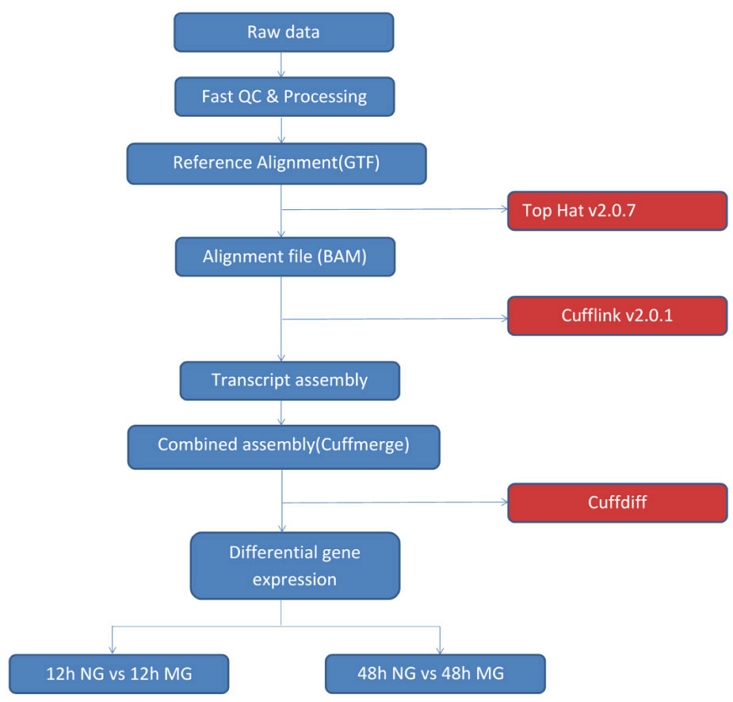
Overview of experiment for reference based RNA-sequencing analysis of A. niger (Yesupatham, 2015; Sathishkumar et al., 2016).
2.8. Quantitative reverse‑transcription‑PCR (qRT‑PCR)
We carried out qRT-PCR on five arbitrarily selected upregulated genes in order to confirm the results from RNA-sequencing (Yesupatham, 2015; Sathishkumar et al., 2016). Using the Primer3 tool (Version 0.4.0), primer design for qRT-PCR was completed. Using the housekeeping gene GAPDH (Glyceraldehyde 3-phosphate dehydrogenase), the mRNA levels of the DEGs were adjusted (Yesupatham, 2015; Sathishkumar et al., 2016; Sheet et al., 2024). Using the 2−ΔΔct technique, relative gene expression values were calculated. In addition, the expression levels of regulated genes were compared between the RNA-sequencing and qRT-PCR data. Table 1 contains the primer sequences for the relevant genes and the reference gene (Yesupatham, 2015; Sathishkumar et al., 2016; Sheet et al., 2024).

List of all primers were used in the current investigation
3. Results and Discussion
The present study reveals significant gene expression changes in A. niger under simulated microgravity compared to normal gravity conditions, highlighting gravity’s role in modulating fungal physiology. Exposure to microgravity altered the expression of genes encoding ABC and MFS transporters, suggesting adaptations in nutrient uptake and cell wall integrity (Yesupatham et al., 2015). Notably, a sustained upregulation of citric acid synthase and oxaloacetate hydrolase genes underscores microgravity’s influence on organic acid biosynthesis, a hallmark of A. niger’s industrial utility. Similar to our previous study, we found here that exposure to microgravity conditions induced several molecular-level biological changes in the A. niger.
The assembly statistics for A. niger sequencing in this study demonstrate a robust and high-quality dataset (Table 1) (Yesupatham, 2015; Sathishkumar, et al., 2016). A total of 25,936 contigs were generated, with lengths ranging from 142 bp to a maximum of 12,256 bp. The average contig length was 1,105.2 bp (±1,041.3), and the median contig length was 1,534 bp, indicating a substantial proportion of longer contigs. The total assembled contig length reached approximately 37.8 Mb, which is consistent with the reported genome size of A. niger strains (33.9–38.5 Mb) (Pel et al., 2007). The N50 value of 1,787 bp reflects moderate assembly continuity, with half of the total assembly contained in contigs of this length or longer. Importantly, there were no non-ATGC characters, confirming the high sequence quality. The dataset includes 10,255 contigs of at least 1 Kbp and 61 contigs of at least 10 Kbp, supporting the completeness and reliability of the assembly.
Contig statistics from Aspergillus niger transcriptome assembly (Yesupatham, 2015)
3.1. Gene expression and gene ontology
At 12 h, a total of 137 genes were upregulated and 35 genes were downregulated in A. niger grown under microgravity conditions compared to normal gravity (Appendix 1 and Appendix 2, respectively). Notably, at 48 h, the trend shifted, with only 61 genes upregulated and 161 genes downregulated (data not shown). More number of genes are upregulated at the 12 h samples compared to 48 h samples, suggesting that the organism is slowly adapting to the microgravity conditions (Yesupatham, 2015; Sathishkumar et al., 2016). This temporal expression pattern indicates a strong early response to microgravity, which appears to subside over time. A heat map with hierarchical clustering (Fig. 2) illustrates the differential gene expression profiles for both time points. The heatmaps illustrate the gene expression profiles of A. niger under normal gravity and microgravity at 12 h and 48 h. At 12 h, there is minimal difference between the normal gravity and microgravity conditions, with most genes showing similar expression levels (predominantly orange and red), indicating only modest early transcriptional changes. However, by 48 h, distinct differences emerge: several genes in the microgravity group display marked upregulation (red) or downregulation (green) compared to normal gravity, reflecting significant transcriptional reprogramming in response to prolonged microgravity exposure. This pattern suggests that A. niger adapts to microgravity over time, with more pronounced gene expression changes occurring after extended exposure. More number of genes are upregulated at the 12 h samples compared to 48 h samples, suggesting that the organism is slowly adapting to the microgravity conditions.
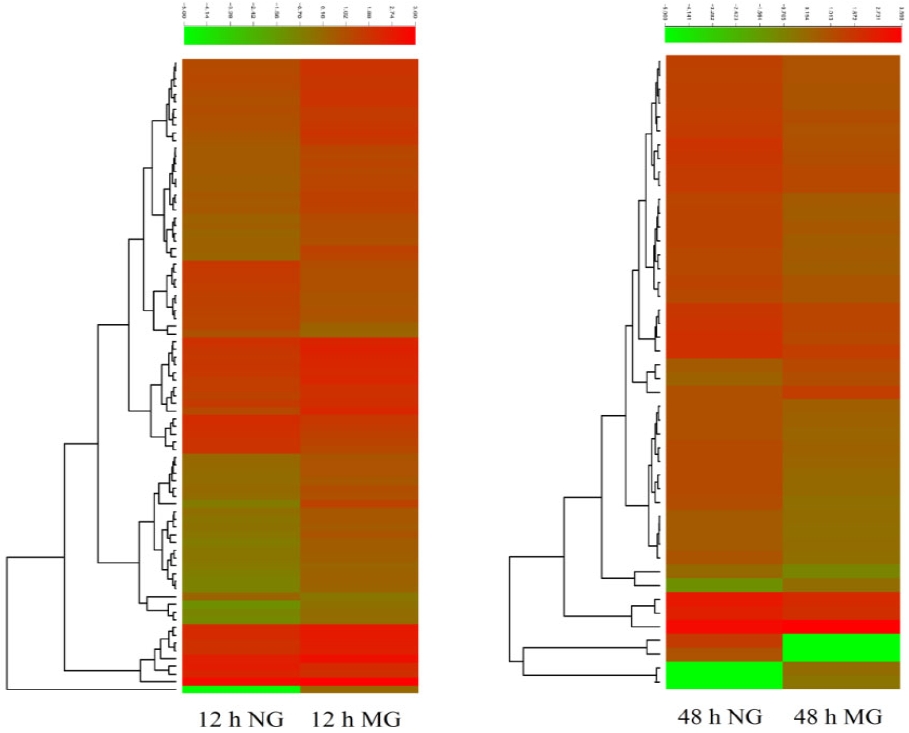
Heat maps depicting the global gene expression profiles of A. niger under microgravity and normal gravity conditions were generated using the plot package. Each row corresponds to a single gene. In the visualization, green indicates high expression levels, while red denotes low expression levels. NG- normal gravity and MG- microgravity (Yesupatham, 2015).
To further investigate the biological significance, the transcripts were annotated using the KEGG Automatic Annotation Server (KAAS), which assigns functional categories based on BLAST alignment against the curated KEGG GENES database. The higher number of upregulated genes at 12 h suggests an acute response phase, while the reduced transcriptional activity at 48 h implies that A. niger begins to adapt to the microgravity environment over time. Our RNA-sequencing analysis of A. niger exposed to microgravity revealed significant changes in gene expression, particularly in categories related to membrane transport, metabolism, stress response, and gene regulation. At 12 h, the gene ontology (GO) analysis of A. niger grown under microgravity versus normal gravity conditions reveals significant alterations across key functional categories (Fig. 3). In the Molecular Function category, enriched terms such as ATP binding (7.53%), DNA binding (5.81%), and zinc ion binding (5.32%) indicate heightened energy metabolism and regulatory activity, likely in response to the altered environment. Activities like RNA polymerase II transcription factor binding and nuclease functions further suggest increased transcriptional control and nucleic acid turnover under stress. Within the biological process category, regulation of transcription (3.81%) and protein folding (3.57%) reflect adaptive responses to microgravity, while processes such as carbohydrate metabolism, oxidation-reduction, and transmembrane transport point to shifts in core metabolic and homeostatic mechanisms. Whereas the integral membrane component (11.16%), cytosol (8.31%), and mitochondrion (1.95%), highlighting structural and organellar adaptations, especially in membranes and energy-related functions were the important GO terms found to be associated under cellular component group. Collectively, these findings suggest that microgravity triggers a coordinated response involving transcriptional reprogramming, metabolic adjustments, and cellular structural remodeling. At 48 h, major changes in the cellular component comes from the nucleus (12.82%) and integral component of membrane (11.28%) (Fig. 4) (Yesupatham, 2015; Sathishkumar, 2016). Regarding the changes in biological process transmembrane transport (4.24%) and carbohydrate metabolism (1.86%) are shown to be noteworthy (Yesupatham, 2015; Sathishkumar et al., 2016). Many studies have proposed that changes in the carbohydrate metabolism is directly linked with the pathogenicity of fungus. Although some of the fungi are shown to be more pathogenic under microgravity, no transcripts were annotated to the pathogenicity related gene set database (Yesupatham, 2015). Molecular functions like Zn++ ion binding (9.39%), ATP binding (7.61%) and oxidative reductase (4.86%) are shown to be increased under 48 h of exposure to microgravity, which could be the reason for A. niger to become more tolerant to pH, acid and oxidative stress (Yesupatham, 2015).
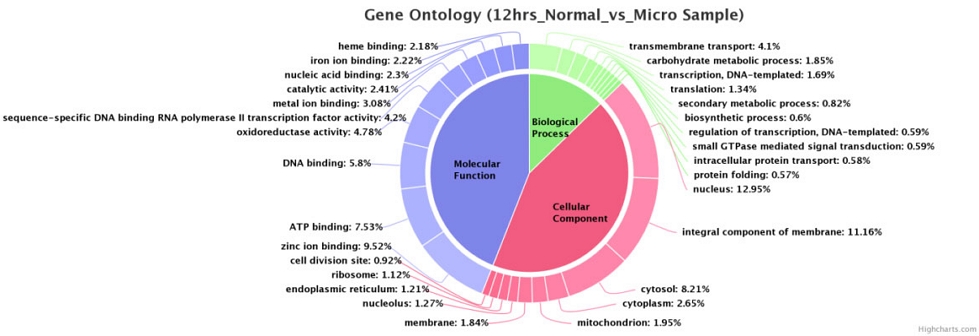
Gene Ontology (GO) classification of differentially expressed genes in A. niger after 12 h under normal gravity and microgravity conditions (Yesupatham, 2015).
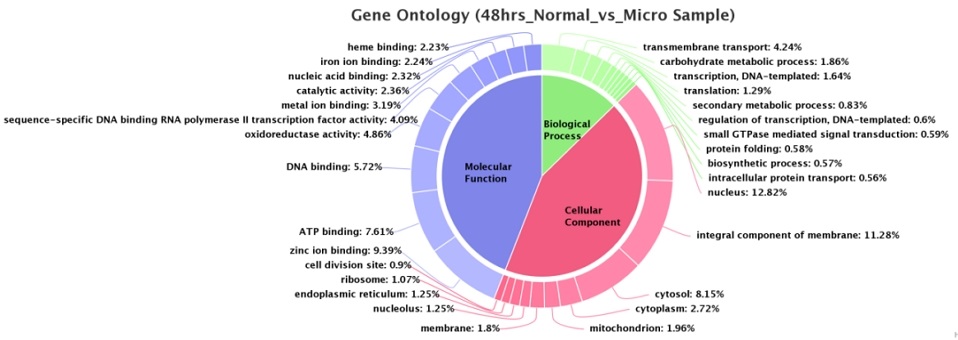
Gene Ontology (GO) classification of differentially expressed genes in A. niger after 48 h under normal gravity and microgravity conditions (Yesupatham, 2015).
The GO enrichment showed that a substantial proportion of differentially expressed genes were involved in ion binding, ATP binding, and oxidoreductase activity, indicating shifts in energy metabolism and redox balance. Many of these genes were associated with membrane components and transmembrane transport, suggesting adaptations in nutrient uptake and environmental sensing under microgravity. There was also notable enrichment in genes related to carbohydrate metabolism, biosynthetic processes, and stress response, reflecting metabolic reprogramming and activation of protective pathways. These findings are reliable with earlier reports, for example published by Zhang et al. and Mauclaire et al., which reported upregulation of transporter genes and stress-related pathways in fungi under microgravity (Mauclaire et al., 2010; Zhang et al., 2022). Similarly, Schuster et al. and Mastroleo et al. observed that microgravity can enhance metabolic flexibility and secondary metabolite production in A. niger and other fungi (Schuster et al., 2002; Mastroleo et al., 2010). The observed transcriptional changes, including increased expression of genes involved in DNA and RNA binding and transcription factor activity, further support the idea of broad transcriptional reprogramming as an adaptive response to altered gravity, as noted in transcriptomic studies by Wang et al. and Crabbé et al. (Wang et al., 2009; Crabbé et al., 2013). Collectively, these results suggest that A. niger adapts to microgravity by modulating key biological pathways, which may enhance its resilience and metabolic output, aligning with concerns about fungal risks and opportunities in space environments (Taylor et al., 1993; Novikova, 2004). Our RNA-sequencing GO analysis reveals that A. niger responds to simulated microgravity by adjusting transcriptional activity, stress response, metabolic processes, and membrane/cytosolic dynamics. These changes are consistent with previous microgravity studies across microbial systems and reinforce concerns about fungal adaptability and potential pathogenicity in space environments.
Additionally, we analyzed the expression of genes associated with environmental stimulus response and stress tolerance in both the 12 h and 48 h groups. Notably, significant changes were observed only in the 12 h microgravity group, while the 48 h group showed minimal differential expression in these categories. Therefore, only the results from the 12 h group are presented and discussed here (Fig. 5 and Fig. 6). Genes associated with environmental stimulus response were analyzed, revealing that 13 genes were upregulated under microgravity, compared to 6 genes under normal gravity (Yesupatham, 2015). Interestingly, 28 genes were downregulated in the microgravity condition, while 22 were downregulated under normal gravity. These findings suggested that A. niger is capable of sensing microgravity as a distinctive environmental cue. The Venn diagram indicated no overlap between the stimulus-responsive genes in the two conditions, implying that entirely different gene sets are involved in responding to microgravity. Moreover, our qRT-PCR resuls showed that expression levels of up-regulated genes (EglA, Sph3, CatA, CatR, AoxB, AbcA, AbcB, XlnR, and XyrA) in 12 h group under normal gravity and microgravity conditions, which validated the findings from the RNA-sequencing analysis (Fig. 7) (Yesupatham, 2015). The qRT-PCR data shows significant upregulation of all ten genes in Aspergillus niger under simulated microgravity. Key transcriptional regulators (AmyR, ~4-fold; XlnR, ~2.2-fold) and their target enzymes (EglA, and XlnA) are upregulated, enhancing carbohydrate metabolism. CatA (catalase A) and CatR (catalase regulator) both show upregulation (~2.2-fold and ~1.6-fold respectively). Catalases are essential antioxidant enzymes that protect cells from oxidative stress by decomposing hydrogen peroxide (Vaquer et al., 2014). AoxB (alternative oxidase B) demonstrates a notable ~3.4-fold increase, suggesting enhanced alternative respiratory pathways that help manage cellular stress and maintain energy homeostasis (Zhao et al., 2010). The ABC transporters AbcA and AbcB1 show significant upregulation (~3-fold and ~1.8-fold respectively). These ATP-binding cassette transporters are involved in the efflux of various compounds, including toxins and metabolites, suggesting enhanced cellular detoxification mechanisms under microgravity (Vaquer et al., 2014). Upregulated ABC transporters (AbcA, and AbcB1) indicate enhanced detoxification. Overall, A. niger activates a coordinated response to microgravity stress, enhancing metabolic flexibility, antioxidant defense, and detoxification capacity. Although, further identification and functional characterization of these unique genes are warranted. Transcripts which have significance at p< 0.001 were used for the generating the Venn diagram (Yesupatham, 2015). Overall, the results show the changes in A. niger under microgravity at molecular level with extra clarity and various dimensions, unlike the conventional limited data from microarray studies (Yesupatham, 2015). These results are reliable with prior findings showed that microgravity acts as a significant environmental stressor, triggering broad transcriptional reprogramming in fungi. For instance, Zhang et al. and Tesei et al. reported that fungi exposed to microgravity or simulated microgravity exhibit increased expression of genes involved in environmental adaptation and stress response, including transporters, oxidoreductases, and stress-protective proteins (Tesei et al., 2021; Zhang et al., 2022). Collectively, these results highlight that microgravity induces a more pronounced and complex adaptive response in A. niger compared to normal gravity, supporting the view that space environments can significantly influence fungal physiology and stress resilience.
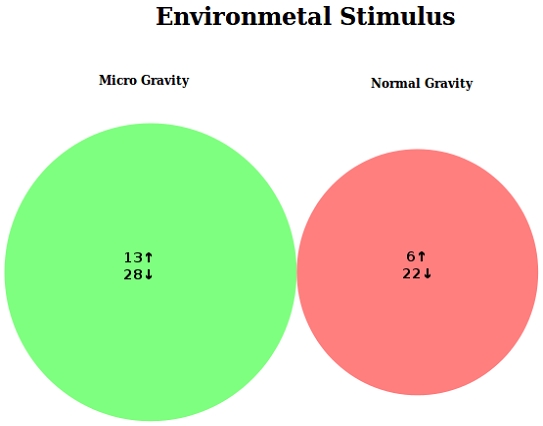
Venn diagram indicating the number of differentially expressed genes under microgravity and normal gravity corresponding to environmental stress in A. niger. Transcripts which have significance at p<0.001 were used for the generating the graph (Yesupatham, 2015).
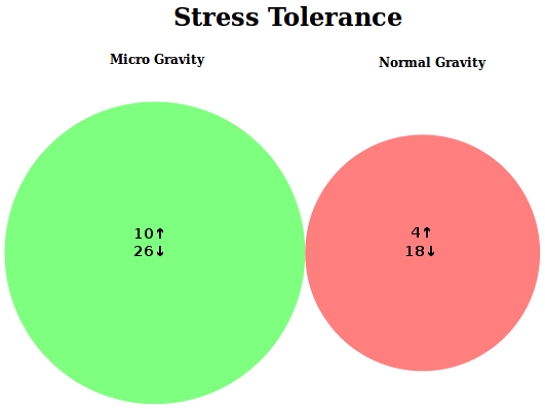
Venn diagram indicating the number of differentially expressed genes under microgravity and normal gravity corresponding to stress tolerance in A. niger. Transcripts which have significance at p<0.001 were used for the generating the graph (Yesupatham, 2015).
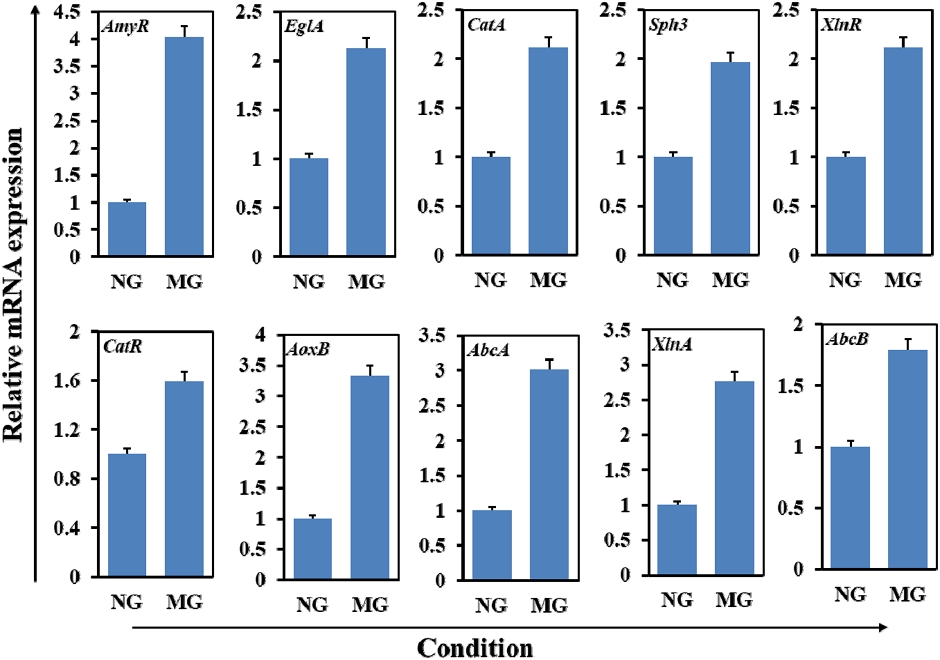
RT-qPCR results of A. niger after cultivating at NG and MG environments for 12 h. The values represent the mean ± standard deviation (n = 3). NG- normal gravity; MG-Microgravity.
4. Conclusions
Collectively this study reports an inclusive transcriptomic analysis of A. niger in response to microgravity using reference based RNA-sequencing method. The enzymatic system of A. niger is boosted by microgravity which can be exploited industrially for the increased production of enzymes (Yesupatham, 2015). This is the first report on the gene expression changes in A. niger under microgravity. Information from previous reports was significantly scarce to predict the biological pathways affected under microgravity. The results obtained in this study not necessarily reflects the changes found in real space conditions as the effects of radiation and vibrations are avoided in our laboratory set up HARV (Yesupatham, 2015). But, the basic knowledge obtained through this reference based RNA-Sequencing study should lay a foundation for future research in the field of space microbiology for the betterment of the astronaut crew health considering the long term space missions (Yesupatham, 2015).
Acknowledgments
This article is partly based on the author's doctoral dissertation submitted to Jeonbuk National University in 2015. The complete manuscript has been rewritten and edited, and additional qRT-PCR experimental validation was conducted by the author, which was not part of the original dissertation. During the preparation of his response, authors used ChatGPT-4o to improve readability and language. After using this tool, author reviewed and edited the content as needed and takes full responsibility for the final publication.
REFERENCES
-
Abarca, M. L., Bragulat, M. R., Castella, G., Cabanes, F. J., 1994, Ochratoxin A production by strains of Aspergillus niger var. niger, Appl. Environ. Microbiol., 60(7), 2650-2652.
[https://doi.org/10.1128/aem.60.7.2650-2652.1994]

-
Altschul, S. F., Gish, W., Miller, W., Myers, E. W., Lipman, D. J., 1990, Basic local alignment search tool, J. Mol. Biol., 215(3), 403-410.
[https://doi.org/10.1016/S0022-2836(05)80360-2]
-
Anderegg, R. J., Biemann, K., Buechi, G., Cushman, M., 1976, Malformin C, A New metabolite of Aspergillus niger, J. Am. Chem. Soc., 98(11), 3365-3370.
[https://doi.org/10.1021/ja00427a051]
-
Anders, S., Huber, W., 2010, Differential expression analysis for sequence count data, Genome Biol., 11(10), R106.
[https://doi.org/10.1186/gb-2010-11-10-r106]
-
Bhadauria, V., Popescu, L., Zhao, W. S., Peng, Y. L., 2007, Fungal transcriptomics, Microbiol. Res., 162(4), 285-298.
[https://doi.org/10.1016/j.micres.2007.06.006]
-
Binder, R. E., Faling, L. J., Pugatch, R, D., Mahasaen, C., Snider, G. L., 1982, Chronic necrotizing pulmonary aspergillosis: A Discrete clinical entity, Medicine, 61(2), 109.
[https://doi.org/10.1097/00005792-198203000-00005]
-
Breakspear, A., Momany, M., 2007, The first fifty microarray studies in filamentous fungi, Microbiology, 153(Pt 1), 7-15.
[https://doi.org/10.1099/mic.0.2006/002592-0]
-
Brown, R. B., Klaus, D., Todd, P., 2002, Effects of space flight, clinorotation, and centrifugation on the substrate utilization efficiency of Escherichia coli, Microgravity Sci. Technol., 13(4), 24-29.
[https://doi.org/10.1007/BF02881678]
-
Cahill, K. M., El Mofty, A. M., Kawaguchi, T. P., 1967, Primary cutaneous aspergillosis, Arch. Dermatol., 96(5), 545-547.
[https://doi.org/10.1001/archderm.1967.01610050067010]
-
Frisvad, J. C., Smedsgaard, J., Samson, R. A., Larsen, T. O., Thrane, U., 2007, Fumonisin B2 production by Aspergillus niger, J. Agric. Food Chem., 55(23), 9727-9732.
[https://doi.org/10.1021/jf0718906]
-
Ghosal, S., Biswas, K., Chakrabarti, D. K., 1979, Toxic naphtho-. gamma.-pyrones from Aspergillus niger, J. Agric. Food Chem., 27(6), 1347-1351.
[https://doi.org/10.1021/jf60226a018]
-
Goldermann, M., Hanke, W., 2001, Ion channel are sensitive to gravity changes, Microgravity Sci. Technol., 13(1), 35-38.
[https://doi.org/10.1007/BF02873330]
-
Grabherr, M. G., Haas, B. J., Yassour, M., Levin, J. Z., Thompson, D. A., Amit, I., Adiconis, X., Fan, L., Raychowdhury, R., Zeng, Q., Chen, Z., Mauceli, E., Hacohen, N., Gnirke, A., Rhind, N., di Palma, F., Birren, B. W., Nusbaum, C., Lindblad-Toh, K., Friedman, N., Regev, A., 2011, Full-length transcriptome assembly from RNA-Seq data without a reference genome, Nat. Biotechnol., 29(7), 644-652.
[https://doi.org/10.1038/nbt.1883]
-
Horneck, G., Klaus, D. M., Mancinelli, R. L., 2010, Space microbiology, Microbiol. Mol. Biol. Rev., 74(1), 121-156.
[https://doi.org/10.1128/MMBR.00016-09]
- Ibekwe, A. O., Okafor, J. I., 1983, Pathogenic organisms in chronic suppurative otitis media in Enugu, Nigeria, Trop. Geogr. Med., 35(4), 389-391.
-
Isogai, A., Horii, T., Suzuki, A., Murakoshi, S., Ikeda, K., Sato, S., Tamura, S., 1975, Isolation and identification of nigragillin as a insecticidal metabolite produced by a Aspergillus niger, Agric. Biol. Chem., 39(3), 739-740.
[https://doi.org/10.1271/bbb1961.39.739]
-
Jennings, M. E., Quick, L. N., Soni, A., Davis, R. R., Crosby, K., Ott, C. M., Nickerson, C. A., Wilson, J. W., 2011, Characterization of the Salmonella enterica serovar Typhimurium ydcI gene, which encodes a conserved DNA binding protein required for full acid stress resistance, J. Bacteriol., 193(9), 2208-2217.
[https://doi.org/10.1128/JB.01335-10]
-
Kraft, T. F., van Loon, J. J., Kiss, J. Z., 2000, Plastid position in Arabidopsis columella cells is similar in microgravity and on a random-positioning machine, Planta, 211(3), 415-422.
[https://doi.org/10.1007/s004250000302]
-
Kumar, Y. S., Unnithan, A. R., Sen, D., Kim, C. S., Lee, Y. S., 2015, Microgravity biosynthesized penicillin loaded electrospun polyurethane-dextran nanofibrous mats for biomedical applications, Colloids Surf. A: Physicochem. Eng. Asp., 477, 77-83.
[https://doi.org/10.1016/j.colsurfa.2015.01.065]
-
Langmead, B., Salzberg, S. L., 2012, Fast gapped-read alignment with Bowtie 2, Nat. Methods, 9(4), 357-359.
[https://doi.org/10.1038/nmeth.1923]
-
Li, W., Jaroszewski, L., Godzik, A., 2001, Clustering of highly homologous sequences to reduce the size of large protein databases, Bioinformatics, 17(3), 282-283.
[https://doi.org/10.1093/bioinformatics/17.3.282]
-
Makimura, K., Hanazawa, R., Takatori, K., Tamura, Y., Fujisaki, R., Nishiyama, Y., Abe, S., Uchida, K., Kawamura, Y., Ezaki, T., Yamaguchi, H., 2001, Fungal flora on board the mir‐space station, Identification by morphological features and ribosomal DNA sequences, Microbiol. Immunol., 45(5), 357-363.
[https://doi.org/10.1111/j.1348-0421.2001.tb02631.x]
-
Mastroleo, F., Van Houdt, R., Atkinson, S., Mergeay, M., Hendrickx, L., Wattiez, R., Leys, N., 2013, Modelled microgravity cultivation modulates N-acylhomoserine lactone production in Rhodospirillum rubrum S1H independently of cell density, Microbiology, 159(Pt 12), 2456-2466.
[https://doi.org/10.1099/mic.0.066415-0]
-
Mauclaire, L., Egli, M., 2010, Effect of simulated microgravity on growth and production of exopolymeric substances of Micrococcus luteus space and earth isolates, FEMS Immunol. Med. Microbiol., 59(3), 350-356.
[https://doi.org/10.1111/j.1574-695X.2010.00683.x]
- Metzger, J., Garagusi, V., Kerwin, D., 1984, Pulmonary oxalosis caused by Aspergillus niger, Am. Rev. Respir. Dis., 129(3), 501-502.
-
Morabito, C., Steimberg, N., Mazzoleni, G., Guarnieri, S., Fanò-Illic, G., Mariggiò, M. A., 2015, RCCS bioreactor-based modelled microgravity induces significant changes on in vitro 3D neuroglial cell cultures, BioMed Res. International, 754283.
[https://doi.org/10.1155/2015/754283]
-
Morey-Holton, E. R., Globus, R. K., 2002, Hindlimb unloading rodent model: Technical aspects, J. Appl. Physiol., 92(4), 1367-1377.
[https://doi.org/10.1152/japplphysiol.00969.2001]
-
Moriya, Y., Itoh, M., Okuda, S., Yoshizawa, A. C., Kanehisa, M., 2007, KAAS: An Automatic genome annotation and pathway reconstruction server, Nucleic Acids Res., 35(2), W182-W185.
[https://doi.org/10.1093/nar/gkm321]
-
Novikova, N. D., 2004, Review of the knowledge of microbial contamination of the Russian manned spacecraft, Microb. Ecol., 47(2), 127-132.
[https://doi.org/10.1007/s00248-003-1055-2]
-
Onofri, S., Barreca, D., Selbmann, L., Isola, D., Rabbow, E., Horneck, G., de Vera, J. P., Hatton, J., Zucconi, L., 2008, Resistance of Antarctic black fungi and cryptoendolithic communities to simulated space and Martian conditions, Stud. Mycol., 61, 99-109.
[https://doi.org/10.3114/sim.2008.61.10]
-
Pel, H. J., de Winde, J. H., Archer, D. B., Dyer, P. S., Hofmann, G., Schaap, P. J., 2007, Genome sequencing and analysis of the versatile cell factory Aspergillus niger CBS 513.88, Nat. Biotechnol, 25(2), 221-231.
[https://doi.org/10.1038/nbt1282]
-
Richter, P. R., Schuster, M., Wagner, H., Lebert, M., Häder, D. P., 2002, Physiological parameters of gravitaxis in the flagellate Euglena gracilis obtained during a parabolic flight campaign, J. Plant Physiol., 159(2), 181-190.
[https://doi.org/10.1078/0176-1617-00605]
-
Sathishkumar, Y., Velmurugan, N., Lee, H. M., Rajagopal, K., Im, C. K., Lee, Y. S., 2014, Effect of low shear modeled microgravity on phenotypic and central chitin metabolism in the filamentous fungi Aspergillus niger and Penicillium chrysogenum, Antonie Van Leeuwenhoek, 160(2), 197-209.
[https://doi.org/10.1007/s10482-014-0181-9]
-
Sathishkumar, Y., Krishnaraj, C., Rajagopal, K., Sen, D., Lee, Y. S., 2016, High throughput de novo RNA sequencing elucidates novel responses in Penicillium chrysogenum under microgravity, Bioprocess Biosyst. Eng., 39(2), 223-231.
[https://doi.org/10.1007/s00449-015-1506-4]
-
Scalzi, G., Selbmann, L., Zucconi, L., Rabbow, E., Horneck, G., Albertano, P., Onofri, S., 2012, LIFE Experiment: Isolation of cryptoendolithic organisms from Antarctic colonized sandstone exposed to space and simulated Mars conditions on the international space station, Orig. Life Evol. Biosph., 42(2-3), 253-262.
[https://doi.org/10.1007/s11084-012-9282-5]
-
Schuster, E., Dunn-Coleman, N., Frisvad, J. C., Van Dijck, P. W., 2002, On the safety of Aspergillus niger–a review, Appl. Microbiol. Biotechnol., 59(4-5), 426-435.
[https://doi.org/10.1007/s00253-002-1032-6]
-
Sheet, S., Jang, S. S., Kim, J. H., Park, W., Kim, D. A., 2024, A Transcriptomic analysis of skeletal muscle tissues reveals promising candidate genes and pathways accountable for different daily weight gain in Hanwoo cattle, Sci. Rep., 14(1), 315.
[https://doi.org/10.1038/s41598-023-51037-9]
-
Souza, G. R., Molina, J. R., Raphael, R. M., Ozawa, M. G., Stark, D. J., Levin, C. S., Bronk, L. F., Ananta, J. S., Mandelin, J., Georgescu, M. M., Bankson, J. A., Gelovani, J. G., Killian, T. C., Arap, W., Pasqualini, R., 2010, Three-dimensional tissue culture based on magnetic cell levitation, Nat. Nanotechnol., 5(4), 291-296.
[https://doi.org/10.1038/nnano.2010.23]
-
Stöffler, D., Horneck, G., Ott, S., Hornemann, U., Cockell, C. S., Moeller, R., Meyer, C., de Vera, J., Fritz, J., Artemieva, N. A., 2007, Experimental evidence for the potential impact ejection of viable microorganisms from Mars and Mars-like planets, Icarus, 186(2), 585-588.
[https://doi.org/10.1016/j.icarus.2006.11.007]
-
Taylor, G. R., 1993, Overview of spaceflight immunology studies, J. Leukoc. Biol., 54(3), 179-188.
[https://doi.org/10.1002/jlb.54.3.179]
-
Taylor, G. R., Konstantinova, I., Sonnenfeld, G., Jennings, R., 1996, Changes in the immune system during and after spaceflight, Adv. Space Biol. Med., 6, 1-32.
[https://doi.org/10.1016/S1569-2574(08)60076-3]
-
Tesei, D., Chiang, A. J., Kalkum, M., Stajich, J. E., Mohan, G. B. M., Sterflinger, K., Venkateswaran, K., 2021, Effects of simulated microgravity on the proteome and secretome of the polyextremotolerant black fungus Knufia chersonesos, Front. Genet., 12, 638708.
[https://doi.org/10.3389/fgene.2021.638708]
-
Tesei, D., Marzban, G., Zakharova, K., Isola, D., Selbmann, L., Sterflinger, K., 2012, Alteration of protein patterns in black rock inhabiting fungi as a response to different temperatures, Fungal Biol., 116(8), 932-940.
[https://doi.org/10.1016/j.funbio.2012.06.004]
-
Vaquer, S., Cuyàs, E., Rabadán, A., González, A., Fenollosa, F., de la Torre, R., 2014, Active transmembrane drug transport in microgravity: A Validation study using an ABC transporter model, F1000Res., 3, 201.
[https://doi.org/10.12688/f1000research.4909.1]
-
Vunjak‐novakovic, G., Searby, N., de Luis, J., Freed, L. E., 2002, Microgravity studies of cells and tissues, Ann. N. Y. Acad. Sci., 974, 504-517.
[https://doi.org/10.1111/j.1749-6632.2002.tb05927.x]
-
Wang, K., Li, M., Hakonarson, H., 2010, Analysing biological pathways in genome-wide association studies, Nat. Rev. Genet., 11(12), 843-854.
[https://doi.org/10.1038/nrg2884]
-
Wang, Z., Gerstein, M., Snyder, M., 2009, RNA-Seq: A Revolutionary tool for transcriptomics, Nat. Rev. Genet., 10(1), 57-63.
[https://doi.org/10.1038/nrg2484]
-
White, R. J., Averner, M., 2001, Humans in space, Nature, 409(6823), 1115-1118.
[https://doi.org/10.1038/35059243]
- Yesupatham, S. K., 2015, The phenotypic and transcriptomic analysis of Penicillium chrysogenum and Aspergillus niger in response to low shear modelled microgravity, Ph. D. thesis, Jeonbuk National University, Korea, 115.
-
Yesupatham, S. K., Unnithan, A. R., Sen, D., Kim, C. S., Lee, Y. S., 2015, Microgravity biosynthesized penicillin loaded electrospun polyurethane-dextran nanofibrous mats for biomedical applications, Colloids Surf. A: Physicochem. Eng. Asp., 477, 77-83.
[https://doi.org/10.1016/j.colsurfa.2015.01.065]
-
Zhang, X., Fang, X., Liu, C., 2015, Genomic and proteomic analysis of Escherichia coli after spaceflight reveals changes involving metabolic pathways, Arch. Med. Res., 46(3), 181-185.
[https://doi.org/10.1016/j.arcmed.2015.03.007]
-
Zhang, Y., Zhang, X., Zhang, J., Ali, S., Wu, J., 2022, Spaceflight changes the production and bioactivity of secondary metabolites in Beauveria bassiana, Toxins, 14(8), 555.
[https://doi.org/10.3390/toxins14080555]
-
Zhao, C., Sun, Y., Yi, Z. C., Rong, L., Zhuang, F. Y., Fan, Y. B., 2010, Simulated microgravity inhibits cell wall regeneration of Penicillium decumbens protoplasts, Adv. Space Res., 46(6), 701-706.
[https://doi.org/10.1016/j.asr.2010.04.026]
Appendix
Genes Up-regulated under microgravity at 12 h (Yesupatham, 2015)
Genes downregulated under microgravity at 12 hours (Yesupatham, 2015)
Department of Wood Science and Technology, College of Agriculture and Life Sciences, Chonbuk National Universitysunirmalsheet@gmail.com
Department of Wood Science and Technology, College of Agriculture and Life Sciences, Chonbuk National Universityysoolee@jbnu.ac.kr
Department of Wood Science and Technology, College of Agriculture and Life Sciences, Chonbuk National Universitysunirmal123@korea.kr