
Anti-Parkinsonian Effects of a Phellodendron and Dendropanax Combined Extract via Nurr1 Activation In Vitro Model
Ⓒ The Korean Environmental Sciences Society. All rights reserved.
This is an Open-Access article distributed under the terms of the Creative Commons Attribution Non-Commercial License (http://creativecommons.org/licenses/by-nc/3.0) which permits unrestricted non-commercial use, distribution, and reproduction in any medium, provided the original work is properly cited.
Abstract
Environmental pollutants, such as pesticides, fine particulate matter, and heavy metals, are linked to the rising prevalence of Parkinson’s disease (PD)rising Parkinson’s disease (PD) prevalence. In toxin-mimicking models, Nurr1 (NR4A2) preserves dopaminergic identity and inhibits inflammatory responsesrestrains inflammatory programs. We evaluated whether a combined extract of Phellodendron bark (PB) and Dendropanax morbifera (DM) confers neuroprotection against 1-methyl-4-phenylpyridinium (MPP⁺) injury via Nurr1. Cytotoxicity windows were defined for single extracts, then and PB–DM combinations were then screened with DM fixed at 62.5 or 125 µg/mL and PB varied to 250 µg/mL. Outcomes included cell viability, Nurr1 protein, and downstream dopaminergic markers (TH, DAT, and VMAT2). Nurr1 dependency was tested usingby siRNA knockdown. PB was non-toxic at ≤250 µg/mL but toxic at 500 µg/mL; DM was non-toxic at ≤125 µg/mL but toxic at 250 µg/mL. The PB:DM ratio of 250:62.5 µg/mL produced the strongest protection from MPP⁺, while 250:125 approached the toxicity boundary. At 250:62.5, Nurr1 levels increased, and TH/DAT/VMAT2 levels markers were restored towardward control levels. Nurr1 silencing attenuated TH rescue, indicating a Nurr1-dependent component,; and the residual benefit suggests additional pathways. In an environmentally toxin–relevant PD model, a PB–DM combination showeds a defined therapeutic window and Nurr1-mediated neuroprotection, with PB:DM = 250:62.5 µg/mL as the optimal tested ratio. These data support mechanism-guided developments toward the mitigation of environment-ally linked PD risk.
Keywords:
Parkinson’s disease, Nurr1/NR4A2, Phellodendron bark, Dendropanax morbifera, 1-methyl-4-phenylpyridinium1. Introduction
Parkinson’s disease (PD) is increasing worldwide. Rising exposure to environmental pollutants contributes to this trend (Chin-Chan et al., 2015; Lim et al., 2022; Lim and Park, 2025). Epidemiology links pesticides, traffic-related particulate matter, and heavy metals to higher PD risk (Chin-Chan et al., 2015; Lim and Park, 2023). Experimental toxins that model such exposures converge on mitochondrial impairment, oxidative stress, and chronic neuroinflammation in the nigrostriatal system (Dorsey and Bloem, 2024). Nurr1 (NR4A2) is a ligandable nuclear receptor that preserves dopaminergic neuron identity (Jankovic et al., 2005). It drives transcription of TH, DAT, and VMAT2 and suppresses pro-inflammatory programs in glia (Jankovic et al., 2005). Genetic or functional loss of Nurr1 aggravates dopaminergic vulnerability, whereas pharmacologic activation is protective in toxin models (Perlmann and Wallén-Mackenzie, 2004). Targeting Nurr1 is therefore a rational strategy for disease modification under environmentally relevant stress.
Botanical medicines contain multi-target constituents suited to complex neurotoxic cascades. Phellodendron bark (PB) provides protoberberine alkaloids with antioxidant and anti-inflammatory actions (Kumar et al., 2010). Dendropanax morbifera (DM) yields phenylpropanoids and flavonoids reported to modulate microglial activation and mitochondrial function (Hyun et al., 2013). However, mechanism-anchored combinations that engage Nurr1 have not been defined.
Within the non-cytotoxic range for neuronal cells, we screened PB–DM combination ratios and identified the ratio that produced the most robust neuroprotection (PB:DM = 250:62.5 µg/mL). At this optimal ratio, we verified inhibition of MPP⁺-induced Parkinsonian toxicity, and we performed experiments to assess the possibility that the effect involves a Nurr1-related mechanism.
2. Materials and Methods
2.1. Preparation of PB and DM extract
PB and DM were purchased from Kwong-Mung-dang Company (Ulsan, Korea) and authenticated by Dr. Goya Choi (Herbal Medicine Resources Research Center, Korea Institute of Oriental Medicine, Naju, Korea), and a voucher specimen (PB: 2-25-0079 and DM: 2-21-0069) was deposited at the Herbal Medicine Resources Research Center, Korea Institute of Oriental Medicine. Briefly, PB and DM were extracted in distilled water for 3 h under reflux (100 ± 2°C). Then, the extract was filtered, evaporated on a rotary vacuum evaporator, and lyophilized (yield, 18.70% and 15.27%). The powder was kept at 4°C until use.
2.2. Differentiated PC12 cell culture and treatments
Rat pheochromocytoma PC12 cells (Korean Cell Line Bank, #21721) were grown in RPMI-1640 (Gibco, MD, USA) containing 10% heat-inactivated fetal bovine serum and 1% penicillin–streptomycin at 37°C in 5% CO₂/95% air. For neuronal differentiation, cultures received nerve growth factor (NGF; Sigma-Aldrich) for 7 days; medium and NGF were refreshed every 24 h (routine maintenance every 2–3 days). Differentiation was confirmed by characteristic neurite outgrowth exceeding the diameter of the cell body, with >70% of cells exhibiting neurite extensions, consistent with established criteria for NGF-induced PC12 differentiation. Differentiated cells were pre-exposed to PB or/and DM for 1 h, followed by MPP⁺ (100 µM) for an additional 23 h.
2.3. Measurement of living cell
Live cells were quantified with the Cell Counting Kit-8 (CCK-8; Dojindo) following the supplier’s instructions. Cells were plated in 96-well plates, exposed to PB and/or DM as indicated, then incubated with CCK-8 solution for 4 h. Absorbance at 450 nm was measured on a SpectraMax i3 reader (Molecular Devices).
2.4. Small interfering RNA transfection
Differentiated PC12 cultures at 80–85% confluence in 100-mm dishes were transfected with stealth siRNA using Lipofectamine 2000 (Invitrogen). For complex formation, 10 µL Lipofectamine 2000 was combined with a 40 µM siRNA solution in 2.5 mL Opti-MEM (Gibco) and incubated for 30 min at room temperature. Per dish, 300 µL of the transfection mix was diluted with 300 µL serum-free RPMI and applied for 24 h. Nurr1-targeting siRNA or equimolar scrambled control siRNA was used as indicated. After transfection, cells were returned to growth medium for downstream assays.
2.5. Quantification of dopaminergic protein markers
Nurr1 (MBS073350, MyBioSource), TH (CSB-E13102r, Cusabio), DAT (MBS9711865, MyBio Source), and VMAT2 (AAA10488, AAA Biotech) expressions were determined using ELISA kit following the manufacturer’s instructions.
2.6. Statistical analyses
Analyses were performed in GraphPad Prism 7.0 (GraphPad Software, San Diego, CA, USA). Data are presented as mean ± SEM. Group differences were assessed by one-way ANOVA followed by Tukey’s multiple-comparison test. Significance was set at p < 0.05.
3. Results and Discussion
Recent research positions Nurr1 (NR4A2) as a promising therapeutic target in Parkinson’s disease. Nurr1 governs dopaminergic lineage programs; its activation increases the expression of biosynthetic and transport factors that support dopamine production (Jankovic et al., 2005). We therefore pursued a botanical strategy to enhance Nurr1 using combinations of traditional medicinal extracts. The Phellodendron bark (PB) and Dendropanax morbifera (DM) pairing yielded the most consistent activity. First, single-agent screening established practical cytotoxicity limits to anchor combinations: PB was non-toxic up to 250 µg/mL and toxic at 500 µg/mL, whereas DM was non-toxic up to 125 µg/mL and toxic at 250 µg/mL. Within these windows, PB–DM mixtures were tested in an MPP⁺ neurotoxin model relevant to environmentally linked PD. Protection was ratio-dependent. Fixing DM at 62.5 or 125 µg/mL and titrating PB up to 250 µg/mL identified an optimum at PB:DM = 250:62.5 µg/mL, which produced the largest gain in viability; PB:DM = 250:125 µg/mL approached the toxicity boundary and conferred smaller net benefit. The optimal ratio restored the dopaminergic program, elevating TH, DAT, and VMAT2 toward control at both mRNA and protein levels, with the largest effect on TH consistent with primary re-engagement of a Nurr1-dependent transcriptional module followed by partial recovery of transport machinery (Kadkhodaei et al., 2013). As expected for Nurr1 targets, TH, DAT, and VMAT2 increased when Nurr1 rose under the optimal combination. Nurr1 knockdown attenuated TH rescue and reduced the survival advantage, confirming a Nurr1-dependent component (Kadkhodaei et al., 2013). A modest residual increase in TH after silencing indicates additional, Nurr1-independent contributions, consistent with multi-target actions typical of botanical combinations. Taken together, the PB:DM complex at a non-toxic 3:1 ratio (250:62.5 µg/mL) increases Nurr1 and restores TH, VMAT2, and DAT, yielding measurable neuroprotection. These findings are based on cellular assays; systematic in vivo validation and more granular profiling of Nurr1-linked pathways, including microglial mechanisms and inflammasome signaling, are needed for translation. While these findings highlight a Nurr1-dependent neuroprotective mechanism of PB and DM, the results are limited to an in vitro system, and additional in vivo investigations are necessary to validate their translational relevance.
4. Conclusions
The optimal PB–DM ratio (250:62.5 µg/mL) identified within a non-cytotoxic range significantly attenuated MPP⁺-induced injury and increased Nurr1, restoring TH, DAT, and VMAT2 toward control. Nurr1 inhibition weakened these effects, confirming a Nurr1-dependent component, while residual efficacy suggests Nurr1-independent pathways. This combination is a mechanism-guided candidate to mitigate environment-linked Parkinson’s disease risk; further study is needed.
Acknowledgments
This research was supported by the Regional Innovation System & Education (RISE) program through the Daejeon RISE Center, funded by the Ministry of Education (MOE) and the Daejeon Metropolitan City, Republic of Korea (#2025-RISE-06-005).
REFERENCES
-
Chin-Chan, M., Navarro-Yepes, J., Quintanilla-Vega, B., 2015, Environmental pollutants as risk factors for neurodegenerative disorders: Alzheimer and Parkinson diseases, Front. Cell. Neurosci., 9, 124.
[https://doi.org/10.3389/fncel.2015.00124]

-
Dorsey, E. R., Bloem, B. R., 2024, Parkinson’s disease is predominantly an environmental disease, J. Parkinsons Dis., 14, 451-465.
[https://doi.org/10.3233/JPD-230357]
-
Hyun, T. K., Kim, M. O., Lee, H., Kim, Y., Kim, E., Kim, J. S., 2013, Evaluation of anti-oxidant and anti-cancer properties of Dendropanax morbifera Léveille, Food chem., 141, 1947-1955.
[https://doi.org/10.1016/j.foodchem.2013.05.021]
-
Jankovic, J., Chen, S., Le, W., 2005, The role of Nurr1 in the development of dopaminergic neurons and Parkinson's disease, Prog. Neurobiol., 77, 128-138.
[https://doi.org/10.1016/j.pneurobio.2005.09.001]
-
Kadkhodaei, B., Alvarsson, A., Schintu, N., Ramsköld, D., Volakakis, N., Joodmardi, E., Yoshitake, T., Kehr, J., Decressac, M., Björklund, A., 2013, Transcription factor Nurr1 maintains fiber integrity and nuclear-encoded mitochondrial gene expression in dopamine neurons, Proc. Natl. Acad. Sci. U.S.A., 110, 2360-2365.
[https://doi.org/10.1073/pnas.1221077110]
-
Kumar, A. P., Graham, H., Robson, C., Thompson, I. M., Ghosh, R., 2010, Natural products: potential for developing Phellodendron amurense bark extract for prostate cancer management, Mini-Rev. Med. Chem., 10, 388-397.
[https://doi.org/10.2174/138955710791330936]
-
Lim, H., Moon, B. C., Park, G., 2022, Cera Flava improves behavioral and dopaminergic neuronal activities in a mouse model of Parkinson’s disease, J. Environ. Sci. Int., 31, 423-429.
[https://doi.org/10.5322/JESI.2022.31.5.423]
-
Lim, H., Park, G., 2023, Cicadidae Periostracum, the cast-off skin of the cicada, attenuates movement impairment and dopaminergic neuronal amage in 6-OHDA-induced Parkinson’s disease model, J. Environ. Sci. Int., 32, 723-729.
[https://doi.org/10.5322/JESI.2023.32.10.723]
-
Lim, H., Park, G., 2025, Improvement of Parkinson’s sleep disorders through melatonin receptor enhancement by 20-hydroxyecdysone, an insect molting hormone, J. Environ. Sci. Int., 34, 79-85.
[https://doi.org/10.5322/JESI.2025.34.2.79]
-
Perlmann, T., Wallén-Mackenzie, Å., 2004, Nurr1, an orphan nuclear receptor with essential functions in developing dopamine cells, Cell Tissue Res., 318, 45-52.
[https://doi.org/10.1007/s00441-004-0974-7]
Appendix
Appendices
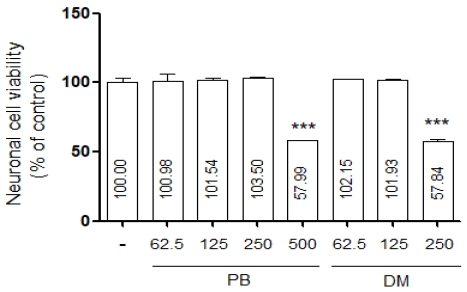
Cytotoxicity of single extracts. Differentiated PC12 were treated for 24 h with Phellodendron bark (PB; 62.5–500 µg/mL) or Dendropanax morbifera (DM; 62.5–250 µg/mL). Cell viability (% of vehicle) was measured by CCK-8. PB was non-toxic up to 250 µg/mL but reduced viability at 500 µg/mL; DM was non-toxic up to 125 µg/mL but reduced viability at 250 µg/mL. Values shown represent means ± S.E.M. Data represent mean ± SEM of three independent experiments (n = 3). ***p < 0.001 compared with the control group.
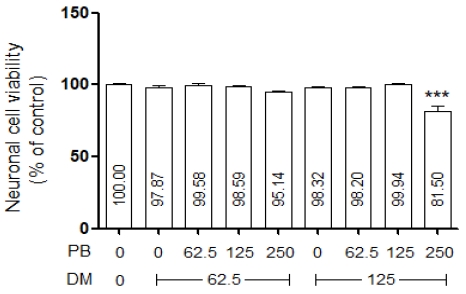
Combination cytotoxicity with fixed DM and graded PB. Differentiated PC12 were exposed for 24 h to Dendropanax morbifera (DM) fixed at 62.5 or 125 µg/mL while Phellodendron bark (PB) was titrated to 62.5, 125, or 250 µg/mL. Cell viability (% of vehicle) was measured by CCK-8. Combinations were generally non-toxic except at PB:DM = 250:125 µg/mL, which reduced viability. Values shown represent means ± S.E.M. Data represent mean ± SEM of three independent experiments (n = 3). ***p < 0.001 compared with the control group.
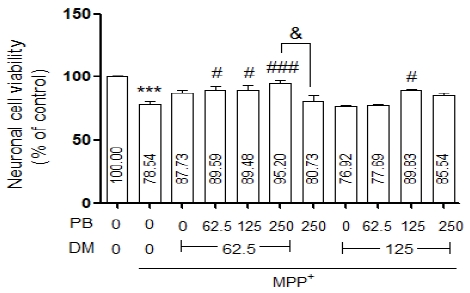
Ratio-dependent neuroprotection of PB–DM against MPP⁺ toxicity. Differentiated PC12 were challenged with MPP⁺ after 24 h exposure to Dendropanax morbifera (DM) fixed at 62.5 or 125 µg/mL and Phellodendron bark (PB) titrated to 62.5, 125, or 250 µg/mL. Cell viability (% of vehicle) was measured by CCK-8. MPP⁺ decreased viability. PB–DM rescued viability in a ratio-dependent manner, with PB:DM = 250:62.5 µg/mL showing the largest protection. Values shown represent means ± S.E.M. Data represent mean ± SEM of three independent experiments (n = 3). ***p < 0.001 compared with the control group and #p < 0.05, ##p < 0.01, and ###p < 0.001 compared with the MPP⁺-treated group.
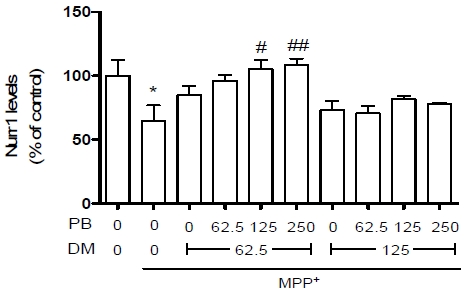
PB–DM increases Nurr1 under MPP⁺ injury in a ratio-dependent manner. Differentiated PC12 were challenged with MPP⁺ after 24 h exposure to Dendropanax morbifera (DM) fixed at 62.5 or 125 µg/mL and Phellodendron bark (PB) titrated to 62.5–250 µg/mL. Nurr1 protein was quantified and expressed as % of vehicle. MPP⁺ lowered Nurr1. PB–DM restored Nurr1, with the strongest increase at PB:DM = 250:62.5 µg/mL. Values shown represent means ± S.E.M. Data represent mean ± SEM of three independent experiments (n = 3). *p < 0.05 compared with the control group and #p < 0.05 and ##p < 0.01 compared with the MPP⁺-treated group.
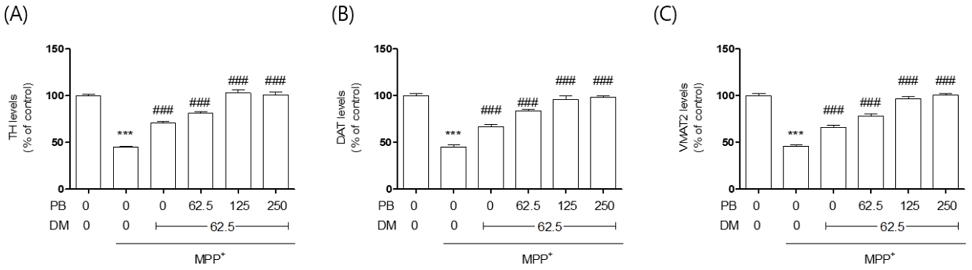
PB–DM restores dopaminergic markers under MPP⁺ injury. Differentiated PC12 were challenged with MPP⁺ after 24 h exposure to Dendropanax morbifera (DM) fixed at 62.5 µg/mL and Phellodendron bark (PB) titrated to 62.5–250 µg/mL. Protein levels of TH, DAT, and VMAT2 were quantified and expressed as % of vehicle. MPP⁺ reduced all three markers. PB–DM dose-dependently restored TH, DAT, and VMAT2, with the greatest recovery at PB:DM = 250:62.5 µg/mL. Values shown represent means ± S.E.M. Data represent mean ± SEM of three independent experiments (n = 3). ***p < 0.001 compared with the control group and ###p < 0.001 compared with the MPP⁺-treated group.
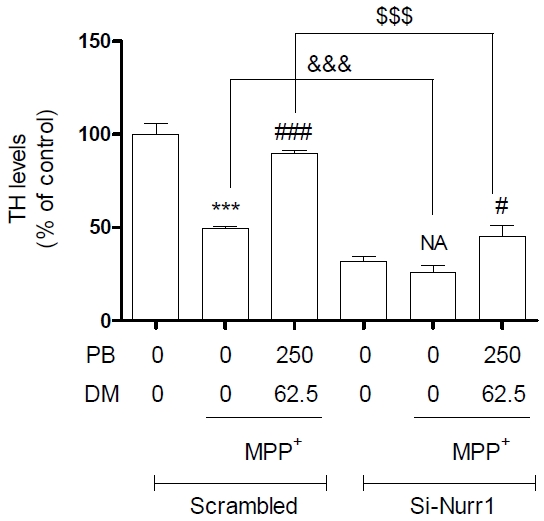
Nurr1 knockdown attenuates PB–DM–mediated TH rescue under MPP⁺. Cells were transfected with scrambled control or Nurr1 siRNA, exposed to MPP⁺, and treated with PB:DM = 250:62.5 µg/mL for 24 h. TH protein is expressed as % of vehicle. MPP⁺ reduced TH. In scrambled cells, PB–DM restored TH toward control. In Nurr1-silenced cells, the PB–DM effect was markedly blunted, though a residual increase remained. &&& indicates the within-scrambled difference between MPP⁺ and PB–DM. $$$ indicates the difference between PB–DM effects in scrambled vs siNurr1. Values shown represent means ± S.E.M. Data represent mean ± SEM of three independent experiments (n = 3). ***p < 0.001 vs. control; ###p < 0.001 vs. MPP⁺ (scrambled group); #p < 0.05 vs. MPP⁺ (si-Nurr1 group); &&&p < 0.001 between scrambled groups; $$$p < 0.001 between scrambled and si-Nurr1 groups.
Department of Cardiology and Neurology of Korean Medicine, College of Korean Medicine, Daejeon Universitys203065@gmail.com
Department of Korean Medicine Rehabilitation, Phil Hospital of Korean Medicinechoeune12@naver.com
Department of Cardiology and Neurology of Korean Medicine, College of Korean Medicine, Daejeon Universityseolinch@dju.kr
Department of Cardiology and Neurology of Korean Medicine, College of Korean Medicine, Daejeon Universityyoonsik@dju.kr
Department of Cardiology and Neurology of Korean Medicine, College of Korean Medicine, Daejeon University and Clinical Trial Center, Daejeon Korean Medicine Hospital of Daejeon Universitymiso.sophia.park@gmail.com
Department of Cardiology and Neurology of Korean Medicine, College of Korean Medicine, Daejeon Universitycsh2217@hanmail.net
Herbal Medicine Resources Research Center, Korea Institute of Oriental Medicinegpark@kiom.re.kr
Department of Cardiology and Neurology of Korean Medicine, College of Korean Medicine, Daejeon Universitymedicdragon@daum.net