
돌단풍(Mukdenia rossii (Oliv.) Koidz)의 건조 스트레스 평가를 위한 RGB 이미지 기반 DT(Decision Tree) 모델 구축
Ⓒ The Korean Environmental Sciences Society. All rights reserved.
This is an Open-Access article distributed under the terms of the Creative Commons Attribution Non-Commercial License (http://creativecommons.org/licenses/by-nc/3.0) which permits unrestricted non-commercial use, distribution, and reproduction in any medium, provided the original work is properly cited.
Abstract
The demand for garden plants such as Mukdenia rossii has increased with the expansion of gardening culture, while concerns regarding drought stress damage have also increased due to climate change and increasing imperviousness in urban environments. Drought stress adversely affects plant physiological functions, including reductions in photosynthetic efficiency, necessitating quantitative and non-destructive assessment of plant water status. However, most image-based and machine learning studies have focused on agricultural crops, leaving a gap in diagnostic criteria for garden plants. Therefore, this study aimed to quantify drought stress responses in M. rossii using RGB-based vegetation indices and to evaluate the applicability of a Decision tree (DT) model for stress level classification. A total of 600 RGB images were collected, from which indices including GLI (Green leaf index), NGRDI (Normalized green red difference index), and BGI (Blue green pigment index) were extracted and analyzed in relation to soil moisture content. GLI and NGRDI showed consistent decreasing trends and strong correlations with declining soil moisture, indicating high sensitivity to drought stress. Notably, NGRDI was identified as the most effective indicator of plant water status. The DT model achieved a classification accuracy of 91.4%, with Precision, Recall, and F1-Score exceeding 0.85, indicating reliable classification performance. These findings suggest that RGB-based vegetation indices effectively reflect drought stress responses in garden plants and provide a scientific basis for non-destructive plant water status monitoring and irrigation management in urban green environments.
Keywords:
Mukdenia rossii, Drought stress, RGB image analysis, Non-destructive monitoring, Decision tree1. 서 론
최근 정원 활동과 생활의 대중화로 정원산업의 범위가 확대됨에 따라 정원식물에 대한 관심이 높아지고 도시정원 문화도 활발해지고 있다(Choi et al. 2017). 장미목 범의귀과에 속하는 돌단풍(Mukdenia rossii (Oliv.) Koidz)은 다년생 초본식물로서 관상용으로 인기가 많아 옥상녹화 등 정원이나 분재로 많이 식재되며, 봄철 개화와 가을철 단풍 등 계절적 색 변화가 뚜렷해 정원 식재에서 활용 가치가 높다는 평가를 받고 있다(Li et al., 2016, Ko et al., 2023).
그러나, 기후변화로 인해 고온, 홍수, 가뭄 등 이상기후가 발생하는 빈도의 증가는 돌단풍 등 정원식물의 생육 안정성에 잠재적인 위협으로 작용하고 있다(Araus, 2002; Fedoroff et al., 2010). 특히, 도시 환경은 아스팔트로 인한 불투수성과 차량 및 난방 에너지 소비로 인해 만성적으로 건조한 상태이기 때문에 건조 스트레스 피해 가능성이 더욱 높아지고 있다(Kim et al., 2014).
식물은 최적의 생육 조건에서 광합성을 위한 빛 에너지 이용 효율 및 생산성이 증대될 수 있으나 건조 조건에서는 광합성을 저해하고 삼투 조절 기능 상실과 주요 대사 장애를 초래하여 식물에 극심한 손상을 입힌다(Taiz and Zeiger, 2006; Pereira, 2016; Zhu, 2016). 일반적으로 스트레스 조건에서 식물은 엽록소 함량 감소 및 광 흡수 색소 비율 변화 등으로 인해 적색과 청색 빛의 반사율이 증가하고, 녹색 빛과 근적외선 반사율이 감소한다(Zarco-Tejada, 2000; Chatterjee et al., 2023). 이러한 분광 반사 특성을 기반으로 식물의 스트레스를 비파괴적으로 평가하기 위해 빛 반사 특성의 변화를 분석하는 접근이 주목받고 있다.
특히, 식물의 스트레스 조기 진단의 정확도를 높여 식물의 피해를 저감하기 위해 최근 RGB 및 초분광 이미지를 활용한 기계학습(Support vector machine, K-nearest neighbors, Decision tree 등) 기반 식물 관리 알고리즘 연구가 활발히 진행되고 있다(Agapiou, 2020; Starý et al., 2020; Lee et al., 2021; Feng et al., 2022; Song et al., 2022; Rockstad et al., 2023). 건조 스트레스의 경우, 색소 조성 변화가 가시광 반사 특성에 직접적으로 반영되기 때문에 RGB 영상 기반 분석의 적용 가능성이 높으며, 이를 통해 콩 및 잔디에서 스트레스 진단이 가능함이 보고된 바 있다(Sang et al., 2021; Rockstad et al., 2023).
그럼에도 불구하고 RGB 이미지를 활용한 식물 스트레스 진단 연구는 대부분 농작물 중심으로 수행되어 왔으며, 정원식물 분야는 여전히 미비한 실정이다(Sang et al., 2021). 특히 돌단풍과 같은 관상용 다년생 초본식물은 농작물과 달리 좁은 면적에 다양한 식물을 식재하는 특성이 있어 RGB 이미지 등 비용 부담이 적은 저가형 장치를 활용한 데이터 획득, 처리, 분석 등을 통해 효율적으로 관리할 수 있는 기반 구축이 필요하다. 따라서 본 연구는 건조 스트레스 조건에서 돌단풍의 RGB 이미지 지수를 정량적으로 분석하고, Decision tree (DT) 모델을 적용하여 스트레스 수준을 구분함으로써 해석 가능한 진단 기준을 도출하고자 하였다. 이는 정원식물의 건조 스트레스에 대한 현장 적용 가능한 평가 기준을 제시함으로써, 향후 자동 관수 의사결정 시스템 구축을 위한 기초 자료로 활용될 수 있을 것으로 기대된다.
2. 재료 및 방법
본 연구는 2023년 7월 15일부터 약 40일간 수행되었다. 경기도 안성시 한경국립대학교 부속농장 하우스(37°00’42”N, 127°19’12”E)에서 돌단풍(Mukdenia rossii (Oliv.) Koidz)을 구입(더케이야생화)하여 포트에 이식하였다. 이식 후 앵글형 드롭스파이크를 각각의 포트에 설치하여 매일 일정량의 수분을 20일간 공급하였으며, 이후 관수를 중단하여 건조 처리를 3반복 실시하였다(Fig. 1A). 토양수분함량 측정은 WaterScout SM 100 (Spectrum Technologies, Inc., Aurora, IL 60504, USA) 센서를 활용하여 1시간 간격으로 데이터로거(WatchDog 1000 Series Watermark Irrigation Stations, Spectrum Technologies Inc., Aurora, IL 60504, USA)에 저장하였으며 일중 변동이 크지 않아 일평균 값으로 대표하여 산출하였다(Fig. 1B).
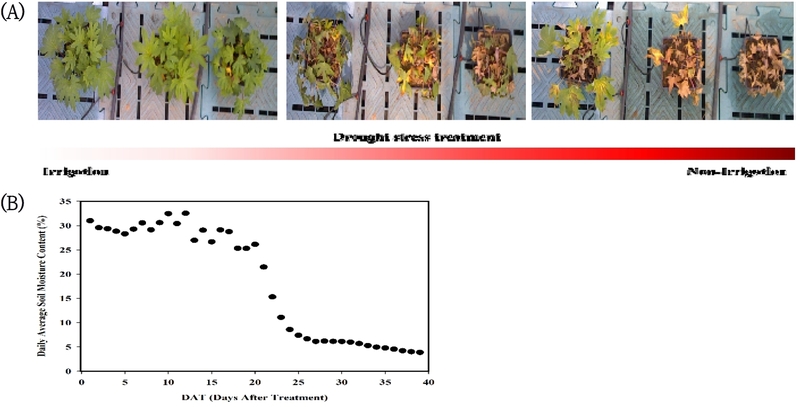
Field setup and drought stress treatments (A), Daily average soil moisture content (B).
건조 스트레스 수준은 돌단풍을 포함한 정원식물의 건조 반응 특성을 엽록소 형광 반응(OJIP)으로 분석한 저자들의 선행연구 결과를 기반으로 본 연구에서 사전에 정의하였다(Lee et al., 2025). 선행연구에 의하면, 토양수분함량이 일정하게 유지되는 관수 조건에서는 PSII 반응 중심의 광화학 효율이 안정적으로 나타나며 전형적인 OJIP 곡선이 관찰됨에 따라 본 연구에서는 해당 수분 구간을 ‘Normal’ 단계로 정의하였다(22% ~ 31%). 건조 처리를 위해 관수를 중단한 후 토양수분함량이 감소함에 따라 형광 파라미터가 점진적으로 저하되나 전자 전달계의 구조적 손상이 관찰되지 않는 전이 구간은 ‘Moderate’ 단계로 설정하였다(11% ~ 21%). 이후 지속적으로 토양수분함량이 감소하여 약 10% 이하에 도달할 경우 PSII 전자 전달이 현저히 제한되어 OJIP 곡선의 단순화가 관찰되었으며, 이러한 생리적 기능 저해가 명확히 나타나는 수분 구간을 ‘Severe’ 스트레스 단계로 정의하였다.
RGB 이미지는 하우스 내부에 파이프를 설치하여 타임랩스 카메라(TLC–200, Brinno, Taiwan)를 지면으로부터 약 2 m 높이에 고정하여 촬영하였다. 촬영은 3개의 독립적 포트를 대상으로 하루 5회(11:00 ~ 15:00)씩 40일간 수행되어 총 600장의 RGB 이미지가 수집되었다. 이후 RGB 이미지 분석을 위해 Matias et al.(2020)의 방법을 기반으로 R Studio (R Core Team, 2021)의 ‘FIELDimageR’ 패키지를 이용하여 수행되었다(Matias et al., 2020). 이 때, 동일 일자 내에서 반복 촬영된 이미지의 중복성을 고려하여, 각 시간대별 3반복(3개 포트)의 RGB 이미지 지수를 추출한 후 그 평균값을 해당 시간의 대표 관측값으로 구성하였다(Table 1, Fig. 2). 최종적으로 일자(40일) × 시간(5회) 구조에서 이상치를 제외한 총 192개의 데이터셋이 구축되었으며, 각 데이터는 동일 일자에 측정된 일평균 토양수분함량과 매칭되었다. 토양수분함량은 실제 모델의 입력 변수로는 사용되지 않았으며, 사전 정의된 기준에 따라 각 데이터의 건조 스트레스 수준(Label)을 분류하는 기준으로만 활용되었다.

Descriptions, formulas, and related traits for RGB image indices used in the analysis
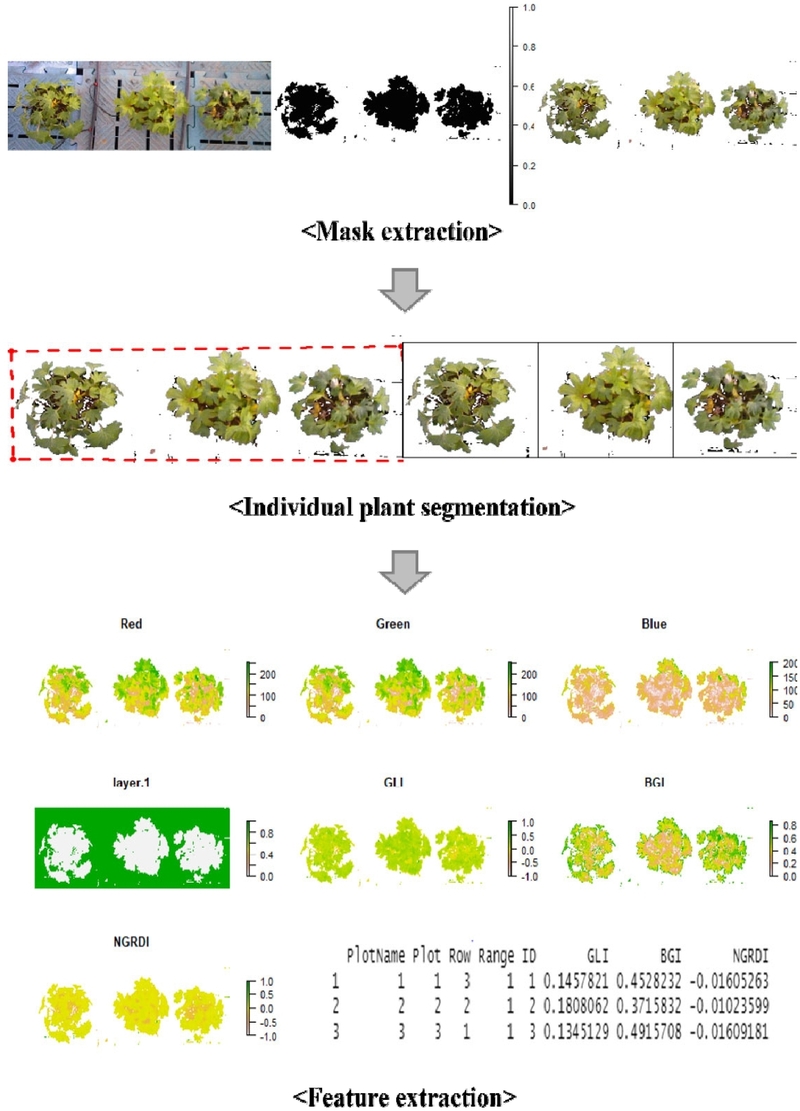
Workflow of image processing for RGB image indicies extraction. The process consists of three main stages: (1) Mask extraction, where the plant area is separated from the background, (2) Individual plant segmentation, which involves isolating each plant into a separate region of interest (ROI) and (3) Feature extraction, where RGB-based vegetation indices (e.g., GLI, BGI, and NGRDI) are calculated as input variables for the Decision tree model.
구축된 데이터셋은 이후 R Studio 환경 내에서 모든 통계 분석 및 모델 구축에 활용되었으며, 최종적으로 RGB 이미지 지수(GLI, NGRDI, BGI)를 입력 변수로 하고 사전 정의된 건조 스트레스 수준을 출력 변수로 하는 DT 분류 모델을 구축하였다. 이 때, DT 모델은 ‘rpart’ 패키지의 ‘rpart’ 함수를 이용하여 구현하였으며, 노드 분할 기준으로 엔트로피 기반의 정보이득(Information gain)을 적용하였다. 데이터셋은 무작위 추출 방식으로 70%를 학습 데이터, 30%를 검증 데이터로 분할하였는데, 본 연구는 시간 경과에 따른 예측보다는 RGB 이미지 지수와 건조 스트레스 수준 간의 분류 규칙 도출을 목적으로 하기 때문에 무작위 분할 방식을 활용하였다. 이후 구축된 모델은 정확도(Accuracy), 정밀도(Precision) 등의 성능 지표를 활용하여 Table 2와 같이 모델의 성능평가를 실시하였다.
Model performance evaluation metrics
3. 결과 및 고찰
토양수분함량의 감소에 따라 GLI 및 NGRDI가 유의하게 감소하는 경향을 보였으며, 특히 10% 이하 구간에서 급격한 감소가 확인되었다(Fig. 3A, 3B). 이는 건조 스트레스에 의해 엽록소 함량이 감소하고 적색 파장대 반사 특성이 변화한다는 기존 분광 연구 결과와 유사한 경향을 나타냈다(Horler et al., 1983; Curran et al., 1990; Blackburn, 2006; Govender et al., 2009). 특히 NGRDI는 토양수분함량과 가장 높은 양의 상관관계를 보였는데(Fig. 3D), 이는 다양한 식생지수 중 NGRDI가 작물의 물 사용 효율(Water use efficiency, WUE) 예측에 효과적인 지표로 평가된 선행연구 결과와 일치하였다(Yang et al., 2020). 이를 통해 적색 파장 기반 RGB 지수가 건조 스트레스 조건에서 식물의 수분 상태를 민감하게 반영하는 유효한 지표인 것으로 확인되었다.
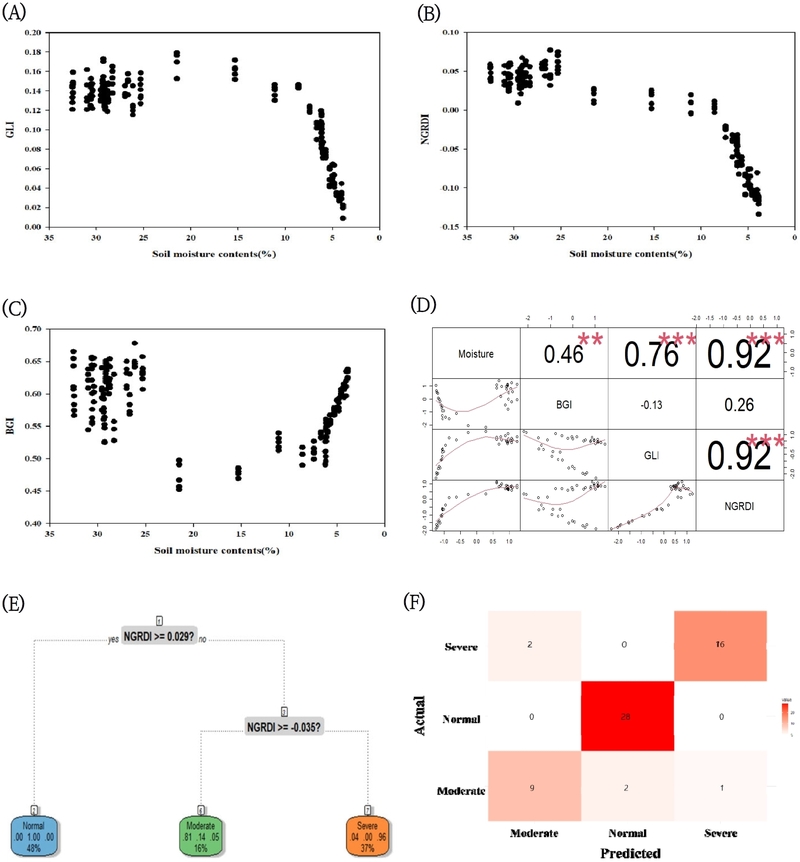
Changes in RGB image indices of Mukdenia rossii in response to soil moisture content GLI (A), NGRDI (B), BGI (C) and their pearson correlation with soil moisture content (D). (E) Decision tree model for drought stress classification and (F) confusion matrix visualization of model performance. Asterisks denote statistically significant differences: ** p < 0.01, *** p < 0.001.
총 192개의 데이터셋을 기반으로 DT 모델을 구축한 결과, 최종 분류 트리에는 NGRDI 지수만이 선택되어 상관분석 결과와 유사한 경향을 보였다(Fig. 3E). 이는 엔트로피 기반 정보이득 기준에서 NGRDI가 가장 큰 불순도 감소를 나타냈기 때문인 것으로 해석되었다. 반면 GLI와 BGI 모두 초기 입력 변수로 포함되었으나, GLI는 NGRDI와 높은 상관관계(r = 0.92)를 보여 정보 중복성이 큰 변수로 확인되었으며, BGI는 분할 기여도가 낮아 최종 모델에서 제외된 것으로 보였다. 특히 BGI는 토양수분함량과 유의한 상관관계를 보였으나, 수분 감소에 따라 비선형적이고 일관되지 않은 변동 패턴을 나타냈다(Fig. 3C). 이는 청색 파장대가 주로 엽록소 b에 의해 흡수되며, 건조 스트레스 조건에서 청색 영역의 반사 변화가 상대적으로 제한적이기 때문인 것으로 사료되었다(Yang et al., 2023).
모델 성능 평가 결과, 전체 분류 정확도는 91.4%로 나타났으며, Precision, Recall, F1-score, Kappa 값 역시 0.85 이상을 기록하여 모델의 안정성과 신뢰성을 확인하였다(Table 3). 클래스별 분석에서 Normal과 Severe 단계는 높은 Sensitivity와 Specificity를 보여 명확히 구분되었으나, Moderate 단계는 Sensitivity가 0.75로 상대적으로 낮았다(Fig. 3F). 이는 건조 반응이 연속적인 생리적 스펙트럼 상에서 나타남에 따라 Moderate 단계의 RGB 지수 값이 Normal 및 Severe 범위와 부분적으로 중첩되었기 때문으로 해석되었다.
Evaluation of classification performance of the DT model based on RGB image indices
본 연구 결과는 RGB 기반 건조 스트레스 진단 연구가 주로 농작물을 대상으로 수행되어 왔다는 점에서, 관상용 정원식물을 대상으로 한 적용 사례를 제시하였다는 의의를 갖는다. 기존 연구에서는 복수의 식생지수를 결합하거나 초분광 자료를 활용한 모델이 다수 보고된 반면, 본 연구는 단일 RGB 지수(NGRDI)만으로도 높은 분류 성능을 확보하였다(Zhang and Zhou, 2019; Wong et al., 2023; Yoon et al., 2025). 또한 블랙박스 기반 기계학습 기법과 달리 DT 모델을 적용함으로써 스트레스 단계 구분에 기여하는 임계값을 명시적으로 제시하였다는 점에서 관리 의사결정 지원 측면의 해석 가능성을 확장하였다.
다만, 본 연구는 단일 수종을 대상으로 제한된 환경 조건에서 수행되었다는 한계를 지닌다. 또한, 건조 스트레스가 시간 경과에 따라 점진적으로 심화되는 특성상 시계열 블록 분할을 적용할 경우 실험 후반부 Severe 단계 데이터가 집중되는 클래스 불균형이 발생하여, 모델 성능의 객관적 평가에 제한이 있었다. 따라서 특정 시점의 화상 정보와 스트레스 단계 간의 직접적 분류 규칙 도출을 위해 무작위 분할 방식을 적용하였으며, 동일 개체 반복 측정에 따른 의존성을 최소화하기 위해 동일 시간대 반복 포트의 평균값을 분석 단위로 설정하였다. 향후 연구에서는 다양한 정원식물 종과 실제 실외 환경 조건에서의 검증이 필요하며, 미학습 개체를 활용한 외부 검증(Independent test set)을 통해 모델의 일반화 성능을 평가할 필요가 있다. 또한 RGB 지수와 엽록소 형광 또는 열영상 지표를 결합한 다중 센서 기반 접근을 통해 Moderate 단계의 분류 정확도를 보완할 수 있을 것으로 기대된다.
4. 결 론
본 연구는 RGB 이미지 지수를 기반으로 돌단풍(Mukdenia rossii (Oliv.) Koidz)의 건조 스트레스 반응을 정량적으로 평가하고, 영상 기반 스트레스 진단의 적용 가능성을 검증하고자 수행되었다. 분석 결과, GLI와 NGRDI는 토양수분함량 감소에 따라 일관된 감소 경향을 나타내며 높은 상관관계를 보였다. 이는 건조 스트레스에 따른 엽록소 감소 및 광합성 기능 저하가 영상 기반 식생 지수에 직접적으로 반영될 수 있음을 시사한다. 반면 BGI는 토양수분함량과 유의한 상관관계를 보였으나 데이터의 변동성이 크게 나타나며, 건조 스트레스 진단을 위한 단일 지표로서의 적용에는 제한이 있는 것으로 판단되었다.
RGB 이미지 지수 기반의 DT 모델은 높은 분류 정확도를 나타내며, 영상 지표를 활용한 건조 스트레스 수준 구분이 효과적으로 수행될 수 있음을 확인하였다. 특히, 식물의 생리적 변화를 RGB 영상 데이터로 정량화하고 이를 단계적으로 분류할 수 있음을 확인함으로써, 영상 기반 비파괴적 식물 상태 진단의 적용 가능성을 실증적으로 제시하였다.
결론적으로 본 연구의 결과는 RGB 영상 지수가 정원식물의 건조 스트레스 반응을 반영하는 유효한 환경 지표로 활용될 수 있음을 보여주며, 향후 녹지 식생의 비파괴적 생육 상태 평가 및 수분 스트레스 기반 관수 관리 의사결정을 위한 기초 자료로 활용될 수 있을 것으로 기대된다.
Acknowledgments
본 논문은 농촌진흥청 연구사업(과제번호: RS-2021-RD009681)의 지원에 의해 수행되었습니다.
REFERENCES
-
Agapiou, A., 2020, Vegetation extraction using visible-bands from openly licensed unmanned aerial vehicle imagery, Drones, 4, 27.
[https://doi.org/10.3390/drones4020027]

-
Araus, J. L., 2002, Plant breeding and drought in c3 cereals: What should we breed for?, Ann. Bot., 89, 925-940.
[https://doi.org/10.1093/aob/mcf049]
-
Blackburn, G. A., 2006, Hyperspectral remote sensing of plant pigments, J. Exp. Bot., 58, 855-867.
[https://doi.org/10.1093/jxb/erl123]
-
Chatterjee, S., Adak, A., Wilde, S., Nakasagga, S., Murray, S. C., 2023, Cumulative temporal vegetation indices from unoccupied aerial systems allow maize (Zea mays L.) hybrid yield to be estimated across environments with fewer flights, PLoS One, 18, e0277804.
[https://doi.org/10.1371/journal.pone.0277804]
-
Choi, W. K., Jin, H. Y., Song, J. H., 2017, Analysis of users recognition on wildflowers as gardening plants, J. People Plants Environ., 20, 81-93.
[https://doi.org/10.11628/ksppe.2017.20.1.081]
-
Curran, P. J., Dungan, J. L., Gholz, H. L., 1990, Exploring the relationship between reflectance red edge and chlorophyll content in slash pine, Tree Physiol., 7, 33-48.
[https://doi.org/10.1093/treephys/7.1-2-3-4.33]
-
Fedoroff, N. V., Battisti, D. S., Beachy, R. N., Cooper, P. J. M., Fischhoff, D. A., Hodges, C. N., Knauf, V. C., Lobell, D., Mazur, B. J., Molden, D., Reynolds, M. P., Ronald, P. C., Rosegrant, M. W., Sanchez, P. A., Vonshak, A., Zhu, J. K., 2010, Radically rethinking agriculture for the 21st century, Science, 327, 833-834.
[https://doi.org/10.1126/science.1186834]
-
Feng, H., Tao, H., Li, Z., Yang, G., Zhao, C., 2022, Comparison of UAV RGB imagery and hyperspectral remote sensing data for monitoring winter wheat growth, Remote Sens., 14, 3811.
[https://doi.org/10.3390/rs14153811]
-
Govender, M., Govender, P. J., Weiersbye, I. M., Witkowski, E. T. F., Ahmed, F., 2009, Review of commonly used remote sensing and ground-based technologies to measure plant water stress, Water SA, 35, 741-752.
[https://doi.org/10.4314/wsa.v35i5.49201]
-
Horler, D. N. H., Dockray, M., Barber, J., 1983, The red edge of plant leaf reflectance, Int. J. Remote Sens., 4, 273-288.
[https://doi.org/10.1080/01431168308948546]
- Kim, J. S., Jung, M. I., Han, S. W., Jang, H. K., 2014, Assessment of drought-resistant garden plants for urban greening, Proceedings of the Society for People, Plants, and Environment Conference, Korea, 39.
-
Ko, B. U., Han, S. W., Kim, W. Y., Lee, H. S., Jeong, N. R., 2023, Analysis of drought stress recovery in ground cover plants for urban green space sustainability, J. East Asian Landsc. Stud., 17, 67-73.
[https://doi.org/10.51549/JORAL.2023.17.4.067]
- Lee, D. H., Jeong, C. H., Go, S. H., Park, J. H., 2021, Evaluation of applicability of RGB image using support vector machine regression for estimation of leaf chlorophyll content of onion and garlic, Korean J. Remote Sens., 37, 1669-1683.
-
Lee, S. J., Kim, T. W., Eom, T. S., Yoon, T. J., Hwang, Y. B., Seo, J. Y., Yoo, S. Y., 2025, Identification of chlorophyll fluorescence parameters for evaluating drought stress in garden plants, J. People Plants Environ., 28, 601-613.
[https://doi.org/10.11628/ksppe.2025.28.5.601]
-
Li, Y., Kim, D. Y., Kim, H. B., Kim, Y. K., 2016, Effects of geohumus mixed with artificial soil on soil water retention and plant stress response, J. Korean Soc. Environ. Restor. Technol., 19, 1-11.
[https://doi.org/10.13087/kosert.2016.19.1.1]
-
Matias, F. I., Caraza-Harter, M. V., Endelman, J. B., 2020, Fieldimager: An R package to analyze orthomosaic images from agricultural field trials, Plant Phenomics, 3, 482.
[https://doi.org/10.1002/ppj2.20005]
-
Pereira, A., 2016, Plant abiotic stress challenges from the changing environment, Front. Plant Sci., 7, 1123.
[https://doi.org/10.3389/fpls.2016.01123]
- R Core Team, 2021, R: A Language and environment for statistical computing, R Foundation for Statistical Computing, Vienna, Austria.
-
Rockstad, G. B. G., Austin, R. E., Gouveia, B. T., Carbajal, E. M., Milla-Lewis, S. R., 2023, Assessing unmanned aerial vehicle-based imagery for breeding applications in St. Augustinegrass under drought and non-drought conditions, Crop Sci., 64, 496-510.
[https://doi.org/10.1002/csc2.21128]
- Sang, W. G., Kim, J. H., Baek, J. K., Kwon, D., Ban, H. Y., Cho, J. I., Seo, M. C., 2021, Detection of drought stress in soybean plants using RGB-based vegetation indices, Korean J. Agric. For. Meteorol., 23, 340-348.
-
Song, H. Y., Cho, B. H., Kim, Y. H., Kim, K. C., 2022, Development of a classification model for tomato maturity using hyperspectral imagery, Korean J. Agric. Sci., 49, 129-136.
[https://doi.org/10.7744/kjoas.20220010]
- Starý, K., Jelínek, Z., Kumhálová, J., Chyba, J., Balážová, K., 2020, Comparing RGB-based vegetation indices from UAV imagery to estimate hops canopy area, Remote Sens., 12, 1028.
- Taiz, L., Zeiger, E., 2006, Plant physiology, 4th ed., Sinauer Associates, Sunderland, USA.
-
Wong, C. Y. S., Gilbert, M. E., Pierce, M. A., Parker, T. A., Palkovic, A., Gepts, P., Magney, T. S., Buckley, T. N., 2023, Hyperspectral remote sensing for phenotyping physiological drought response of common and tepary bean, Plant Phenomics, 5, 0021.
[https://doi.org/10.34133/plantphenomics.0021]
-
Yang, M., Hassan, M. A., Xu, K., Zheng, C., Rasheed, A., Zhang, Y., Jin, X., Xia, X., Xiao, Y., He, Z., 2020, Assessment of water and nitrogen use efficiencies through UAV-based multispectral phenotyping in winter wheat, Front. Plant Sci., 11, 927.
[https://doi.org/10.3389/fpls.2020.00927]
-
Yang, Y., Nan, R., Mi, T., Song, Y., Shi, F., Liu, X., Wang, Y., Sun, F., Xi, Y., Zhang, C., 2023, Rapid and nondestructive evaluation of wheat chlorophyll under drought stress using hyperspectral imaging, Int. J. Mol. Sci., 24, 5825.
[https://doi.org/10.3390/ijms24065825]
-
Yoon, T. J., Kim, T. W., Yoo, S. Y., 2025, Non-destructive drone-based multispectral and RGB image analyses for regression modeling to assess waterlogging stress in Pseudolysimachion linariifolium, Horticulturae, 11, 1139.
[https://doi.org/10.3390/horticulturae11091139]
-
Zarco-Tejada, P., 2000, Chlorophyll fluorescence effects on vegetation apparent reflectance I. leaf-level measurements and model simulation, Remote Sens. Environ., 74, 582-595.
[https://doi.org/10.1016/S0034-4257(00)00148-6]
-
Zhang, F., Zhou, G., 2019, Estimation of vegetation water content using hyperspectral vegetation indices under water stress treatments in summer maize, BMC Ecol., 19, 18.
[https://doi.org/10.1186/s12898-019-0233-0]
-
Zhu, J. K., 2016, Abiotic stress signaling and responses in plants, Cell, 167, 313-324.
[https://doi.org/10.1016/j.cell.2016.08.029]
Department of Plant Resources and Landscape Architecture, Hankyong National Universityleesj9691@naver.com
Urban Agriculture Research Division, National Institute of Horticultural and Herbal Science, RDAsjy0225@korea.kr
Urban Agriculture Research Division, National Institute of Horticultural and Herbal Science, RDAhansgarden@korea.kr
Institute of ecological phytochemistry, Hankyong National Universitylsn136@hknu.ac.kr