계분에 동애등에 유충과 아미노산제제 및 밀기울을 혼합 적용시 분해능력과 암모니아 발생 및 총 질소 함량에 미치는 영향
Ⓒ The Korean Environmental Sciences Society. All rights reserved.
This is an Open-Access article distributed under the terms of the Creative Commons Attribution Non-Commercial License (http://creativecommons.org/licenses/by-nc/3.0) which permits unrestricted non-commercial use, distribution, and reproduction in any medium, provided the original work is properly cited.
Abstract
This study investigated the effects of mixing amino acid additives or wheat bran with poultry manure and applying it to Black Soldier Fly (BSF) larvae, specifically examining decomposition efficiency, ammonia emission, and total nitrogen content. The experimental groups were established as follows, with each treatment replicated three times: T1) a mixture of 1 kg of poultry manure and 1 kg of amino acid additives + 0.5 kg of third-instar BSF larvae, and T2) a mixture of 1 kg of poultry manure and 1 kg of wheat bran + 0.5 kg of third-instar BSF larvae. The results indicate that poultry manure treated with amino acid additives exhibited a superior decomposition performance compared with the mixture containing wheat bran when subjected to third-instar BSF larvae. This difference in decomposition efficacy was particularly pronounced on the 18th day of the experiment. However, ammonia emissions and total nitrogen content showed no comparable levels between the two manure treatments with third-instar BSF larvae. These findings suggest that further research is necessary to elucidate the mechanisms underlying these similarities and to provide additional clarity.
Keywords:
Amino acid additives, Ammonia, Black soldier fly larvae, Decomposition efficiency, Poultry manure, Total nitrogen, Wheat bran1. 서 론
축분의 분해 과정은 일반적으로 축사 내에서 이루어지고 이 과정에서 암모니아를 비롯한 다양한 휘발성 유기화합물이 배출된다. 이는 심각한 악취를 유발하여 인근 지역 주민들에게 잠재적인 건강 위험을 초래할 수 있는 문제로 지적되고 있다(Beskin et al., 2018). 특히, 계분에서 방출되는 주요 휘발성 유기화합물은 인돌, 스카톨, 암모니아 등으로 보고되었다(Yasuhara, 1987). 이에 따라 축분의 지속 가능한 처리 방안을 모색하는 노력의 일환으로 동애등에(Black Soldier Fly, BSF) 유충 활용이 유망한 대안으로 주목받고 있다(Beskin et al., 2018). 동애등에 유충은 그 특유의 생물학적 특성으로 축분 처리를 위한 중요한 연구 대상으로 자리 잡았다. 선행 연구에 의하면, 동애등에 유충은 계분 중량과 질소함량을 각각 약 50%와 62% 감소시킬 수 있는 것으로 관찰되었다(Sheppard, 1983; Sheppard, 1994). 이러한 처리 기술 외에도 계분이 퇴비화 되는 과정에서 생균제와 농산부산물을 함께 사용하는 경우, 악취는 물론 난분해성 부산물의 처리가 가능하여 품질 높은 유기질 비료를 생산할 가능성도 제시된다. 예를 들면, 아미노산 기반 생균제를 활용할 경우, 축사 환경의 오염을 효과적으로 줄일 수 있다는 연구 결과가 제시된 바 있다(Lee and Lim, 2010). 한편, 밀기울은 풍부한 식이섬유와 단백질, 지방 성분 등을 포함하고 있어 식품 및 사료 산업, 의약품 제조, 발효 공정 등의 분야에서 중요한 원료로 활용되고 있다. 특히 가축 사료 및 퇴비 제조 시 발효 미생물의 탄소원과 영양 공급원으로의 중요한 역할과 수분 조절기능을 병행하여 발효 과정을 촉진하는 데에도 사용된다(Kim et al., 2006; Saini et al., 2023; Fan et al., 2024). 그러나 축분의 자가처리 비율이 90%정도인 비점오염(non-point source)을 근원적으로 저감하고 탄소중립의 최적 방안인 경축순환의 기반 확립을 위해서라도 계분의 지속가능한 처리방안 연구는 시급하다.
따라서 본 연구에서는 계분에 아미노산제제와 밀기울을 혼합 첨가하여 동애등에 유충과 함께 적용했을 시 분해능력과 암모니아 발생량 및 총 질소 함량에 미치는 영향을 평가하였다.
2. 재료 및 방법
본 연구에 활용된 공시 곤충은 동애등에 유충 3령으로 ㈜써큘러바이오(Ansung, South Korea)로부터 공급받아 경성대학교 동물보건생명과학내 실험실에서 30일간 사육되었다. 실험 재료로 사용된 아미노산 제제는 ㈜태영이앤비(Geumsan, South Korea)로부터 제공받았고, 밀기울은 ㈜써큘러바이오에서 공급받아 이들 재료들을 계분과 혼합하여 사용하였다. 계분은 충청남도 금산 지역 내 양계농장으로부터 제공받았다. 동애등에 3령 유충의 사육 환경은 온도 24℃, 상대습도 50%를 유지하였으며, 광주기는 주간 16시간 광조(光照)와 야간 8시간 암조(暗照)의 조건(16L:8D)으로 설정하였다. 유충의 사육을 위해 사용된 용기는 크기 30 cm × 15 cm × 20 cm의 직사각형 플라스틱 상자로 구성되었으며, 뚜껑 부분에는 지름 0.5 cm의 환기 구멍을 4면에 배치하여 적절한 통풍이 가능하도록 설계하였다. 실험군은 다음과 같이 구성되어 각 처리구는 3회 반복으로 수행되었다.
- T1 = a mixture of 1 kg of poultry manure and 1 kg of amino acid additives + 0.5 kg of 3rd instar BSF larvae
- T2 = a mixture of 1 kg of poultry manure and 1 kg of wheat bran + 0.5 kg of 3rd instar BSF larvae
동애등에 유충 3령 각 처리구는 3일 간격으로 전자저울을 이용해 무게를 측정하고 기록하였다. 분해 능력(decomposition)은 0일 무게와 이후 각각 3일 및 6일, 9일 경과 시점의 무게 차이를 활용해 계산하였다. 암모니아(ammonia) 농도는 kit이 장착할 수 있는 gastech을 이용하여, 측정 시 플라스틱 용기의 뚜껑을 반쯤 연 상태로 처리군별 네 지점에서 측정하였다. 또한 암모니아는 3일 간격으로 측정하여 기록하였다. 각 처리구에서 3일마다 10 g씩 샘플을 채취하여 총 질소(total nitrogen, TN) 함량을 분석하였고, 그 과정은 시료 분해, 증류, 적정의 세 단계를 거쳐 진행하였다(AOAC, 1990). 통계분석은 SAS (Version 9.4) 프로그램을 활용하여 T-검정을 통해 처리군 간 평균 차이의 통계적 유의성을 검증하였다. 유의 수준은 5% 수준에서 설정하였다.
3. 결과 및 고찰
Fig. 1은 동애등에 3령 유충을 계분이 첨가된 아미노산제제와 밀기울에 처리시 분해능력에 대한 결과를 제시하였다. 분해능력에 대한 두 처리구의 통계적 유의성은 18일 이후 지나 30일까지 측정한 결과에서 관측되었다(p<0.05). 그러나 시험 첫날 0일에서 15일까지는 유의한 차이가 없는 것으로 확인되었다(p>0.05). 두 처리구의 분해 능력을 비교한 결과, 계분에 아미노산 제제를 처리한 동애등에 3령 유충이 계분에 밀기울을 첨가한 경우보다 더 높은 분해 효과를 보였다. 특히 18일 기준에서 뚜렷한 차이를 나타냈다. 이는 사용된 아미노산 제제가 생균제로서 유충의 기호성에 긍정적인 영향을 미쳤기 때문으로 판단된다. 생균제는 일반적으로 장내 미생물 균형을 개선하여 동물의 생산성을 높이는 데 유용한 특성을 가지고 있어 주목할 점이다. 예를 들어, Jeong(2025)의 연구에서는 밀기울의 대체제로 아미노산 생균제를 이용할 경우, 동애등에 유충의 성장과 발달에 긍정적인 효과가 있음을 보고하였다. 한편, 밀기울의 영양 성분은 가공 처리 방법에 따라 변동되며(Hwang et al., 1995) 대체로 단백질 14~18%, 식이섬유 40~50%, 탄수화물 40~50%를 포함한다. 이를 활용하면 동애등에 유충의 영양 강화뿐만 아니라 농업 부산물의 재활용을 통해 지속 가능한 단백질 공급에도 기여할 수 있다(Danieli et al., 2019; Zolfaghari et al., 2022; Mannaa et al., 2024). 따라서 이 결과는 계분 내 밀기울 사용 사례와의 차이가 밀기울의 가공 처리 방식에 기인했음을 시사한다.
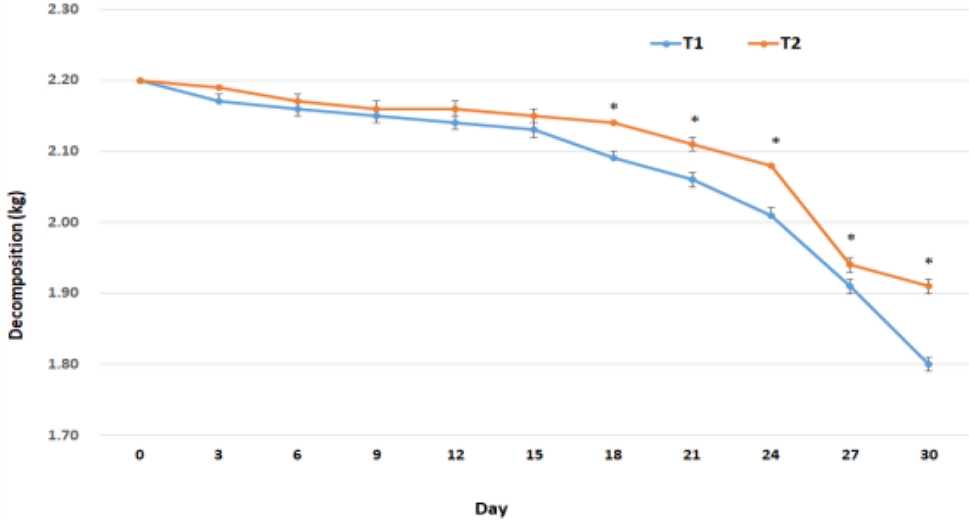
Decomposition ability in poultry manure with both wheat bran and amino acid additives processed by BSF larvae.*Marks denote statistically significant differences (p<0.05).Data are expressed as the mean ± standard error of the mean (SEM). Treatment means: T1 = a mixture of 1 kg of poultry manure and 1 kg of amino acid additives + 0.5 kg of 3rd instar BSF larvae; T2 = a mixture of 1 kg of poultry manure and 1 kg of wheat bran + 0.5 kg of 3rd instar BSF larvae.
동애등에 3령 유충을 계분이 첨가된 아미노산제제와 밀기울에 처리했을 때, 암모니아 발생량과 총 질소 함량에 대한 결과는 Table 1에 요약하였다. 암모니아의 경우, 통계적으로 유의미한 차이는 두 처리구에서 3일부터 12일까지의 기간 동안에만 관찰되었다(p<0.05). 암모니아 농도 결과를 보면, 0일부터 12일까지 계분에 아미노산제제를 처리한 구의 동애등에 3령 유충이 계분에 밀기울 처리구 보다 약간 낮은 수치를 보였다. 그러나 그 이후로는 두 처리구 모두 유사한 수준의 115 ppm 이상으로 나타났다.

Ammonia production and total nitrogen contents in poultry manure with both amino acid additives and wheat bran processed by BSF larvae
두 처리구의 총 질소 함량은 0일에서만 통계적 유의성을 보였지만 나머지 기간에는 차이가 없었다(p>0.05). 전체적으로 동애등에 3령 유충을 계분이 첨가된 아미노산제제와 밀기울 처리한 총 질소 함량은 비슷한 수준으로 나타났다. 결과적으로 동애등에 유충이 계분을 분해하는 능력이 있다 하더라도(Sanchez Matos et al., 2020) 계분 자체의 성분 중 질소함량이 매우 높아 암모니아 발생률이 높은 특징이 있다. 따라서 계분의 밀기울과 아미노산제제 첨가는 암모니아 발생과 총 질소 함량에 아무런 영향을 주지 않은 것으로 판단된다.
4. 결 론
본 연구는 계분에 아미노산제제 또는 밀기울을 혼합하여 동애등에 유충에 적용했을 때의 분해 능력, 암모니아 발생, 총 질소 함량에 미치는 영향을 조사하였다. 아미노산 제제를 처리한 계분에서는 동애등에 3령 유충이 밀기울을 첨가한 경우보다 더 높은 분해 효과를 보였으며, 특히 18일 시점에서 뚜렷한 차이가 나타났다. 그러나 동애등에 3령 유충이 첨가된 계분에 아미노산 제제와 밀기울로 처리한 경우, 암모니아 발생과 총 질소 함량에 아무런 영향을 나타내 않은 것으로 나타나 추가적인 연구를 통해 규명할 필요성이 있다.
REFERENCES
- AOAC, 1990, Official Methods of Analysis of the Association of Official Analytical Chemists. 15th ed., Association of Official Analytical Chemist, Washington DC, USA.
-
Beskin, K. V., Holcomb, C. D., Cammack, J. A., Crippen, T. L., Knap, A. H., Sweet, S. T., Tomberlin, J. K., 2018, Larval digestion of different manure types by the black soldier fly (Diptera: Stratiomyidae) impacts associated volatile emissions, Waste Manag., 74, 213–220.
[https://doi.org/10.1016/j.wasman.2018.01.019]

-
Danieli, P. P., Lussiana, C., Gasco, L., Amici, A., Ronchi, B., 2019, The effects of diet formulation on the yield, proximate composition, and fatty acid profile of the Black Soldier Fly (Hermetia illucens L.) prepupae intended for animal feed, Animals (Basel), 9, 178.
[https://doi.org/10.3390/ani9040178]
-
Fan L., Ma S., Li L., Huang, J., 2024, Fermentation biotechnology applied to wheat bran for the degradation of cell wall fiber and its potential health benefits: A Review, Int. J. Biol. Macromol., 275, 133529.
[https://doi.org/10.1016/j.ijbiomac.2024.133529]
- Hwang, J. K., Kim, C. T., Cho, S. J., Kim, C. J., 1995, Effects of various thermal treatments on physiochemical properties of wheat bran, Korean J. Food Sci. Technol., 27, 394-403.
-
Jeong, Y. W., 2025, Evaluating the impact of amino acid additives as a replacement for wheat bran on feed intake and proximate composition in black soldier fly (Hermetia illucens) larvae diets, J. Environ. Sci. Int., 34, 549-552.
[https://doi.org/10.5322/JESI.2025.34.9.549]
- Kim, H. L., Sohn, B. K., Jung, K. H., Kang, Y. K., 2006, The effects of anaerobic fermentation treatment of rice or wheat bran on the physical and chemical property of plastic film house soil, Korean J. Soil Sci. Fert., 39, 366-371.
- Lee, E. Y., Lim, J. S., 2010, Current status and perspectives of livestock environment improving agents for the characteristics and control of swine manure odor, Microbiol. Biotechnol. Lett., 38, 244-254.
-
Mannaa, M., Mansour, A., Park, I., Lee, D. W., Seo, Y. S., 2024, Insect-based agri-food waste valorization: Agricultural applications and roles of insect gut microbiota, Environ. Sci. Ecotechnol., 17, 100287.
[https://doi.org/10.1016/j.ese.2023.100287]
-
Sanchez Matos, J., Barberino, A. T. M. S., de Araujo, L. P., Lobo, I. P., de Almeida Neto, J. A., 2021, Potentials and limitations of the bioconversion of animal manure using fly larvae, Waste Biomass Valor., 12, 3497-3520.
[https://doi.org/10.1007/s12649-020-01141-y]
-
Sheppard, C., 1983, House fly and lesser fly control utilizing the black soldier fly in manure management-systems for caged laying hens, Environ. Entomol., 12, 1439–1442.
[https://doi.org/10.1093/ee/12.5.1439]
-
Sheppard, D. C., Newton, G. L., Thompson, S. A., Savage, S., 1994, A Value added manure management system using the black soldier fly, Bioresour. Technol., 50, 275–279.
[https://doi.org/10.1016/0960-8524(94)90102-3]
-
Saini, P., Islam, M., Das, R., Shekhar, S., Sinha, A. S. K., Prasad, K., 2023, Wheat bran as potential source of dietary fiber: Prospects and challenges, J. Food Compos. Anal., 116, 105030.
[https://doi.org/10.1016/j.jfca.2022.105030]
-
Yasuhara, A., 1987, Identification of volatile compounds in poultry manure by gas chromatography-mass spectrometry, J. Chromatogr., 387, 371-378.
[https://doi.org/10.1016/S0021-9673(01)94539-X]
- Zolfaghari, M., Pourfathollah, E., Esmaili, A., 2022, Nutritional composition, effect of four organic side-streams on black soldier fly larvae feeding, Iran J. Entomol. Res., 13, 237-246.
Department of Veterinary Technology and Zoology, Kyungsung University happydvm@ks.ac.kr