
Determination of Functional Roles of Corolla and Calyx on Fruit Growth and Morphology in Eggplant (Solanum melongena L. cv. ‘Otoking’) via Graded Post-pollination Removal
Ⓒ The Korean Environmental Sciences Society. All rights reserved.
This is an Open-Access article distributed under the terms of the Creative Commons Attribution Non-Commercial License (http://creativecommons.org/licenses/by-nc/3.0) which permits unrestricted non-commercial use, distribution, and reproduction in any medium, provided the original work is properly cited.
Abstract
In this study, we evaluated the functional roles of floral organs by examining the effects of post-anthesis corolla and calyx removal on fruit development in eggplant (Solanum melongena L. cv. ‘Otoking’). Corolla removal had limited, albeit significant, effects, depending on the extent and spatial pattern of removal. Whereas the effects of single-petal removal did not differ from the control (intact corolla), more extensive or asymmetric removal resulted in significant reductions in fruit length, diameter, and fresh weight, indicating an inhibition of early fruit growth. In contrast, calyx removal caused a more pronounced and sustained reduction in fruit growth throughout development. The size and weight of fruits declined progressively in response to increasing levels of calyx removal, and although removal had no significant effects on the fruit shape index, increases in the incidence of abnormal fruit morphology, such as curvature and tapering, with complete calyx removal reducing the proportion of marketable fruits was observed. Notably, among all treatments, the level of fruit set remained high (>90%), indicating that fertilization had not been substantially affected. However, compared with corolla removal, fruit drop increased to a greater extent in response to calyx removal, with both fruit drop and the proportion of unmarketable fruit increasing with increasing levels of removal. These findings indicate that the corolla may play a role as an initial regulator of fruit development, plausibly by buffering the microenvironment and influencing early growth signals, whereas by providing protection and supporting resource allocation during development, the calyx may act as a subsequent sustained regulator. Collectively, these complementary roles are proposed to contribute to the stable growth and quality of eggplant fruits.
Keywords:
Calyx, Corolla, Eggplant, Fruit morphology, Microclimate, Solanum melongena1. Introduction
Eggplant (Solanum melongena L.) is one of the major fruit vegetables belonging to the solanaceous family cultivated extensively under protected environments, enabling stable, year-round production. With the rapid expansion of smart farming and controlled-environment agriculture, improving fruit uniformity, yield stability, and overall marketable quality has become a central objective in eggplant production systems. Because market value is largely determined by external fruit attributes such as size, shape, and curvature, precise management of cultivation during the early stages of fruit set is essential for the consistent production of high-quality fruits.
Eggplant is predominantly self-pollinating and exhibits characteristic floral traits, including a conical anther structure (anther cone) and poricidal dehiscence, in which pollen is released through vibration (Buchmann, 1983; Kowalska, 2008; Sekara and Bieniasz, 2008; Lyu et al., 2025). These features generally ensure reliable pollination and fruit set under greenhouse conditions. However, they also suggest that the structural integrity and physiological status of floral organs at anthesis and during the immediate post-fertilization period may influence early fruit development and subsequent fruit morphology. The eggplant flower is a typical perfect flower composed of calyx, corolla, stamens, and pistil, arranged in a pentamerous structure.
Following pollination, fruit development is initiated by pollen tube growth and fertilization, and is subsequently regulated by phytohormones such as auxin and gibberellins, which drive coordinated processes of cell division and cell expansion (Gillaspy et al., 1993; Srivastava and Handa, 2005; Capua et al., 2019; Baral et al., 2025). Although hormonal regulation constitutes the primary control mechanism of fruit growth (Li et al., 2025), the microenvironment surrounding the ovary—particularly temperature, humidity, and light conditions—plays a critical modulatory role during early fruit development.
The corolla is known primarily as a specialized part of the plant attracting pollinators (Kowalska, 2008); however, in self-pollinating crops such as eggplant, its functional significance may extend beyond this role. By enclosing the ovary, the corolla can buffer environmental fluctuations, reduce transpirational water loss, and contribute to the stabilization of the immediate microenvironment, thereby indirectly supporting early fruit development (van Doorn and Kamdee, 2014; Gao et al., 2019). In addition, the corolla may serve as a transient site of hormonal signaling, potentially influencing early developmental processes.
In contrast, the calyx persists after anthesis and remains attached to the developing fruit, functioning as a protective organ throughout fruit growth. Beyond its role in mechanical protection and moisture conservation, the calyx has been suggested to contribute to fruit development through assimilate production and allocation, acting as a transient source or sink within the source-sink framework (Fahn, 1990; Marcelis, 1996). Consequently, damage or removal of the calyx may disrupt water balance and assimilate partitioning in young fruits, potentially leading to reduced fruit enlargement, increased morphological abnormalities, and elevated fruit drop (Rylski et al., 1984; Dennis, 2000; Lee et al., 2017).
In commercial greenhouse production, floral organs are frequently subjected to partial damage or removal due to routine cultural practices such as pruning, training, pest management, and assisted pollination. Despite the practical importance of these factors, their effects on post-fertilization fruit growth, morphological stability, and marketability remain insufficiently quantified. This limitation is particularly critical in eggplant, where fruit shape characteristics—including length, diameter, and curvature—are key determinants of commercial quality. To date, quantitative information regarding the effects of varying levels of corolla and calyx removal on fruit development in self-pollinating eggplant is limited.
Therefore, the present study was conducted to evaluate the effects of graded post-pollination removal of the corolla and calyx on fruit growth, morphology, and marketable yield in eggplant cv. ‘Otoking’. The objective was to elucidate the functional roles of these floral organs during early fruit development and to provide a scientific basis for establishing practical management strategies for floral organ retention in protected cultivation systems.
2. Materials and Methods
2.1. Plant material and growth conditions
The experiment was conducted using a self-pollinating eggplant cultivar ‘Otoking’ (Solanum melongena L.; Sakata Seed Co., Yokohama, Japan). Seeds were sown in 40-cell plug trays filled with a commercial horticultural substrate and grown for 40 days. Uniform seedlings with 3–4 fully expanded true leaves were selected and transplanted on 21 Mar. 2024. Plants were established in cocopeat-based slab media (100 × 15-20 × 10 cm; cocopeat : perlite = 7:3, v/v) at a spacing of 30 cm between plants.
The experiment was conducted in a greenhouse at the Gyeongnam Smart Innovation Valley (Miryang, Republic of Korea). During the cultivation period, air temperature and relative humidity were maintained at 26 ± 2°C and 80 ± 5%, respectively. Plants were grown under natural solar radiation, and environmental conditions were automatically regulated using an integrated climate-control system (MAGMAPLUS-1000; Green CS Co., Ltd., Green CS Co., Ltd.). Light intensity was not measured, as plants were grown under natural solar radiation without supplemental lighting. The first flower of the first cluster reached anthesis approximately 30 days after transplanting, and the second cluster flowered about 10 days later. All experimental treatments were applied to flowers on the second cluster to minimize variation in developmental stage.
Plants were trained to a two-stem system, and standard greenhouse cultural practices, including pruning, pest and disease control, and nutrient management, were followed. Automated drip irrigation was supplied via a drip system using a nutrient solution with an electrical conductivity (EC) of 2.0-2.5 dS·m⁻¹ and pH 5.8-6.5. Substrate moisture content was maintained within an optimal range to avoid both excessive drying and waterlogging. Drain ratio and substrate water content were not measured, as irrigation was automatically regulated daily to maintain optimal moisture levels.
2.2. Corolla removal treatments
Corolla removal treatments were arranged in a completely randomized design with three replicates per treatment and five plants per replicate. Flowering was monitored daily from 07:00 hr. Flowers that opened on the same day were subjected to artificial pollination between 07:30 and 09:00 hr using an electric vibrator to ensure effective pollen release from poricidal anthers.
After pollination, each flower was tagged, and the number of days after anthesis (DAA) was recorded. To minimize variation in developmental stage, only the first flower of the second inflorescence on each plant was used for treatment. This approach ensured consistency in floral position and developmental timing among treatments.
Corolla removal was performed at 1 days after pollination to exclude potential effects on pollination and fertilization processes and to specifically evaluate the post-anthesis functional roles of floral organs. All treatments were conducted at the same time of day using sterilized fine forceps, taking care to avoid damage to the calyx, stamens, pistil, and ovary.
Six levels of corolla removal were established based on the extent and spatial arrangement of removal (Fig. 1). The control (A) retained all five petals. Treatments included (B) removal of one petal, (C) removal of two adjacent petals, (D) removal of three adjacent petals, (E) removal of two non-adjacent petals, and (F) complete removal of all five petals.
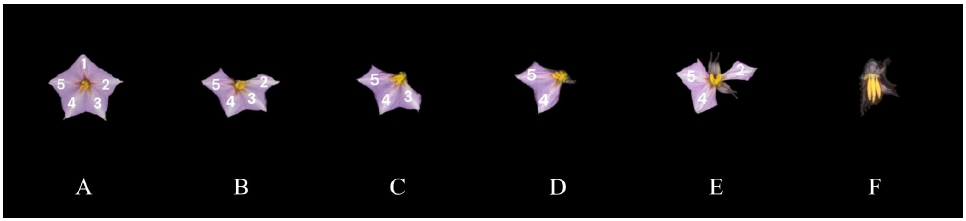
Representative images of graded corolla removals. A; intact corolla (control), B; 1 petal removed on flower, C; 1+2 petals removed on flower, D; 1+2+3 petals removed on flower, E; 1+3 petals removed on flower, F; all petals removed on flower.
This gradient removal design was intended to simulate natural senescence and partial mechanical damage of petals and to quantitatively evaluate the effects of both the degree and spatial pattern of petal loss on fruit development.
2.3. Calyx removal treatment
Calyx removal treatments were conducted under the same cultivation conditions as the corolla removal experiment; however, the two experiments were performed independently to avoid potential interaction effects. The experiment was arranged in a completely randomized design with three replicates per treatment and five plants per replicate.
Calyx removal was performed at 1 day after anthesis (1 DAA) using sterilized fine forceps, with the same precautions to avoid damage to adjacent floral organs as described in section 2.2. To ensure experimental uniformity, only the first flower of the second cluster on each plant was used for treatment.
The treatments consisted of six levels based on the degree and spatial arrangement of calyx removal (Fig. 2): (A) all sepals intact (control), (B) removal of one sepal, (C) removal of two adjacent sepals, (D) removal of three adjacent sepals, (E) removal of two non-adjacent sepals, and (F) complete removal of all sepals.
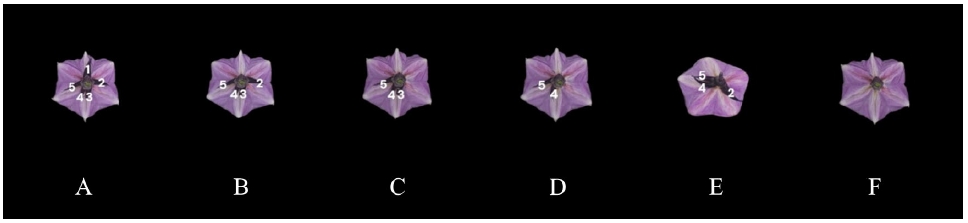
Representative images of graded calyx removals. A; intact calyx (control), B; 1 sepal removed on flower, C; 1+2 sepals removed on flower, D; 1+2+3 sepals removed on flower, E; 1+3 sepals removed on flower, F; all sepals removed on flower.
This gradient removal design was intended to simulate natural senescence and mechanical damage of sepals and to evaluate the effects of both the extent and spatial configuration of sepal loss on the microenvironment surrounding the ovary and subsequent fruit development (Marcelis, 1996).
2.4. Fruit growth and morphological measurements
Fruit growth was monitored non-destructively using tagged fruits on the same plants. Measurements were conducted at 3, 6, 9, 12, and 15 days after anthesis (DAA) to assess temporal patterns of fruit development.
The measured parameters included fruit length (cm), fruit diameter (maximum transverse width, cm), fresh weight (g), and fruit shape index (FSI). Fruit length was measured from the base of the calyx to the fruit apex, and fruit diameter was determined at the widest point of the fruit. Length and diameter were measured using a digital caliper (DC150P, Bluetec, China; precision 0.01 mm), and fresh weight was recorded at harvest using an electronic balance.
The fruit shape index (FSI) was calculated as the ratio of fruit length to fruit diameter (length/width). Fruit set and fruit drop were determined by continuously tracking tagged flowers and fruits. Fruit set was calculated as the proportion of flowers that developed into enlarging fruits within a defined period after treatment, whereas fruit drop was calculated as the proportion of fruits that abscised during the growth period after initial set.
Fruit morphology was classified according to the UPOV(2002) descriptor guidelines for eggplant, including cylindrical, oblong-cylindrical, and clavate types. In addition, fruits were categorized as normal or abnormal based on uniformity, curvature, and irregular enlargement.
2.5. Statistical analysis
All data were analyzed using SAS software (version 9.4; SAS Institute Inc., Cary, NC, USA). Treatment effects at each observation time were evaluated using one-way analysis of variance (ANOVA). When significant differences were detected, mean comparisons were performed using Duncan’s multiple range test (DMRT) at the 5% significance level.
3. Results
3.1. Effects of corolla removal on fruit growth and morphogenesis
Fruit growth responses of eggplant cv. ‘Otoking’ to corolla removal varied depending on developmental stage. During the early stages of fruit development (3-6 DAA), no significant differences in fruit length or diameter were observed among treatments. However, treatment effects became apparent after 9 DAA, with differences in fruit growth progressively increasing thereafter (Table 1; Fig. 3). This pattern suggests that external factors, including microenvironmental modifications induced by petal removal, exert a greater influence during the cell expansion phase rather than during the initial cell division stage.

Development of fruit length and width of ‘Otoking’ eggplant after anthesis as affected by graded corolla removal
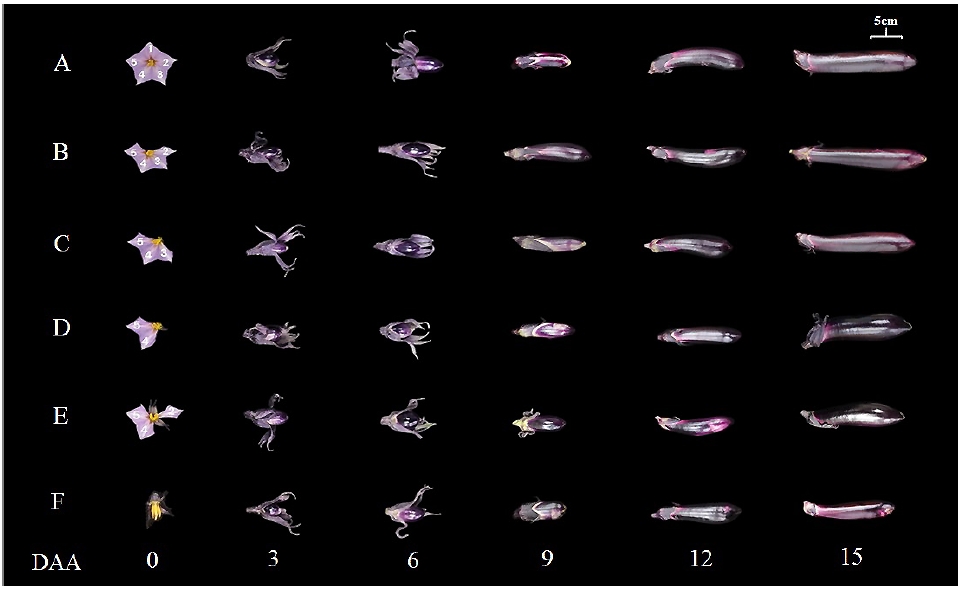
Representative images of eggplant fruits at 3, 6, 9, 12, and 15 days after anthesis following graded corolla removal treatments. A; intact corolla (control), B; 1 petal removed on flower, C; 1+2 petals removed on flower, D; 1+2+3 petals removed on flower, E; 1+3 petals removed on flower, F; all petals removed on flower.
At harvest (15 DAA), fruit length did not differ significantly between the control (A) and the single-petal removal treatment (B), indicating that limited corolla loss has minimal impact on longitudinal fruit growth. In contrast, higher levels of corolla removal and asymmetric removal patterns (C–F) significantly reduced fruit length, with the greatest reduction observed in the complete corolla removal treatment (F). Fruit diameter exhibited a similar trend, with all petal removal treatments showing reduced values compared with the control by 12 DAA.
Fruit fresh weight was the most sensitive parameter to corolla removal (Table 2). Differences among treatments became evident after 9 DAA, and at harvest, fruit weight decreased significantly with increasing levels of petal removal. The lowest fruit weight was observed in the complete removal treatment (F), indicating a strong inhibitory effect on fruit biomass accumulation.
Changes in fruit weight of ‘Otoking’ eggplant after anthesis as affected by graded corolla removal
Although the fruit shape index (FSI) ranged from 4.15 to 4.58 and did not differ significantly among treatments, qualitative variations in fruit morphology were evident (Table 3; Fig. 3). Corolla removal increased the incidence of malformed fruits, including curved and clavate types, with the effect being more pronounced under asymmetric removal treatments. These results suggest that spatial imbalance in the floral structure may lead to uneven microenvironmental conditions around the ovary, thereby affecting uniform cell expansion and fruit shape development.
Fruit shape index and fruit shape characteristics of ‘Otoking’ eggplant at 15 days after anthesis as affected by graded corolla removal
Corolla removal also influenced fruit set and marketable yield (Table 4). Fruit set decreased slightly with increasing levels of petal removal, from 98.0% in the control to 94.2% in the complete removal treatment. Although fruit drop did not differ significantly among treatments, relatively higher values were observed in the complete removal treatment.
Fruit set, fruit drop, and marketable fruit proportion of ‘Otoking’ eggplant as affected by graded corolla removal
In contrast, a clear treatment effect was observed in fruit quality. The proportion of marketable (normal) fruits remained relatively stable (92.8%–94.2%) in the control and partial removal treatments (B–E), but decreased significantly to 88.2% in the complete petal removal treatment (F). Correspondingly, the proportion of abnormal fruits increased, reaching 11.8% in treatment F.
Overall, these results indicate that while partial corolla removal has limited effects on fruit growth and quality, extensive or asymmetric petal loss disrupts the microenvironment surrounding the ovary and leads to reduced fruit growth and increased morphological disorders. This supports the interpretation that corolla contributes to the early fruit development by buffering environmental conditions and maintaining structural symmetry around the developing fruit.
3.2. Effects of calyx removal on fruit growth and morphological development
Calyx removal significantly affected fruit growth from the early developmental stage. A reduction in fruit length was observed as early as 3 DAA in some treatments, and from 12 DAA onward, all treatments except the single-removal treatment showed significantly lower values compared with the control. Fruit diameter also declined markedly after 9 DAA, with the magnitude of reduction increasing as the level of calyx removal intensified (Table 5).
Development of fruit length and width of ‘Otoking’ eggplant after anthesis as affected by graded calyx removal
Fruit fresh weight was the most sensitive parameter to calyx removal, showing a progressive decrease with increasing removal intensity (Table 6). Differences among treatments became apparent from 6 DAA, and significant reductions were observed at 12 DAA and 15 DAA. At final harvest, the control produced the highest fruit weight, whereas increasing levels of sepal removal resulted in a stepwise decline. Notably, complete sepal removal reduced final fruit weight by approximately 38% relative to the control, indicating a substantial inhibitory effect on fruit growth.
Changes in fruit weight of ‘Otoking’ eggplant after anthesis as affected by graded calyx removal
Calyx removal did not significantly affect the fruit shape index (FSI), which remained within a similar range (4.17-4.81) across all treatments (Table 7). This suggests that sepal removal had limited influence on the proportional relationship between longitudinal and radial growth. However, qualitative assessment revealed clear differences in fruit morphology. Control plants produced straight and uniform long cylindrical fruits, whereas calyx removal treatments showed increased incidence of morphological abnormalities, including curvature and club-shaped fruits. These abnormalities were particularly pronounced under asymmetric calyx removal treatments. Thus, while calyx removal had minimal effects on quantitative shape indices, it substantially affected morphological uniformity, a key determinant of market quality.
Fruit shape index and fruit shape characteristics of ‘Otoking’ eggplant at 15 days after anthesis as affected by graded calyx removal
Calyx removal also influenced fruit set, fruit retention, and marketable yield (Table 8). Fruit set remained generally high across treatments but showed significant differences. The control and partial removal treatments (B and C) exhibited similarly high fruit set (96.2-97.8%), whereas higher removal treatments (D-F) showed significantly reduced values (93.2-95.4%).
Fruit set, fruit drop, and marketable fruit proportion of ‘Otoking’ eggplant as affected by graded calyx removal
Fruit drop increased significantly with increasing levels of sepal removal. The control showed the lowest fruit drop (2.2%), whereas higher removal treatments (D-F) exhibited significantly higher rates (4.6-6.8%). The highest fruit drop (6.8%) was observed in the complete removal treatment, indicating that the sepals play a critical role in maintaining fruit retention.
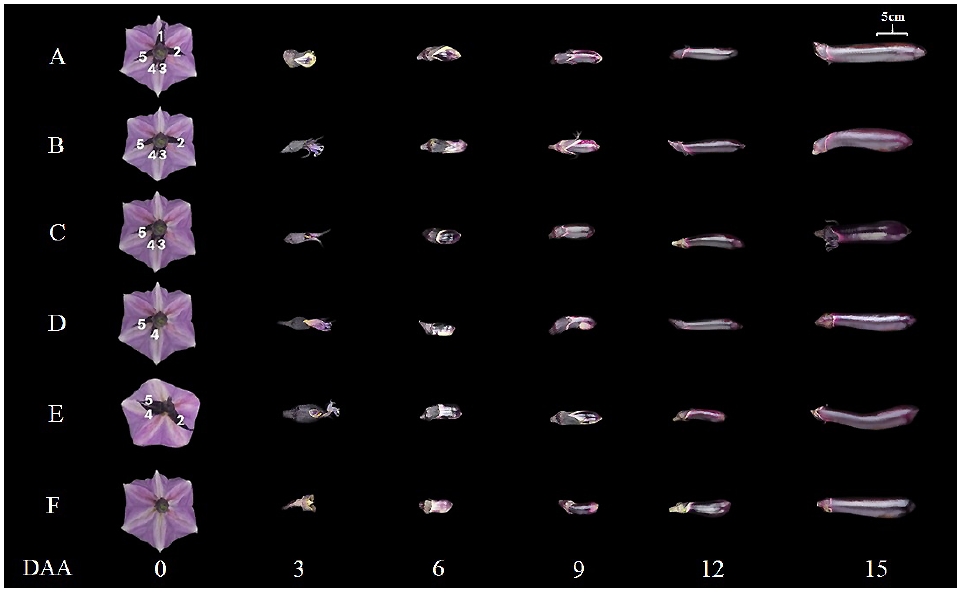
Representative images of eggplant fruits at 3, 6, 9, 12, and 15 days after anthesis following graded calyx removal treatments. A; intact calyx (control), B; 1 sepal removed on flower, C; 1+2 sepals removed on flower, D; 1+2+3 sepals removed on flower, E; 1+3 sepals removed on flower, F; all sepals removed on flower.
The proportion of marketable fruit also differed among treatments. The control and partial removal treatments maintained relatively high proportions of normal fruits (90.7-94.0%) without significant differences. In contrast, complete sepal removal significantly reduced the proportion of marketable fruit to 86.2%. Conversely, the incidence of abnormal fruit increased, reaching 11.8% under complete sepal removal, compared with 6.0-9.3% in other treatments.
Overall, these results indicate that calyx plays a critical role in sustaining fruit growth, enhancing fruit retention, and maintaining morphological uniformity. The observed reductions in fruit size, increased fruit drop, and decreased marketable yield with increasing sepal removal suggest that sepals contribute to stabilizing the microenvironment surrounding developing fruits and may facilitate assimilate allocation during fruit development.
4. Discussion
Flowers are complex reproductive organs composed of structurally and functionally differentiated components, among which the petals and sepal play distinct yet complementary roles (Endress, 1996; Fenster et al., 2004; Schiestl and Johnson, 2013). While the corolla is primarily associated with pollinator attraction through visual and olfactory cues, the calyx functions mainly in protecting reproductive organs during the bud stage. Recent studies, however, suggest that floral organs may extend their functional roles beyond anthesis, contributing to the regulation of early fruit development through physiological and environmental mechanisms (Yuki et al., 2014; Baral et al., 2025; Li et al., 2025).
In the present study, post-anthesis removal of the corolla and calyx in eggplant revealed that both organs contribute to fruit growth and quality formation, although distinct temporal and functional differences. Corolla removal exerted relatively less impact on fruit development; however, increased or asymmetric removal resulted in reductions in fruit length, diameter, and fresh weight, along with increased incidence of malformed fruits such as curvature and club-shaped structures. In contrast, single petal removal did not significantly affect fruit growth, indicating a degree of functional redundancy or compensatory capacity.
These findings suggest that, despite being a transient organ that undergoes rapid senescence after anthesis, the corolla contributes to stabilizing the microenvironment surrounding the ovary during the early stages of fruit development. This likely includes buffering fluctuations in temperature, light, and humidity, which are known to influence early cell division and expansion processes (van Doorn and Kamdee, 2014). In addition, the possibility that the petal contributes to local hormonal regulation, particularly involving auxin-mediated growth signals, cannot be excluded, although further investigation is required to elucidate the underlying mechanisms (Gillaspy et al., 1993). Notably, the increased occurrence of asymmetric fruit growth under uneven corolla removal highlights the importance of spatial uniformity in the floral microenvironment for coordinated cell expansion and morphological stability (Lee et al., 2017).
In contrast, calyx removal resulted in more pronounced and persistent inhibition of fruit growth throughout the entire developmental period. Fruit length, diameter, and weight decreased progressively with increasing levels of sepal removal, with more consistent effects observed at later developmental stages. These results indicate that the sepal plays a sustained and critical role in supporting fruit development. Unlike the corolla, the calyx remains attached to the fruit after anthesis, enclosing the basal region and contributing to the stabilization of the surrounding microenvironment (Fahn, 1990).
One key function of the calyx appears to be the maintenance of fruit water status. Given that cell expansion is highly dependent on tissue hydration (van Doorn and Kamdee, 2014), the removal of the sepal likely increases water loss, thereby restricting fruit enlargement. Furthermore, the calyx, as a chlorophyll-containing non-foliar organ, may contribute to photosynthesis and serve as a temporary source or reservoir of assimilates (Marcelis, 1996; Aschan and Pfanz, 2003). Its removal may therefore limit carbon supply to developing fruits, exacerbating growth inhibition.
Calyx removal also had a marked effect on fruit morphology and market quality. Despite proportional inhibition of longitudinal and radial growth (as reflected in the stable FSI), qualitative abnormalities including curvature, tapering, and uneven growth were significantly increased. These effects were particularly pronounced under asymmetric removal treatments, suggesting that disruption of the microenvironmental uniformity around the developing fruit leads to uneven cell division and expansion. Such morphological instability is a critical determinant of reduced marketable yield, consistent with previous reports linking floral organ damage to fruit quality deterioration (Rylski et al., 1984; Dennis, 2000; Lee et al., 2017).
Both corolla and calyx removal influenced fruit retention. Fruit drop increased with the extent of floral organ removal, particularly under calyx removal indicating that floral organs contribute to post-fertilization fruit stability. The greater increase in fruit drop following calyx removal compared with corolla removal underscores the more substantial role of the calyx in maintaining fruit retention. Differences from previous findings in other crops, such as cherry (Yuki et al., 2014), may reflect species-specific variations in floral structure and physiological regulation.
Collectively, these results demonstrate that the corolla and calyx perform functionally differentiated roles during fruit development. The corolla acts as an initial regulator, contributing to microenvironmental buffering and early developmental stability, whereas the calyx functions as a sustained regulator, providing prolonged protection, maintaining water balance, and supporting assimilate allocation throughout fruit growth. This dual regulatory system is likely essential for ensuring stable fruit development and morphological uniformity.
From an agronomic perspective, these findings highlight the importance of floral organ management in greenhouse eggplant production. Retention of the corolla for a certain period after pollination appears beneficial for early fruit development, whereas preservation of the calyx throughout the fruiting period is critical for maintaining fruit size, reducing fruit drop, and ensuring marketable quality. Minimizing mechanical damage and pest-related injury to the sepal during cultural practices is therefore essential.
In conclusion, this study suggests that, contrary to the conventional view that floral organs become functionally redundant after pollination, both the corolla and calyx may play active and complementary roles in regulating fruit development. However, further studies are needed to confirm these roles and elucidate the underlying mechanisms. Recognizing these potential roles provides a basis for refining cultivation practices and improving fruit quality in controlled environment agriculture systems.
5. Conclusions
This study investigated the effects of post-anthesis removal of corolla and calyx on fruit development in eggplant (Solanum melongena L. cv. ‘Otoking’) and demonstrated that both floral organs play significant functional roles in fruit growth and quality formation.
Corolla removal exerted significant effects depending on the extent and spatial pattern of removal. While single petal removal maintained fruit growth comparable to the control, increased or asymmetric removal resulted in significant reductions in fruit length, diameter, and fresh weight. In contrast, calyx removal induced more pronounced and persistent inhibition of fruit growth throughout the entire developmental period, with fruit size and weight decreasing progressively as the level of removal increased.
In this study, graded removals of corolla and calyx did not significantly affect fruit set, but they increased fruit drop and reduced marketable yield. These findings suggest that corolla contributes to early fruit development by buffering the microenvironment and stabilizing morphological formation, whereas calyx plays a sustained role in protecting developing fruits and maintaining developmental stability throughout the fruiting period.
Collectively, the results indicate that both corolla and calyx may influence fruit growth by affecting the translocation of assimilates, water, and phytohormones to the developing fruit, potentially through their vascular connections via the pedicel. While the corolla appears to play a role in early-stage microenvironmental buffering and morphological stabilization, the calyx acts as a sustained regulator providing prolonged protection and resource allocation support. However, these proposed functions remain hypothetical and require confirmation through additional experiments under varied environmental conditions and direct measurements of vascular transport. This complementary regulatory system is essential for stable fruit development and quality maintenance.
From an agronomic perspective, preservation of calyx is particularly critical, as sepal integrity is directly associated with maintaining fruit size, reducing fruit drop, and ensuring marketable quality. These findings provide a scientific basis for optimizing floral organ management in eggplant cultivation systems.
Acknowledgments
This work was carried out with the support of “Cooperative Research Program for Agriculture Science and Technology Development (Project No. RS-2025-02303116)”, Rural Development Administration, Korea.
REFERENCES
-
Aschan, G., Pfanz, H., 2003, Non-foliar photosynthesis: A Strategy of additional carbon acquisition, Flora, 198, 81–97.
[https://doi.org/10.1078/0367-2530-00080]

-
Baral, R., Vainer, A., Melzer, S., Hause, B., Panda, S., 2025, ‘Bud to fruit’: Hormonal interactions governing early fruit development, J. Exp. Bot., 76(22), 6657–6673.
[https://doi.org/10.1093/jxb/eraf363]
- Buchmann, S. L., 1983, Buzz pollination in angiosperms, in: Jones, C. E., Little, R. J. (eds.), Handbook of experimental pollination biology, Van Nostrand & Reinhold, New York, 73–113.
-
Capua, Y., Shwartz, I., Bar, M., Efroni, I., Israeli, A., Tal, L., Meir, Z., 2019, Multiple auxin-response regulators enable stability and variability in leaf development, Curr. Biol., 29(10), 1746–1759.
[https://doi.org/10.1016/j.cub.2019.04.047]
-
Dennis, F. G., 2000, The history of fruit thinning, Plant Growth Regul., 31, 1–16.
[https://doi.org/10.1023/A:1006330009160]
-
Endress, P. K., 1996, Diversity and evolutionary biology of tropical flowers, Cambridge Univ. Press, Cambridge, UK, 1–27.
[https://doi.org/10.1086/419297]
- Fahn, A., 1990, Plant anatomy, 4th ed., Pergamon Press, Oxford, UK, 1–588.
-
Fenster, C. B., Armbruster, W. S., Wilson, P., Dudash, M. R., Thomson, J. D., 2004, Pollination syndromes and floral specialization, Annu. Rev. Ecol. Evol. Syst., 35, 375–403.
[https://doi.org/10.1146/annurev.ecolsys.34.011802.132347]
-
Gao, Y., Wang, C., Song, B., Du, F., 2019, Corolla retention after pollination facilitates the development of fertilized ovules in Fritillaria delavayi (Liliaceae), Sci. Rep., 9(1), 729.
[https://doi.org/10.1038/s41598-018-37358-0]
-
Gillaspy, G., Ben-david, H., Gruissem, W., 1993, Fruits: A Developmental perspective, Plant Cell, 5(10), 1439–1451.
[https://doi.org/10.2307/3869794]
- Kowalska, G., 2008, Flowering biology of eggplant and procedures intensifying fruit-set, Acta Sci. Pol. Hortorum Cultus, 7(2), 63–76.
-
Lee, G. B., Choe, Y. U., Park, E. J., Park, Y. H., Choi, Y. W., Kang, N. J., Kang, J. S., 2017, Effect of removing corolla and calyx lobes on fruit shape and quality of strawberry, J. Environ. Sci. Int., 26(1), 87–96.
[https://doi.org/10.5322/JESI.2017.26.1.87]
-
Li, X., He, B., Djari, A., Frasse, P., Maza, E., Regad, F., Pirrello, J., Hu, G., Bouzayen, M., 2025, Transcriptomic reprogramming and epigenetic regulation underlying pollination-dependent and auxin-induced fruit set in tomato, Front. Plant Sci., 16, 1495494.
[https://doi.org/10.3389/fpls.2025.1495494]
-
Lyu, J., Jin, L., Ma, X., Li, Y., Sun, M., Jin, N., Wang, S., Hu, L., Yu, J., 2025, Agronomic and quality traits of 30 eggplant germplasm resources from China, Plants (Basel), 14(12), 1838.
[https://doi.org/10.3390/plants14121838]
-
Marcelis, L. F. M., 1996, Sink strength as a determinant of dry matter partitioning in the whole plants, J. Exp. Bot., 47(Special Issue), 1281–1291.
[https://doi.org/10.1093/jxb/47.Special_Issue.1281]
-
Rylski, I., Nothmann, J., Arcan, L., 1984, Differential fertility in short styled eggplant flowers, Sci. Hortic., 22(1-2), 39–46.
[https://doi.org/10.1016/0304-4238(84)90081-5]
-
Schiestl, F. P., Johnson, S. D., 2013, Pollinator-mediated evolution of floral signals, Trends Ecol. Evol., 28(5), 307–315.
[https://doi.org/10.1016/j.tree.2013.01.019]
-
Sekara, A., Bieniasz, M., 2008, Pollination, fertilization and fruit formation in eggplant (Solanum melongena L.), Acta Agrobotanica, 61(1), 107–113.
[https://doi.org/10.5586/aa.2008.014]
-
Srivastava, A., Handa, A. K., 2005, Hormonal regulation of fruit development: A Molecular perspective, J. Plant Growth Regul., 24(2), 67–82.
[https://doi.org/10.1007/s00344-005-0015-0]
- UPOV (International Union for the Protection of New Varieties of Plants), 2002, Guidelines for the conduct of tests for distinctness, uniformity and stability of eggplant (Solanum melongena L.), TG/117/4, Geneva, Switzerland.
-
van Doorn, W. G., Kamdee, P., 2014, Flower opening and closure: An Update, J. Exp. Bot., 65(20), 5749–5762.
[https://doi.org/10.1093/jxb/eru327]
-
Yuki, M., Matsumoto, D., Ikeda, K., Taira, S., 2014, Effects of wound treatments to flower organs on fruit set, development, and quality in sweet cherry (Prunus avium L.), Adv. Hortic. Sci., 28(4), 231–235.
[https://doi.org/10.36253/ahsc-18463]
Department of Horticultural Bioscience, Pusan National Universitykangjs@pusan.ac.kr
Department of Horticultural Bioscience, Pusan National Universitywittyguy010@naver.com
Department of Horticultural Bioscience, Pusan National Universitymdfaraazbio1803@gmail.com
Department of Horticultural Bioscience, Pusan National Universitytkdflajaid@naver.com
Department of Horticultural Bioscience, Pusan National Universitydlwlrn15@naver.com
Department of Horticultural Bioscience, Pusan National Universitymcchryl@gmail.com