갈색거저리 유충 2령과 4령의 스타이로폼 분해능력과 생존율 비교 연구
Ⓒ The Korean Environmental Sciences Society. All rights reserved.
This is an Open-Access article distributed under the terms of the Creative Commons Attribution Non-Commercial License (http://creativecommons.org/licenses/by-nc/3.0) which permits unrestricted non-commercial use, distribution, and reproduction in any medium, provided the original work is properly cited.
Abstract
In this study, we conducted a comparative analysis of the Styrofoam biodegradation capacities and survival of Tenebrio molitor (TM) larvae at the 2nd and 4th instar stages. The experimental setup was designed as follows, with each treatment being replicated three times: TM larvae (2nd instar) = 1 g of Styrofoam + 1.2 g of 2nd instar TM larvae (n=50); TM larvae (4th instar) = 1 g of Styrofoam + 1.2 g of 4th instar TM larvae (n=42). The findings revealed that compared to 4th instar TM larvae, those at 2nd instar stage were relatively more efficient in biodegrading Styrofoam. Although the average weight of 4th instar TM larvae was consistently higher than that of the 2nd instar larvae, the larvae at both stages of growth underwent gradual decline in weight as the consumption of Styrofoam progressed. However, the weight differential was notably more pronounced in the 2nd instar larvae, thereby indicating a stronger influence of Styrofoam ingestion on their weight dynamics. In addition, throughout the study period, we observed no larval mortalities in either of the two experimental groups. In summary, compared with the 4th instar larvae, those at the 2nd instar stage had a superior capacities to biodegrade Styrofoam and underwent more substantial change in weight. These findings thus indicate that comparatively, over short-term periods, 2nd instar larvae may be more effective in addressing environmental challenges relating to the management of plastic wastes.
Keywords:
Styrofoam biodegradation ability, Survival rate, Tenebrio molitor larvae, Weight, Weight difference1. 서 론
스타이로폼(styrofoam)은 단열재와 일회용 식품 포장재로 널리 사용되는 폴리스티렌(polystyrene)의 대표적인 형태로, 바람에 쉽게 날아가거나 물 위에 떠다니며 하천과 해양 생태계를 오염시키는 주요 원인으로 알려져 있다(Kwon et al., 2014; Matyja et al., 2020). 특히 스타이로폼의 대량 생산과 낮은 재활용률은 자연 환경에 지속적인 축적으로 말미암아 동물과 인간의 건강에 심각한 위협을 초래하고 있다는 점에서 간과할 수 없다(Lou et al., 2020). 현재 스타이로폼 폐기물을 처리하기 위한 재활용 방법으로 기계적, 화학적, 열적 접근 방식 등 다양한 방법이 있지만(Maharana et al., 2007), 고 비용 처리문제와 탄소중립에 역행하는 등의 문제점을 가지고 있다. 이러한 한계를 극복하기 위한 대안으로 곤충을 활용한 연구가 주목받고 있다. 이는 환경적으로 지속 가능하며 경제적 측면에서도 매우 타당성이 높은 처리방법으로 간주된다. 선행연구로 갈색거저리(Tenebrio molitor, TM), 아메리카왕거저리(Zophobas morio), 벌집나방(Galleria mellonella) 등 일부 곤충이 폴리스티렌 분해에 효과적이라는 보고가 있었다(Yang et al., 2015a, b; Choi et al., 2020; Lou et al., 2020). 일반적으로 곤충들 중에서 밀웜(mealworm)으로 알려진 갈색거저리 유충은 자연에서 낙엽수의 부패한 나무껍질에 서식하며, 곡물 저장창고, 가금류 농장 등에서 발견되기도 한다(Matyja et al., 2020). 이 유충은 주로 곡류 부산물 또는 죽은 동물들을 먹이로 삼는 경우도 있다(Matyja et al., 2020). 또한 이 곤충의 유충을 활용한 연구에서 중요한 점은 유충 3~4령이 섭취하는 스타이로폼 탄소의 약 47.7%가 이산화탄소(CO2)로 전환되고, 49.2%는 배설물 그리고 극히 소량인 약 0.5%만이 생체 조직에 흡수된다고 하였다(Yang et al., 2015a). 따라서 갈색거저리 유충은 스타이로폼 분해를 위한 적절한 방법으로 간주할 수 있음을 시사한다. 그러나 스타이로폼 분해 능력이 최적화되는 유충의 성장 단계 별 분해 능력을 평가한 기초 연구는 거의 없다.
본 연구는 갈색거저리 유충 2령과 4령의 스타이로폼 분해 능력과 생존율을 비교 연구하였다.
2. 재료 및 방법
공시 곤충은 갈색거저리의 2령과 4령 유충이며 울주군 언양에 위치한 ㈜Modnilove에서 구입하여 중부대학교 동물사양학 실험실에서 연구를 진행하였다. 갈색거저리 유충은 온도 23±1℃, 상대습도 50±5%, 광주기 14D:10L 조건에서 사육되었으며, 이러한 환경은 10일 동안 일정하게 유지되었다. 사육 용기는 투명 직사각형 형태로 크기는 15 cm × 8 cm × 10 cm이다. 뚜껑에는 유충의 호흡이 가능하도록 지름 0.3 cm의 구멍을 뚫어 주고, 여기에 스타이로폼을 5 cm3 크기로 잘라 6조각으로 1 g을 넣어 주었다. 사양 실험 설계는 다음과 같으며, 각 처리 조건은 3반복으로 수행하였다.
갈색거저리 유충의 2령 및 4령 상태에서 스타이로폼 분해 능력(g)과 유충 무게(g) 변화는 각각의 처리군에 대해 2일 간격으로 전자저울을 사용하여 측정하였다. 측정은 실험 시작 시점(0일)의 무게와 2일 후, 또는 4일 후의 무게 차이를 계산하는 방식으로 진행하였다. 또한, 2령 및 4령의 갈색거저리 유충 생존율(%)은 실험 시작 시 유충의 마리 수와 종료 시 생존한 유충의 마리 수를 비교해 백분율로 계산하였다. 통계 분석은 SAS (Version 9.4) 프로그램을 이용하여 T-검정을 수행함으로써 스티로폼 분해 능력과 유충 무게의 처리 군 간 평균 차이에 대한 통계적 유의성을 평가하였다. 분석의 유의 수준은 5%에서 검정하였다. 모든 자료 중 스타이로폼 분해능력과 곤충 무게는 각 처리구 별로 평균에 대한 표준오차로 나타내었지만 곤충 무게차이와 생존율에서는 제시하지 않았다.
3. 결과 및 고찰
갈색거저리 2령과 4령 유충의 스타이로폼 분해 능력을 비교한 결과는 Fig. 1에 제시하였다. 실험 결과에 대한 통계적 유의성은 2일, 6일, 8일 그리고 10일에서 관찰되었다(p<0.05). 두 처리구 간 비교에서 갈색거저리 2령 유충이 상대적으로 더 높은 스타이로폼 분해 능력을 보였다는 점이 주목할 만하다. 이와 관련 선행연구에서 Behzad et al.(2022)은 갈색거저리 총 1,200마리를 대상으로 다양한 온도와 습도 조건에서 실험을 수행하였다. 이 연구에서 습도의 조건을 70%로 설정하고 온도를 각각 25°C 및 30°C에서 배양한 결과, 스타이로폼이 각각 12.22 g과 15.72 g 분해된 것으로 보고하였다. 더 나아가, 습도를 80%로 증가시키고 동일한 온도 환경(25°C 및 30°C) 하에서 배양했을 때, 스타이로폼은 각각 16.38 g과 17.18 g이 분해되는 결과를 관찰하였다. 이러한 결과는 갈색거저리가 상대적으로 높은 온도(30°C)와 습도(80%) 환경에서 스타이로폼 분해 능력이 극대화됨을 시사한다(Behzad et al., 2022). Yang et al.(2018)은 영양분이 있는 옥수수를 먹이로 공급하였을 때, 갈색거저리의 성장은 25~28℃에서 최적이고 30℃ 이상에서는 성장이 어렵다고 보고된 바 있다. 더 나아가 Johnsen et al.(2021)은 70~85%의 상대습도에서도 갈색거저리의의 성장이 관찰된다고 하였다. 그러나 본 연구의 경우, 갈색거저리 유충 사육 조건이 위 선행연구와 다르게 온도 및 습도를 통제 변인으로 진행되었기 때문에 스타이로폼 분해 능력은 이들 환경 요인의 영향을 크게 받지 않았다고 판단된다. 따라서 본 연구에서 관찰된 갈색거저리 2령 유충의 높은 분해능력은 생물학적 요인만을 고려하였다. 즉 유충 개체수 차이와 더불어 2령 유충이 4령 유충보다 더 활발하게 먹이로서 스타이로폼을 섭취하려는 행동 특성에서 기인한 것으로 해석될 수 있다.
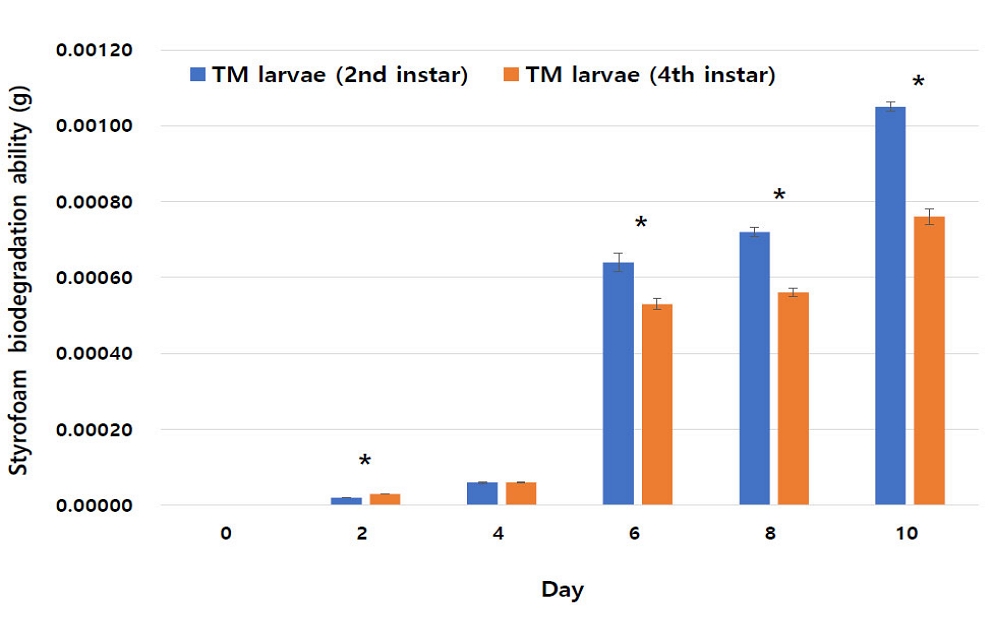
Biodegradation capacities of Styrofoam by 2nd and 4th instar Tenebrio molitor (TM) larvae. *Marks indicate statistically significant differences (p<0.05). Data are presented as the mean ± standard error of the mean (SEM). The treatments were as follows: TM larvae (2nd instar) = 1 g of Styrofoam + 1.2 g of 2nd instar TM larvae (n=50); TM larvae (4th instar) = 1 g of Styrofoam + 1.2 g of 4th instar TM larvae (n=42).
Table 1은 갈색거저리 2령과 4령 유충의 무게, 무게 차이, 생존율에 대한 실험 결과를 요약하였다. 분석 결과 무게 차이에서 통계적으로 유의미한 차이가 확인되었다(p<0.05). 특히 갈색거저리 2령 유충에서 더 큰 무게 차이가 관찰되었다. 이 결과는 스타이로폼 섭취에 따라 두 유충 간 무게 변화의 차이가 나타났음을 보여주며, 스타이로폼 분해 능력이 유충의 체중 변화에 영향을 미친다는 점을 명확히 드러낸 것이다. 추가적으로 갈색거저리 4령 유충의 평균 무게는 2령 유충보다 더 컸으며, 두 유충 모두 시간이 지남에 따라 스타이로폼 섭취로 인해 체중이 감소하는 경향을 보였다. 이는 스타이로폼 섭취과정에서 발생할 수 있는 자연스러운 결과로 판단된다. 또한, 두 처리구 모두 100%의 생존율을 기록하며 실험기간 동안 단 한 마리도 폐사하지 않아 높은 생존율을 유지한 결과를 나타냈다. 특히 갈색거저리 유충의 스타이로폼 분해 능력과 생존율이 지속적으로 유지되는지를 명확히 파악하기 위해서는 이들이 번데기로 변태할 때까지 장기간에 걸친 관찰과 연구가 요구된다.

Analysis of the weight, weight difference, and survival of 2nd and 4th instar Tenebrio molitor (TM) larvae reared on Styrofoam during the experimental period
4. 결 론
본 연구는 갈색거저리 유충의 2령과 4령 단계에서 스타이로폼 분해 능력 및 생존율을 비교 분석하였다. 결과적으로, 갈색거저리 2령 유충은 4령 유충에 비해 상대적으로 높은 스타이로폼 분해 능력을 보였다. 갈색거저리 4령 유충의 평균 무게는 2령 유충보다 더 무거웠지만, 두 유충 모두 스타이로폼 섭취가 진행됨에 따라 무게가 점차 감소하는 경향이 관찰되었다. 특히 무게 차이는 갈색거저리 2령 유충에서 더 크게 나타났으며, 이는 스타이로폼 섭취가 각 유충의 무게 변화에 미치는 영향을 시사한다. 또한, 실험기간 동안 두 처리구 모두 100%의 생존율을 유지하였다. 향후 갈색거저리 유충의 스타이로폼 분해 능력과 생존율을 안정적으로 유지되는지를 명확히 확인하기 위해서는 보다 지속적이고 장기적인 관찰과 추가 연구가 필요할 것으로 판단된다.
REFERENCES
-
Behzad, M., Kim, M. J., Kim, I. W., Park, S. E., Lee, T. J., 2022, Polystyrene (PS) degradation by Tenebrio molitor larvae, J. Korean Soc. Environ. Eng., 44, 249-257.
[https://doi.org/10.4491/KSEE.2022.44.8.249]

-
Choi, I. H., Lee J. H., Chung, T. H., 2020, Polystyrene biodegradation using Zophobas morio, J. Ent. Res., 44, 475-478.
[https://doi.org/10.5958/0974-4576.2020.00079.1]
-
Johnsen, N. S., Andersen, J. L., Offenberg, J., 2021, The effect of relative humidity on the survival and growth rate of the yellow mealworm larvae (Tenebrio molitor, Linnaeus 1758), J. Insects Food Feed, 7, 311-318.
[https://doi.org/10.3920/JIFF2020.0068]
-
Kwon, G. B., Saido, K., Koizumi, K., Sato, H., Ogawa, N., Chung, S. Y., Kusui, T., Kodera, Y., Kogure, K., 2014, Regional distribution of styrene analogues generated from polystyrene degradation along the coastlines of the North-East Pacific Ocean and Hawaii, Environ. Pollut., 188, 45-49.
[https://doi.org/10.1016/j.envpol.2014.01.019]
-
Lou, Y., Ekaterina, P., Yang, S. S., Lu, B., Liu, B., Ren, N., Corvini, P. F. X., Xing, D., 2020, Biodegradation of polyethylene and polystyrene by greater wax moth larvae (Galleria mellonella L.) and the effect of co-diet supplementation on the core gut microbiome, Environ. Sci. Technol., 54, 2821-2831.
[https://doi.org/10.1021/acs.est.9b07044]
-
Maharana, T., Negi, Y. S., Mohanty, B., 2007, Review article: Recycling of polystyrene, Polym. Plast. Technol. Eng., 46, 729-736.
[https://doi.org/10.1080/03602550701273963]
-
Matyja, K., Rybak, J., Hanus-Lorenz, B., Wrobel, M., Rutkowski, R., 2020, Effects of polystyrene diet on Tenebrio molitor larval growth, development and survival: dynamic energy budget (DEB) model analysis, Environ. Pollut., 264, 114740.
[https://doi.org/10.1016/j.envpol.2020.114740]
-
Yang, Y., Yang, J., Wu, W. M., Zhao, J., Song, Y., Gao, L., Yang, R., Jiang, L., 2015a, Biodegradation and mineralization of polystyrene by plastic-eating meal worms: Part 1. Chemical and physical characterization and isotopic tests, Environ. Sci. Technol., 49, 12080-12086.
[https://doi.org/10.1021/acs.est.5b02661]
-
Yang, Y., Yang, J., Wu, W. M., Zhao, J., Song, Y., Gao, L., Yang, R., Jiang, L., 2015b, Biodegradation and mineralization of polystyrene by plastic-eating meal worms: Part 2. Role of gut microorganisms, Environ. Sci. Technol., 49, 12087-12093.
[https://doi.org/10.1021/acs.est.5b02663]
-
Yang, S. S., Wu, W. M., Brandon, A. M., Fan, H. Q., Receveur, J. P., Li, Y., Wang, Z. Y., Fan, R., McClellan, R. L., Gao, S. H., 2018, Ubiquity of polystyrene digestion and biodegradation within yellow mealworms, larvae of Tenebrio molitor Linnaeus (Coleoptera: Tenebrionidae), Chemosphere, 212, 262-271.
[https://doi.org/10.1016/j.chemosphere.2018.08.078]
Division of Pet & Companion Animal Science, Joongbu Universityanimalscience@naver.com