
성장 단계별 갈색거저리 유충을 돈분에 첨가시 조회분과 조지방 함량 변화에 대한 조사
Ⓒ The Korean Environmental Sciences Society. All rights reserved.
This is an Open-Access article distributed under the terms of the Creative Commons Attribution Non-Commercial License (http://creativecommons.org/licenses/by-nc/3.0) which permits unrestricted non-commercial use, distribution, and reproduction in any medium, provided the original work is properly cited.
Abstract
This study evaluated changes in crude ash and crude fat content in pig manure during the rearing period of Tenebrio molitor (TM) larvae by incorporating the larvae at different growth stages. The treatments were categorized into three groups: T1) 2000 g of pig manure plus 500 g of 3th- instar TM larvae, T2) 2000 g of pig manure plus 500 g of 4th-instar TM larvae, and T3) 2000 g of pig manure plus 500 g of 5th-instar TM larvae. In terms of crude ash content, significant differences among the treatment groups were observed only at days 0 and 15 (p<0.05), and all treatment groups exhibited an increasing trend over time. Among the treatment groups, the 4th-instar larvae showed the highest crude ash content, whereas the 3th-instar larvae had the lowest. Changes in the crude fat content were influenced by all treatment groups, except for the analysis conducted on day 30 (p<0.05). The crude fat content increased in the order of 3th-instar < 4th-instar < 5th-instar. These differences may be attributed to variations in the decomposition capability of TM larvae at each developmental stage. In conclusion, considering the importance of crude ash content as a nutrient in the composting process of pig manure, the application of 4th-instar TM larvae was deemed the most effective.
Keywords:
Composting, Crude ash, Crude fat, Tenebrio molitor larvae, Pig manure1. 서 론
2020년 기준 식용이 가능한 곤충은 갈색거저리(Tenebrio molitor, TM)를 포함해 총 9종으로 보고되고 있다(Kim et al., 2021). 갈색거저리는 과거 농업 해충으로 알려졌으나, 현재는 단백질 함량이 높아 고단백 식품 소재로서 뿐만 아니라 높은 항산화 활성도를 가지는 것으로 확인되었다(Park et al., 2018). 특히 이 곤충은 높은 산란율 덕분에 개체 수를 빠르게 증식시킬 수 있어, 대규모 사육 및 산업화에 손쉽게 적용할 수 있는 이점이 있다(Lee et al., 2021). 예를 들어 갈색거저리는 딱정벌레목 거저리과에 속하며 알, 유충, 번데기, 성충의 단계를 거치는 완전 변태 곤충에 속한다(Ku, 2022; Yang et al., 2022; Zhong et al., 2023). 이 곤충의 생활사 중 특히 중요한 단계는 유충기이며, 유충 기간 동안 사육 기간이 가장 길고, 먹이를 섭취하면서 탈피를 위한 에너지를 저장한다는 특징이 있다(Ku, 2022; Yang et al., 2022; Zhong et al., 2023). 그러나 성충의 경우, 수분 부족 시 동족 개체 또는 번데기를 먹는 경향이 있다는 단점이 지적되었다(Bulak et al., 2021). 따라서 갈색거저리 산업에서 대량 사육 측면에서는 성충보다 어린 유충을 활용하는 것이 더 유리할 것으로 보인다. 최근 연구에 의하면, 갈색거저리 유충의 환경정화 곤충으로서 산란 계분에 첨가 시 분해능력 즉 환경 제어 능력이 있어 곤충농가에 중요한 정보를 제공할 수 있다고 확인되었다(Chung, 2025). 환경정화를 목적으로 활용되는 곤충 중 하나인 동애등에(Hermetia illucens L.; BSF)는 축사 야적장에서 발생하는 축분이나 음식물 쓰레기와 같은 유기성 폐기물 속에서 서식한다. 이러한 유충의 생태적 특성을 바탕으로 친환경적 자원 재활용 분야에서 널리 활용되고 있다(Sheppard and Newton, 2000; Shepperd et al., 2002). 그러나 갈색거저리 유충의 경우, 축분과의 상호작용 사례가 상대적으로 부족하고 이를 기반으로 한 다양한 연구의 필요성이 제기되고 있다. 본 연구에서는 성장 단계에 따라 갈색거저리 유충을 돈분에 첨가한 후, 사양 기간 동안 수집된 돈분의 조회분과 조지방 함량 변화를 조사하는데 초점을 두었다. 또한 돈분의 퇴비화 과정을 위해 가장 효과적인 유충 투입 시기를 판단할 수 있는 준거를 제공할 수 있다.
2. 재료 및 방법
갈색거저리 유충(3령, 4령 그리고 5령)은 ㈜Modnilove (Ulju, Korea)로부터 구입하였고 돈분은 경북 영주에 위치한 양돈농장으로부터 공급받아 30일 동안 곤충사양시험에 이용하였다. 갈색저저리 유충은 원형 모양의 투명플라스틱 용기(1 L)에서 사육되었고 원형 뚜껑에는 양쪽 방향으로 두 곳을 정하여 5 mm 구멍을 뚫어 신선한 공기를 원활하게 통하도록 호흡 및 사육환경조건을 만들어 주었다(Table 1).

Tenebrio molitor (TM) larvae rearing conditions
곤충사양시험을 위한 갈색거저리 유충 처리구는 3처리구, 처리구당 3반복으로 난괴법으로 설계되었다. 처리구 비율은 돈분 2000 g 기준으로 갈색거저리 3령(T1), 4령(T2) 및 5령(T3) 500 g을 각각 첨가하였다. 조회분(crude ash; CA)과 조지방(crude fat; CF) 분석을 위한 샘플은 5일마다 라텍스 글로버를 이용하여 샘플이 골고루 섞이도록 해서 약 50 g을 수집하였다. 샘플은 즉시 지퍼백에 넣어 분석시까지 냉장보관 하였다. 조회분 분석은 샘플을 회화로 550℃에서 태워 남은 부분을 무게 차이로 평가하였다(AOAC, 1990). 조지방은 샘플의 지방성분을 유기용매로 추출하고, 속실렛(Soxhlet)을 이용하여 분석하였다(AOAC, 1990). 분석은 3반복으로 측정하였다. 통계자료는 분산분석을 위해 SAS program (Version 9.4)을 이용하였고 평균간 유의성은 95% 신뢰수준에서 Duncan’s Multiple Range Test로 검정을 실시하였다.
3. 결과 및 고찰
성장 단계에 따른 갈색거저리 유충을 돈분에 처리했을 때 조회분 함량의 변화는 Fig. 1에서 제시하였다. 통계적으로 유의미한 차이는 0일과 15일에서만 처리구 간 차이가 있는 것으로 나타났다(p<0.05). 조회분 함량은 시간 경과에 따라 모든 처리구에서 증가하는 경향을 보였다. 처리구별 조회분 함량의 변화를 살펴보면, 갈색거저리 유충 4령(T2) 처리구가 가장 높은 수치를 보였으며, 그 다음은 갈색거저리 유충 5령(T3)과 3령(T1) 처리구 순이었다. 이 결과는 돈분을 분해하는 과정동안 성장 단계별 갈색거저리 유층이 성장을 위한 조회분이 영양성분으로서 선택성의 결과로 해석할 수 있다. 즉 조회분 함량이 낮고 높다는 점은 무기물이 적거나 많다는 것을 의미하지만, 돈분을 분해하는 과정에서 갈색거저리 유충의 분해 능력 차이에 의해 함량이 달라질 수 있음을 시사한다. 한 예로 Jang and Choi(2024)의 연구에서는 갈색거저리와 굼벵이 유충 3령을 돈분에 처리했을 경우 초기인 0일과 5일에 조회분 함량이 갈색거저리 유충 처리구에서 더 높게 나타났으나, 이후에는 굼벵이 유충 처리구와 비슷한 수준으로 관측되었다고 보고된 바 있다. 본 연구와의 차이점은 성장 단계별로 구분된 갈색거저리 유충과 돈분의 다른 처리비율을 적용했다는 점에서 찾을 수 있다.
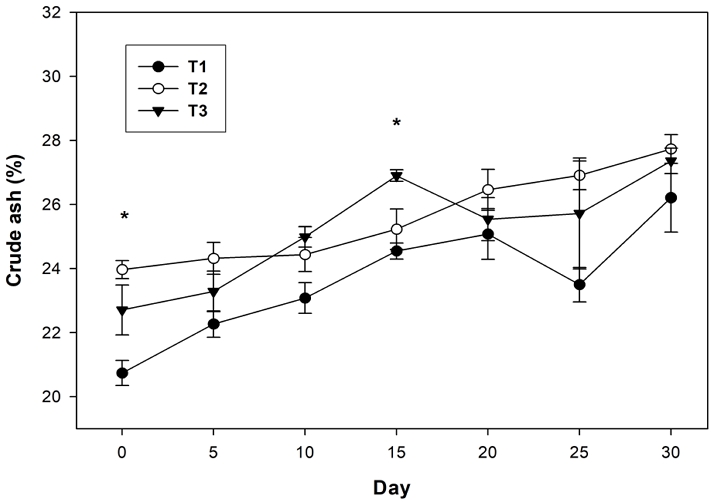
Change in crude ash contents of pig manure treated with Tenebrio molitor larvae at different growth stage. *Values show a statistically significant difference when p<0.05. Treatments indicate: T1 = 2000 g of pig manure plus 500 g of 3th-instar TM larvae, T2 = 2000 g of pig manure plus 500 g of 4th-instar TM larvae. T3 = 2000 g of pig manure plus 500 g of 5th-instar TM larvae.
Fig. 2는 갈색거저리 유충을 성장 단계별 돈분에 처리시 조지방 함량의 변화를 나타내었다. 30일에서 분석된 결과를 제외하고 모든 처리구는 0일에서 25일까지 조지방 함량에 영향을 주는 것으로 관측되었다(p<0.05). 분석된 조지방 함량 변화는 갈색거저리 유충 3령(T1) < 4령(T2) < 5령(T3) 순으로 높았다. 이 결과는 앞에서 언급한 조회분 함량과 마찬가지로 갈색거저리 유충의 분해 능력 차이에 의해 설명될 수 있다(Jang and Choi, 2024). 또한 돈분에 갈색거저리 유충을 첨가하는 것은 퇴비화 과정의 일부분으로 조지방 함량 역시 유기물이 분해되는 것이기 때문에 퇴비의 가치는 비료공정규정에 따라 유기물 함량으로 평가하는 것으로 알려져 있다(RDA, 2010). 우리나라 퇴비의 축종별 성분함량 실태 평가 중 유기물 함량을 조사한 결과는 계분 39.1%, 돈분 40.7% 및 우분 39.6%로 차이가 없는 것으로 보고되고 있다(Nam et al., 2010). 하지만 현재까지 조지방 함량을 기준으로 하는 퇴비와 곤충 관련 자료는 거의 없는 실정이다.
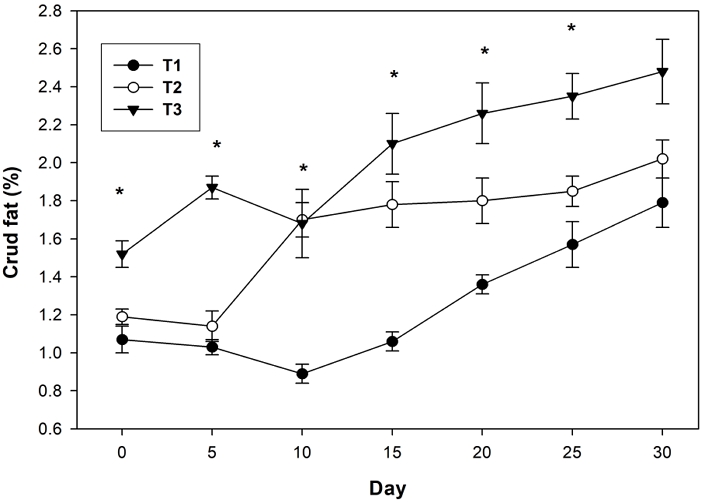
Change in crude fat contents of pig manure treated with Tenebrio molitor larvae at different growth stage. *Values show a statistically significant difference when p<0.05. Treatments indicate: T1 = 2000 g of pig manure plus 500 g of 3th instar TM larvae, T2 = 2000 g of pig manure plus 500 g of 4th instar TM larvae. T3 = 2000 g of pig manure plus 500 g of 5th instar TM larvae.
4. 결 론
본 연구는 성장 단계별 갈색거저리 유충을 돈분에 첨가하여 곤충사양기간동안 돈분에서 조회분과 조지방 함량 변화를 평가하였다. 조회분 함량의 경우, 0일과 15일에서만 처리구 간 차이가 있는 것으로 나타났으며(p<0.05), 시간이 경과에 따라 모든 처리구에서 증가하는 경향을 보였다. 처리구별로 갈색거저리 유충 4령(T2) 처리구가 가장 높은 수치를 보였으며, 갈색거저리 3령(T1) 처리구가 가장 낮았다. 조지방 함량은 30일에서 분석된 결과를 제외하고 모든 처리구에 영향을 주는 것으로 관측되었다(p<0.05). 분석된 조지방 함량 변화는 갈색거저리 유충 3령(T1) < 4령(T2) < 5령(T3) 순으로 높게 관측되었다. 이는 조회분과 조지방 함량이 갈색거저리 유충의 분해 능력 차이에 의해 설명될 수 있음을 알 수 있다. 결과적으로 돈분의 퇴비화 과정을 위한 영양소 중 조회분 함량이 중요하다. 따라서 갈색거저리 4령을 돈분에 처리하는 것이 가장 효과적인 것으로 판단된다.
REFERENCES
- AOAC, 1990, Official methods of analysis of the association of official analytical chemists, 15th ed., Association of Official Analytical Chemists, Washington D.C,, USA.
-
Bulak, P., Proc, K., Pytlak, A., Puszka, A., Gawdzik, B., Bieganowski, A., 2021, Biodegradation of different types of plastics by Tenebrio molitor insect, Polymers., 13, 3508.
[https://doi.org/10.3390/polym13203508]

-
Chung, T. H., 2025, Evaluation of environmental control ability of Tenebrio molitor larvae on laying hens' manure, J. Environ. Sci. Int., 34, 249-252.
[https://doi.org/10.5322/JESI.2025.34.4.249]
-
Jang, W. W., Choi, I. H., 2024, Effect of treating environmental purification insect larvae to pig manure on crude ash content and ammonia production, J. Environ. Sci Int., 33, 187-191.
[https://doi.org/10.5322/JESI.2024.33.2.187]
-
Kim, S. Y., Kwak, K. W., Kang, G., Oh, Y. S., Yoon, H. J., Kim, Y. S., Park, K. H., Kim, E. S., Ki, S. D., 2021, In Vivo toxicity study of freeze-died skimmed powder of Zophobas atratus Larvae (frpfdZAL), a novel food source, J. Korean Soc. Food Sci. Nutr., 50, 437-441.
[https://doi.org/10.3746/jkfn.2021.50.5.437]
- Ku, B. J., 2022, Fine structural study on the microplastic biodegradation in the digestive tract of the mealworm, Tenebrio molitor, Master D. Dissertation, Dankook University, Yongin, South Korea.
-
Lee, H. S., Kim, W. Y., Yang, J. E., Park, S. H., Jhee, O. H., Ly, S. Y., 2021, Quality and characteristics of the yanggaeng made with mealworm powder, Korean J. Hum. Ecol., 30, 169-179.
[https://doi.org/10.5934/kjhe.2021.30.1.169]
- Nam, Y., Yong, S. H., Song, K. K., 2010, Evaluating quality of fertilizer manufactured (livestock manure compost) with different sources in Korea, Korean J. Soil Sci. Fert., 43, 644-649.
-
Park, K. H., Kim, G. Y., 2018, Quality and characteristics of manufacturing sunsik with edible insect (Mealworm), Culi. Sci. & Hos. Res., 24, 13-23.
[https://doi.org/10.20878/cshr.2018.24.1.002]
- RDA, 2010, Fertilizer regulations, Rural Development Administration, Suwon, Korea.
-
Sheppard, D. C., Tomberlin, J. K., Joyce, J. A., Kiser, B. C., Sumner, S. M., 2002, Rearing methods for the black soldier fly (Diptera: Stratiomyidae), J. Med. Entomol., 39, 695-698.
[https://doi.org/10.1603/0022-2585-39.4.695]
- Sheppard, D. C., Newton, G. L., 2000, Valuable by-products of a manure management system using the black soldier fly-a literature review with some current results, Proceedings of the 8th International Symposium-Animal, Agricultural and Food Processing Wastes, 9-11 October 2000, Des Moines, IA. American Society of Agricultural Engineering, St. Joseph, MI.
-
Yang, S. S., Ding, M. Q., Ren, X. R., Zhang, Z. R., Li, M. X., Zhang, L. L., Pang, J. W., Chen, C. X., Zhao, L., Xing, D. F., Ren, N. Q., Ding, J., Wu, W. M., 2022, Impacts of physical-chemical property of polyethylene on depolymerization and biodegradation in yellow and dark mealworms with high purity microplastics, Sci. Total Environ., 828, 154458.
[https://doi.org/10.1016/j.scitotenv.2022.154458]
-
Zhong Z., Zhou X., Xie Y., Chu L.M., 2023, The interplay of larval age and particle size regulates micro-polystyrene biodegradation and development of Tenebrio molitor L, Sc. Total Environ., 857, 159335.
[https://doi.org/10.1016/j.scitotenv.2022.159335]
Department of Food and Resource Economics, Kyungpook National Universitywwjang@knu.ac.kr
Division of Companion Animal Behavior Welfare, Joongbu Universityanimalscience@naver.com