
Effect of LED Fixture Spacing on the Growth and Yield of Sweet Pepper (Capsicum annuum L.)
Ⓒ The Korean Environmental Sciences Society. All rights reserved.
This is an Open-Access article distributed under the terms of the Creative Commons Attribution Non-Commercial License (http://creativecommons.org/licenses/by-nc/3.0) which permits unrestricted non-commercial use, distribution, and reproduction in any medium, provided the original work is properly cited.
Abstract
This study was conducted to evaluated the effect of LED fixture spacing on the vegetative growth, reproductive development, yield, and water-soluble vitamin contents of greenhouse-cultivated paprika (Capsicum annuum L.) to address yield and quality limitations caused by severe light deficits during winter. Treatments included a control with no supplemental lighting and LED fixtures spaced at 2.5 m or 3 m. The 2.5 m treatment led to shorter plants smaller leaves than the 3m treatment and control. However, the number of leaves increased, maintaining the total leaf area. In addition, this treatment significantly promoted reproductive growth, as evidenced by the increased flowering node position and fruit set per plant. During the 20-week harvest period, the 2.5 m LED spacing resulted in the highest cumulative fruit number, fruit yield per plant, and total yield per unit area (51.6 ton·ha-1), while maintaining individual fruit weight. Analysis of water-soluble vitamin content revealed that fruits from the 2.5 m treatment contained the highest levels of vitamins B₂ and B₅, In contrast, vitamins B₁, B₉, and C were relatively higher in the non-lighted control, indicating differential responses among vitamin types to supplemental lighting distance. Collectively, these results suggest that sapcing LED fixtures at 2.5 m intervals is a practical guideline for optimizing light use efficiency, enhancing stable productivity, and improving the nutritional quality of paprika under winter greenhouse conditions.
Keywords:
Capsicum annuum, LED fixture spacing, Productivity, Water-soluble vitamins, Winter greenhouse cultivation, Yield1. Introduction
Paprika (Capsicum annuum L.) has emerged as a high-value horticultural crop within Korea's protected cultivation systems, driven by efforts to secure year-round production and achieving stable, high-quality yields. In winter however, the significant reduction in natural sunlight leads to limitations in photosynthetic capacity, resulting in delayed growth, reduced fruit set and a lower proportion of marketable fruits (Lee et al., 2014). To overcome these challenges, supplemental lighting using light-emitting diodes (LEDs) has gained attention as a promising technology to enhance the light environment during periods of insufficient natural radiation. Previous studies indicate that LED supplementation can enhance biomass accumulation, reproduction performance, yield and phytochemical quality across diverse cropping systems (Kwon et al., 2023). Previous studies on LED supplementation have primarily focused on spectral quality, light intensity and photoperiodic parameters (Johkan et al., 2012; Wollaeger and Runkle, 2014; Bantis et al., 2018). These studies demonstrated that appropriate light quality and quantity can stimulate photosynthesis, facilitate the transition to reproductive growth, and improve fruit quality. However, in commercial greenhouse production, the spacing of LED fixtures is one of the key determinants of installation configuration and energy efficiency remains a critical but underexplored factor (Wollaeger and Runkle, 2014). While narrower spacing may improve light distribution uniformity and canopy penetration, it also incurs higher installation and operational costs. Conversely, excessive spacing can create uneven light environments, resulting in suboptimal photosynthetic activity and reduced productivity. Korean greenhouses, especially during winter, are characterized by short day lengths and variable solar radiation, with more severe light limitations. Recent studies suggest that adjusting the spatial arrangement of LED lights can improve crop performance, increase the proportion of marketable fruits, and enable earlier harvests, thus potentially compensating for initial investment costs and enhancing overall profitability (Nelson and Bugbee, 2014; Gómez and Mitchell, 2015). Despite these findings, research specifically evaluating the effects of LED fixture spacing on growth, yield components, marketable fruit ratio, and economic efficiency in paprika remains limited. However, little is known about how LED fixture spacing, which determines light distribution and energy use, affects comprehensive paprika productivity and economic return under winter greenhouse conditions. Therefore, this study aimed to quantify the effects of different LED fixture spacings on paprika cultivation under winter greenhouse conditions in Korea. The specific objectives were (1) to evaluate the impact on vegetative growth and reproductive development, (2) to analyze the differences in final yield and productivity, and (3) to determine the resultant changes in water-soluble vitamin content. The findings are expected to provide a practical basis for determining optimal LED spacing that balances crop performance and energy efficiency for high value horticultural production.
2. Materials and Methods
2.1. Planting material and experimental site
The experimental crop used in this study was a red paprika (Capsicum annuum L.) cultivar ‘Sirocco’ (Enza Zaden Co., Netherlands). The experiment was conducted at a smart greenhouse facility located in Sosang-ri, Yongdeok-myeon, Uiryeong-gun, Gyeongsangnam-do, Korea. The total area of the greenhouse was 12,540 m2, with a ridge height of 6 m and sidewall height of 4 m. The greenhouse was oriented in the north-south direction and covered with a high-transmittance polyethylene (PE) film. Environmental conditions such as temperature, humidity, and solar radiation were monitored and controlled in real time using an integrated greenhouse control system (Green CNS, MAGMA, Korea).
2.2. Cultivation conditions and management
Seeds of paprika were sown into rockwool kin plug. And seedlings were grown into rockwool cubes (10 × 10 × 6.5 cm) under natural light conditions. The seedlings were raised for approximately 40 days, during which the day and night temperatures were maintained at 24 ± 2°C and 18 ± 2°C, respectively. Uniform seedlings were selected for transplanting based on their growth condition. Transplanting was performed into cocopeat slabs (100 × 15 × 12 cm, Happy Farmers, Korea) composed of a 1:1 (v/v) mixture of chip and dust. The planting density was set at 3.5 plants·m-2. Irrigation was automated in proportion to solar radiation, with an average supply of 80–100 mL per 100 J. The electrical conductivity (EC) and pH of the nutrient solution were maintained at 2.7–3.5 dS·m-1 and 5.6, respectively. During the cultivation period, the greenhouse environment was maintained at a daytime temperature of 25 ± 3°C, nighttime temperature of 17 ± 2°C, and an average temperature of 20 ± 2°C. The relative humidity was controlled within a range of 60–80%. Plants were trained using a two-stem ‘V’ system, with branching induced at the 4th to 5th node, and fruit set beginning from the third branching node. No fruit thinning was conducted, and all naturally set fruits were retained. To ensure adequate leaf area, one main stem leaf and one lateral leaf were retained at each fruiting node, and excess leaves were removed. Other cultivation practices followed the standard commercial recommendations provided by the Rural Development Administration (RDA, Korea).
2.3. Supplemental LED system
The supplemental lighting system consisted of circular LED lamps (CPFLL150, DandW Special Lighting, Korea) with a diameter of 36 cm and a power consumption of 150 W. The spectral distribution of the LEDs was primarily concentrated in the photosynthetically active radiation regions of blue (400–500 nm) and red (600–700 nm) light. The green to yellow spectrum (500–580 nm) exhibited relatively low intensity, while a pronounced spike was also observed in the near-infrared region around 770 nm, indicating a broad-spectrum light source (Table 1). The LED fixtures were installed 1.0 m above the plant canopy and were adjusted weekly as the plant growth progresses. The planting distance was approximately 17 cm within the row, and in both the 2.5 m and 3.0 m spacing treatments, five LED fixtures were installed per row for each treatment. This ensured that the number of light sources was constant, and the light intensity difference resulted solely from the variation in horizontal spacing. The light intensity at each treatment was measured at three positions: (1) midway between the front and back of the LED lamp, (2) directly beneath the lamp, and (3) the midpoint between these two locations. The average value of these measurements was used as the representative photosynthetic photon flux density (PPFD) for each treatment. To evaluate the effects of supplemental LED lighting distance on the growth and productivity of paprika (Capsicum annuum L.), two top-lighting installation spacings were established at 2.5 m and 3.0 m between LED fixtures (Table 2, Fig. 1). The experiment was laid out in a completely randomized design (CRD) with three replications per treatment. Each replicate consisted of three paprika plants. All treatments were managed under identical environmental control settings to minimize external variability. Growth and yield parameters were assessed periodically throughout the growing season following transplanting.

Spectral characteristics of the LED light source used in this experiment
Characteristics of LED supplemental lighting intervals and time schedules used in the experiment
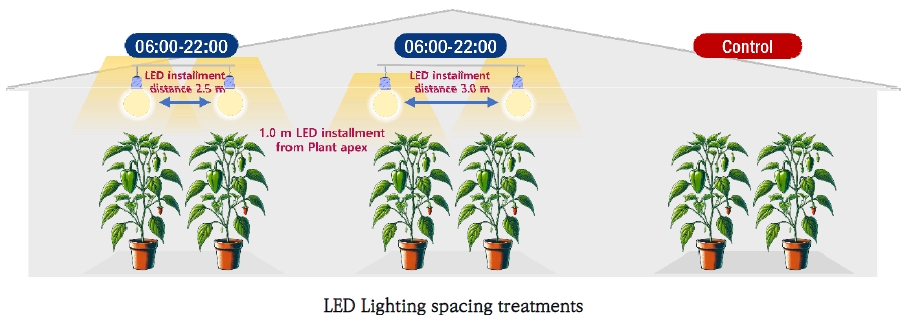
Schematic representation of experimental treatment based on LED supplemental lighting time and horizontal spacing intervals.
2.4. Growth and yield assessment
Growth-related parameters were measured every two weeks, up to 20 weeks of the growth stage for a total of 10 indices. For each treatment, three representative plants with uniform growth were randomly selected for measurement. To evaluate vegetative growth, plant height, leaf length, leaf width, number of fully expanded leaves, total leaf area, and leaf shape index were measured. Plant height was measured from the base of the stem to the apical meristem. Leaf length and width were measured on the third fully expanded leaf below the shoot apex. Leaf number was determined by counting all visible leaves above the soil surface. Leaf area was measured using a leaf area meter (LI-3100, LI-COR, USA). The leaf shape index was calculated as the ratio of leaf length to leaf width. Reproductive development was assessed by measuring stem diameter (basal diameter immediately below the top flowering node), the position of the flowering node (count of internodes from the base to the uppermost inflorescence), and the length between the shoot apex and the terminal inflorescence (LSTI). LSTI is a crucial indicator of the efficiency and speed of the transition from vegetative to reproductive phase; a shorter LSTI suggests earlier and more robust reproductive organ formation. Fruit-related traits included number of set fruits, harvested fruit number, cumulative harvested fruit number, individual fruit weight, total yield per plant, marketable fruit rate, and non-marketable fruit rate. The number of fruits set was determined by counting developing fruits, while harvested fruit number was recorded during each harvest. The cumulative number of harvested fruits was calculated as the sum over the growing period. Fruit weight was recorded per individual fruit, and total yield per plant was calculated by dividing total fruit weight by number of plants. Marketable and non-marketable rates (%) were determined based on fruit size, color uniformity, and shape defects.
2.5. Water soluble vitamin analysis
To analyze the effect of lighting timing on fruit quality, water-soluble vitamin contents (B1, B2, B3, B5, B6, and C) were measured. Mature fruits were harvested 40 days after the onset of supplemental lighting in each treatment. The fruit samples were freeze-dried, and 50 mg of dry powder was used for analysis. One milliliter of internal standard solution (1 mg·mL-1) was added to each sample. The extraction solvent consisted of 650 μL methanol, 700 μL 10 mM ammonium acetate, and 50 μL of 0.1% butylated hydroxytoluene (BHT). Samples were vortexed for 5 min, then subjected to sonication (Ultrasonicator, 2510RDTH, BransonicⓇ, Danbury, USA) for 5 min at room temperature. After centrifugation at 4,000 rpm for 5 min (MICRO 17TR, Hanil, Korea), the supernatant was collected and filtered through a PTFE syringe filter (SMI-Lab Hut Co., Ltd., Maisemore, UK). LC–MS/MS analysis was performed on a HILIC column (ACQUITY BEH Amide, 2.1 × 100 mm, 1.7 µm; Waters, USA) maintained at 35°C. The mobile phase consisted of solvent A (10 mM ammonium acetate in water, pH 5.0 adjusted with acetic acid) and solvent B (acetonitrile: water = 90:10 (v/v), containing 10 mM ammonium acetate). The gradient program was 95–70–40–95% B over 13 min at a flow rate of 0.3 mL min-1. Detection was performed on a triple quadrupole mass spectrometer equipped with an electrospray ionization source operating in positive ion mode (ESI+). Data were acquired in multiple reaction monitoring (MRM) mode for individual vitamins.
2.6. Statistical analysis
Data was analyzed using SAS statistical software (version 9.4; SAS Institute Inc., Cary, NC, USA). One-way analysis of variance (ANOVA) was conducted to determine the effects of treatments. When significant differences were found, means were separated using Duncan’s multiple range test (DMRT) at the 5% significance level (P < 0.05). All figures present the results as means ± standard error (SE).
3. Results and Discussion
3.1. Effects of LED fixture spacing on plant height, leaf morphology, and leaf shape index in paprika
Significant differences in shoot growth characteristics of paprika were observed among treatments differing in horizontal LED spacing. From table 3., Plant height has depicted significant differences from week 4 till the end of the growth period (p < 0.05). By week 20, the control plants attained tallest plants (246.8 cm), followed by those grown under 3.0 m spacing (243.0 cm), while the 2.5 m spacing produced the shortest plants (214.7 cm). Stem elongation in the 2.5 m spacing group was noticeably suppressed beginning at week 12, resulting in a 13.0% reduction in height compared to the control. This morphological change is consistent with a photomorphogenic response where high light intensity from closer LED spacing restricted internode elongation. Leaf length and width exhibited similar patterns. Significant differences kept fluctuating throughout the growth period, but from week 12, leaf development began to differ among treatments. By week 20, the control had the longest leaves (16.6 cm), while both the spacings produced slightly shorter leaves (15.6 cm). Leaf width also decreased under lighting treatments, with values of 10.3 cm (control), 9.6 cm (2.5 m), and 9.4 cm (3.0 m). These reductions under the 2.5 m treatment are indicative of growth inhibition caused by prolonged high light intensity. Leaf area showed no significant differences early in the experiment. However, significant difference was noted from week 4 until week 16. 3.0 m spacing produced highest leaf area throughout the experiment which has leaf area comparable to control. Conversely, 2.5 m spacing led to significantly lowest leaf area from week 4 to week 16 (Table 4). A 2.5 m spacing of LED fixtures has been shown to influence plant morphology by promoting leaf unfolding and restricting internode elongation, enabling a more compact architecture that preserves photosynthetic surface area despite smaller individual leaves. This morphological plasticity is considered a compensatory adaptation to high light conditions and is highly influenced by fixture arrangement and spectral composition (Nelson and Bugbee, 2014; Park and Runkle, 2017). In general, the 3.0 m spacing yielded better vegetative growth than the control, likely due to its ability to maintain a more balanced light environment and distribution. Thus, from a vegetative standpoint, the 3.0 m interval may be suitable for balanced shoot development and stable leaf morphology.
Effect of horizontal spacing between overhead LED fixtures on plant height, leaf length, leaf width and leaf shape index (LSI) of paprika under greenhouse conditions
Effect of horizontal spacing between overhead LED fixtures on number of leaves and leaf area of paprika under greenhouse conditions
3.2. Effects of LED fixture spacing on stem diameter, LSTI, flowering nodes, and fruit setting
Except flowering node number, other parameters did not show a significant difference among treatments during most of the cultivation period. After 4 weeks, stem diameter gradually decreased across all treatments (Table 5). By week 20, mean diameters measured 5.2 mm in control, 5.1 mm at 2.5 m spacing, and 5.0 mm at 3.0 m spacing, with no statistically significant differences observed. These findings suggest that fixture spacing had a limited influence on stem diameter development. In contrast, the LSTI, which reflects the efficiency of reproductive organ formation, showed more noticeable treatment effects. Although no significant differences were observed among treatments during the early growth period, from week 8 onward, the 2.5 m spacing treatment consistently showed shorter LSTI values (ranging from 2.8 to 4.1 cm), suggesting a more rapid transition to reproductive development. During the late growth period, LSTI values stabilized within the range of 4.0–5.5 cm across all treatments, indicating that lighting spacing had a more prominent effect during the early reproductive phase. The flowering node order began to differ significantly among treatments from week 4 onward. From week 10 through to the end of the experiment, both LED lighting treatments (2.5 m and 3.0 m spacings) exhibited significantly higher flowering nodes compared to the control. At week 20, plants in the 2.5 m and 3.0 m spacing treatments reached an average flowering node order of 26.2 and 26.3, respectively, while the control group showed a lower value of 24.4. This result indicates that supplemental lighting promoted floral differentiation at higher nodes, enhancing flowering potential. These results are consistent with previous studies reporting that supplemental lighting under low light conditions promotes reproductive development and increases flowering nodes (Wollaeger and Runkle, 2014). The number of fruits set showed a significant increase under LED lighting treatments during the early reproductive period. At week 2, the 2.5 m spacing group recorded 10.8 fruits, followed by 10.4 fruits at 3.0 m spacing and 8.2 fruits in the control. Although fruit set declined over time in all treatments, the 2.5 m spacing maintained the highest fruit set throughout the 20-week cultivation period, reaching 6.4 fruits per plant by the end. These results suggest that closer spacing improved light uniformity and intensity, facilitating more stable flower development and fruit retention under winter low-light conditions (Goto, 2012).
Effect of horizontal spacing between overhead LED fixtures on stem diameter, length between the shoot apex and the terminal inflorescence (LSTI), flowering nodes and number of fruits set in paprika under greenhouse conditions
3.3. Effects of LED lighting spacing on cumulative fruit number, fruit weight, yield per plant, and productivity per unit area
Determining the optimal LED lighting spacing should not be based solely on vegetative parameters. Reproductive development, fruit set, total yield, and marketable fruit ratio must also be considered. In this study, despite shorter plant height and smaller leaves under the 2.5 m spacing, the increased leaf number and stable development of reproductive organs are expected to improve fruit set and marketability, which could ultimately enhance overall productivity. This finding is particularly relevant for winter cultivation, where early harvest and high marketable yield are critical. Under such conditions, the denser 2.5 m lighting may offer greater profitability due to increased reproductive performance and fruit quality (Massa et al., 2008). Therefore, LED lighting spacing should be optimized not only for growth morphology but also for comprehensive production efficiency and economic return. The spacing of LED lighting significantly influenced not only the reproductive development of paprika but also the final yield and productivity. Over the 20-week cultivation period, plants grown under LED lighting spaced at 2.5 m and 3.0 m were compared with a non-lighted control, and clear differences were observed in cumulative fruit number, average fruit weight, yield per plant, and productivity per unit area (Fig. 2, Fig. 3). Fruit harvest commenced on week 6. The cumulative fruit number was consistently highest under the 2.5 m fixture spacing throughout the growing period. By week 20, both 2.5 m and 3.0 m treatments recorded an average of 10.4 fruits per plant. However, the 2.5 m treatment maintained more stable yield levels, particularly during the mid-growth phase (weeks 10-14), contributing to its superior overall productivity. In contrast, the control group without supplemental lighting produced an average of only 7.3 fruits per plant, approximately 30% lower than the lighting treatments. This suggests that supplemental LED lighting effectively compensated for insufficient natural light, thereby enhancing photosynthetic capacity and promoting reproductive development (Hernández and Kubota, 2016). Average fruit weight increased sharply after week 10. At week 20, the 2.5 m spacing treatment showed the highest average fruit weight of 248.4 g, followed by the control at 241.5 g and the 3.0 m spacing at 235.5 g. Despite a higher fruit set under 2.5 m spacing, fruit enlargement remained stable, indicating a positive role of enhanced light intensity and uniformity in supporting fruit development and sink strength (Fanwoua et al., 2019). Yield per plant increased rapidly after week 8. By week 20, the 3.0 m spacing treatment produced the highest total yield at 2,326.8 g per plant, followed by 2,271.7 g for the 2.5 m spacing, and 1,588.6 g for the control. Although the 3.0 m spacing achieved the highest final yield per plant, it exhibited greater weekly variability and delayed initial harvest. Notably, during the mid-growth phase (weeks 10-14), yield from the 2.5 m treatment exceeded that of the 3.0 m spacing and was more than 43% greater than that of the control. These findings indicate that 2.5 m spacing provided more stable and balanced production, particularly during the critical mid-season harvest window. In terms of overall productivity, the 2.5 m spacing offered the most balanced performance by maintaining a relatively high cumulative fruit count, stable fruit weight, and consistent yield trends throughout the growth period. This suggests that high-density lighting under closer spacing without compromising quality effectively enhanced both reproductive growth and fruit development. Although the 3.0 m spacing yielded slightly higher final per-plant yield, the 2.5 m spacing showed superior early and mid-season harvest stability, which could be particularly beneficial under winter production conditions where early yield and market timing are critical. Therefore, optimal lighting design should consider not only total yield but also harvest timing, fruit development consistency, and marketable quality to maximize economic returns in controlled environment production systems. At 20 weeks after transplanting, yield per unit area was highest under the 2.5 m LED lighting spacing, reaching 51.6 tons·ha⁻¹, followed by 49.3 tons·ha⁻¹ at 3.0 m spacing, and 41.1 tons·ha⁻¹ in the non-lighted control (Fig. 2, Fig. 3). These results indicate that improved light uniformity and optimal light saturation levels achieved through supplemental LED lighting directly contributed to increased yield performance. Paprika, being a high light-demanding crop, is particularly vulnerable to reproductive growth inhibition and impaired fruit development under limited solar radiation, such as during winter or low-light conditions. This study confirmed that appropriate adjustment of LED lighting spacing can effectively overcome these limitations by optimizing the light environment. While the 3.0 m spacing showed superior results in certain growth parameters, it demonstrated less stability in maintaining fruit weight and consistent harvest compared to the 2.5 m spacing. Specifically, the wider spacing resulted in larger shaded zones between LEDs, which restricted light penetration to the lower leaf area and reduced photosynthetic activity (van Iersel, M. W. 2017) Therefore, considering the cumulative effects on fruit number, fruit weight, total yield, and productivity per unit area, the 2.5 m LED lighting spacing was the most effective treatment in this study. Furthermore, the stable mid-season yield and enhanced fruit quality under the 2.5 m spacing directly contribute to commercial viability by securing an earlier harvest advantage and maximizing the return on investment in supplemental lighting infrastructure.
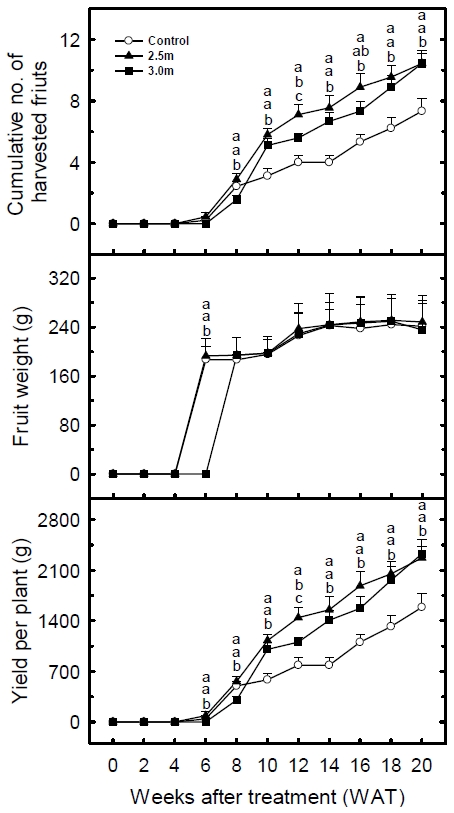
Effects of different LED lighting horizontal spacings on cumulative no. of harvested fruits, fruit weight and yield per plant of paprika at various weeks after treatment. Control, 2.5 m spacing and 3.0 m spacing measured biweekly for 20 weeks. Error bars represent the standard error of the mean (n = 9).
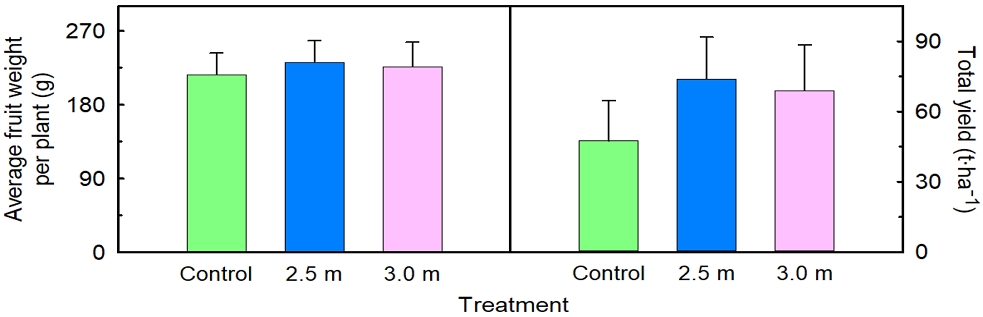
Effects of different LED lighting horizontal spacings on average fruit weight per plant and average yield in tons per hectare of paprika at various weeks after treatment. Control, 2.5 m spacing and 3.0 m spacing measured biweekly for 20 weeks. Error bars represent the standard error of the mean (n = 9).
3.4. Changes in water-soluble vitamin content in sweet pepper fruit according to LED lighting spacing
Significant variations in the content of water-soluble vitamins (Vitamin B₁, B₂, B₅, B₆, B₉, and C) in sweet pepper fruit were observed according to the horizontal spacing of LED supplemental lighting (Table 6). These results suggest that variations in light environment influence secondary metabolism and biosynthetic pathways of water-soluble vitamins. Since vitamins are closely linked to energy metabolism in chloroplasts and mitochondria and related to photosynthetic activity, lighting conditions can serve as important regulators of their biosynthesis (Bian et al., 2015; Dou et al., 2018). Among the vitamin B group, Vitamin B₁ (Thiamine) content tended to decrease under lighting treatments. The control recorded 0.45 mg·kg⁻¹, whereas 2.5 m and 3.0 m spacing treatments showed significantly lower values of 0.36 and 0.34 mg·kg⁻¹, respectively. This suggests that thiamine biosynthesis may have been suppressed, or its metabolic utilization increased under light stimulation. Conversely, Vitamin B₂ (Riboflavin) content was highest at 0.83 mg·kg⁻¹ in the 2.5 m spacing treatment, significantly exceeding the control (0.52 mg·kg⁻¹) and the 3.0 m spacing (0.53 mg·kg⁻¹). Riboflavin is a light-sensitive vitamin closely associated with photosynthetic pigment metabolism and is known to increase under high light conditions vitamin (Hernández and Kubota, 2016). Vitamin B₅ (Pantothenic acid) also peaked at 10.1 mg·kg⁻¹ under 2.5 m spacing, representing a 17.8% and 12.2% increase compared to the control (8.57 mg·kg⁻¹) and 3.0 m spacing (9.0 mg·kg⁻¹), respectively. This implies that LED lighting at the narrower spacing promoted the accumulation of B₅, a coenzyme involved in carbon metabolism and fatty acid biosynthesis. Vitamin B₆ (Pyridoxine) contents were generally low across treatments. In contrast, Vitamin B₉ (Folic acid) content was highest in the control group (0.52 mg·kg⁻¹) and decreased as lighting spacing narrowed (2.5 m: 0.37 mg·kg⁻¹; 3.0 m: 0.29 mg·kg⁻¹). This pattern suggests that folate biosynthesis pathways may be inhibited by increased light intensity or light-induced stress, particularly due to the sensitivity of chloroplast reactions to light stress, consistent with prior studies (Hanson and Gregory, 2011). Furthermore, Vitamin C (Ascorbic acid) and Vitamin B₆ (Pyridoxine) contents showed no statistically significant differences among treatments (Table 6). The consistent levels observed across all treatments emphasize that supplemental LED lighting successfully supported fruit quality, ensuring that even under low winter light conditions, the fruits maintained nutrient levels comparable to the control. Overall, the 2.5 m LED lighting spacing effectively enhanced Vitamin B₂ and B₅ content but resulted in decreased or maintained levels of B₁, B₉, and C. This indicates that LED lighting spacing differentially affects biosynthetic pathways and metabolic regulation depending on the vitamin type. Specifically, vitamins like Riboflavin and Pantothenic acid accumulate more under improved photosynthetic conditions, whereas folate, which is highly light-sensitive within chloroplasts, tends to be suppressed (Hanson and Gregory, 2011). Therefore, for the production of functionally enhanced, high-value sweet pepper, a 2.5 m LED lighting spacing appears advantageous in improving Vitamin B₂ and B₅ contents.
Effect of supplemental lighting periods on water soluble vitamin content of paprika fruit cultivated under greenhouse conditions
4. Conclusions
The results demonstrate that LED lighting spacing had a profound impact on paprika productivity. This study confirms that optimizing LED fixture spacing plays a critical role in enhancing the efficiency and sustainability of paprika cultivation under controlled environment conditions. Closer LED spacing at 2.5 m not only improved early and mid-season yield stability and overall productivity (51.6 tons·ha-1) but also enriched the nutritional quality of fruits by increasing Vitamin B₂ and B₅ content. By suppressing excessive vegetative growth and stabilizing reproductive performance under winter low-light conditions, the 2.5 m spacing promoted more effective use of supplemental light energy, reducing wasted irradiance and improving light distribution within the canopy. These outcomes highlight that appropriate LED spacing can minimize energy inputs while maximizing yield and product quality, presenting an environmentally responsible strategy for high-value horticultural production. A limitation of this study is the focus solely on the effects of fixture spacing without comprehensive measurement of light distribution uniformity or the energy cost-benefit ratio across the greenhouse. Therefore, future research should integrate detailed light mapping and economic analysis to establish a more precise guideline for optimal LED installation, extending this research to include other high-value crops and varying spectral qualities. Therefore, the 2.5 m fixture spacing is recommended as a practical approach to achieving resource-efficient, sustainable, and economically viable paprika production in greenhouse systems. Based on the observed productivity and quality enhancements, the 2.5 m spacing shows strong promise for optimizing winter paprika cultivation. However, the final economic viability requires further validation through a comprehensive energy-cost analysis.
Acknowledgments
This work was carried out with the support of “Cooperative Research Program for Agriculture Science and Technology Development (Project No. RS-2025-02303116)”, Rural Development Administration, Korea.
REFERENCES
-
Bantis, F., Smirnakou, S., Ouzounis, T., Koukounaras, A., Ntagkas, N., Radoglou, K., 2018, Current status and recent achievements in the field of horticulture with the use of light-emitting diodes (LEDs), Sci. Hortic. (Amst), 235, 437-451.
[https://doi.org/10.1016/j.scienta.2018.02.058]

-
Bian, Z. H., Yang, Q. C., Liu, W. K., 2015, Effects of light quality on the accumulation of phytochemicals in vegetables produced in controlled environments: A Review, J. Sci. Food Agric., 95, 869-877.
[https://doi.org/10.1002/jsfa.6789]
-
Cellar, N. A., McClure, S. C., Salvati, L. M., Reddy, T. M., 2016, A New sample preparation and separation combination for precise, accurate, rapid, and simultaneous determination of vitamins B1, B2, B3, B5, B6, B7, and B9 in infant formula and related nutritionals by LC-MS/MS, Anal. Chim. Acta, 934, 180-185.
[https://doi.org/10.1016/j.aca.2016.05.058]
-
Dou, H., Niu, G., Gu, M., Masabni, J. G., 2017, Effects of light quality on growth and phytonutrient accumulation of herbs under controlled environments, Horticulturae, 3, 36.
[https://doi.org/10.3390/horticulturae3020036]
-
Fanwoua, J., Vercambre, G., Buck-Sorlin, G., Dieleman, J. A., de Visser, P., Génard, M., 2019, Supplemental led lighting affects the dynamics of tomato fruit growth and composition, Sci. Hort., 256, 108571.
[https://doi.org/10.1016/j.scienta.2019.108571]
-
Gómez, C., Mitchell, C. A., 2015, Growth responses of tomato seedlings to different spectra of supplemental lighting, HortScience, 50, 112-118.
[https://doi.org/10.21273/HORTSCI.50.1.112]
-
Goto, E., 2012, Plant production in a closed plant factory with artificial lighting, Acta Hortic., 956, 37-49.
[https://doi.org/10.17660/ActaHortic.2012.956.2]
-
Hanson, A. D., Gregory III, J. F., 2011, Folate biosynthesis, turnover, and transport in plants, Annu. Rev. Plant Biol., 62, 105-125.
[https://doi.org/10.1146/annurev-arplant-042110-103819]
-
Hernández, R., Kubota, C., 2016, Physiological responses of cucumber seedlings under different blue and red photon flux ratios using LEDs, Environ. Exp. Bot., 121, 66-74.
[https://doi.org/10.1016/j.envexpbot.2015.04.001]
-
Johkan, M., Shoji, K., Goto, F., Hahida, S., Yoshihara, T., 2012, Effect of green light wavelength and intensity on photomorphogenesis and photosynthesis in Lactuca sativa, Environ. Exp. Bot., 75, 128-133.
[https://doi.org/10.1016/j.envexpbot.2011.08.010]
-
Kwon, Y. B., Lee, J. H., Roh, Y. H., Choi, I. -L., Kim, Y., Kim, J., Kang, H. -M., 2023, Effect of supplemental inter-lighting on paprika cultivated in an unheated greenhouse in summer using various light-emitting diodes, Plants, 12, 1684.
[https://doi.org/10.3390/plants12081684]
-
Lee, J. W., Kim, H. C., Jeong, P. H., Ku, Y. G., Bae, J. H., 2014, Effects of supplemental lighting of high pressure sodium and lighting emitting plasma on growth and productivity of paprika during low radiation period of winter season, Hortic. Sci. Technol., 32, 346-352.
[https://doi.org/10.7235/hort.2014.14029]
-
Massa, G. D., Kim, H., Wheeler, R. M., Mitchell, C. A., 2008, Plant productivity in response to LED lighting, HortScience, 43, 1951-1956.
[https://doi.org/10.21273/HORTSCI.43.7.1951]
-
Nelson, J. A., Bugbee, B., 2014, Economic analysis of greenhouse lighting: Light emitting diodes vs. high intensity discharge fixtures, PLoS One, 9, e99010.
[https://doi.org/10.1371/journal.pone.0099010]
-
Park, Y., Runkle, E. S., 2017, Far-red radiation promotes growth of seedlings by increasing leaf expansion and whole-plant net assimilation, Environ. Exp. Bot., 136, 41-49.
[https://doi.org/10.1016/j.envexpbot.2016.12.013]
-
Van Iersel, M. W., 2017, Optimizing LED lighting in controlled environment agriculture, in: Light emitting diodes for agriculture, Springer, Berlin, 59-80.
[https://doi.org/10.1007/978-981-10-5807-3_4]
-
Wollaeger, H. M., Runkle, E. S., 2014, Growth of impatiens, petunia, salvia, and tomato seedlings under blue, green, and red light-emitting diodes, HortScience, 49, 734-740.
[https://doi.org/10.21273/HORTSCI.49.6.734]
Department of Horticultural Bioscience, Pusan National Universityjtkcc21@naver.com
Department of Horticultural Bioscience, Pusan National Universitytkdflajaid@naver.com
Department of Horticultural Bioscience, Pusan National Universitymdfaraazbio1803@gmail.com
Department of Horticultural Bioscience, Pusan National Universitymcchryl@gmail.com
Department of Horticultural Bioscience, Pusan National Universitydlwlrn15@naver.com
Department of Horticultural Bioscience, Pusan National University kangjs@pusan.ac.kr