
판도라, 돕슨, 및 브루어 오존 전량의 상호비교와 GEMS 오존 전량 산출물 검증
Ⓒ The Korean Environmental Sciences Society. All rights reserved.
This is an Open-Access article distributed under the terms of the Creative Commons Attribution Non-Commercial License (http://creativecommons.org/licenses/by-nc/3.0) which permits unrestricted non-commercial use, distribution, and reproduction in any medium, provided the original work is properly cited.
Abstract
This study assesses the consistency of total column ozone (TCO) measurements from ground-based Dobson, Brewer, and Pandora instruments for validating TCO products from the Geostationary Environment Monitoring Spectrometer (GEMS). Strong agreement is found between Pandora and the established reference instruments, with root mean square errors of 1.88–2.08% and standard deviations of 1.97–2.95%, and no significant long-term drift during 2021–2025. Compared with Pandora observations, GEMS exhibits a systematic negative bias of approximately 5%, attributable to residual radiometric calibration uncertainties in Level-1 processing.. The bias shows a weak dependence on latitude and observation time, indicating a stable temporal performance. Furthermore, during a springtime event characterized by a pronounced latitudinal gradient, GEMS successfully reproduced the spatiotemporal distribution of TCO in close agreement with Pandora measurements. These findings establish the Pandora network as a robust reference framework for ongoing validation and long-term quality assessment of the GEMS TCO record.
Keywords:
Pandora, Dobson, Brewer, GEMS, Total Column Ozone1. 서 론
대기 중 오존은 성층권에서 유해한 자외선을 흡수하여 지표로의 도달을 감소시키는 보호막 역할을 하지만, 대류권에서는 지구 복사 에너지를 흡수하는 온실가스로 작용하여 기후 변화를 유발한다(Seinfeld and Pandis, 2016; WHO, 2021). 특히 지표 근처의 고농도 오존 노출은 호흡기 질환 및 천식을 유발·악화 시키며, 장기적으로는 인체의 폐 기능 저하와 농작물 수확량 감소를 초래한다(Heck et al., 1983; Fiore et al., 2012; Holm and Balmes, 2021). 이러한 오존의 이면적 특성으로 인해, 오존 농도를 정밀하게 관측하고 지속적으로 모니터링하는 것은 환경 보건 관리와 기후 변화 대응을 위한 필수 과제이다.
세계 오존 및 자외선 복사 자료센터(World Ozone and Ultraviolet Radiation Data Center, WOUDC)는 돕슨(Dobson, 1931)와 브루어 분광광도계(Kerr et al., 1981) 등 지상 원격 기반의 오존 전량 관측 자료를 수집·표준화하여 제공해 왔으며, 이는 오존층의 장기 추세 분석 및 위성 산출물 검증을 위한 표준 자료로 널리 활용되어 왔다 (Harris et al., 2003; Bak et al., 2015; Herman et al., 2015). 한편, 2010년 이후 도입된 판도라(Pandora)는 기존 장비보다시간 해상도가 높고 운영이 효율적이라는 장점이 있어, 최근 위성 검증 자료로서의 활용 범위가 확대되고 있다(Herman et al., 2015; Spinei et al., 2018; Rawat et al., 2025). 이와 더불어, 위성 오존 관측 체계가 저궤도 위성 중심의 일 1회 관측에서 정지궤도 위성을 활용한 시간 단위 연속 관측으로 확대됨에 따라(Ingmann et al., 2012; Zoogman et al., 2017; Kim et al., 2020), 정지궤도 환경위성의 특성을 반영할 수 있는 고해상도 지상 검증 자료 확보가 더욱 중요해졌다.
2020년 2월 발사된 정지궤도 환경위성(GK-2B) 탑재체 GEMS (Geostationary Environment Monitoring Spectrometer)는 동아시아 전역의 오존 및 주요 대기 오염물질을 매시간 관측하는 초분광 센서이다(Kim et al., 2020; Lee et al., 2024). GEMS 산출물 운영을 주관하는 국립환경과학원(National Institute of Environment Research, NIER)은 판도라 관측망이 부족한 동남아시아 지역을 중심으로 한국국제협력단(Korea International Cooperation Agency, KOICA), 한국환경공단(Korea Environment Corporation, KECO), 아시아·태평양 경제사회위원회(United Nations Economic and Social Commission for Asia and the Pacific, UNESCAP) 등과 협력하여 태국, 몽골, 인도네시아, 캄보디아, 라오스, 필리핀, 베트남의 국가에 판도라 관측 장비 설치 및 운영 교육을 지원하였다. 이러한 노력을 통해 구축된 Pandora Asia Network (PAN)는 GEMS 산출물 검증을 위한 핵심적인 지상 기반 관측 체계로 기능하고 있다.
이와 같이 동아시아 지역에서는 다양한 지상 기반 관측망의 확충과 함께 오존 전량 자료의 축적이 이루어지고 있다. 그러나 관측 기기별 특성, 운영 방식으로 인해 서로 다른 관측 자료의 일관성과 신뢰성을 평가하는 작업이 요구된다. 특히 위성 자료의 검증과 장기 추세 분석을 위해서는 서로 다른 지상 관측 자료를 통합적으로 검토하고 상호 비교하는 기반 연구가 필수적이다.
본 연구의 목적은 브루어, 돕슨, 판도라 등 서로 다른 지상 관측 기기 간 오존 전량 자료의 상호 일관성을 정량적으로 평가하는 데 있다. Table 1에서 확인되듯이, GEMS의 주요 관측 영역인 동아시아에서는 일부 돕슨 및 브루어 관측소의 운영 종료로 장기적으로 활용 가능한 기준 자료가 점차 감소하는 반면, 판도라 관측소는 최근 지속적으로 확대되고 있다. 이에 따라 GEMS 산출물의 실시간 및 장기 검증 체계에서 판도라 자료의 역할은 더욱 중요해지고 있다. 따라서 판도라 관측 자료의 정밀도와 기존 표준 장비 대비 상호 일관성에 대한 체계적인 평가는 필수적이다. 이를 바탕으로 본 연구에서는 시·공간적으로 충분히 확보된 판도라 자료를 활용하여 최근 GEMS 현업 오존 전량(v2.1) 산출물의 특성과 성능을 제시하고자 한다.

Specifications and locations of ground-based ozone monitoring sites within the GEMS domain
2. 실험 방법
2.1. 관측 기기 및 자료
본 연구에서는 세계기상기구(World Meteorological Organization, WMO) 지구대기감시(Global Atmosphere Watch, GAW) 프로그램의 일환으로 세계 오존 및 자외선 복사 자료센터(World Ozone and Ultraviolet Radiation Data Center, WOUDC)에서 제공하는 돕슨(Dobson) 및 브루어(Brewer) 분광광도계 기반의 일평균 오존 전량 자료를 사용하였다(2025년 12월 획득, https://woudc.org, doi:10.14287/10000004). 돕슨과 브루어는 오존층 및 기후 변화 특성 연구에 널리 활용되는 표준 지상 원격 관측 기기이다(Harris et al., 2003; Krzyścin et al., 2021; Park et al., 2025). 돕슨 분광광도계는 오존 흡수에 민감한 자외선 파장과 상대적으로 민감도가 낮은 파장의 복사 세기 비(예: A-Pair; 305.5 nm 및 325.4 nm)를 측정하는 차분흡수기법을 통해 오존 전량을 측정한다(Komhyr and Evans, 2008). 브루어 분광광도계는 5개의 특정 자외선 파장(306.3, 310.1, 313.5, 316.8, 320.1 nm)의 복사 강도를 측정하며, 오존 산출 시 이산화황의 흡수 간섭과 에어로졸 산란 영향을 최소화하기 위해 최적화된 가중 계수를 적용한 선형 결합 기반의 차분 흡수 기법을 사용한다(Kerr, 2002).
판도라 분광계는 자외선-가시광선 영역의 직달 일사(direct-sun) 및 산란복사(sky-scan) 스펙트럼을 이용하여 대기 중 미량 기체(trace gases)의 수직 컬럼 농도(vertical column density, VCD)를 산출하는 지상 원격 관측 장비이다. 특히 직달 일사 관측을 통해 약 1-2분 간격의 고해상도 자료를 생성하며, Padonia Global Network (PGN)의 표준화된 산출 및 품질관리(QA/QC) 알고리즘을 적용하여 관측 자료의 높은 정밀도와 신뢰성을 확보하고 있다. 판도라의 오존 전량 산출물은 직달광 관측자료만을 기반으로 생성되며, 현재 준실시간(near-real-time)으로 제공되고 있다(2025년 12월 자료 기준, https://pandora.gsfc.nasa.gov/PGN/). 이에 따라 전 지구적 위성 산출물 검증을 위한 핵심 자료로 활용되고 있다. 또한, 판도라 분광계는 GEMS 위성과 유사한 관측 파장 대역을 공유하고, 고해상도의 연속 관측이 가능하다는 점에서 GEMS 오존 전량의 검증 및 일변동 특성 분석에 적합하다.
GEMS는 동아시아 지역의 대기질 및 기후 변화를 상시 감시하기 위해 개발된 자외선-가시광선 초분광기(hyperspectral spectrometer)로, 오존을 비롯하여 이산화황, 이산화질소, 포름알데히드 등 대기질 관련 주요 기체와 에어로졸을 관측한다(Kim et al., 2020). 본 센서는 동경 128.2° 적도 상공에 위치한 천리안위성 2B호(Geostationary Korea Multi-Purpose Satellite–2B, GEO-KOMPSAT-2B)에 해양관측탑재체 GOCI-II (Geostationary ocean color imager -II)와 함께 탑재되어 운영 중이다. 정지궤도 위성의 특성을 활용하여 주간 동안 1시간 간격으로 관측을 수행하며, 계절에 따라 하루 6(동절기)-10(하절기)회의 관측 자료(scene)를 제공한다(Lee et al. 2024). 본 연구에서는 3.5 km × 8 km의 높은 공간 해상도로 산출된 GEMS 오존 전량 산출물 v2.1 자료를 활용하였다(Kim et al., 2024).
2.2. 분석 영역 및 기간
본 연구에서 지상 관측 자료와 위성 관측 자료의 시・공간적 비교 분석 범위는 GEMS의 관측 영역으로 한정하였다. GEMS는 2020년 2월 발사 이후 궤도상 안정화 기간을 거처, 2020년 11월 1일부터 안정적인 관측 자료를 제공하기 시작하였다. 이에 따라 본 연구에서는 2021년부터 2025년까지의 GEMS Level-2 오존 전량 산출물을 분석에 사용하였다. 지상 관측소는 위도 5°S-45°N, 경도 75°E-145°E 범위 내에서 분석 기간 동안 장기 관측 공백이 없는 관측소를 선별하였다(기준: 일 년 12개월 관측자료 존재). 최종 선정된 돕슨, 브루어, 판도라 관측소의 지리적 위치와 세부 정보는 Fig. 1과 Table 1에 기술하였다. 다만, Table 1에 포함된 대구(Daegu), 서울-KU(Seoul-KU), 도쿄-소피아(Tokyo-Sophia), 고베(Kobe) 관측소는 2025년 3월 28일 사례일(Fig. 7) 분석에만 사용하였으므로 Fig. 1에는 포함하지 않았다.
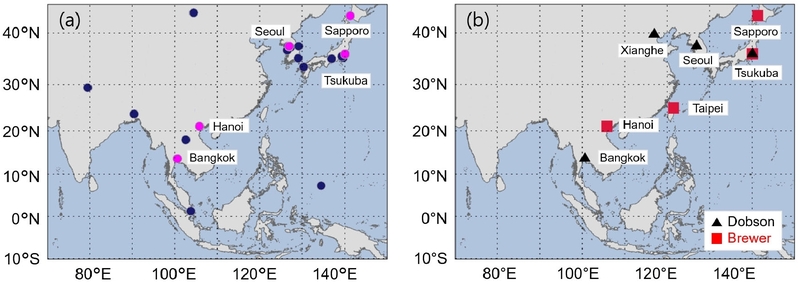
Spatial distribution of ground-based stations within the GEMS domain (75°E-150°E, 10°S-45°N) used in this paper: (a) locations of Pandora sites and (b) locations of Dobson(black triangles) and Brewer(red squares) stations. In panel (a), Pandora sites co-located either Dobson or Brewer are highlighted with pink symbols.
2.3. 검증 방법
돕슨과 브루어 오존 자료는 일평균 농도로 제공되는 반면, 판도라 관측 자료는 1-2분 간격의 고해상도 자료로 제공되며, GEMS는 매시 45분(예: 00:45, 01:45, ···, 07:45 UTC)을 기준으로 관측이 수행된다. 본 연구에서는 자료 간 관측 시각 차이로 인한 비교·분석의 불확실성을 최소화하기 위해 시·공간 매칭(collocation) 과정을 수행하였다. 첫째, 시간 매칭을 위해 GEMS 자료는 돕슨 및 브루어의 일평균 시각을 기준으로 선형 보간하여 추출하였다. 판도라 자료의 경우, 지상(Brewer/Dobson) 및 위성(GEMS) 자료와의 비교 시각을 기준으로 ±0.5시간 범위 내의 관측값을 평균하여 활용하였다. 둘째, 공간 매칭을 위해 각 지상 관측소를 중심으로 반경 10 km 이내에 위치한 GEMS 격자 중 가장 인접한 값을 선택하여 분석에 사용하였다.
3. 결과 및 분석
3.1. 관측 기하(직달광/산란광)에 따른 돕슨 및 브루어 분광광도계의 비교
동아시아 지역 내에서 돕슨과 브루어 장비를 동일 관측소에서 장기간 동시에 운영하며 오존 전량을 관측해 온 사례는 일본의 츠쿠바(Tsukuba) 관측소가 유일하다. 따라서 츠쿠바의 자료는 서로 다른 관측 원리를 가지는 두 표준 장비 간의 일관성을 정량적으로 평가할 수 있는 충분한 샘플을 제공하며, 지상 관측 자료의 신뢰성을 검증하는데 데 핵심적인 기준이 된다. 츠쿠바에서는 돕슨 관측이 1957년부터 수행되어 왔으며, 브루어 관측은 2018년부터 도입되었다. Fig. 2(a)는 2021년 1월부터 2025년 7월까지 두 분광광도계로 관측된 오존 전량 자료의 산점도(scatter plot) 비교 결과를 보여준다. 비교 분석에는 총 517개의 자료의 쌍이 사용되었으며, 두 자료 간 피어슨 상관계수(R)는 0.99 이상으로 매우 높은 상관도를 나타냈다. 브루어로 관측된 오존 전량은 돕슨에 비해 약 1.16%의 양의 편차(mean bias, MB)를 보였으며, 이러한 차이는 기존 연구 및 WMO 보고서의 결과와도 부합한다 (Komhyr and Evans, 2008; Scarnato et al., 2009; Fioletov et al., 2005).
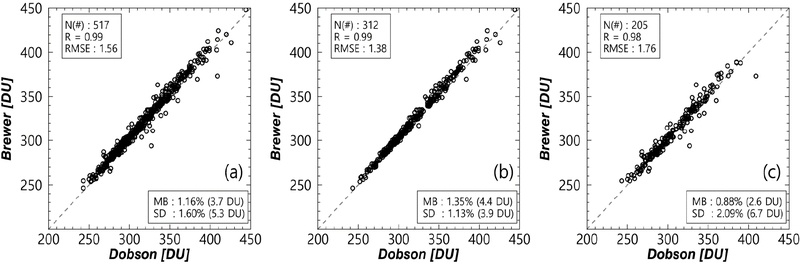
(a) Correlation plots between total ozone measured by Dobson and Brewer at Tsukuba from January 2021 to July 2025, including all-sky observations. Direct sun and Zenith-sky observations are shown separately in (b) and (c), respectively. The legend lists the number of coincident measurements (N), the correlation coefficient (R), and the mean bias (MB), with its 1-σ standard deviations (SD) derived from both relative (%) and absolute (DU) differences.
돕슨과 브루어 간 오존 전량 자료의 편차를 완화하고 시계열의 연속성을 확보하기 위한 선행 연구가 수행되어 왔다 (Vaníček et al., 2012; Redondas et al., 2014; Krzyścin et al., 2021). 그중 Kerr et al. (1988)은 두 관측 체계 간 전환 과정에서 자료의 일관성을 유지하기 위한 보정식을 제안하였으며, 엄격한 관측 자료 품질 관리(quality control, QC)가 수반 될 경우 두 기기 간의 높은 일관성을 충분히 확보할 수 있음을 강조하였다.
앞선 Fig. 2(a)의 결과는 직달광(direct sun, DS)과 산란광 관측(zenith-sky, ZS)을 모두 포함한 것이며, 이를 각각 분리하여 분석한 경우에도 오존 전량 간 상관계수는 각각 0.99와 0.98로 나타나 두 관측 방식 모두에서 매우 높은 상관성을 보였다(Fig. 2(b), (c)). 다만, 직달광 관측에서는 두 자료 간 통계적 특성이 산란광 관측에 비해 보다 뚜렷하게 구분되는 경향이 확인되었다. 구체적으로 브루어와 돕슨의 평균 편차(MB)는 직달광 관측에서 1.35%로 산란광 관측(0.08%)에 비해 증가하였으나, 표준편차(SD)는 직달광(1.13%)이 산란광(2.09%)보다 작게 나타났다. 또한 평균제곱근오차(RMSE) 역시 직달광(1.38%)보다 산란광(1.16%)에서 더 크게 나타나, 산란광 관측 시 자료의 변동성이 상대적으로 더 높음을 확인하였다. 이는 광경로가 단순한 직달광 관측에서는 측정 불확실성이 상대적으로 낮아 기기 간의 “systematic”한 차이가 명확하게 드러나는 반면, 산란광 관측에서는 다중 산란과 관측 기하학적 영향으로 인해 “random” 오차가 증가하며 기기 간의 차이가 완화되거나 분산되기 때문으로 해석된다. 따라서 본 연구에서는 기기 간의 체계적 차이를 보다 엄밀하게 평가하기 위해 직달광 관측 자료만을 선별하여 비교·검증을 수행하였다.
3.2. 판도라와 WOUDC(돕슨/브루어) 관측 자료의 관측소별 비교 분석
Fig. 1(a)는 판도라 관측망 중 돕슨 또는 브루어 관측이 병행되는 5개 관측소의 위치를 보여준다. Fig. 3은 판도라와 WOUDC 자료 간 오존 전량의 상대 차이를 비교한 결과로, 이에 따른 통계적 분포(평균, 분산 및 빈도 분포)를 관측소별로 제시한다. 하노이(Hanoi) 관측소의 경우 2024년 12월부터 판도라 관측이 운영되었으나, 동일 기간 브루어 자료의 대부분이 산란광 조건에서 획득되어 직달광 기반의 유효한 매칭 자료가 부족하므로 본 분석에서는 제외하였다. 방콕(Bangkok, R = 0.84)을 제외한 모든 관측소에서 판도라는 WOUDC 자료와 약 0.97 이상의 높은 상관도를 보였다. 이는 저위도 지역인 방콕의 경우, 일변동 및 계절 변동폭이 중위도에 비해 작아 상대적으로 상관도가 낮게 나타나는 경향이 있기 때문이며, 이러한 결과는 기존 선행 연구 결과와도 일치한다(Toihir et al., 2018; Russo et al., 2023). 돕슨과 판도라 자료는 저위도에서 –1.28%(방콕)의 음의 편차를 보인 반면, 중·고위도 관측소인 츠쿠바와 서울(Seoul)에서는 각각 0.84%와 1.08%의 양이 편차를 나타냈다. 이러한 평균 편차의 위도 의존성은 직달광 관측 조건에서도 태양천정각(solar zenith angle) 변화에 따른 관측 기하 및 대기 산란 효과 차이가 오존 전량 산출 민감도에 영향을 미칠 수 있음을 지시한다. 츠쿠바 관측소에서는 기기 간(판도라, 돕슨, 브루어) 일관성은 전반적으로 우수하였다. RMSE 기준으로는 브루어-판도라 간의 1.88%(Fig. 3(d))로 가장 낮았으며, 돕슨-판도라 (1.93%, Fig. 3(a))와 돕슨-판도라(1.95%, Fig. 3(c)) 순으로 나타났다. 한편, 분석 대상 중 가장 고위도인 삿포로(Sapporo, 43.07°N)에서는 RMSE가 2.75%로 산출되어 타 관측소 대비 자료 간 불일치가 상대적으로 크게 나타났다. Table 2에 제시된 삿포로의 계절별 비교·분석 결과에 따르면, 브루어와 판도라 간 평균 편차는 태양천정각과 연관되어 최소 1.82%(JJA)에서 최대 8.49%(DJF)까지 증가하는 뚜렷한 계절 의존성을 보였다. 뿐만 아니라, 겨울철 표준편차(SD)는 3.57%로, 그 외 계절(2.38-2.94%) 대비 유의미하게 높게 나타나 관측 자료 간의 이질성이 증대함을 확인하였다. 회귀분석 결과에서도 겨울철에만 기울기(slope)가 1보다 작은 0.94가 산출되었으며, 그 외 계절에는 약 1.1 내외의 값이 도출되었다. 이와 대조적으로 서울 관측소에서는 판도라와 돕슨 자료 간 회귀 기울기가 전 계절에 걸쳐 1.02-1.03의 범위를 유지하여, 자료 간 선형성이 매우 견고함을 확인하였다. 또한 서울의 경우 주요 검증 통계치와 태양천정각 간 상관성이 낮게 나타났다. 따라서 삿포로에서 관측되는 계절적 불일치는 단순한 태양 천정각 변화만으로 설명되기 어려우며, 추가적인 요인에 대한 고려가 필요하다.
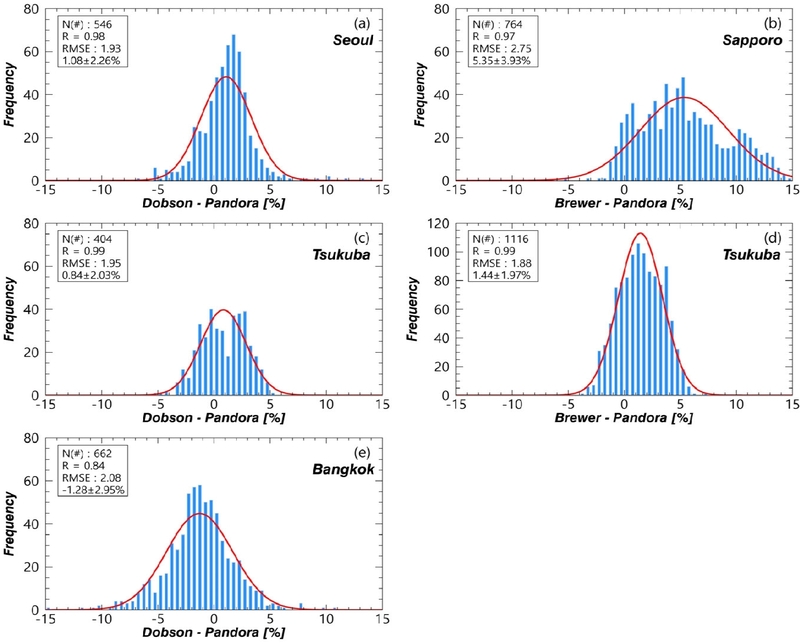
Frequency distribution (blue bars) of relative differences (%) in total ozone between Dobson/Brewer and Pandora measurements for (a) Seoul, (b) Sapporo, (c, d) Tsukuba, and (e) Bangkok. A bin width of 0.5% is used. The red curves represent Gaussian fits derived from the mean and standard deviation of the relative differences.
Comparison metrics, including the number of samples (N), correlation coefficient (R), slope of the regression line, Mean Bias (MB), and standard deviations (SD) for Sapporo (Brewer-Pandora) and Seoul (Dobson-Pandora)
3.3. 지상 관측 기기 간 오존 전량의 시계열 및 장기 안정성 검토
Fig. 4는 3.2절에서 분석된 지상 관측 자료 간 오존 전량의 시계열 비교 결과를 보여준다. 저위도에 위치한 방콕과 하노이에서는 연중 오존 전량이 상대적으로 낮고 계절 변동 폭 또한 작게 나타났다(방콕 : 72 DU, 하노이 : 93.8 DU). 여름철에는 방콕이 약 290 DU, 하노이가 약 320 DU 내외의 최대값을 보이는 반면, 겨울철에는 각각 226 DU(방콕), 229 DU(하노이) 수준으로 감소하여 전반적으로 완만한 계절 변화를 보였다. 반면, 츠쿠바, 서울, 삿포로의 오존 전량 시계열은 봄철에 최대값, 가을철에 최저값을 나타내는 뚜렷한 계절 주기성을 보인다. 이와 더불어, 일변동성은 중위도 관측소에서 상대적으로 크게 나타났는데, 이는 선행 연구들에서 제시된 바와 같이 중위도 지역의 활발한 기압계 활동과 대기 역학적 변동성의 영향으로 해석된다(Hood and Soukharev, 2005; Liu et al., 2019). 이와 대조적으로 저위도 관측소에서는 연중 안정적인 오존 전량 분포를 유지함에 따라 일변동 폭이 제한적인 양상을 보였다. Fig. 5는 판도라와 WOUDC 자료 간 상대 차이의 월별 시계열을 나타낸 것이다. 대부분의 기간에서 두 관측 자료 간 편차는 특정 방향으로 치우치지 않고 일정 범위 내에서 안정적으로 유지되는 것으로 나타났다. 선형 회귀 분석을 통해 산출된 연간 변화율(DU/year)에서도 통계적으로 유의미한 추세가 발견되지 않았으며(p > 0.05), 이는 판도라 관측 시스템이 전통적인 표준 관측 장비인 돕슨 및 브루어와 비교해 장기적으로 안정적인 관측 성능을 유지하고 있음을 보여준다. 다만, 삿포로 관측소에서는 2022년부터 2024년 사이에 두 자료 간의 편차가 점진적으로 증가하는 경향이 관찰되었다. 특히 평균 편차(MB)가 2022년 약 4.0 DU(8월)에서 2024년에는 44.8 DU(12월)까지 증가하였으며, 이는 해당 기간 동안 판도라 기기의 하드웨어적 노후화로 인해 오존 전량을 실제보다 과소 산출되는 경향이 강화된 것으로 판단된다. 이후 2025년에는 삿포로 관측소의 편차가 일본 츠쿠바 관측소와 유사한 안정적인 수준으로 감소하였으며, 이는 판도라 기기 교체(instrument number 196 ⟶ 276, 2025년 2월) 시점과 일치한다.
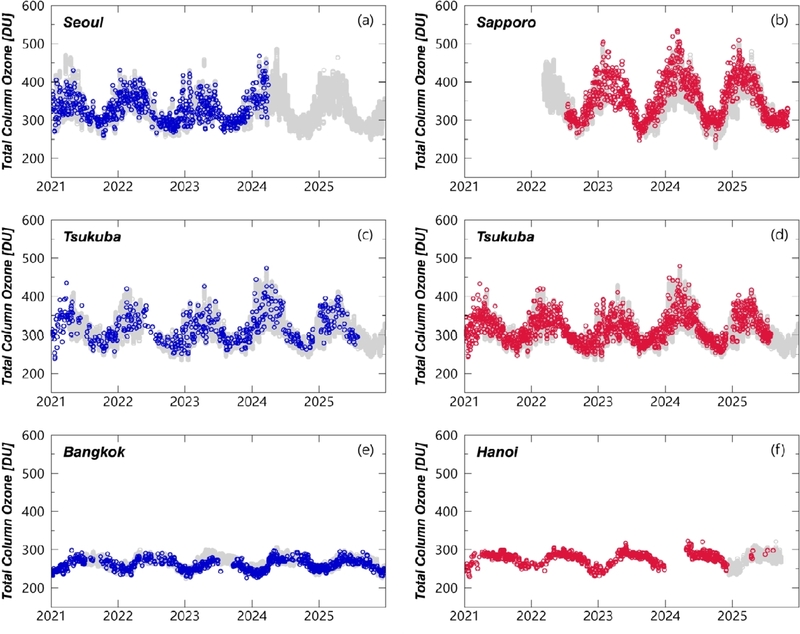
Time series of total column ozone from Dobson (Blue) and Brewer (Red) direct-sun measurements at Seoul (a), Sapporo (b), Tsukuba (c, d), Bangkok (e), and Hanoi (f), overlaid with Pandora observations (grey).
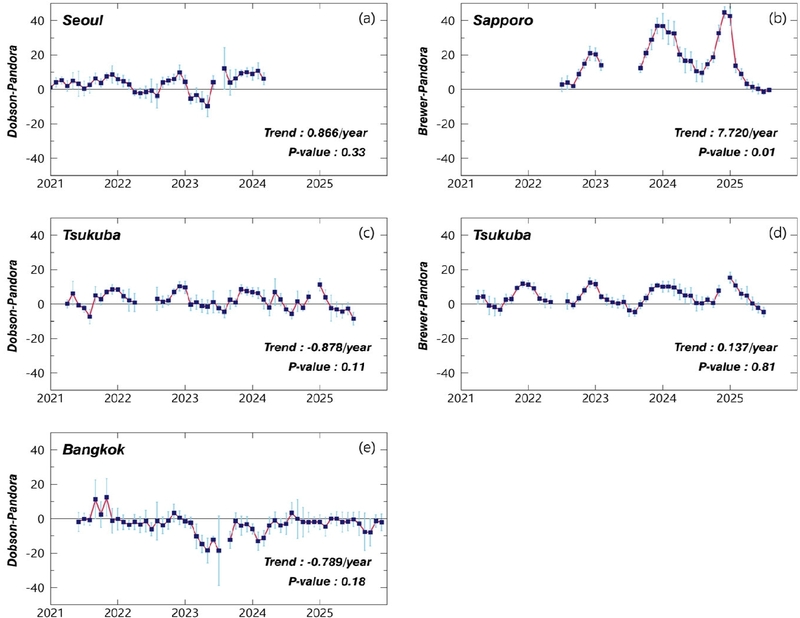
Same as Fig. 4, but for monthly mean relative differences between Dobson/Brewer and Pandora ground-based measurements. The legend includes the linear regression trend (DU/year) and the corresponding p-values for statistical significance.
3.4. GEMS 오존 전량 자료와의 비교 및 검증
Fig. 6은 GEMS 오존 전량 산출물과 지상 관측자료 간의 상대차이를 2025년 자료에 대해 GEMS 관측 시각별로 비교한 결과이다. 판도라 자료는 시간적 정합성을 확보하기 위해 GEMS 관측 시각을 중심으로 ±30분 이내의 자료를 평균하였다. GEMS 오존 전량 산출물은 Level-1 처리 단계어서 복사조도(irradiance)의 BTDF (bidirectional transmittance distribution function) 의존성에 대한 보정이 충분히 반영되지 않고, 감도 변화에 대한 장기 보정이 누락되어 있어 오존 전량을 과소 추정하는 편향이 있음이 보고되었다(Bak et al., 2025, 2026; Hong et al., 2025). 특히 이러한 보정의 미반영은 궤도상 운영 기간이 경과함에 따라 과소추정 경향을 더욱 강화시키는 요인으로 작용하며, Hong et al.(2025)에 따르면, GEMS 오존 전량은 연간 약 1% 수준으로 음의 편향이 증가하는 것으로 보고되었다. Fig. 6에 제시된 2024년 사례에서 지상 관측 자료 대비 GEMS의 평균 편차는 약 –5%로 나타났으며, 이는 앞서 보고된 체계적 과소추정 특성에 기인한다. 도쿄-TMU(Tokyo-TMU) 관측소를 제외하면, 북위 30–40° 위도대에 위치한 관측소들에서는 편차는 약 –4%에서 –7% 범위로 비교적 일관되게 나타났다. 도쿄-TMU의 경우 동일 위도대(약 35-36°N)의 다른 관측소들(츠쿠바, 요코하마(Yokohama), 서산(Seosan))에 비해 관측 고도가 높아, 지상과 위성 관측 간 차이가 상대적으로 작게 나타났으며 약 –1% 수준의 편차를 보였다. 한편, GEMS 관측 시각에 따른 평균 편차의 변화는 크지 않았으며, 이는 GEMS 오존 전량 산출물이 시간적 측면에서도 일관된 산출 정확도를 유지하고 있음을 나타낸다.
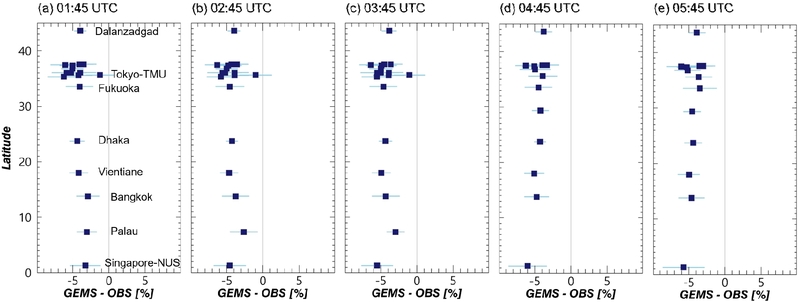
Relative differences (mean ± standard deviation) between GEMS and Pandora total column ozone for 2024 at hourly observation times from 01:45 to 05:45 UTC.
Fig. 7은 판도라 관측소가 상대적으로 밀집되어 있는 한국과 일본 지역을 확대하여, GEMS 오존 전량 배경장과 판도라 관측소의 공간적 분포를 2025년 3월 28일 01:45, 03:45, 06:45 UTC 시각에 대해 비교한 결과이다. Fig. 6에서 확인된 GEMS 오존 전량의 내재적 편향을 고려하여, 본 사례분석에서는 시·공간적 조건과 관계없이 일괄적으로 +15 DU의 보정을 적용하였다. 분석결과, 한반도를 경계로 북쪽으로 갈수록 오존 전량이 증가하고 남쪽으로 갈수록 감소하는 뚜렷한 남북 위도 구배가 나타났다. 이는 봄철 성층권 순환에 의해 고위도에서 오존이 축적되는 계절적 특성을 반영한 결과로 해석된다. 이로 인해 한반도 내 판도라 관측소 간 오존 전량 차이는 03:45 UTC 사례에서 약 30 DU에 달했으며, 이러한 공간 구배는 GEMS 산출물에서도 유사하게 재현되었다. 한편, 오존의 일변화는 주로 지표 부근에서의 광화학적 생성·소멸 과정에 의해 조절되지만, 봄철에는 그 변동 폭이 성층권 역학에 의해 형성되는 대규모 공간 구배에 비해 상대적으로 작다. 따라서 본 사례에서는 GEMS와 판도라 자료 모두에서 시간대별로 유의미한 변화는 나타나지 않았다.
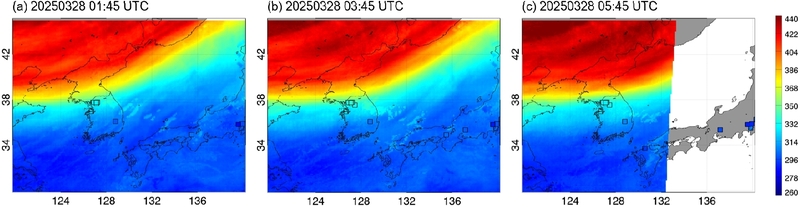
Spatial distribution of total column ozone from GEMS (shown as contours) and Pandora ground-based measurements (shown as symbols) at (a) 01:45, (b) 03:45, and (c) 06:45 UTC on 28 March 2025.
4. 결 론
본 연구에서는 돕슨, 브루어, 판도라 간 오존 전량 자료의 일관성을 평가함으로써, 판도라 관측망이 GEMS 산출물 검증에 활용 가능한 신뢰성 있는 자료임을 확인하였다. 또한 돕슨과 브루어 지상관측이 동시에 운영되고 있는 츠쿠바 관측소의 장기 관측 자료를 활용하여 두 기기 간 체계적 편차와 통계적 일관성을 추가로 분석하였다. 특히 산란광 관측에 비해 직달광 관측에서 두 기기 간 평균 편차가 더욱 뚜렷하게 나타났으며, 이는 관측 기하 조건 및 대기 산란 효과의 차이에 기인한 것으로 해석된다. 기기 결함이 확인된 Pandora 196번 장비(삿포로)를 제외하고 판도라와 비교가 가능한 4개 돕슨/브루어 관측 자료 세트를 분석한 결과, RMSE는 1.88–2.08%, 표준편차는 1.97–2.95% 범위로 전반적으로 양호한 통계적 일치도를 보였다. 또한 분석 기간(2021–2025년) 동안 두 자료 간 장기 추세에서 유의미한 변화는 나타나지 않았으며, 두 관측 시스템은 기기 노후화에 따른 성능 저하 없이 안정적으로 운영된 것으로 판단된다.
GEMS 오존 전량 산출물은 판도라 관측 자료와의 비교에서 전반적으로 약 5% 수준의 체계적 과소추정 경향을 보였다. 이는 오존 전량 산출에 사용되는 위성 입력 자료를 처리하는 Level-1 단계에서의 BTDF 광확특성에 대한 보정과 장기 감도 변화에 대한 보정이 반영되지 않아 잔류된 검보정 영향으로 해석된다. 편차는 위도에 따라 비교적 일관되게 나타났으며, 관측 시각에 따른 평균 편차의 변화도 크지 않아, GEMS 오존 전량 산출물이 시간적 측면에서도 안정적인 산출 신뢰성을 유지하고 있음을 보여준다. 또한 GEMS는 봄철 남북 위도 구배가 뚜렷한 사례에서도 오존 전량의 공간 분포를 판도라 관측 자료와 전반적으로 일치하는 수준으로 재현하였다.
이러한 결과는 판도라 관측망을 기반으로 GEMS 오존 전량 산출물의 체계적 편향을 지속적으로 평가하고 보정할 수 있는 검증 체계를 구축할 수 있음을 보여주며, GEMS 장기 자료의 품질 일관성 확보와 장기 변동성 분석의 신뢰도 향상에 활용될 수 있을 것으로 기대된다.
Acknowledgments
이 연구는 정부(교육부)의 재원으로 한국연구재단의 지원을 받아 수행되었음(NO. RS-2023-00247459).
REFERENCES
-
Bak, J., Yang, K., Keppens, A., Kim, M., Liu, X., Kim, J. H., 2025, Geostationary environment monitoring spectrometer (GEMS): Long-term radiometric accuracy and spectral stability from 4.5 years of on-orbit solar irradiance observations, IEEE Trans. Geosci. Remote Sens., 63.
[https://doi.org/10.1109/TGRS.2025.3627802]

-
Bak, J., Keppens, A., Choi, D., Hong, S., Kim, J.-H., Kim, C.-H., Lee, H.-J., Jeon, W., Kim, J., Koo, J.-H., Kim, J., Baek, K., Yang, K., Liu, X., Abad, G. G., Heue, K.-P., Lambert, J.-C., Jung, Y., Hong, H., Lee, W.-J., 2026, GEMS ozone profile retrieval: Impact and validation of version 3.0 improvements, Atmos. Meas. Tech., 19, 119–134.
[https://doi.org/10.5194/amt-19-119-2026]
-
Bak, J., Liu, X., Kim, J. H., Chance, K., Haffner, D. P., 2015, Validation of OMI total ozone retrievals from the SAO ozone profile algorithm and three operational algorithms with Brewer measurements, Atmos. Chem. Phys., 15, 667-683.
[https://doi.org/10.5194/acp-15-667-2015]
-
Dobson G. M. B., 1931, A Photoelectric spectrophotometer for measuring the amount of atmospheric ozone, Proc. Phys. Soc., 43(3), 324.
[https://doi.org/10.1088/0959-5309/43/3/308]
-
Fioletov, V. E., Kerr, J. B., McElroy, C. T., Wardle, D. I., Savastiouk, V., Grajanr, T. S, 2005, The Brewer reference triad, Geophys. Res. Lett., 32(20).
[https://doi.org/10.1029/2005GL024244]
-
Fiore, A. M., Naik, V., Spracklen. D. V., Steiner A., Unger N., Parather M., Bergmann, D., Cameron-Smith, P. J., Cionni, I., Collins, W. J., Dalsoren, S., Eyring, V., Folberth, G. A., Ginoux, P., Horowitz, L. W., Josse, B., Lamarque, J. F., Mackenzie, I. A., Nagashima, T., O'Connor, F. M., Righi, M., Rumbold, S. T., Shindell, D. T., Skeie, R. B., Sudo, K., Szopa, S., Takemura T., Zeng, G., 2012, Global air quality and climate, Chem. Soc. Rev., 41, 6663-6683.
[https://doi.org/10.1039/c2cs35095e]
-
Harris J. M., Oltmans S. J., Bodeker G. E., Stolarski R., Evans R. D., Quincy D. M., 2003, Long-term variations in total ozone derived from Dobson and satellite data, Atmos. Environ., 37, 3167-3175.
[https://doi.org/10.1016/S1352-2310(03)00347-9]
-
Heck, W. W., Adams, R. M., Cure, W. W., Heagle, A. S., Heggestad, H. E., Kohut, R. J., Kress, L. W., Rawling, J. O., Taylor, O. C., 1983, A Reassessment of crop loss from ozone, Environ. Sci. Technol., 17(22), 572-581.
[https://doi.org/10.1021/es00118a001]
-
Herman, J., Evans, R., Cede, A., Abunhassan, N., Petropavlovskikh, I., McConville, G., 2015, Comparison of ozone retrievals from the Pandora spectrometer system and Dobson spectrophotometer in Boulder, Colorado, Atmos. Meas. Tech., 8, 3407-3418.
[https://doi.org/10.5194/amt-8-3407-2015]
-
Holm, S. M., Balmes, J. R., 2021, Systematic review of ozone effects on human lung function, 2013 through 2020, Chest, 161(1), 190-201.
[https://doi.org/10.1016/j.chest.2021.07.2170]
-
Hong, S., Bak, J., Keppens, A., Yang, K., Baek, K., Liu, X., Kim, M., Kim, J., Chang, L.-S., Lee, H., Kim, J.-H., 2025, Cross-validation of GEMS total ozone from ozone profile and total column products using Pandora and satellite observations, Remote Sens., 17(18), 3249.
[https://doi.org/10.3390/rs17183249]
-
Hood, L. L., Soukhare, B. E., 2005, Interannual variations of total ozone at northern midlatitudes correlated with stratopsheric EP flux and potential vorticity, J. Atmos. Sci., 62, 3724-3740.
[https://doi.org/10.1175/JAS3559.1]
-
Ingmann, P., Veihelmann, B., Lang en, J., Lamarre, D., Stark, H., Courrèges-Lacoste, G. B., 2012, Requirements for the GMES atmosphere service and ESA’s implementation concept: Sentinels-4/-5 and –5p, Remote Sens. Environ., 120, 58–69.
[https://doi.org/10.1016/J.RSE.2012.01.023]
-
Kerr, J. B., 2002, New methodology for deriving total ozone and other atmospheric variables from Brewer spectrophotometer direct sun spectra, J. Geophys. Res. Atmos., 107(23), Pages ACH-22–1-ACH22 -17.
[https://doi.org/10.1029/2001JD001227]
-
Kerr, J. B., Asbridge, I. A., Evans, W. F. J., 1988, Intercomparison of total ozone measured by the Brewer and Dobson spectrophotometers at Toronto, J. Geophys. Res. Atmos., 93, 11129-11140.
[https://doi.org/10.1029/JD093iD09p11129]
- Kerr, J. B., McElroy, C. T., Olafson, R. A., 1981, Measurements of ozone with the Brewer spectrophotometer, Proc. Quadrennial Int. Ozone Symp., Colorado, USA, 74-79.
-
Kim, J., Jeong, U., Ahn, M.-H., Kim, J. H., Park, R. J., Lee, H., Song, C. H., Choi, Y.-S., Lee, K.-H., Yoo, J.-M., Jeong, M.-J., Park, S. K., Lee, K.-M., Song, C.-K., Kim, S.-W., Kim, Y. J., Kim, S.-W., Kim, M., Go, S., Liu, X., Chance, K., Miller, C. C., Al-Saadi, J., Veihelmann, B., Bhartia, P. K., Torres, O., Abad, G. G., Haffner, D. P., Ko, D. H., Lee, S. H., Woo, J.-H., Chong, H., Park, S. S., Nicks, D., Choi, W. J., Moon, K.-J., Cho, A., Yoon, J., Kim, S., Hong, H., Lee, K., Lee, H., Lee, S., Choi, M., Veefkind, P., Leve lt, P. F., Edwards, D. P., Kang, M., Eo, M., Bak, J., Baek, K., Kwon, H.-A., Yang, J., Park, J., Han, K. M., Kim, B.-R., Shin, H.-W., Choi, H., Lee, E., Chong, J., Cha, Y., Koo, J.-H., Irie, H., Hayashida, S., Kasai, Y., Kanaya, Y., Liu, C., Lin, J., Crawford, J. H., Carmichael, G. R., Newchurch, M. J., Lefer, B. L., Herman, J. R., Swap, R. J., Lau, A. K. H., Kurosu, T. P., Jaross, G., Ahlers, B., Dobber, M., McElroy, C. T., Choi, Y., 2020, New era of air quality monitoring from space: Geostationary environment monitoring spectrometer (GEMS), Bull. Am. Meteorol. Soc., 101(1), E1–E22.
[https://doi.org/10.1175/BAMS-D-18-0013.1]
- Kim, J. H., Baek, K. H., Lee, H. J, 2024, Geostationary environment monitoring spectrometer (GEMS) ATBD Total Column Retrieval Algorithm, https://nesc.nier.go.kr/ko/html/satellite/doc/doc.do, (accessed on Oct. 29, 2025).
- Komhyr, W. D., Evans R. D., 2008, Operations handbook-Ozone observations with a Dobson spectrophotometer revised 2008, WMO Global Ozone Research and Monitoring Project, GAW Report No. 183, WMO GAW, Geneva, Switzerland, 85, https://gml.noaa.gov/ozwv/dobson/GAW183-Dobson-WEB.pdf, (accessed on Feb. 2, 2026).
-
Krzyścin, J. W., Rajewska-Więch, B., Jarosławski, J., 2021, Total column ozone measurements by the Dobson spectrophotometer at Belsk (Poland) for the period 1963–2019: homogenization and adjustment to the Brewer spectrophotometer, Earth Syst. Sci. Data, 13(9), 4425–4436.
[https://doi.org/10.5194/essd-13-4425-2021]
-
Lee, K., Lee, D.-W., Chang, L.-S., Yu, J.-A., Lee, W.-J., Kang, K.-H., Jeong, J., 2024, Pionnering air quality monitoring over East and Southeast Asia with the geostationary environment monitoring spectrometer (GEMS), Korean J. Remote Sens., 40, 741-752.
[https://doi.org/10.7780/kjrs.2024.40.5.2.5]
-
Liu, J., Wang, L., Li, M., Liao, Z., Sun, Y., Song, T., Gao, W., Wang, Y., Li, Y., Ji, D., Hu, B., Kerminen, V.-M., Wang, Y., Kulmala, M., 2019, Quantifying the impact of synoptic circulation patterns on ozone variability in northern China from April to October 2013–2017, Atmos. Chem. Phys., 19, 14477–14492.
[https://doi.org/10.5194/acp-19-14477-2019]
-
Park, S. S., Jeong, U., Kwon, H. A., 2025, Introduction of ground-based remote sensing and applications for air quality monitoring, J. Korean Soc. Atmos. Environ., 41(2).
[https://doi.org/10.5572/KOSAE.2025.41.2.254]
-
Rawat, P., Crawford, J. H., Travis, K. R., Judd, L. M., Demetillo, M. A. G., Valin, L. C., Szykman, J. J., Whitehill, A., Baumann, E., Hanisco, T. F., 2025, Maximizing the scientific application of Pandora column observations of HCHO and NO2, Atmos. Meas. Tech., 18, 2899–2917.
[https://doi.org/10.5194/amt-18-2899-2025]
-
Redondas, A., Evans, R., Stuebi, R., Köhler, U., Weber, M., 2014, Evaluation of the use of five laboratory-determined ozone absorption cross sections in Brewer and Dobson retrieval algorithms, Atmos. Chem. Phys., 14, 1635–1648.
[https://doi.org/10.5194/acp-14-1635-2014]
-
Russo, M. R., Kerridge, B. J., Abraham, N. L., Keeble, J., Latter, B. G., Siddans, R., Weber, J., Griffiths, P. T., Pyle, J. A., Archibald, A. T., 2023, Seasonal, interannual and decadal variability of tropospheric ozone in the North Atlantic: Comparison of UM-UKCA and remote sensing observations for 2005–2018, Atmos. Chen. Phys., 23, 6169–6196.
[https://doi.org/10.5194/acp-23-6169-2023]
-
Scarnato, B., Staehelin, J., Stubi, R., Schill, H., Buchmann, B., 2009, Intercomparision of Dobson and Brewer UV spectral measurements at Arosa, Switzerland, J. Geophys. Res. Atmos., 114, D24301.
[https://doi.org/10.1029/2008JD011560]
- Seinfeld, J. H., Pandis, S. N., 2016, Atmospheric chemistry and physics: From air pollution to climate change, 3rd. ed., John Wiley & Sons. Inc., New Jersey.
-
Spinei, E., Whitehill, A., Fried, A., Tiefengraber, M., Knepp, T. N., Herndon, S., Herman, J. R., Müller, M., Abuhassan, N., Cede, A., Richter, D., Walega, J., Crawford, J., Szykman, J., Valin, L., Williams, D. J., Long, R., Swap, R. J., Lee, Y., Nowak, N., Poche, B., 2018, The first evaluation of formaldehyde column observations by improved Pandora spectrometers during the KORUS-AQ field study, Atmos. Meas. Tech., 11, 4943–4961.
[https://doi.org/10.5194/amt-11-4943-2018]
-
Toihir, A. M., Portafaix, T., Sivakumar, V., Bencherif, H., Pazmiño, A., Bègue, N., 2018, Variability and trend in ozone over the southern tropics and subtropics, Ann. Geophys., 36(2), 381–404.
[https://doi.org/10.5194/angeo-36-381-2018]
-
Vaníček, K., Metelka, L., Skřivánková, P., Staněk, M., 2012, Dobson, Brewer, ERA-40 and ERA-Interim original and merged total ozone data sets – evaluation of differences: A Case study, Hradec Králové (Czech), 1961–2010, Earth Syst. Sci. Data, 4, 91–100.
[https://doi.org/10.5194/essd-4-91-2012]
- WHO (World Health Organization), 2021, WHO global air quality guidelines: particulate matter (PM2.5 and PM10), ozone, nitrogen dioxide, sulfur dioxide and carbon monoxide, Geneva, https://iris.who.int/bitstream/handle/10665/345329/9789240034228-eng.pdf, (accessed on Jan. 30, 2026).
-
Zoogman P., Liu, X., Suleiman, R. M., Pennington, W. F., Flittner, D. E., Al-Saadi, J. A., Hilton, B. B., Nicks, D. K., Newchurch, M. J., Carr, J. L., Janz, S. J., Andraschko, M. R., Arola, A., Baker, B. D., Canova, B. P., Miller, C. C., Cohen, R. C., Davis, J. E., Dussault, M. E., Edwards, D. P., Fishman, J., Ghulam, A., González Abad, G., Grutter, M., Herman, J. R., Houck, J., Jacob, D. J., Joiner, J., Kerridge, B. J., Kim, J., Krotkov, N. A., Lamsal, L., Li, C., Lindfors, A., Martin, R. V., McElroy, C. T., McLinden, C., Natraj, V., Neil, D.O., Nowlan, C. R., O'Sullivan, E. J., Palmer, P. I., Pierce, R. B., Pippin, M. R., Saiz-Lopez, A., Spurr, R. J. D., Szykman, J. J, Torres, O., Veefkind, J. P., Veihelmann, B., Wang, H., Wang, J., Chance, K., 2017, Tropospheric emissions: Monitoring of pollution (TEMPO), J. Quant. Spectrosc. Radiat. Transf., 186, 17-39.
[https://doi.org/10.1016/j.jqsrt.2016.05.008]
Department of Atmospehric Science, Pusan National University iamhyunjin@gmail.com
Institute of Environmental Studies, Pusan National Univeristy juseonbak@pusan.ac.kr
Institute of Environmental Studies, Pusan National Univeristy ymjeong@pusan.ac.kr