
이해관계자별 프레이밍에 따른 산림복지 서비스의 가치 인식 차이
Ⓒ The Korean Environmental Sciences Society. All rights reserved.
This is an Open-Access article distributed under the terms of the Creative Commons Attribution Non-Commercial License (http://creativecommons.org/licenses/by-nc/3.0) which permits unrestricted non-commercial use, distribution, and reproduction in any medium, provided the original work is properly cited.
Abstract
Despite the expansion of forest welfare services in South Korea, a critical gap persists in how stakeholders perceive their social values. To address this, the structural differences in value perceptions between practitioners and users were investigated using the Common International Classification of Ecosystem Services (CICES) v5.2 framework. The 15 social value indicators were restructured into regulating, cultural, and support services to identify stakeholder framing. Data from 16 project sites (n = 68; seven practitioners and 61 users) were analyzed using Term Frequency (TF)-based text mining. Results revealed a significant “value framing gap”. Practitioners predominantly employed an analytical frame centered on quantifiable performance management, using keywords like “indicator”, “measurement”, and “impact”. Conversely, users adopted an experience-oriented frame focused on social interaction and accessibility, emphasizing “facility”, “space”, and “together”. The disparity was greatest in cultural services, where users prioritized emotional restoration and relational values, social bonds, and community belonging, whereas practitioners focused on evaluative metrics. This indicates that the social capital fostered through forest welfare is systematically underrepresented in current quantitative frameworks. These findings provide empirical grounds for advancing demand-oriented policies by supplementing supply-side metrics with relational and experiential dimensions.
Keywords:
Ecosystem services, Green fund, Forest welfare, Value framing, Stakeholder perception, Social capital1. 서 론
생태계서비스(Ecosystem Services, ES) 연구는 지난 20여 년간 평가 대상과 개념적 범위를 지속적으로 확장해 왔다. MEA (Millennium Ecosystem Assessment, 2005)는 ES 평가의 초점을 생물・물리적 기능에서 인간의 복지로 전환하는 분기점이 되었으며, 이후 International Classification of Ecosystem Services, 2023)의 분류 표준화와 IPBES (Intergovernmental Science-Policy Platform on Biodiversity and Ecosystem Services, 2019)의 NCP (Nature's Contributions to People) 개념 도입을 통해 비물질적・관계적 가치에 대한 국제적 관심이 높아졌다. 관계적 가치(relational value)란 생태계와 인간의 상호의존적 관계에서 파생되는 문화적・사회적・심리적 편익을 의미하며(Chan et al., 2012), 이해관계자 집단이 ES를 인식하고 해석하는 방식인 가치 프레이밍(value framing)은 집단의 사회적・제도적 맥락에 따라 구조적으로 달라질 수 있다(Tadaki et al., 2017). 실제로 WHO Europe(2023)은 녹・청색 공간이 신체적・정신적 건강에 기여하는 경로를 체계화하며 보건 정책과의 연계를 권고한 바 있다.
그러나 이러한 제도적 발전이 정책 현장에서 이해관계자 간 가치 인식의 수렴으로 곧바로 이어지지는 않는다. ES 분류 체계가 정교해졌음에도 불구하고, 정책 실무자와 이용자 사이의 맥락 의존적 인식 차이는 정책 실행 단계에서 구조적 불일치를 반복적으로 야기하는 것으로 보고된다(Zhang et al., 2022). 문화적 ES에 대한 이해관계자 간 인식 차이는 정책 수용성과 실행 효과를 실질적으로 저하시킬 수 있으며, 분류 체계의 정비가 현장 행위자들의 가치 인식을 자동으로 수렴시키지 않는다는 점에서 집단 간 인식 격차를 실증적으로 규명하는 작업은 정책 설계의 선결 과제로 간주된다(Sultana et al., 2022).
해당 이슈는 국내 산림복지 정책의 핵심 재원인 녹색자금 운용 현장에서 구체적으로 확인된다. 녹색자금은 「복권 및 복권기금법」에 따른 복권수익금을 재원으로 하며, 「산림자원의 조성 및 관리에 관한 법률」 제58조에 근거하여 산림환경 보호와 산림 기능 증진을 목적으로 설치된 공익적 기금이다(FOWI, 2026a). 국토의 약 63%가 산림인 한국에서 산림 이용은 목재 생산과 보전을 넘어 도시숲, 공원, 생활권 녹지로 확대되고 있으며(Jo et al., 2021; Park et al., 2023), 이에 따른 이용 수요도 증가 추세에 있다. 제6차 산림기본계획(2018~2037)에 따르면 산림복지 인프라는 2018년 664개소에서 2022년 1,058개소로 확충되었으나(KFS, 2018), 동일 조사에서 산림치유 인지율(69%) 및 이용의향(45.4%)에 비해 실제 경험률은 1.7%에 그쳤다. 두 수치는 측정 대상이 상이하여 직접 비교에 한계가 있으나, 인프라의 양적 공급만으로는 이용자의 실질적 편익 체감이 충분히 담보되지 않을 수 있음을 시사한다.
선행연구를 검토한 결과, 국내 산림복지 서비스 평가는 주로 탄소 흡수량, 열섬 완화, 미세먼지 저감 등 측정 가능성이 높은 공급 중심의 정량 지표에 편중되어 왔다(Cho et al., 2024). 이러한 경향은 정책 실무자가 조절서비스의 공학적 성과나 경제적 파급효과와 같이 비교적 계량화가 용이한 지표를 중심으로 정책 효과를 설명해 온 기존 연구 경향과 궤를 같이하는 것으로 해석될 수 있다. 반면, 이용자는 산림 환경에서의 정서적 회복, 사회적 고립 해소, 공동체적 유대와 같은 관계적 가치를 핵심 편익으로 인식하는 경향이 보고된다(Jeong et al., 2025). 이처럼 ‘관리 효율성 중심의 산림’과 ‘삶의 질 개선을 위한 공간으로서의 산림’ 사이의 구조적 인식 차이는 국내 사례연구들에서도 일관되게 확인된다. 구체적으로 산림 관리자와 이용자 간의 서비스 선호도 비대칭성(Jo et al., 2021) 및 산림 복원 사업에서의 전문가-주민 간 인식 분리(Lee et al., 2025)가 실증된 바 있다. 그러나 이들 연구는 대개 설문조사 등 정형화된 척도에 의존하고 있어, 이해관계자가 발화하는 실제 언어 속에 내재된 다층적인 가치 프레이밍을 포착하는 데 한계가 있다. 특히 국제 표준인 CICES 분류 체계를 준거로 국내의 구체적인 정책 지표(녹색자금 평가지표)를 재구조화하고, 이를 실제 이용자의 비정형 데이터와 대조하여 인식 격차의 실체를 규명한 연구는 여전히 제한적인 실정이다.
본 연구는 위와 같은 연구 공백을 배경으로, CICES v5.2 프레임워크를 이론적 준거로 삼아 녹색자금 지원사업의 2024년 사회적 가치 평가지표 15개를 ES 기능 범주로 재구조화하고, 현장 인터뷰 발화 데이터의 텍스트 마이닝 분석을 통해 실무자와 이용자 간 가치 인식의 구조적 차이를 실증적으로 규명하는 것을 목적으로 한다. 이는 정량 지표 체계에서 충분히 가시화되지 않았던 사회적 포용과 문화서비스 범주의 편익을 체계적으로 탐색할 수 있다는 점에서 방법론적 의의가 있다. 또한 국내 정책 지표 체계를 국제 ES 담론과 연결하는 개념적 가교를 제공함으로써, 향후 수요자 중심의 산림복지 정책 고도화 및 녹색자금 사업의 사회적 가치 측정 방법론 개선에 실증적 근거를 제시하고자 한다.
2. 재료 및 방법
2.1. 이론적 프레임워크
본 연구는 「2024년 녹색사업 사회적 가치 측정」보고서 결과에서 도출된 15개 정량 지표를 분석의 이론적 기반으로 활용하였다(FOWI, 2024). 해당 지표는 녹색사업의 사회적 가치를 환경, 웰빙증진, 지역경제, 사회통합의 네 영역으로 구분한다. 본 연구에서는 이를 정책 성과 지표로만 활용하는 데 그치지 않고, CICES v5.2 분류 체계에 따라 조절서비스, 문화서비스, 지지・유지서비스로 재구조화하였다(CICES, 2023).
재분류 작업의 타당성을 확보하기 위해 다음의 절차를 적용하였다. 첫째, 각 CICES 범주에 대한 조작적 정의를 문헌에 근거하여 설정하였다. 조절서비스는 '생태계가 생물・물리적 과정을 통해 인간 환경을 조절하는 기능', 문화서비스는 '생태계와의 비물질적 상호작용을 통해 인간이 얻는 심리적・사회적・경제적 편익으로서 관계적 가치를 포함하는 것', 지지・유지 기능은 '생태계서비스의 토대가 되는 구조적・기능적 생태 과정'으로 각각 정의하였다. 둘째, 지역경제 및 사회통합 관련 지표는 생태계의 비물질적 기여가 사회・경제적 결과로 연결된다는 CICES 해석 틀(Haines-Young, 2023)과 Chan et al.(2012)의 관계적 가치 논의에 근거하여 문화서비스의 파생적 성과로 설정하였다. CICES v5.2는 지지서비스를 독립적 최종 서비스 범주로 분류하지 않으므로, 산소 생산과 생물다양성 보전은 분석적 명확성을 위해 '지지・유지 기능'으로 별도 표기하였다. 15개 지표의 범주별 대응 관계는 Table 1과 같다.

Reclassification of 15 Social Value Indicators in 2024 Based on CICES (2023)
2.2. 연구 대상지
2025년도 녹색자금 지원사업은 공간 조성 및 환경 개선을 목적으로 하는 취약지역 녹색인프라 확충사업(hardware, HW)과 취약계층 대상 숲체험・교육 지원사업(software, SW)으로 구분된다(FOWI, 2026b). HW 사업군은 사회복지시설 실내 환경 개선을 위한 산림복지목재인테리어(실내나눔숲), 취약계층 주거지 인근 녹지 조성을 위한 산림복지나눔숲(실외나눔숲), 보행 약자의 산림 접근성 제고를 위한 산림복지무장애나눔길(무장애나눔길), 도시 공원 내 유니버설 디자인 적용을 목적으로 하는 산림복지도시숲무장애환경(무장애도시숲)의 4개 세부 유형으로 구성된다. SW 사업군은 효과증진 및 체험확산형 공모사업・직접사업을 포괄하는 숲체험・교육 프로그램과 국립산림치유원・국립숲체원 등 거점 시설을 통한 전문 서비스 제공의 2개 유형을 포함한다. 최종 연구 대상지는 사업 유형별 대표성과 수도권・충청권・호남권의 지역적 균형을 고려하여 유형별 2개소씩 총 16개소를 선정하였다.
2.3. 자료 수집
본 연구는 사업 현장에서 이용자와 실무자가 체감하는 가치를 수집하기 위해 2025년 11월 3일부터 11월 20일까지 전국 16개 사업지에서 심층 인터뷰와 설문을 병행하였다. 표본은 실무자 7명과 이용자 61명, 총 68명으로 구성되었다. 실무자 표본은 녹색자금 지원사업에 대한 정책 이해도가 높은 담당자(한국산림복지진흥원 주임급 이상)를 중심으로 기관 추천을 통해 모집하였다. 실무자 표본이 7명으로 소규모인 것은 녹색자금 사업 전담 인력 풀이 구조적으로 제한적이라는 현실에 기인한다. 이용자 표본은 각 사업 유형의 실제 방문자를 대상으로 현장 표집으로 모집하였다.
조사 방식은 사회・경제적 취약계층 및 고령층 이용자의 문해력 수준 차이를 고려하여, 조사자가 구어체로 질문 내용을 해설하고 응답을 기록하는 반구조화 인터뷰를 채택하였다. 인터뷰 질문지는 응답자 기본 정보, 가치 체감도, 종합 의견의 세 파트로 구성되었다. 가치 체감도 파트는 5점 리커트 척도 기반 만족도 평가 문항을 포함하였다. 이는 구술 중심의 인터뷰 응답을 수량화하여 집단 간 체감 수준의 차이를 보조적으로 파악하고 질적 응답 내용을 구체화하기 위한 보완적 수단으로 활용되었다. 이러한 다각적 접근은 정량측정과 질적 조사를 통합하여 연구의 외적 타당성을 확보하려는 혼합연구법(mixed methods)의 설계 원리에 기초한다(Creswell and Plano Clark, 2018). 수치로 나타나는 집단 간 체감 차이를 어휘 분석을 통해 내용적・구조적 맥락에서 규명함으로써, 가치 인식 격차를 삼각검증하고 해석의 신뢰도를 높이고자 하였다.
모든 음성 데이터는 분석 전에 전사 및 인덱싱 과정을 거쳤다. 모든 참여자에게는 연구 목적, 자료 활용 방식, 익명성 보장 원칙을 사전에 고지하였으며, 자발적 참여 동의를 확인한 후 조사를 진행하였다. 응답자 분포는 Table 2에 제시하였다.
Distribution of survey respondents by project type and site (n=68)
2.4. 자료 분석
수집된 인터뷰 자료로부터 재현 가능한 분석 결과를 도출하기 위해, 본 연구는 자연어 처리(NLP) 기반 어휘 빈도 분석과 질적 내용 분석을 유기적으로 결합된 통합 분석 체계를 적용하였다(Creswell and Plano Clark, 2018). 분석은 자료 구조화, 형태소 분석 및 불용어 제거, 빈도 분석 및 시각화 순으로 진행되었다(Fig. 1).

Text-mining workflow for keyword extraction and comparative analysis. The process includes transcription, preprocessing, keyword extraction, frequency analysis, and word cloud visualization (≥ 5 occurrences) to compare perception structures between practitioners and users.
세부적으로, 첫째 자료 구조화 단계에서는 68건의 음성 데이터를 Naver Clova AI 엔진으로 1차 전사한 후, 연구자 2인이 원본 음성과 대조하는 수동 검교정을 수행하였다. 단, 검교정 과정이 내부 연구자로만 이루어진 점에서 외부 독립 검교정자의 참여를 통한 교차 검증이 수행되지 못한 것은 본 연구의 방법론적 한계로 인정된다. 그 다음 전사 자료는 발화 구간 단위로 분할한 후 화자, 역할(Q/A), 발화 내용, 지표별 고유 식별 코드(예: bQSEs1, bQSEs2) 등의 메타데이터를 포함하는 엑셀 기반 데이터셋으로 재편성하였다(Table 3). 분석 대상은 응답자(A) 발화로 한정하고, 조사자(Q) 발화는 제외하였다.
Sample of data restructuring into an Excel-compatible format (.csv) with interval-wise indexing applied
둘째, 형태소 분석 및 불용어 제거 단계에서는 Python fk KoNLPy의 Okt(Open Korean Text) 형태소 분석기를 활용하였다. Okt는 구어체 전사 데이터에서의 오탈자 보정 및 어간 추출(stemming) 성능이 우수한 것으로 평가된 바 있어 분석 도구로 선택하였다(Park and Cho, 2014). 추출된 형태소는 명사・동사・형용사로 분류하고 활용형을 사전적 기본형으로 정규화하였다. 의미 분석에 기여하지 않는 고빈도 형태소를 제거하기 위해 Kil(2018)의 한국어 표준 불용어 목록을 기초로 6단계 불용어 제거 알고리즘을 설계하였다(Table 4). 이 과정에서 ‘사업’, ‘나눔’ 등 정책명칭에 포함되어 반복적으로 출현하는 용어는 분별력을 저해할 우려가 있어 ‘Contextual’ 단계에서 제외 처리하였다. 불용어 목록은 연구자 2인의 독립 검토를 거쳐 확정하였다.
6-step stopword removal process (based on Kil, 2018)
셋째, 핵심 어휘 추출 및 빈도 분석 단계에서는 정제된 형태소를 대상으로 단어 빈도(term frequency, TF)를 산출하였다. 실무자와 이용자 집단 간 상위 빈도 어휘의 일치도와 순위 변동 폭을 비교함으로써 두 집단이 지각하는 가치 프레임의 구조적 차이를 분석하였다.
넷째, 시각화 및 어휘 분석 단계에서는 분석 단위의 규모와 데이터의 밀도를 고려하여 차등적인 빈도 임계치(threshold)를 적용하였다. 여기서 ‘시각화’는 워드클라우드(word cloud)를 활용하여 추출된 고빈도 어휘를 빈도 비례 크기로 배열함으로써 두 집단의 가치 인식 구조를 시각적으로 비교・제시하는 것을 의미한다. 집단 간 전반적인 가치 인식 구조를 비교하기 위한 워드클라우드 생성 시에는 시각적 노이즈를 제거하고 핵심 어휘에 초점을 맞추기 위해 원시 빈도 5회 이상의 어휘를 추출하였다(Liu et al., 2022). 반면, CICES 범주별 15개 세부 지표 분석에서는 데이터가 특정 발화 구간으로 세분화됨에 따라 발생하는 키워드 누락을 방지하고 분석의 유의성을 확보하기 위해 TF 2회 이상의 어휘를 분석 범위에 포함하였다. 이는 소규모 말뭉치나 세분화된 텍스트 구간에서 높은 임계치를 설정할 경우 유의미한 패턴임에도 분석에서 제외되는 정보 누락 문제를 방지하기 위한 조치로(Bestgen, 2018), 데이터의 파편화로 인한 정보 손실을 최소화하면서도 개별 지표 내에서 나타나는 유의미한 맥락을 포착하기 위함이다. 어휘 빈도 분석만으로 파악하기 어려운 발화의 맥락적 의미는 상위 빈도 어휘가 포함된 구간을 원문으로 재확인하는 귀납적 내용 분석을 통해 보완하였다.
다만, 본 연구에서는 두 집단 간 어휘 구조의 차이를 코사인 유사도(cosine similarity) 등 통계적 거리 측도로 정량화하여 검증하지는 않았다. 이는 소규모 말뭉치와 분석 단위의 이질성에 기인하는 바, 향후 연구에서는 어휘차이를 통계적으로 검증할 수 있는 방법론(예: 유사도 분석, LDA 토픽 모델링 등)을 도입하여 본 연구의 탐색적 결과를 재확인 할 필요가 있다. 또한 본 연구는 HW 및 SW 사업군 산하 6개 유형을 통합적으로 분석하였으나, 각 유형이 상이한 목적과 대상을 지향함에 따라 사업 유형별 이해관계자 간 어휘 패턴에도 차이가 존재할 수 있다. 소표본 제약으로 인해 사업 유형을 독립변수로 한 하위집단 분석을 실시하지 못한 것은 본 연구의 한계이며, 향후 충분한 표본이 확보된 연구에서 이를 보완하는 비교 분석이 수행될 필요가 있다.
3. 결과 및 고찰
3.1. 이용자-실무자 간 가치 인식 비교
녹색자금 지원사업에 대한 실무자(n=7)와 이용자(n=61)의 TF 기반 어휘 분석 결과, 두 집단은 동일한 사업을 경험하면서도 서로 다른 어휘 구조를 나타냈다(Fig. 2; Table 5). 실무자의 상위 어휘는 ‘지표(75)’, ‘지역(49)’, ‘효과(43)’, ‘측정(28)’으로, 사업의 성과를 관리하고 입증해야 하는 정책적 과제로 인식하는 경향을 보여준다. 이러한 어휘 구조는 ES를 정량화 가능한 단위로 환산하려는 관리 합리성의 맥락과 유사하며(Edens et al., 2022), 정책 실무자가 조절서비스의 공학적・경제적 지표를 우선시하는 분석적 프레임(Cho et al., 2024)이 실무자의 인식 구조에 반영된 결과로 해석된다. 한편 실무자 7위에 위치한 ‘계속(29)’은 사업의 지속적 운영과 반복적 성과 확인에 대한 관심을 반영하는 것으로 판단된다.
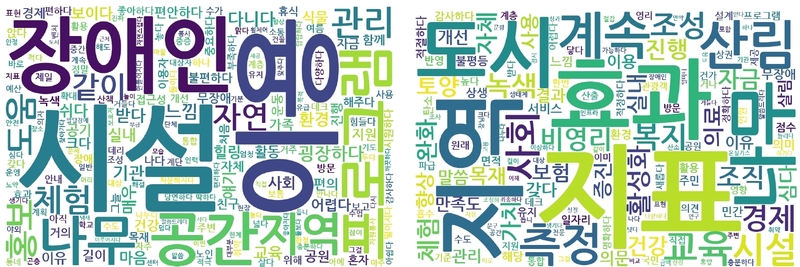
Comparison of high-frequency keyword (≥ 5 occurrences) reflecting value perception of users (left) and practitioners (right).
Frequency analysis of core keyword (Top 20) for users and practitioners
반면 이용자의 상위 어휘는 ‘시설(119)’, ‘이용(110)’, ‘장애인(106)’, ‘공간(100)’, ‘같이(56)’, ‘굉장하다(54)’, ‘느낌(53)’으로, 일상적 접근 경험과 사회적 관계를 중심으로 구성되었다. 이용자에게 해당 사업은 행정적 성과물이 아닌 일상적 경험과 관계가 형성되는 생활 공간으로 인식되고 있음을 보여준다. 이는 문화적 생태계서비스의 장소성, 경험성, 관계성이 이용자의 언어에서 직접적으로 드러난 결과라 할 수 있다(Daniel et al., 2012).
두 집단 간 가치 프레이밍 차이는 ‘관리’ 키워드의 순위 변동에서 명확하게 확인된다. 이용자 집단에서 '관리'는 TF 기준 8위(75회)를 기록한 반면, 실무자 집단에서는 전체 34위에 그쳤다. 이는 실무자에게 관리가 인식되지 않음을 의미하는 것이 아니라, ‘지표’, ‘효과’, ‘측정’과 같은 성과 중심 어휘에 비해 상대적으로 후순위에 위치함을 의미한다. 이용자에게 관리는 청결, 안전, 접근성 유지와 같이 서비스 품질을 결정하는 핵심 요소인 반면, 실무자의 어휘에서는 사업 조성과 정량적 성과 입증이 우선적 관심사로 나타난다. 이러한 순위 차이는 녹색 인프라 정책에서 공급량 중심 지표와 이용자의 체감 품질 사이에 발생하는 구조적 긴장을 반영한다(Chen and Marzbali, 2024).
어휘의 추상성 수준에서도 차이가 나타났다. 실무자는 ‘지역’, ‘사회’, ‘경제’, ‘활성화’ 등 거시적 범주를 사용하는 경향이 있는 반면, 이용자는 ‘장애인’, ‘가족’, ‘같이’와 같이 구체적 관계 단위를 중심으로 사업을 설명하였다. 이는 정책 설계 단계에서 설정된 지역 활성화나 사회적 가치가 이용자의 실제 경험에서는 돌봄, 접근성, 동행과 같은 관계적 편익으로 재구성되고 있음을 시사한다. 도시 녹지의 복원적 효과가 물리적 규모나 예산 투입량에 비례하지 않는다는 선행 연구(Schindler et al., 2022)를 고려할 때, 해당 결과는 녹색자금 사업의 실질적 성과가 계량 지표보다 체감 경험과 관계적 편익에 의해 평가되고 있음을 의미한다.
즉, 본 연구를 통해 실무자의 성과・지표 중심 프레임과 이용자의 경험・관계 중심 프레임이 구조적으로 분리되어 있음이 확인되었다. 이는 산림관리자와 이용자 간의 서비스 선호 비대칭성 및 산림 복원 사업 내 전문가-주민간 인식 분리를 보고한 선행 연구 결과와 부합하며(Jo et al., 2021, Lee et al., 2025), 집단 간 가치 프레이밍 차이가 녹색자금 사업 현장에서도 실증된 것으로 평가된다. 따라서 성과평가 체계는 공급 규모 중심의 계량 지표에 국한되지 않고, 관리 품질과 관계적 편익을 보완적으로 반영할 수 있도록 다층화될 필요가 있다.
본 연구에서 도출된 정책 실무자(전문가)와 일반 대중 간의 ES 인식 격차는 국제적 연구 흐름과도 일치한다. 선행연구에 따르면, 전문가와 일반 시민은 ES의 중요도 변화에 대해 체계적으로 상이한 인식 구조를 형성하며, 이러한 불일치는 정책적 갈등의 잠재적 요인이 된다(Greeves et al., 2025). 또한 공공 담당자들은 문화서비스보다 조절 및 공급 서비스를 더욱 중요하게 인식하는 경향이 있는데(Vaz et al., 2021), 이는 연구결과에서 나타난 실무자 프레이밍과 유사한 방향성을 보인다. 도시 공원 연구에서도 지식 수준에 따른 집단 간 체계적 인식 차이가 보고된 바와 같이(Ge et al., 2024), 공급자와 수요자 간 가치 인식의 구조적 격차는 국내외에서 반복적으로 확인되는 패턴이다. 결과적으로 이 연구는 산림복지 정책이라는 특수 맥락을 넘어, ES 인식 연구의 보편적 현상과 높은 정합성을 지님을 시사한다. 다만, 본 연구의 실무자 표본(n=7)이 갖는 소규모 특성으로 인해 해당 집단의 어휘 구조와 인식 패턴은 탐색적 수준에서 해석되어야 한다. 따라서 본 결과를 녹색자금 사업 전체 실무자로 일반화하는 데에는 신중한 접근이 요구되며, 향후 실무자 개인의 직무 특성이나 사업 유형에 따른 변이 가능성에 대한 추가적인 검토가 필요하다.
3.2. CICES 범주별 체감도 및 가치 인식 분석
CICES v5.2 분류 체계에 따라 15개 지표별 체감 점수와 TF 기반 어휘 표현을 비교한 결과, 조절서비스, 문화서비스, 지지・유지 기능 전반에서 두 집단 간 인식의 초점 차이가 확인되었다(Table 6). 본 절에서는 어휘 표현 분석을 주된 근거로, 5점 리커트 척도 기반 체감 점수를 보완적 근거로 활용하여 해석한다.
조절서비스(5개 지표) 영역에서 이용자는 ‘시원하다’, ‘그늘’, ‘공기’, ‘상쾌하다’와 같이 직접 감각된 환경 품질 중심의 어휘를 사용하였다. 반면 실무자는 ‘지표’, ‘측정’, ‘흡수’, ‘탄소’와 같이 관리・평가 중심 어휘를 사용하였다. 보완적으로 확인한 체감 점수에서는 이용자 평균(4.13점)이 실무자(3.71점)보다 다소 높게 나타났으나, 두 집단 간 차이는 수치보다 어휘 표현 방식에서 더 뚜렷하였다. 동일한 조절 기능이 이용자에게는 체감 환경 품질로, 실무자에게는 관리 성과 지표로 해석되고 있음을 보여준다.
Comparative analysis of perceived satisfaction and perception gaps across 15 indicators
문화서비스(8개 지표) 영역에서는 어휘 표현과 체감 점수 모두에서 집단 간 차이가 나타났다. ‘의료비 절감을 수반한 건강 증진’ 지표에서 이용자(4.63점)와 실무자(3.29점) 간 격차가 가장 컸으며, 이용자는 ‘힐링’, ‘마음’, ‘기분’, ‘좋아지다’ 등 정서적 회복 어휘를 사용한 반면 실무자는 ‘보험’, ‘재정’, ‘절감’, ‘측정’ 등 계량적 어휘를 사용하였다. MEA(2005)가 문화서비스를 정신적 풍요와 정서적 만족 등 비물질적 편익으로 정의한 것과 같이, 이용자의 인식은 체감된 삶의 질 향상에 초점을 두고 있었다. 또한 ‘장애인’, ‘가족’, ‘같이’의 반복적 출현은 자연 혜택이 사회적 관계 속에서 형성된다는 관계적 가치 논의와 정합성을 보인다. 이는 이용자들이 산림공간에서의 경험을 통해 타인과의 유대감을 확인하고, 나아가 지역사회 내 유대와 신뢰라는 ‘사회적 자본’형성의 가능성을 시사한다. 해당 결과는 문화적 생태계서비스가 비물질적・맥락 의존적 특성을 지닌다는 기존 연구와도 일치한다(Riechers et al., 2016; Hegetschweiler et al., 2022). ‘녹색 체험 형평성’ 지표에서도 이용자(4.88점)의 어휘는 ‘화장실’, ‘부족하다’, ‘시급하다’와 같이 접근성 개선 요구를 직접 드러낸 반면, 실무자는 ‘문항’, ‘점수’, ‘조사’와 같이 평가 도구 중심 어휘를 사용하였다. ‘삶의 질 향상’ 지표의 이용자 점수(5.00점)는 해당 지표가 숲체험・교육사업에만 적용되어 동 사업 응답자 8명 전원이 만점을 부여한 결과임을 밝힌다. 이러한 결과는 문화서비스가 정량적 지표보다 체감 경험과 관계 맥락에서 인지될 가능성이 높음을 시사하며, 서론에서 제기한 정량 지표 체계의 과소 대표 문제를 구체적으로 뒷받침한다.
지지・유지 기능(2개 지표) 영역에서는 체감 점수 차이가 크지 않았으나, 어휘 표현에서 구분이 나타났다. 이용자는 ‘맑다’, ‘다람쥐’, ‘새’, ‘청설모’, ‘야생화’ 등 직접 관찰 어휘를 사용한 반면, 실무자는 ‘생태계’, ‘보전’, ‘다양성’, ‘지표’ 등 추상적・관리 범주 어휘를 사용하였다. 이는 지지・유지 기능에 대한 인식이 이용자의 감각 경험과 실무자의 정책 관리 언어라는 서로 다른 구조 속에서 형성됨을 시사한다.
종합하면, 조절 및 지지・유지 기능에서는 주로 어휘 표현 방식의 차이가, 문화서비스에서는 체감 점수 격차와 어휘 프레이밍 차이가 동시에 나타났다. 이는 CICES 범주가 기능적 분류 체계일 뿐 아니라, 집단별 가치 인식 구조에서도 차별적으로 작동함을 시사한다. 특히 문화서비스 범주에서 반복적으로 확인된 이용자의 관계적 어휘는, 2.1절의 CICES 재구조화 과정에서 문화서비스로 분류된 지표들이 실제 현장에서도 관계적 가치 중심으로 체감되고 있음을 뒷받침한다. 따라서 성과관리 체계는 기존의 공급 중심 지표를 유지하되, 문화서비스 범주에서 나타난 체감 경험과 관계적 요소를 보완적으로 반영하는 방향으로 다층화 할 필요가 있다. 이는 공급 지표를 대체하기 위한 접근이 아니라, CICES 범주 특성에 부합하는 평가 체계의 정합성을 강화하기 위한 조정으로 이해하는 것이 적절하다.
4. 결 론
본 연구는 CICES v5.2를 이론적 준거로 설정하여, 녹색자금 지원사업의 15개 사회적 가치 지표를 조절, 문화, 지지・유지 서비스 범주로 재구조화하고 실무자와 이용자 간 가치 프레이밍의 구조적 차이를 실증하였다.
텍스트 마이닝 기반의 어휘 빈도분석 결과, 두 집단은 동일한 사업을 상이한 관점에서 해석하는 '인식의 격차'를 보였다. 실무자는 ‘지표’, ‘측정’, ‘효과’ 등 성과관리 중심의 분석적・합리적 프레임을 구축하여 정책 집행의 책무성을 강조하는 경향이 나타났다. 반면, 이용자는‘시설’, ‘공간’, ‘장애인’, ‘같이’등 접근성과 실질적 체감 경험을 중심으로 한 관계적・경험적 프레임을 구성하였다. 이는 정책 지표가 지향하는 관리적 효율성과 현장의 수요자가 체감하는 삶의 질 사이의 괴리를 상징적으로 보여준다.
특히 문화서비스 범주에서 이러한 간극은 더욱 극명하게 드러났다. 이용자들의 발화에서는 정서적 회복과 공동체적 유대를 의미하는 관계적 어휘가 빈번하게 출현하였으나, 기존의 정량적 성과지표는 이러한 사회적 자본의 축적 과정을 충분히 포착하지 못하고 있었다. 이는 산림복지 정책이 단순한 녹색 인프라 공급을 넘어, 사회적 포용성을 매개하는 공동체적 플랫폼으로 기능하고 있음을 시사하며, 현행 평가 체계의 질적 전환이 필요함을 입증한다.
본 연구는 CICES 체계와 텍스트 분석 기법을 결합함으로써, 생태계서비스의 기능적 분류와 이용자의 인식 구조를 연결하는 통합적 분석 틀을 제시하였다는 점에서 중요한 학술적 기여를 지닌다. 다만, 실무자 표본 규모의 제한성과 특정 사업지에 국한된 분석이라는 방법론적 한계로 인해 연구 결과의 일반화에는 신중한 접근이 요구된다. 따라서 향후 연구에서는 분석 대상 표본과 사업 유형을 다변화하여 지역별・유형별 비교 분석을 수행할 필요가 있으며, 특히 문화서비스의 관계적 가치를 반영한 평가 지표의 타당성에 대한 추가 검증이 이루어져야 한다.
구체적으로, 관계적 가치를 반영한 지표의 후보로는 (1) 프로그램 참여 전후의 사회적 연결감 또는 공동체 귀속감을 변화를 측정하는 사회・심리적 척도(예, UCLA 외로움 척도의 역항목, 지역사회 통합 지수 등), (2) 동반 방문 빈도 및 방문시 동행 구성원의 다양성에 관한 정량적 지표, (3) 이용자가 보고하는 심리적 회복 경험과 사회적 상호작용의 질에 대한 질적 코딩 체계를 도입하여 다각적인 측정이 가능할 것이다. 이러한 접근은 산림치유 프로그램이 정신건강에 미치는 긍정적 효과를 실증한 선행연구(Kim et al., 2014; Song et al., 2022) 및 산림복지시설 유형별 이용자 만족도의 차별적 결정요인을 규명한 연구 결과(Sim et al., 2024)와 정합성을 보이며, 문화 서비스 내 관계적 편익 측정 가능성을 강력히 뒷받침한다. 본 연구는 기능적 분류 체계와 정책 현장의 인식 구조를 정합적으로 연결하는 실증 기반을 강화함으로써, 향후 수요자 중심의 산림복지 정책 설계와 사회적 가치 측정 고도화에 기여할 것으로 기대된다.
Acknowledgments
본 논문은 한국산림복지진흥원의 ‘2025년 녹색자금 지원사업 사회적가치 측정’ 보고서 중 일부 내용을 발전시켜 작성하였으며, 교육부의 재원으로 한국연구재단의 지원을 받아 수행되었습니다(과제번호: RS-2025-25435124).
REFERENCES
-
Bestgen, Y., 2018, Evaluating the frequency threshold for selecting lexical bundles by means of an extension of the Fisher's exact test. Corpora, 13(2), 205-228.
[https://doi.org/10.3366/cor.2018.0144]

-
Chan, K. M., Satterfield, T., Goldstein, J., 2012, Rethinking ecosystem services to better address and navigate cultural values, Ecol. Econ., 74, 8-18.
[https://doi.org/10.1016/j.ecolecon.2011.11.011]
-
Chen, X., Marzbail, M. H., 2024, How urban park features impact perceived safety by considering the role of time spent in the park, gender, and parental status, Cities, 153, 105272.
[https://doi.org/10.1016/j.cities.2024.105272]
-
Cho, C.-J., Cheon, K., Kang, W., 2024, Assessment of the spatial variation of the economic benefits of urban green spaces in a highly urbanized area, Land, 13(5), 577.
[https://doi.org/10.3390/land13050577]
- Common International Classification of Ecosystem Services (CICES), 2023, CICES v5.2 Structure Guide, https://cices.eu/cices-structure
- Creswell, J. W., Plano Clark, V. L., 2018, Designing and conducting mixed methods research, 3rd ed., SAGE Publications, Thousand Oaks, CA, USA.
-
Daniel, T. C., Muhar, A., Arnberger, A., Aznar, O., Boyd, J. W., Chan, K. M. A., Costanza, R., Elmqvist, T., Flint, C. G., Gobster, P. H., Gret-Regamey, A., Lave, R., Muhar, S., Penker, M., Ribe, R. G., Schauppenlehner, T., Sikor, T., Soloviy, I., Spierenburg, M., Taczanowska, K., Tam, J., von der Dunk, A., 2012, Contributions of cultural services to the ecosystem services agenda, Proc. Natl. Acad. Sci. U.S.A., 109(23), 8812-8819.
[https://doi.org/10.1073/pnas.1114773109]
-
Edens, B., Maes, J., Hein, L., Obst, C., Siikamaki, J., Schenau, S., Javorsek, M., Chow, J., Chan, J. Y., Steurer, A., Alfieri, A., 2022, Establishing the SEEA Ecosystem Accounting as a global standard, Ecosyst. Serv., 54, 101413.
[https://doi.org/10.1016/j.ecoser.2022.101413]
-
Ge, Y., Chen, S., Ma, Y., Wang, Y., Guo, Y., Gan, Q., 2024, Ecosystem services and public perception of green infrastructure from the perspective of urban parks: A Case study of Luoyang City, China, Sustainability, 16(17), 7657.
[https://doi.org/10.3390/su16177657]
-
Greeves, S., McGovern, R., Castro, A., 2025, A Social assessment of ecosystem services: A Comparative stakeholder analysis of the Portneuf River Watershed, Idaho, Ecosystems and People, 21(1), 2478568.
[https://doi.org/10.1080/26395916.2025.2478568]
-
Hegetschweiler, K. T., Wartmann, F. M., Dubernet, I., Fischer, C., Hunziker, M., 2022, Urban forest usage and perception of ecosystem services-A Comparison between teenagers and adults, Urban For. Urban Green., 74, 127624.
[https://doi.org/10.1016/j.ufug.2022.127624]
- IPBES, 2019, Global assessment report of the Intergovernmental Science-Policy Platform on Biodiversity and Ecosystem Services, Assessment report, IPBES secretariat, Bonn, Germany.
-
Jeong, M., Park, J., Lee, H., Lee, J., 2025, Personal characteristics, gardening engagement, and the value of local garden: A Social and economic perspective, Front. Sustain. Cities, 7, 1519500.
[https://doi.org/10.3389/frsc.2025.1519500]
-
Jo, J. H., Park, S. H., Koo, J. C., Rho, T., Lim, E. M., Chang, Y. Y., 2020, Preferences for ecosystem services provided by urban forests in South Korea, Forest sci. technol., 16, 86-103.
[https://doi.org/10.1080/21580103.2020.1762761]
-
Jo, J. H., Lee, C. B., Cho, H. J., Lee, J., 2021, Estimation of citizens’ willingness to pay for the implementation of payment for local forest ecosystem services: The case of taxes and donations, Sustainability, 13(11), 6186.
[https://doi.org/10.3390/su13116186]
-
Kil, H. H., 2018, A Study on the list of Korean stopwords for text mining, Uri-Mal-Geul, 78, 1-25.
[https://doi.org/10.18628/urimal.78..201809.1]
-
Kim, J. Y., Shin, C. S., Lee, J. K., 2017, The effects of forest healing program on mental health and melatonin of the elderly in the urban forest, J. People Plants Environ., 20(1), 95-106.
[https://doi.org/10.11628/ksppe.2017.20.1.095]
- Korea Forest Service (KFS), 2018, The 6th basic forest plan (2018~2037), Government report, Daejeon, Korea.
- Korea Forest Welfare Institute (FOWI), 2024, Research service for measuring the social value of green fund projects 2024, Research service report, Daejeon, Korea.
- Korea Forest Welfare Institute (FOWI), 2026a, Green fund management and operation overview, https://fowi.or.kr/user/contents/contentsView.do?cntntsId=125
- Korea Forest Welfare Institute (FOWI), 2026b, Green fund project types, https://fowi.or.kr/user/contents/contentsView.do?cntntsId=127
-
Lee, B., Joung, D., Kim, W., Ko, J., Rhee, H., 2025, The social and ecological dimension of ecosystem service enhancement in post-mining forest rehabilitation: Integrating stakeholder perspectives, Forests, 16(1), 7.
[https://doi.org/10.3390/f16010007]
-
Liu, B., Fan, Y., Xue, B., Wang, T., Chao, Q., 2022, Feature extraction and classification of climate change risks: A Bibliometric analysis, Environ. Monit. Assess., 194(7), 495.
[https://doi.org/10.1007/s10661-022-10074-z]
- MEA (Millennium Ecosystem Assessment), 2005, Ecosystems and human well-being: Current state and trends, Island Press, Washington, DC, USA.
- Park, E. L., Cho, S., 2014, KoNLPy: Korean natural language processing in Python, Proceedings of the 26th Annual Conference on Human & Cognitive Language Technology, Korean Institute of Information Scientists and Engineers; The Korean Society for Cognitive Science, Chuncheon, Korea, 133-136.
-
Park, S. I., Ko, B. J., Park, H. J., Choi, Y. L., Lee, S. H., 2023, Importance-performance analysis for the quality improvement of forest experience education for vulnerable social groups, J. Environ. Sci. Int., 32(3), 149-159.
[https://doi.org/10.5322/JESI.2023.32.3.149]
-
Riechers, M., Barkmann, J., Tscharntke, T., 2016, Perceptions of cultural ecosystem services from urban green, Ecosyst. Serv., 17, 33-39.
[https://doi.org/10.1016/j.ecoser.2015.11.007]
-
Schindler, M., Le Texier, M., Caruso, G., 2022, How far do people travel to use urban green space? A Comparison of three European cities, Appl. Geogr., 141, 102673.
[https://doi.org/10.1016/j.apgeog.2022.102673]
- Sim, S. T., Kim, B., Park, J., 2024, Analysis of factors influencing user satisfaction with forest welfare facilities and suggestions to improve forest policy, J. Korean Soc. For. Sci., 113(4), 456-469.
- Song, I., Lee, G., Song, C., 2022, Analysis of recent trends in research on the effects of forest healing programs on humans in Korea, J. Korean Soc. For. Sci., 111(4), 651-666.
-
Sultana, R., Selim, S. A., Alam, M. S., 2022, Diverse perceptions of supply and demand of cultural ecosystem services offered by urban green spaces in Dhaka, Bangladesh, J. Urban Ecol., 8(1), juac003.
[https://doi.org/10.1093/jue/juac003]
-
Tadaki, M., Sinner, J., Chan, K. M., 2017, Making sense of environmental values: A Typology of concepts, Ecol. Soc., 22(1), 17.
[https://doi.org/10.5751/ES-08999-220107]
-
Vaz, A. S., Graa, M., Carvalho-Santos, C., Pinto, E., Vicente, J. R., Honrado, J. P., Santos, J. A., 2021, Perceptions of public officers towards the effects of climate change on ecosystem services: A Case-study from Northern Portugal, Front. Ecol. Evol., 9, 710293.
[https://doi.org/10.3389/fevo.2021.710293]
- WHO Europe, 2023, Valuing the health benefits of urban green and blue spaces: A Six-step procedure, Technical report, World Health Organization, Copenhagen, Denmark.
-
Zhang, J., He, C., Huang, Q., Li, J., Qi, T., 2022, Evaluating the supply and demand of cultural ecosystem services in the Tibetan Plateau of China, Landsc. Ecol., 37, 2131-2148.
[https://doi.org/10.1007/s10980-022-01467-z]
Appendix

Python Implementation of the Multi-stage Stopword Removal Process. > This figure illustrates the categorized stopword lists used for refining interview transcriptions. Morphological analysis was conducted using the KoNLPy Okt analyzer for its superior stemming performance. The process includes a six-stage filtering algorithm based on Kil (2018), supplemented by contextual removal of high-frequency policy-related terms (e.g., 'Project', 'Sharing') to enhance analytical discernment.
Institute of Agricultural Science, Chungnam National University bolee@cnu.ac.kr
Department of Forest Sciences and Landscape Architecture, Wonkwang University osmanthusfvam007@wku.ac.kr
Department of Geography, Geomatics and Environment, University of Toronto at Mississauga janghwan.jo@utoronto.ca
School of Business, Chungnam National University jh.seok@cnu.ac.kr
Korea Forest Welfare Institute, Forest Welfare R&D Center byunghoon2@fowi.or.kr
Korea Forest Welfare Institute, Forest Welfare R&D Center edrkch@fowi.or.kr
Korea Forest Welfare Institute, Forest Welfare R&D Center uptake@fowi.or.kr