Effects of Soil-Applied Radionuclides on Growth and Soil-to-Plant Transfer Factors in Rice
Ⓒ The Korean Environmental Sciences Society. All rights reserved.
This is an Open-Access article distributed under the terms of the Creative Commons Attribution Non-Commercial License (http://creativecommons.org/licenses/by-nc/3.0) which permits unrestricted non-commercial use, distribution, and reproduction in any medium, provided the original work is properly cited.
Abstract
This study examined the effects of soil-applied radionuclides on rice (Oryza sativa L.) growth and soil-to-plant transfer factors. Cesium (Cs), strontium (Sr), and uranium (U) were applied at 0, 50, 100, and 200 mg·kg-1, to rice cultivated under controlled greenhouse conditions. Radionuclide levels in soil and plant tissues were measured, and soil-to-plant transfer factors (TFs) were calculated to evaluate mobility and accumulation. Plant growth and radionuclide uptake were primarily governed by radionuclide chemical properties and mobility rather than application rates. Low Cs concentrations slightly enhanced growth, whereas Sr application significantly reduced the tiller number, leaf area, and biomass; U-treated plants exhibited intermediate responses. Cs and Sr accumulated mainly in roots with limited shoot translocation, whereas U uptake and translocation were negligible owing to strong soil adsorption. Uptake was the highest during the early growth stages and declined with maturity. The transfer factors were ranked as follows: Sr > Cs > U. These findings provide baseline data for assessing radionuclide uptake by crops and transfer risks in contaminated agricultural soils.
Keywords:
Cesium, Radionuclides, Soil-to-plant transfer factor, Strontium, Uranium1. Introduction
Radionuclide contamination of agricultural soils is an increasing concern from nuclear power plant accidents, nuclear fuel processing, as well as military and industrial activities. This raises concerns about their environmental behavior and transfer to food crops (Shaw and Bell, 1991; Zhu and Smolders, 2000; Chen et al., 2021; Choi et al., 2024; Ammar et al., 2024). Cesium (Cs), strontium (Sr), and uranium (U) persist in soils and are absorbed by plant roots, accumulating in edible tissues. Soil-to-plant transfer of these radionuclides is essential for assessing food safety, environmental risk, and remediation strategies (International Atomic Energy Agency, 2010).
Rice (Oryza sativa L.) is a globally important staple crop primarily cultivated in flooded paddy soils. Unlike upland systems, paddy soils undergo periodically reduced conditions causing significant physicochemical changes, including increased dissolved organic matter and reductive dissolution of iron and manganese oxides. These changes influence radionuclide solubility, speciation, and bioavailability. Rice serves as a representative model crop for soil-to-plant studies (Tsukada et al., 2002a, 2002b; Yamaguchi et al., 2012).
Cs, Sr, and U are not essential nutrients and enter plants through non-selective pathways shared with essential nutrients (White and Broadley, 2000; Kamiya et al., 2009). Cs+ mimics K+, whereas Sr2+ resembles Ca2+ (White and Broadley, 2000; Robison et al., 2009; Smolders and Tsukada, 2011; Ma et al., 2020; Rout et al., 2024). Uranium (U) bioavailability depends on soil pH, carbonate, and phosphorus levels (Ehlken and Kirchner, 2002). These differences govern their mobility, accumulation, and plant responses.
Previous studies primarily focused on Cs. Rice studies show Cs accumulates at high concentrations in vegetative tissues, particularly older leaves (Tsukada et al., 2002a, 2002b). Cultivar-wise differences of up to 20-30-fold suggest genetic control (Yamaguchi et al., 2012). Limited information exists on Sr and U uptake behavior, growth responses, and tissue-specific accumulation. Comparative studies under identical conditions remain scarce.
Soil-to-plant transfer factors (TFs) are the ratio of radionuclide concentrations in plant tissue to soil and serve as key parameters for assessing accumulation potential and food contamination risk (Shaw and Bell, 1991; International Atomic Energy Agency, 2010). TF values vary with soil pH, clay composition, cation exchange capacity (CEC), organic matter, chemical speciation, crop species, and growth stage. In flooded paddy soils, redox-driven increases in organic matter decomposition influence radionuclide mobility (Tanoi et al., 2011; Yamaguchi et al., 2012; Tanoi et al., 2013).
This study examined the effects of soil-applied Cs, Sr, and U on rice growth and soil-to-plant transfer under controlled conditions. These data clarify radionuclide behavior in paddy rice systems and inform contamination risk assessment.
2. Materials and Methods
2.1. Soil preparation and radionuclide treatment
The experiment was conducted in a greenhouse (Venlo type, 86.4 m2; 28.8 m × 3 m) at Pusan National University, Republic of Korea, with 20 ± 3°C and 65 ± 5% RH. The rice cultivar used was 'Pungnyeonbyeo' (Oryza sativa L.), developed by the Rural Development Administration of Korea.
Rice plants were grown in 1/5,000 a Wagner pots on a high-bench system in the greenhouse. Each pot was filled with approximately 80% of a prepared soil mixture and equilibrated for 2 weeks pre-transplanting to ensure uniform conditions. Soil consisted of horticultural substrate (Chamgro, Korea), rice nursery soil (Seonghwa Co, Korea), peat moss (PRO-MOSS TBK Co, Korea), and organic fertilizer (Hyeondaeteugsan Co, Korea) at a volumetric ratio of 120:120:12:2 (v/v). Initial soil properties were pH 6.5 ± 0.1, electrical conductivity (EC) 0.5 dS·m-1, and organic matter content approximately 5%.
Stable isotope analogs of the radionuclides were used to avoid radiation safety requirements, a common approach in soil-to-plant studies. Chemicals used: cesium chloride (CsCl; Sigma-Aldrich, USA), strontium chloride hexahydrate (SrCl2·6H2O; Daejung Chemicals, Korea), and uranium standard solution (Cambridge Isotope Laboratories, USA). Radionuclides were applied to soil at concentrations of 0, 50, 100, and 200 mg·kg-1 (soil dry weight basis) in each Wagner pot. Cs and Sr powders were thoroughly mixed into soil after weighing as per respective concentrations; U (aqueous solution) was applied as soil drench.
Seedlings were transplanted post-treatment. To minimize radionuclide leaching during irrigation, Wagner pots with U treatment were sealed at drainage holes throughout the cultivation period.
The experiment was arranged in a randomized complete block design (RCBD) with three blocks to minimize environmental variations within the greenhouse. Each treatment consisted of three replicates. Rice seedlings at the two-leaf stage were transplanted (3 plants pot-1), and each pot was considered an independent experimental unit. The control treatment was soil without radionuclide addition under identical cultivation conditions.
2.2. Plant cultivation and growth measurements
Rice cultivation and management practices followed standard Rural Development Administration of Korea guidelines. Plant growth was evaluated at 60 and 140 days after radionuclide treatment. Growth parameters measured included number of tillers, number of leaves, leaf area, leaf length, leaf width, plant height, root length, shoot fresh weight, root fresh weight, shoot dry weight, root dry weight, and chlorophyll content. For growth measurements, three plants were sampled from each replicate. Leaves >1 cm2 were counted. Leaf area was measured using a leaf area meter (LI-3000; LI-COR Inc., Lincoln, NE, USA). Chlorophyll content was measured in the third fully expanded leaf using a chlorophyll meter (SPAD-502; Minolta Co., Japan). Measurements were taken at three points per leaf and averaged. Leaf length and width were measured on the third fully expanded leaf. Plant height was measured from the soil surface to the tip of the highest leaf, and root length was determined by measuring the longest root. Fresh weights of shoots and roots were recorded immediately after harvest. Dry weights were determined after drying samples at 70°C for 72 h to constant weight. All growth data were analyzed using SAS software (version 9.4; SAS Institute Inc., Cary, NC, USA). Two-way analysis of variance (ANOVA) was performed to evaluate the effects of radionuclide type and concentration. Mean comparisons between treatments were conducted using duncan’s multiple range test (DMRT) at P < 5% significance level.
2.3. Radionuclide quantification and soil-to-plant transfer factor analysis
The concentrations of radionuclides (Cs, Sr, and U) in soil and plant tissues were determined using inductively coupled plasma mass spectrometry (ICP-MS; iCAP Q, Thermo Scientific, USA). Soil and plant samples were collected at 60 and 140 days after transplanting. Plant samples were separated into shoot and root tissues and dried in a forced-air oven at 70 °C for ≥24 h to constant weight. The dried samples were ground into fine powder using a grinder before analysis. Soil samples were air-dried and passed through a 2-mm sieve for homogeneous samples. Sample digestion and preparation followed the standard soil contamination test method of the Ministry of Environment, Korea. Briefly, a known amount of dried sample was digested using nitric acid (HNO3) for complete dissolution. The digested solution was diluted to a known volume with deionized water and filtered before ICP-MS analysis to determine Cs, Sr, and U concentrations. To evaluate radionuclide uptake and translocation in rice plants, the soil-to-plant transfer factor (TF) was calculated. While IAEA(2010) defines TF using radioactivity (Bq·kg-1), this study used mass concentrations (mg·kg-1 dry weight) from ICP-MS measurements. To correct for background concentrations, radionuclide concentrations measured in the control treatment were subtracted from those of the treated samples. The transfer factor was calculated using the following equation:
where 𝐶𝑝,𝑖 is the radionuclide concentration in plant tissue of treatment i (mg·kg-1 dry weight), 𝐶𝑝,0 is the radionuclide concentration in plant tissue of the control treatment, 𝐶s,𝑖 is the radionuclide concentration in soil of treatment i, and 𝐶s,0 is the radionuclide concentration in soil of the control treatment.
3. Results and discussion
3.1. Changes in growth characteristics
Rice plants grown in soils treated with radionuclides (Cs, Sr, and U) exhibited distinct differences in growth responses depending on radionuclide type. Analysis of variance at 60 days after treatment showed radionuclide type was the most significant factor affecting most growth parameters (Table 1). Significant differences among radionuclides were observed for tiller number, leaf number, and leaf area, whereas treatment concentration was statistically significant only for tiller number. These results indicate that early rice growth was influenced more strongly by the chemical properties and plant uptake characteristics of radionuclides than by their applied concentrations.

Effects of various radionuclide treatment on tiller number, leaf traits, plant height, and root length in rice at 60 and 140 days after transplanting under greenhouse conditions at 20°C
In Cs-treated soil, the 50 mg·kg-1 treatment resulted in the highest tiller number and leaf number, suggesting a slight stimulatory effect on plant growth at low concentrations. However, growth parameters tended to decline at concentrations above 100 mg·kg-1. This pattern is consistent with previous studies reporting that Cs+, chemically similar to K+, can be absorbed through plant potassium transport systems, while excessive Cs+ may inhibit plant growth by competing with K+ uptake (White and Broadley, 2000; Hampton et al., 2005; Ali et al., 2024).
In contrast, Sr treatment markedly reduced tiller number and leaf area at higher concentrations. Because Sr2+ shares chemical similarity with Ca2+, it can be absorbed via calcium uptake pathways in plants. However, Sr can disrupt Ca2+ metabolism involved in cell wall formation and cell elongation, thereby suppressing plant growth (Tsukada et al., 2002a). The substantial growth inhibition observed in the Sr treatment likely reflects this physiological interference with Ca-related processes.
Rice plants grown in U-treated soil generally maintained relatively stable growth, and slight increases in certain growth parameters were observed in some treatments. Uranium strongly binds to phosphate in soil, and its bioavailability largely depends on soil chemical conditions and uranium speciation. Consequently, at relatively low concentrations, uranium toxicity to plants may be limited (Chen et al., 2021).
Leaf area also differed clearly among radionuclide treatments. Plants grown in Cs-treated soil maintained relatively larger leaf areas at both 60 and 140 days after treatment. This response may be associated with the relatively high mobility of Cs within plant tissues, which facilitates its translocation to leaves and may contribute to increased leaf biomass (Tanoi et al., 2013). In contrast, leaf area tended to decrease in the Sr treatment, likely due to its relatively low internal mobility and competitive interaction with Ca2+ during plant uptake (Tsukada et al., 2002a).
Leaf length and leaf width did not differ significantly among treatments, indicating that radionuclide application had a greater influence on quantitative growth traits such as leaf number and leaf area rather than on morphological leaf characteristics. Similarly, plant height and root length were not significantly affected by radionuclide type or treatment concentration. This suggests that the growth response of rice to radionuclide exposure was reflected more strongly in shoot growth than in root elongation, which may also be related to the translocation and accumulation of certain radionuclides in above ground plant tissues.
At 140 days after treatment, differences in growth among radionuclide treatments remained evident, whereas treatment concentration had little significant effect on most growth parameters. In the Cs and U treatments, several growth parameters increased compared with those observed at 60 days, while the Sr treatment consistently maintained lower levels of tiller number and leaf area throughout the growth period. These results suggest that the ionic properties of radionuclides, their mobility in soil, and their competitive interactions with essential plant cations such as K+ and Ca2+ are key factors influencing rice growth responses.
Overall, as plant growth progressed, some treatments showed partial recovery from early growth inhibition, suggesting that physiological adaptation or regulatory mechanisms in plants may mitigate the initial stress caused by radionuclide exposure.
3.2. Changes in fresh weight, dry weight, and chlorophyll content
Rice plants grown in soils treated with radionuclides (Cs, Sr, and U) for 60 days showed significant differences in fresh weight and dry weight among radionuclide treatments (Table 2, Fig. 1). However, treatment concentration and the interaction between radionuclide type and concentration were not statistically significant. These results indicate that rice growth was influenced more strongly by the chemical characteristics and mobility of radionuclides than by their applied concentrations.
Effects of various radionuclide treatment on fresh weight and dry weight in rice at 60 and 140 days after transplanting under greenhouse conditions at 20℃
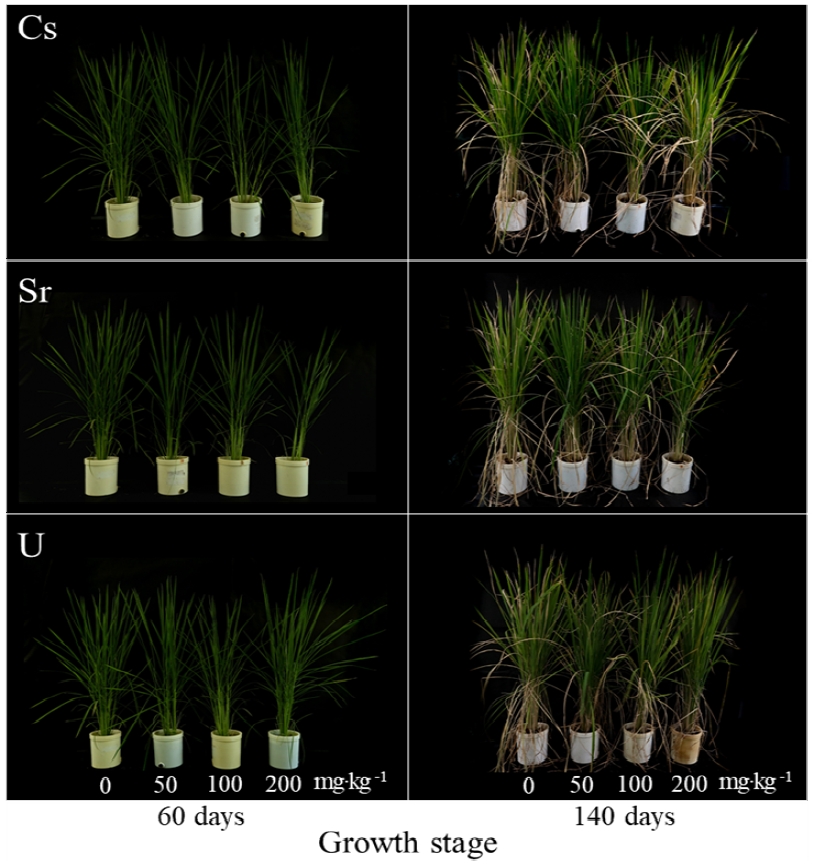
Growth responses of rice plants at 60 and 140 days after transplantation (DAT) as affected by soil application of radionuclides (Cs, Sr, and U) under 5% organic matter conditions. Radionuclide concentrations were 0, 50, 100, and 200 mg·kg-1 (from left to right).
Fresh weight in the Cs-treated plants ranged from 88.5 to 107.1 g, which was similar to or slightly higher than that of the control (83.8 g). Dry weight also remained relatively stable, ranging from 15.3 to 17.5 g. These results are consistent with previous studies indicating that Cs competes with K+ during plant uptake but generally exhibits limited growth inhibition at relatively low concentrations (White and Broadley, 2000).
In contrast, plants grown in Sr-treated soil exhibited substantially reduced biomass compared with other treatments. Fresh weight ranged from 34.6 to 59.1 g, while dry weight ranged from 4.8 to 8.9 g, representing the lowest values among all treatments. In particular, the Sr treatment at 200 mg·kg-1 showed a pronounced reduction in shoot fresh weight. This response can be explained by the chemical similarity between Sr2+ and Ca2+, which allows Sr to compete with Ca2+ uptake in plants. Such interference with Ca2+-related physiological processes, including cell wall formation and tissue development, can lead to suppression of plant growth (Tsukada et al., 2002a).
Plants grown in U-treated soil exhibited fresh weights ranging from 73.4 to 95.4 g, which were slightly lower than those observed in the Cs treatments but comparable to the control. Dry weight values ranged from 15.8 to 20.0 g, indicating relatively stable biomass accumulation. Uranium is known to induce metal stress in plants; however, its toxicity can be limited at relatively low concentrations depending on soil chemical conditions and uranium speciation (Chen et al., 2021). The relatively moderate growth response observed in the present study is consistent with these findings.
Chlorophyll content measured as SPAD values ranged from 33.5 to 40.7 across most treatments, and no significant differences among radionuclide types were observed. However, a slight increase in SPAD values (40.7) was detected in the Sr treatment at 200 mg·kg-1, accompanied by reduced plant biomass. This trend suggests that Sr exposure at higher concentrations may influence chlorophyll formation and photosynthesis-related physiological processes.
At 140 days after treatment, significant differences in fresh and dry weights among radionuclide treatments were still observed, whereas treatment concentration remained non-significant for most growth parameters. The Cs treatment consistently showed the highest fresh and dry weights, whereas the Sr treatment maintained the lowest biomass values throughout the growth period, indicating that the growth-inhibitory effects of Sr persisted during plant development. Plants grown in U-treated soil showed intermediate growth responses between those observed in the Cs and Sr treatments.
Overall, among the tested elements, Sr exerted the strongest inhibitory effect on plant biomass production, while Cs and U showed relatively moderate impacts on rice growth under the experimental conditions.
3.3. Analysis of soil-to-plant transfer factors
The soil–plant transfer factor (TF) is widely used as a quantitative indicator for evaluating the movement of radionuclides from soil to plants and reflects both the bioavailability of radionuclides and the uptake characteristics of plants (Shaw and Bell, 1991; Staunton et al., 2003; Ali et al., 2024; Dirican et al., 2025). The TF provides important information for understanding radionuclide behavior in agricultural ecosystems and for assessing potential risks associated with food-chain contamination.
As shown in Tables 3 and 4, the accumulation and transfer characteristics of Cs, Sr, and U in rice plants differed markedly depending on their chemical properties and mobility in soil. In the Cs-treated soils, radionuclide accumulation in plant tissues during the early growth stage (60 days) increased with increasing treatment concentration. Root Cs concentrations ranged from 41.12 to 53.74 mg·kg-1 in the 50–200 mg·kg-1 treatments, which were approximately 17–22 times higher than that observed in the control (2.43 mg·kg-1). Shoot Cs concentrations ranged from 11.07 to 24.44 mg·kg-1, also substantially higher than those in the control (0.19 mg·kg-1).
Effects of soil-applied radionuclides on radionuclide accumulation in soil, shoots, and roots of rice after 60 and 140 days of growth following transplanting
Effects of soil applied radioisotopes on tissue specific soil-to-plant transfer factors of rice at different growth stage
These results are consistent with previous findings that Cs+, which has chemical properties similar to those of K+, can be absorbed through potassium transport systems in plants (White and Broadley, 2000; Ehlken and Kirchner, 2002). In most plant species, Cs is initially accumulated in roots, after which a portion is translocated to aboveground tissues (Tsukada et al., 2002a; Staunton et al., 2003). A similar trend was observed in the present study, where the root TF values were higher than those of shoots.
During the early growth stage (60 days), the total TF values for Cs tended to increase from 1.5524 to 3.0137 with increasing treatment concentration. This increase may reflect enhanced plant uptake resulting from the higher availability of Cs in soil solution. However, during the later growth stage (140 days), TF values generally decreased (Table 4). This reduction may be attributed to changes in plant nutrient uptake and ion distribution patterns during plant development, as well as the progressive fixation of Cs by clay minerals in soil (Gommers et al., 2000; Shiozawa et al., 2011; Yamaguchi et al., 2012). In addition, previous studies reported that Cs accumulated primarily in vegetative tissues of rice plants. For example, 65% of Cs was detected in straw, while only 10% each was distributed in polished rice, bran, and husk (Tsukada et al., 2002a).
In the Sr-treated soils, relatively high accumulation levels and TF values were consistently observed in roots regardless of growth stage. During the early growth stage (60 days), TF values ranged from 3.7865 to 11.8073, representing the highest values among the radionuclides evaluated in this study. In particular, the root TF reached 9.9203 in the 200 mg·kg-1 treatment, indicating that Sr can be readily transferred from soil to plants (Table 4). Strontium is an alkaline earth metal with chemical properties similar to Ca2+ and is therefore absorbed through calcium uptake pathways in plants (Shaw and Bell, 1991; Roca and Vallejo, 1995; Ishikawa et al., 2008; Ammar et al., 2024). Because Ca has relatively low mobility within plant tissues, Sr is also mainly accumulated in root tissues and cell walls (Ehlken and Kirchner, 2002). Furthermore, Sr generally exhibits weaker fixation in soil compared with Cs, resulting in higher mobility in soil solution and facilitating its transfer to plants (Park et al., 2019; Bots et al., 2021). The high root TF values observed in this study are consistent with these characteristics.
In contrast, the U-treated soils showed extremely low TF values across all treatments, indicating that uranium has very limited mobility in the soil–plant system (Table 4). In particular, shoot TF values ranged from 0.0019 to 0.0491 during the early growth stage (60 days) and from 0.0015 to 0.0153 during the later growth stage (140 days), which were substantially lower than those observed for Cs and Sr.
These results can largely be attributed to the low solubility and strong adsorption capacity of U in soils (Dong et al., 2012; Favas et al., 2016). Uranium readily forms insoluble complexes with phosphate and organic matter in soil (Zhang et al., 2020; Fuller et al., 2020), which limits its bioavailability. In addition, U tends to adsorb strongly to root surfaces, including cell walls and root mucilage, thereby restricting its translocation to aboveground plant tissues (Ehlken and Kirchner, 2002; Liu et al., 2020; Dong et al., 2023). In the present study, root TF values increased up to 2.2728 during the later growth stage (140 days), whereas shoot TF values remained extremely low, further supporting the limited translocation of U within rice plants.
In general, soil-to-plant transfer factors are influenced not only by the chemical properties of radionuclides but also by environmental factors such as soil redox conditions, organic matter decomposition rates, and ionic composition of soil solution (Shiozawa, 2012). In flooded paddy soils used for rice cultivation, changes in redox conditions and ion composition during plant growth can alter radionuclide solubility and mobility, thereby affecting TF values at different growth stages (Yamaguchi et al., 2012). Overall, the soil–to-plant transfer factors observed in this study followed the order Sr > Cs > U. Radionuclide uptake and accumulation were relatively active during the early growth stage but generally decreased as plant growth progressed. In addition, TF values were generally higher in roots than in shoots for most radionuclides.
These findings indicate that the chemical properties of radionuclides and soil–plant interactions are key factors governing radionuclide mobility and accumulation in agricultural environments.
4. Conclusions
This study examined the effects of soil-applied radionuclides (Cs, Sr, and U) on rice (Oryza sativa L.) growth and soil-to-plant transfer. The results demonstrated that both plant growth responses and radionuclide accumulation patterns were influenced more strongly by the chemical properties and mobility of radionuclides in soil than by their applied concentrations. Growth analysis indicated that the Cs treatment showed relatively minor effects on rice growth. At low concentrations, Cs slightly increased tiller number and leaf area, and fresh and dry biomass remained relatively stable. In contrast, the Sr treatment resulted in the greatest growth inhibition, with significant reductions observed in tiller number, leaf area, fresh weight, and dry weight. The U treatment showed intermediate growth responses between those observed for Cs and Sr, with slight growth reductions observed at some treatment levels. Analysis of radionuclide accumulation in plant tissues revealed clear differences in distribution and mobility among the tested radionuclides. Both Cs and Sr accumulated predominantly in root tissues, with a portion translocated to aboveground plant parts. In contrast, U exhibited very limited uptake and translocation due to its strong adsorption to soil particles and low mobility in soil. In addition, radionuclide uptake and accumulation were relatively active during the early growth stage but generally decreased as plant development progressed, resulting in reduced transfer factors over time. The soil-to-plant transfer factor (TF) analysis indicated that radionuclide transfer followed the order Sr > Cs > U. Sr (Strontium) showed the highest TF values, indicating relatively high mobility from soil to plant tissues, whereas uranium exhibited the lowest TF values, suggesting extremely limited transfer to rice plants. These differences are primarily attributed to variations in the chemical properties of radionuclides and their behavior in soil environments. Overall, the results demonstrate that the chemical characteristics and soil behavior of radionuclides play critical roles in determining plant growth responses and radionuclide transfer in rice cultivation systems. The radionuclide-specific transfer characteristics identified in this study provide important baseline information for evaluating crop safety and predicting radionuclide movement in agricultural soils contaminated with radioactive substances.
Acknowledgments
This work was supported by the Institute for Korea Spent Nuclear Fuel (iKSNF) and Korea Institute of Energy Technology Evaluation and Planning (KETEP) grant funded by the Korea government (Ministry of Climate, Energy and Environment (MCEE))(No. RS-2021-KP002656).
REFERENCES
-
Ali, S., Baloch, S. B., Bernas, J., Konvalina, P., Onyebuchi, E. F., Naveed, M., Ali, H., Jamali, Z. H., Nezhad, M. T. K., Mustafa, A., 2024, Phytotoxicity of radionuclides: A Review of sources, impacts and remediation strategies, Environ. Res., 240, 117479.
[https://doi.org/10.1016/j.envres.2023.117479]

-
Ammar, A., Nouira, A., Mouridi, Z. E., Boughribil, S., 2024, Recent trends in the phytoremediation of radionuclide contamination of soil by cesium and strontium: sources, mechanisms and methods: A Comprehensive review, Chemosphere, 359, 142273.
[https://doi.org/10.1016/j.chemosphere.2024.142273]
-
Bots, P., Comarmond, M. J., Payne, T. E., Gückel, K., Lunn, R. J., Rizzo, L., Schellenger, A. E. P., Renshaw, J. C., 2021, Emerging investigator series: a holistic approach to multicomponent EXAFS: Sr and Cs complexation in clayey soils, Environ. Sci. Process. Impacts, 23 (8), 1101-1115.
[https://doi.org/10.1039/D1EM00121C]
-
Chen, L., Liu, J., Zhang, W., Zhou, J., Luo, D., Li, Z., 2021, Uranium (U) source, speciation, uptake, toxicity and bioremediation strategies in soil–plant system: A Review, J. Hazard. Mater., 413, 125319.
[https://doi.org/10.1016/j.jhazmat.2021.125319]
- Choi, Y. J., Bae, E. Y., Kim, S. R., Ahmed, M. F., Kang, J. S., 2024, Effect of organic matter content in soil treated with radionuclide cesium on the growth of Chinese cabbage, J. Environ. Sci. Int., 23, 1143–1150.
-
Dirican, A., Dikmen, H., Çantay, E., 2025, Soil to plant transfer factor of 137Cs, 40K, and stable Cs in a semi-arid region, J. Environ. Radioact., 286, 107700.
[https://doi.org/10.1016/j.jenvrad.2025.107700]
-
Dong, W., Tokunaga, T. K., Davis, J. A., Wan, J., 2012, Uranium (VI) adsorption and surface complexation modeling onto background sediments from the F-Area Savannah River Site, Environ. Sci. Technol., 46, 1565-1571.
[https://doi.org/10.1021/es2036256]
-
Dong, L., He, Z., Wu, J., Zhang, K., Zhang, D., Pan, X., 2023, Remediation of uranium-contaminated alkaline soil by rational application of phosphorus fertilizers: Effect and mechanism, Environ. Res., 220, 115172.
[https://doi.org/10.1016/j.envres.2022.115172]
-
Ehlken, S., Kirchner, G., 2002, Environmental processes affecting plant root uptake of radioactive trace elements and variability of transfer factor data: A Review, J. Environ. Radioact., 58, 97–112.
[https://doi.org/10.1016/S0265-931X(01)00060-1]
-
Favas, P. J. C., Pratas, J., Mitra, S., Sarkar, S. K., Venkatachalam, P., 2016, Biogeochemistry of uranium in the soil–plant and water–plant systems in an old uranium mine, Sci. Total Environ., 568, 350–368.
[https://doi.org/10.1016/j.scitotenv.2016.06.024]
-
Fuller, A. J., Leary, P., Gray, N. D., Davies, H. S., Mosselmans, J. F. W., Cox, F., Robinson, C. H., Pittman, J. K., McCann, C. M., Muir, M., Graham, M. C., Utsunomiya, S., Bower, W. R., Morris, K., Shaw, S., Bots, P., Livens, F. R., Law, G. T. W., 2020, Organic complexation of U (VI) in reducing soils at a natural analogue site: Implications for uranium transport, Chemosphere, 254, 126859.
[https://doi.org/10.1016/j.chemosphere.2020.126859]
-
Gommers, A., Thiry, Y., Vandenhov, H., Vandecasteele, C. M., Smolders, E., Merckx, R., 2000, Radiocaesium uptake by one-year-old willows planted as short rotation coppice, J. Environ. Qual., 29, 1384–1390.
[https://doi.org/10.2134/jeq2000.00472425002900050003x]
- Hampton, C. R., Broadley, M. R., White, P. J., 2005, Short review: The mechanisms of radiocaesium uptake by Arabidopsis roots, Nukleonika, 50, S3–S8.
- IAEA (International Atomic Energy Agency), 2010, Handbook of parameter values for the prediction of radionuclide transfer in terrestrial and freshwater environments, Report 14, Technical Reports Series No. 472, IAEA Publishing, Vienna, Austria.
- Ishikawa, N. K., Uchida, S., Tagami, K., 2008, Soil-soil solution distribution coefficients for Se, Sr, Sn, Sb, and Cs in Japanese agricultural soils, Proceedings of Waste Management, University of Arizona, Tucson (AZ), 1-7.
-
Kamiya, T., Tanaka, M., Mitani, N., Ma, J. F., Maeshima, M., Fujiwara, T., 2009, NIP1;1, an aquaporin homolog, determines the arsenite sensitivity of Arabidopsis thaliana, J. Biol. Chem., 284, 2114–2120.
[https://doi.org/10.1074/jbc.M806881200]
- Liu, Z., Lai, J., Li, J., Ding, F., Zhang, Y., Luo, X., 2020, Toxic mechanism of uranium on photosynthetic characteristics and respiratory metabolism of Vicia faba L., J. Agro-Environ. Sci., 39, 1916–1924.
-
Ma, M., Wang, R., Xu, L., Xu, M., Liu, S., 2020, Emerging health risks and underlying toxicological mechanisms of uranium contamination: Lessons from the past two decades, Environ. Int., 145, 106107.
[https://doi.org/10.1016/j.envint.2020.106107]
-
Park, S. M., Alessi, D. S., Baek, K., 2019, Selective adsorption and irreversible fixation behavior of cesium onto 2:1 layered clay mineral: A Mini review, J. Hazard. Mater., 369, 569-576.
[https://doi.org/10.1016/j.jhazmat.2019.02.061]
-
Roca, M. C., Vallejo, V. R., 1995, Effect of soil potassium and calcium on caesium and strontium uptake by plant roots, J. Environ. Radioact., 28, 141–159.
[https://doi.org/10.1016/0265-931X(94)00052-X]
-
Robison, W. L., Brown, P. H., Stone, E. L., Hamilton, T. F., Conrado, C. L., Kehl, S., 2009, Distribution and ratios of 137Cs and K in control and K-treated coconut trees at Bikini Island where nuclear test fallout occurred: effects and implications, J. Environ. Radioact., 100, 76–83.
[https://doi.org/10.1016/j.jenvrad.2008.10.016]
-
Rout, S., Patra, A., Yadav, S., Wagh, S., Pulhani, V., Saradhi, I. V., Kumar, A. V., 2024, Uranium bioavailability in soil pore water: A Long-term investigation in a contaminated soil mesocosm, Sci. Total Environ., 907, 167893.
[https://doi.org/10.1016/j.scitotenv.2023.167899]
-
Shaw, G., Bell, J. N. B., 1991, Competitive effects of potassium and ammonium on caesium uptake kinetics in wheat, J. Environ. Radioact., 13, 283–296.
[https://doi.org/10.1016/0265-931X(91)90002-W]
-
Shiozawa, S., 2013, Vertical migration of radiocesium fallout in soil in Fukushima, Agricultural Implications of the Fukushima Nuclear Accident, in: Nakanishi, T. M., Tanoi, K. (eds.), Springer Tokyo.
[https://doi.org/10.1007/978-4-431-54328-2]
-
Shiozawa, S., Tanoi, K., Nemoto, K., Yoshida, S., Nishida, K., Hashimoto, K., Nakanishi, T., Nihei, N., Ono, Y., 2011, Vertical concentration profiles of radioactive cesium and convective velocity in soil in a paddy field in Fukushima, Radioisotopes, 60, 323–328.
[https://doi.org/10.3769/radioisotopes.60.323]
-
Smolders, E., Tsukada, H., 2011, The transfer of radiocesium from soil to plants: Mechanisms, data, and perspectives for potential countermeasures in Japan, Integr. Environ. Assess. Manag., 7, 379–381.
[https://doi.org/10.1002/ieam.236]
-
Staunton, S., Hinsinger, P., Guivarch, A., Brechignac, F., 2003, Root uptake and translocation of radiocaesium from agricultural soils by various plant species, Plant Soil, 254, 443–455.
[https://doi.org/10.1023/A:1025584016465]
-
Tanoi, K., Hashimoto, K., Sakurai, K., Nihei, N., Ono, Y., Nakanishi, T. M., 2011, Cs-134 and Cs-137 in wheat tissue grown in Fukushima, Radioisotopes, 60, 317–322.
[https://doi.org/10.3769/radioisotopes.60.317]
-
Tanoi, K., Kobayashi, N. I., Ono, Y., Fujimura, S., Nakanishi, T. M., Nemoto, K., 2013, Radiocaesium distribution in rice plants grown in contaminated soil in Fukushima Prefecture in 2011, Radioisotopes, 62, 25–29.
[https://doi.org/10.3769/radioisotopes.62.25]
-
Tsukada, H., Hasegawa, H., Hisamatsu, S., Yamasaki, S., 2002a, Rice uptake and distributions of radioactive 137Cs, stable 133Cs and K from soil, Environ. Pollut., 117, 403–409.
[https://doi.org/10.1016/S0269-7491(01)00199-3]
-
Tsukada, H., Hasegawa, H., Hisamatsu, S., Yamasaki, S., 2002b, Transfer of 137Cs and stable Cs from paddy soil to polished rice in Aomori, Japan, J. Environ. Radioact., 59, 351–363.
[https://doi.org/10.1016/S0265-931X(01)00083-2]
-
White, P. J., Broadley, M. R., 2000, Mechanisms of caesium uptake by plants, New Phytol., 147, 241–256.
[https://doi.org/10.1046/j.1469-8137.2000.00704.x]
- Yamaguchi, N., Takata, Y., Hayashi, K., Ishikawa, S., Kuramata, M., Eguchi, S., Yoshikawa, S., Sakaguchi, A., Asada, K., Wagai, R., Makino, T., Akahane, I., Hiradate, S., 2012, Behavior of radiocesium in soil–plant systems and its controlling factors: A Review, Report 31, NIAES Japan, Tsukuba, Japan.
-
Zhang, D., Chen, X., Larson, S. L., Ballard, J. H., Knotek-Smith, H. M., Ding, D., Hu, N., Han, F. X., 2020, Uranium biomineralization with phosphate—biogeochemical process and its application, ACS Earth Space Chem., 4, 2205–2214.
[https://doi.org/10.1021/acsearthspacechem.0c00252]
-
Zhu, Y. G., Smolders, E., 2000, Plant uptake of radiocaesium: a review of mechanisms, regulation and application, J. Exp. Bot., 51, 1635–1645.
[https://doi.org/10.1093/jexbot/51.351.1635]
Department of Horticultural Bioscience, Pusan National Universitykangjs@pusan.ac.kr
Department of Horticultural Bioscience, Pusan National Universitytkdflajaid@naver.com
Department of Horticultural Bioscience, Pusan National Universitymdfaraazbio1803@gmail.com
Department of Horticultural Bioscience, Pusan National Universitydlwlrn15@naver.com
Department of Horticultural Bioscience, Pusan National Universitymcchryl@gmail.com
Department of Horticultural Bioscience, Pusan National Universitymg6188@naver.com
Department of Horticultural Bioscience, Pusan National Universitydaegeunjeong99@gmail.com
Department of Horticultural Bioscience, Pusan National Universityatom0821@pusan.ac.kr
Research Institute, Korea Radioactive Waste Agency (KORAD)jeongms@korad.or.kr