
NAA and BAP Differentially Regulate Glucosinolates Accumulation and Vegetative Growth in an Organ- and Cultivar-Dependent Manner in Wasabia japonica Seedlings
Ⓒ The Korean Environmental Sciences Society. All rights reserved.
This is an Open-Access article distributed under the terms of the Creative Commons Attribution Non-Commercial License (http://creativecommons.org/licenses/by-nc/3.0) which permits unrestricted non-commercial use, distribution, and reproduction in any medium, provided the original work is properly cited.
Abstract
This study investigated on the regulatory roles of foliar-applied α-naphthaleneacetic acid (NAA) and 6-benzylaminopurine (BAP) on the growth characteristics and bioactive metabolite accumulation in the ‘Daewang’ and ‘Dalma’ cultivars of Wasabia japonica seedlings. A high performance liquid chromatography with UV-diode array detector (HPLC-UV) analysis results for sinigrin and allyl isothiocyanate (AITC) showed excellent linearity (r2 > 0.998) and sensitivity within 5–200 µg·mL-1. Sinigrin accumulation exhibited strong organ- and cultivar-dependent responses. In ‘Daewang’ leaves, 50 mg·L⁻¹ NAA increased sinigrin to 143.0% of the control, whereas BAP significantly suppressed leaf sinigrin at all concentrations. In contrast, ‘Dalma’ leaves showed a concentration-dependent response to BAP, with sinigrin contents reaching 172.70 ± 7.73, 208.43 ± 15.35, and 1603.00 ± 30.50 μg·g⁻¹ DW, representing 123%, 149%, and 1143% of the control at 50, 100, and 200 mg·L⁻¹, respectively. In the petiole of ‘Daewang’, NAA increased the sinigrin content to 180.4% of the control at 200 mg·L⁻¹, whereas BAP reduced it to 46.0% of the control. Roots contained the highest sinigrin levels; in ‘Daewang’, the sinigrin content reached 119.8% of the control following treatment with 200 mg·L⁻¹ NAA, whereas it decreased to 44.0% of the control following treatment with 200 mg·L⁻¹ BAP. AITC was detected predominantly in the roots, reaching 117.8% of the control under 200 mg·L⁻¹ NAA and 131.2% of the control under 100 mg·L⁻¹ BAP. Growth responses showed clear hormonal divergence. In ‘Daewang’, BAP increased chlorophyll content to 108.4% of the control at 200 mg·L⁻¹ and total leaf area to 146.4% of the control at 50 mg·L⁻¹. Total fresh weight reached 193.3% of the control under 50 mg·L⁻¹ BAP. Conversely, high NAA (200 mg·L⁻¹) reduced total leaf area and leaf dry weight to 57.7% and 56.9% of the control, respectively. Root biomass was comparatively stable across treatments. Overall, exogenous auxin and cytokinin differentially regulated glucosinolate metabolism and vegetative growth in a cultivar-dependent manner. Moderate BAP application effectively promoted biomass production, whereas targeted NAA treatment enhanced sinigrin accumulation in specific organs, providing a practical basis for optimizing plant growth regulator (PGR) strategies in wasabi cultivation.
Keywords:
Allyl isothiocyanate, Foliar application, HPLC-UV analysis, Plant growth regulators, Sinigrin1. Introduction
Wasabia japonica (Miq.) Matsum. is a perennial herb whose rhizome is a valuable edible part owing to its characteristic pungent flavor. Driven by the increasing global demand for wasabi-based products, Wasabi cultivation has recently expanded beyond Japan to countries such as South Korea, Canada, China, and New Zealand (Park et al., 2022; Truong et al., 2024). Its distinctive flavor is primarily attributed to glucosinolates and their hydrolysis products called isothiocyanates, particularly sinigrin and allyl isothiocyanate (AITC), which exhibit various biological activities, including anticancer, anti-inflammatory, neuroprotective, and antimicrobial effects (Ko et al., 2016; Subedi et al., 2017; Yano et al., 2018; Park et al., 2022).
Plant growth and development are orchestrated by a complex network of phytohormones that regulate cell division, elongation, differentiation, organogenesis, lateral growth, and secondary metabolism (Uddin et al., 2023; Ma et al., 2024; Ashraf et al., 2026). Of these, auxins and cytokinins are major classes of plant growth regulators that profoundly influence morphological and physiological processes, including shoot and root development, leaf expansion, branching, reproductive organ formation, and responses to environmental stimuli (Hirose et al., 2008; Li et al., 2018). Beyond their classical functions in vegetative growth regulation, these hormones are increasingly being recognized as key modulators of fruit ripening, senescence (Iqbal et al., 2017), and secondary metabolite biosynthesis, underscoring their broad significance in both horticultural and medicinal plant research (Li et al., 2025).
Auxins regulate plant growth and development by modulating cell division, elongation, organ differentiation, and other metabolic processes (Hanaa and Safaa, 2019; Uddin et al., 2023). Their effects are strongly concentration- and organ-dependent, with optimal levels promoting vegetative growth, whereas excessive levels inhibit growth and induce morphological abnormalities, highlighting the need to evaluate the effects of auxin concentration in experimental conditions (Hanaa and Safaa, 2019; Talukdar et al., 2022). Auxins also exhibit close crosstalk with ethylene, a hormone involved in ripening, senescence, and stress responses (Konings and Jackson, 1979; Pierik et al., 2006; Iqbal et al., 2017). Exogenous auxin application stimulates ethylene biosynthesis by upregulating key ethylene biosynthetic enzymes, including 1-aminocyclopropane-1-carboxylate (ACC) synthase, ACC oxidase, and ethylene-responsive transcription factors, resulting in elevated ethylene production (Wei et al., 2000; El-Sharkawy et al., 2014; Shi and Zhang, 2014; Yue et al., 2020; Dias et al., 2025). Therefore, excessive auxin levels can accelerate ethylene-mediated senescence, whereas appropriately controlled auxin application may promote growth without triggering premature aging, underscoring the importance of precise dosage and timing in studies on plant growth regulators (Arteca and Arteca, 2008; Jiang et al., 2025). Cytokinins promote cell division, shoot branching, leaf expansion, and reproductive organ formation, and delay senescence (Hirose et al., 2008). Exogenous application of 6-benzylaminopurine (BAP) stimulates lateral branching and leaf expansion, although excessive branching can reduce main stem thickening owing to resource redistribution (Talukdar et al., 2022; Su et al., 2023).
Secondary metabolites are specialized plant compounds involved in defense and ecological interactions; they are typically synthesized in response to developmental, environmental, or hormonal cues and exhibit organ-and stage-specific accumulation. In addition to growth regulation, auxins and cytokinins substantially influence secondary metabolism in medicinal and aromatic plants. The exogenous application of α-naphthaleneacetic acid (NAA) has been reported to enhance the biosynthesis of secondary metabolites such as flavonoids, anthocyanins, polyphenols, and carotenoids in blueberries and grapes (He et al., 2020; Uddin et al., 2023). Cytokinin treatment alone is also known to enhance the accumulation of phenolic compounds, flavonoids, and alkaloids in several ornamental plants (Hu et al., 2012; Wu et al., 2015). Although the effects of NAA and BAP have been widely studied in other medicinal plants (Al-Abdallat et al., 2023; Szewczyk et al., 2023), the specific roles of NAA and BAP in growth regulation and bioactive compound accumulation in W. japonica remain poorly understood, and optimization of their foliar application may offer a practical strategy to enhance both biomass production and phytochemical content, thereby improving productivity, quality, and pharmacological efficacy.
Therefore, the present study aimed to elucidate the concentration-dependent effects of foliar-applied NAA and BAP on growth parameters, morphological traits, and the accumulation of key bioactive compounds in W. japonica.
2. Materials and Methods
2.1. Chemicals and reagents
Sinigrin, AITC, and formic acid were purchased from Sigma-Aldrich (St. Louis, MO, USA). High performance liquid chromatography (HPLC)-grade solvents including water, acetonitrile (ACN), and methanol (MeOH) were obtained from Fisher Scientific Korea Ltd. (Seoul, Korea). NAA and BAP were purchased from Kisan Bio (Seoul, South Korea). All other reagents and chemicals used were of analytical grade.
2.2. Plant materials and growth conditions
The seeds of Wasabia japonica cultivars ‘Daewang’ and ‘Dalma’ were obtained from the Highland Agricultural Experiment Station. These seeds were surface-sterilized and germinated in a controlled growth chamber maintained at 25 ± 2℃, with 70% relative humidity, and a 16 h light/8 h dark photoperiod. Uniform seedlings were transplanted into plastic pots containing a commercial field soil mix (Field King; Farm Hannong, Seoul, Republic of Korea). The plants were cultivated in a glasshouse at Pusan National University under controlled environmental conditions, with the temperature maintained at 25 ± 2°C throughout the experimental period. Irrigation was applied as needed to maintain adequate soil moisture, and all plants were managed using uniform standard cultural practices.
2.3. Plant growth regulator sprays and measurement of seedling growth
Seedlings were treated with varying concentrations of NAA (0, 50, 100, 200 mg·L⁻¹) and BAP (0, 50, 100, 200 mg·L⁻¹) through foliar spraying. Treatments were applied twice at one-month intervals, starting two months after germination. Five months after germination, the plants were harvested for analyzing growth and the contents of sinigrin and AITC. After treatment, growth characteristics, including leaf number, leaf area, petiole length, root length, fresh weight (FW), and dry weight (DW) were recorded. Chlorophyll content was determined using a SPAD meter.
2.4. HPLC analysis
HPLC analysis was conducted using an Agilent 1100 system (Agilent Technologies Inc., La Jolla, CA, USA) equipped with a quaternary pump, autosampler, column oven, and diode array detector. A Luna C18 column (4.6 × 150 mm, 5 μm particle size) was employed for chromatographic separation. A binary mobile phase system comprising solvent A (acetonitrile) and B (0.5% formic acid in water) was employed with a linear gradient elution of 10% A (0–5 min), 20% A (5–10 min), 40% A (10–15 min), 100% A (15–20 min), 100% A (20–25 min), and 10% A (25–30 min). The flow rate was set to 0.5 mL·min-1, with the column maintained at room temperature and an injection volume of 10 μL. These conditions enabled efficient separation and precise quantification of the target compounds. Dried seedling samples were extracted with methanol and analyzed for sinigrin and AITC contents using HPLC. The concentration of each compound was expressed as μg·g⁻¹ DW.
2.5. Standard solutions and calibration curves
Stock solutions of sinigrin and AITC were prepared in methanol at a concentration of 2 mg·ml-1 and used as reference standards for compound identification and quantification. Serial dilutions of stock solutions were prepared in methanol to yield various concentrations for calibration curve construction and quantitative analysis. At least six concentrations (5, 10, 25, 50, 100, and 200 mg·L-1) of each standard compound were prepared, and each was analyzed in triplicate. Calibration curves were generated by correlating HPLC peak areas with the corresponding analyte concentrations. Inclusion of multiple concentration levels and replicate analyses enabled assessment of linearity and determination of regression equations for the target compounds.
2.6. The LOD and LOQ analysis
Stock solutions of sinigrin and AITC were prepared by dissolving 2 mg of each compound in 2 mL of methanol and stored at -20°C until analyzed. Standard solutions of sinigrin and AITC (5, 10, 25, 50, 100, and 200 µg·mL-1) were prepared by serially diluting the methanolic stock solution. Calibration curves were generated by HPLC analysis, and the limits of detection (LOD) and quantification (LOQ) were established under the defined chromatographic conditions.
2.7. Statistical analysis
All samples were extracted in triplicate, and the results are presented as mean ± standard error. Statistical analyses were performed using SAS 9.4 (SAS Korea, Seoul, Korea). Analysis of variance (ANOVA) was performed, and significant differences among the means were determined at p < 0.05 using Duncan’s multiple-range test (DMRT).
3. Results
3.1. Analytical validation of sinigrin and allyl isothiocyanate
Calibration curves for sinigrin and AITC were constructed using HPLC-UV detection at 227 nm (Table 1). The regression equations showed excellent linearity within the tested concentration range of 5–200 µg·mL-1, with correlation coefficients (r²) exceeding 0.999. For sinigrin, the regression equation was y = 11.56x - 13.51 with a correlation coefficient of 0.9999, limit of detection (LOD) of 8.88 µg·mL-1, and limit of quantitation (LOQ) of 29.29 µg·mL-1. Similarly, AITC showed the same regression y = 17.35x - 34.09, r² = 0.9985, with LOD and LOQ values of 6.62 µg·mL-1 and 21.84 µg·mL-1, respectively. These results indicate that the developed HPLC-UV method presents high sensitivity and reliability for the quantitative determination of sinigrin and AITC within the tested concentration range.

Calibration curve, correlation coefficient, LOD, and LOQ data of sinigrin and allyl isothiocyanate by HPLC-UV at 227 nm
3.2. Effects on sinigrin and allyl isothiocyanate accumulation
Foliar application of NAA and BAP significantly affected the accumulation of sinigrin and its hydrolysis product, AITC, in different organs of W. japonica seedlings (Fig. 1 and 2; Appendix 1; Appendix 2). Sinigrin content in the leaves varied significantly depending on the cultivar and PGR treatment (Fig. 2; Appendix 2). In ‘Daewang’, leaves sinigrin significantly increased from 323.07 ± 9.20 μg·g⁻¹ DW in the control to 461.87 ± 6.87 μg·g⁻¹ DW with 50 mg·L⁻¹ NAA (143.0% of the control), whereas 200 mg·L⁻¹ NAA reduced it to 272.77 ± 21.30 μg·g⁻¹ DW (84.4% of the control). However, sinigrin content was significantly suppressed at all BAP treatment concentrations compared with the control. In the ‘Dalma’, leaf sinigrin content increased with increasing NAA concentration, reaching a 163% of the control at 200 mg·L⁻¹ NAA compared with the control; however, these differences were not statistically significant. In contrast to the ‘Daewang’, BAP treatment exhibited a markedly different pattern from that observed in the ‘Daewang’. In ‘Dalma’, sinigrin content increased in a concentration-dependent manner with BAP application at 50, 100, and 200 mg·L⁻¹, reaching 172.70 ± 7.73 μg·g⁻¹ DW (123% of the control), 208.43 ± 15.35 μg·g⁻¹ DW (149% of the control), and 1603.00 ± 30.50 μg·g⁻¹ DW (1143% of the control), respectively (Fig. 2A; Appendix 2). These results indicate a strong cultivar-specific response to cytokinin treatment.
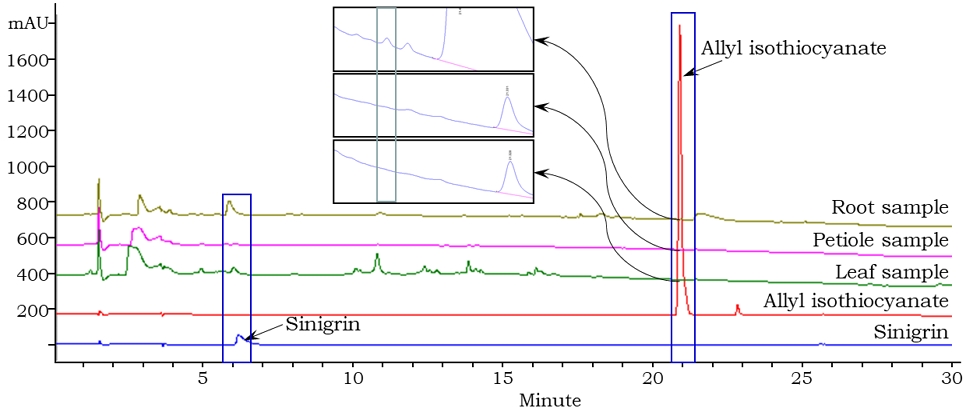
HPLC chromatograms of sinigrin and allyl isothiocyanate standards and sample extracts obtained from the leaf, petiole, and root of Wasabia japonica seedlings at five months after germination. Foliar application of NAA and BAP was performed twice at one-month intervals, starting two months after germination. Seedlings were harvested five months after germination.
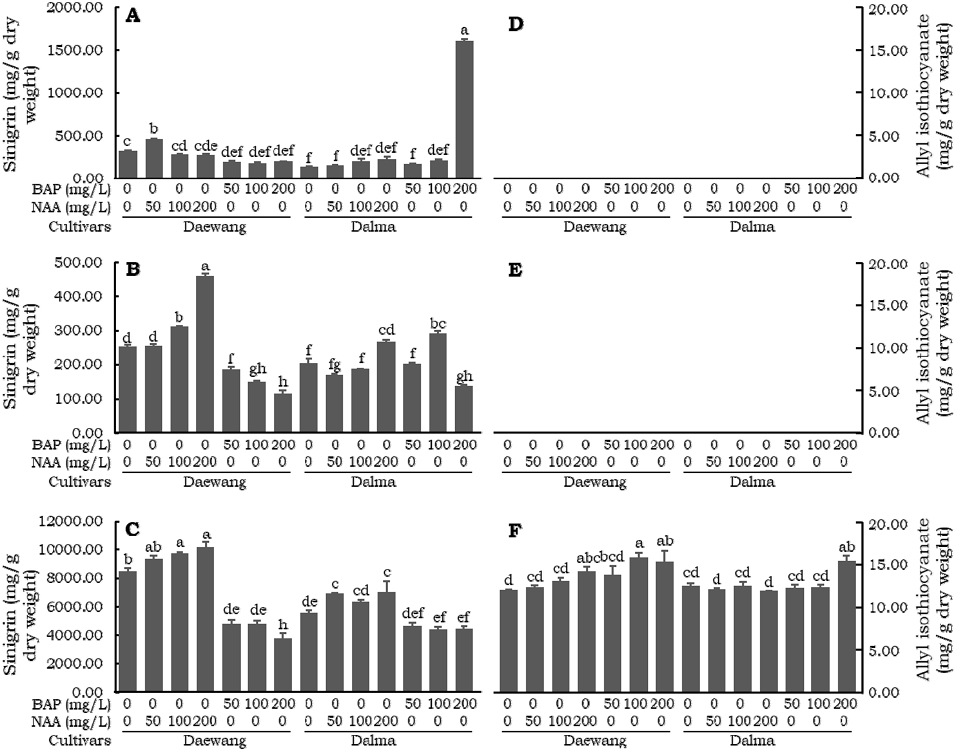
Effects of NAA and BAP foliar sprays on sinigrin content in leaf (A), petiole (B), and root (C), as well as allyl isothiocyanate content in leaf (D), petiole (E), and root (F) of Wasabia japonica seedlings. Foliar application of NAA and BAP was performed twice at one-month intervals, starting two months after germination. Seedlings were harvested five months after germination and extracted with 100% methanol to determine sinigrin and allyl isothiocyanate contents. Bars represented means ± SE with three replicates. Different letters above the bars for sinigrin and allyl isothiocyanate indicate significant differences among treatments at p < 0.05 according to Duncan’s multiple range test (DMRT).
Sinigrin accumulation in the petioles exhibited a distinct response pattern (Fig. 2B). In ‘Daewang’, the petiole sinigrin content in the control (253.40 ± 5.47 μg·g⁻¹ DW) increased progressively with increasing NAA concentrations, reaching a maximum of 457.17 ± 8.18 μg·g⁻¹ DW at 200 mg·L⁻¹ NAA, corresponding to an 180.4% of the control, whereas BAP treatments resulted in comparatively lower levels. In contrast, BAP treatment resulted in a concentration-dependent decrease in sinigrin content. At 200 mg·L⁻¹ BAP, the level declined to 115.93 ± 9.26 μg·g⁻¹ DW, corresponding to 46% of the control. In ‘Dalma’, the petiole sinigrin content in the control (203.03 ± 14.49 μg·g⁻¹ DW) peaked at 292.50 ± 6.07 μg·g⁻¹ DW under 100 mg·L⁻¹ BAP, with other treatments showing moderate accumulation. Overall, petiole sinigrin accumulation appeared to be more sensitive to NAA, particularly in ‘Daewang.’
The roots exhibited the highest sinigrin content among all organs, highlighting them as the principal sites of glucosinolate accumulation (Fig. 2C; Appendix 2). In ‘Daewang’, root sinigrin content increased from 8482.23 ± 225.87 μg·g⁻¹ DW in the control to 10164.43 ± 362.03 μg·g⁻¹ DW with 200 mg·L⁻¹ NAA, representing a 119.8% of the control. In contrast, BAP treatment caused a concentration- dependent decrease in root sinigrin content. At 200 mg·L⁻¹ BAP, the level declined to 3736.50 ± 390.65 μg·g⁻¹ DW, representing 44% of the control and indicating a statistically significant reduction. In ‘Dalma’, root sinigrin content increased from 5574.57 ± 198.22 μg·g⁻¹ DW in the control to 7021.77 ± 792.12 μg·g⁻¹ DW, corresponding to a 126.0% of the control under stimulatory treatments. In contrast, similar to the pattern observed in the petiole, BAP treatment decreased root sinigrin accumulation in a concentration-dependent manner. At 200 mg·L⁻¹ BAP, the content declined to 4435.00 ± 173.66 μg·g⁻¹ DW, corresponding to 44% of the control.
AITC was predominantly detected in the roots, whereas the leaf and petiole organs showed negligible or undetectable levels across all treatments (Fig. 2D–F). In ‘Daewang’ roots, AITC content increased from 11.97 ± 0.09 μg·g⁻¹ DW in the control to 14.10 ± 0.58 μg·g⁻¹ DW with 200 mg·L⁻¹ NAA, representing a 117.8% of the control significantly increase, and further increased to 15.70 ± 0.58 μg·g⁻¹ DW with 100 mg·L⁻¹ BAP, corresponding to a 131.2% of the control. AITC content showed a concentration-dependent increasing trend with NAA application up to 200 mg·L⁻¹, whereas BAP treatment resulted in the highest AITC accumulation at 100 mg·L⁻¹. Similarly, ‘Dalma’ roots exhibited an AITC content of 12.40 ± 0.35 μg·g⁻¹ DW in the control, with values ranging from 11.83 ± 0.03 to 12.43 ± 0.49 μg·g⁻¹ DW under the NAA treatments, indicating no clear NAA-induced effect. In contrast, BAP application increased the AITC content in a concentration-dependent manner, reaching a maximum of 15.33 ± 0.61 μg·g⁻¹ DW at 200 mg·L⁻¹ BAP, corresponding to a 123.6% of the control.
Overall, sinigrin accumulation and its hydrolysis to AITC were strongly organ-specific and cultivar-dependent, with the roots serving as the major site of AITC production. The PGRs, cultivar, and their interaction significantly influenced the sinigrin and AITC contents across all organs (p < 0.001), underscoring the complex regulation of glucosinolate metabolism by exogenous growth regulators in W. japonica seedlings.
3.3. Effects of NAA and BAP on the chlorophyll content and growth of Wasabia japonica seedlings
Foliar application of NAA and BAP significantly influenced the chlorophyll content, shoot elongation, and leaf development in W. japonica seedlings (Table 2; Fig. 3). In the ‘Daewang’ cultivar, NAA application concentration-dependently decreased chlorophyll content (Table 2). Treatment with 50 mg·L⁻¹ NAA significantly reduced chlorophyll content to 18.2 ± 2.1, corresponding to 76.8% of the control (23.7 ± 1.6). Higher NAA levels of 100 and 200 mg·L⁻¹ further decreased the chlorophyll values to 16.6 ± 1.1 and 16.0 ± 0.9, corresponding to 70.0% and 67.5% of the control, respectively. In contrast, foliar application of BAP increased chlorophyll content in a concentration-dependent manner. Chlorophyll content at 50 and 100 mg·L⁻¹ BAP did not differ significantly from that of the control, whereas treatment with 200 mg·L⁻¹ BAP increased the chlorophyll content to 25.7 ± 0.6, corresponding to 108.4% of the control. In the ‘Dalma’ cultivar, chlorophyll content was significantly reduced to 16.0 ± 0.7 with 200 mg·L⁻¹ NAA treatment compared with the control (21.9 ± 0.5), corresponding to 73.0% of the control. In contrast, treatment with 200 mg·L⁻¹ BAP significantly increased the chlorophyll content to 24.1 ± 0.8, corresponding to 110.0% of the control. The magnitude of the BAP-induced increase was smaller than that observed in ‘Daewang’, indicating a cultivar-dependent response to BAP treatment. Overall, the chlorophyll content was significantly influenced by plant growth regulator (PGR) treatment (p < 0.001), the cultivar (p < 0.01), and their interaction (p < 0.01) (Table 2), indicating cultivar-specific responses to exogenous hormone types and concentrations.
Effects of NAA and BAP foliar applications on chlorophyll and top parts of Wasabia japonica seedlingsz)
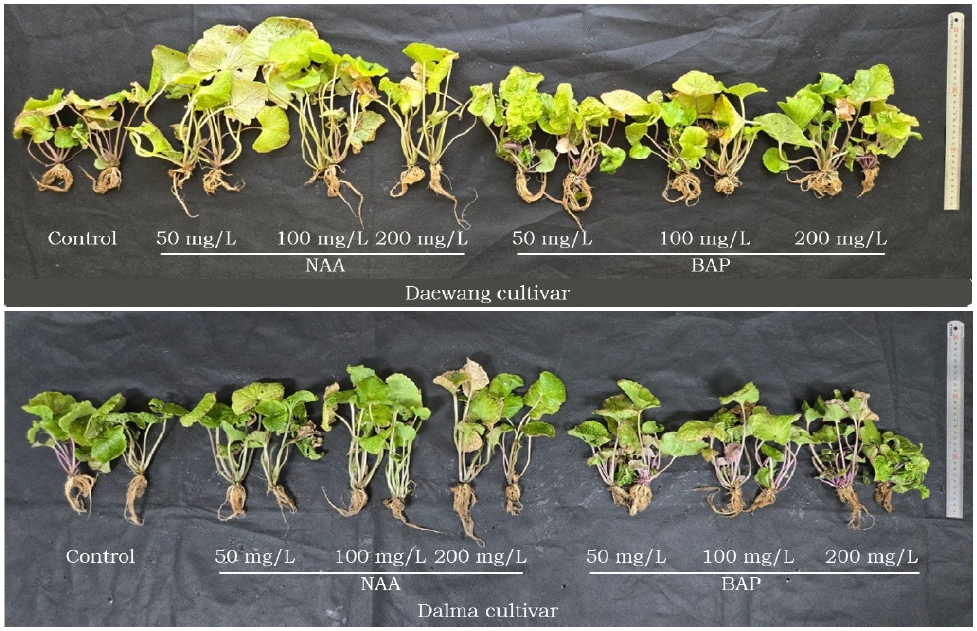
Morphological characteristics of ‘Daewang’ and ‘Dalma’ cultivars (Wasabia japonica) seedlings in response to foliar spray of NAA and BAP.
Shoot growth parameters, including plant height, petiole length, and stem diameter, responded markedly to the foliar application of NAA and BAP (Table 2). In the ‘Daewang’ cultivar, NAA application significantly increased plant height compared with the control, reaching 21.0 ± 1.3 cm at 50 mg·L⁻¹ (120.7% of the control) and 22.5 ± 0.6 cm at 100 mg·L⁻¹ (129.3% of the control). However, plant height declined at 200 mg·L⁻¹, suggesting that excessive auxin levels may have caused a saturation or inhibitory effect on stem elongation.
BAP application moderately increased plant height, reaching a maximum of 19.7 ± 0.5 cm at 100 mg·L⁻¹, corresponding to 113.2% of the control. In the ‘Dalma’ cultivar, plant height exhibited a similar but less pronounced response to NAA, reaching 20.0 ± 0.8 cm at 50 mg·L⁻¹, corresponding to 121.2% of the control. Petiole elongation responded more strongly than plant height did. In ‘Daewang’, petiole length increased from 11.8 ± 0.7 cm in the control to 15.6 ± 1.0 cm at 50 mg·L⁻¹ NAA (132.2% of the control) and peaked at 17.3 ± 0.5 cm with 100 mg·L⁻¹ (146.6% of the control), showing no further increase at higher concentrations. BAP application also promoted petiole elongation, reaching 14.4 ± 0.5 cm at 200 mg·L⁻¹ (122.0% of the control). Stem diameter was significantly increased by BAP treatment. In ‘Daewang’, the stem diameter increased from 8.3 ± 0.7 mm in the control to 11.9 ± 1.5 mm at 200 mg·L⁻¹ BAP (143.4% of the control), whereas NAA treatments showed inconsistent effects on stem diameter.
In ‘Daewang’, BAP treatment significantly increased the total leaf area from 146.5 ± 8.2 cm² in the control to 214.4 ± 11.6 cm² at 50 mg·L⁻¹ (146.4% of the control), with values remaining elevated at 100 and 200 mg·L⁻¹ (133.6% and 120.3% of the control, respectively). In contrast, 200 mg·L⁻¹ NAA reduced the leaf area to 84.6 ± 11.3 cm², corresponding to a 57.7% of the control, indicating a strong suppression of lateral organ expansion at high auxin levels. Leaf number showed a trend similar to that of leaf area. In ‘Daewang’, 50 mg·L⁻¹ BAP increased the leaf number from 6.0 ± 0.2 to 8.8 ± 0.5 (146.7% of the control), whereas NAA treatments produced minor or negative effects, particularly at higher concentrations. In ‘Daewang’, BAP application enhanced root elongation, increasing the root length from 12.0 ± 1.4 cm in the control to 17.9 ± 1.9 cm at 50 mg·L⁻¹ (149.2% of the control). In contrast, ‘Dalma’ showed a concentration-dependent reduction in root length, declining from 13.0 ± 1.2 cm to 9.0 ± 1.4 cm at 200 mg·L⁻¹ BAP (69.2% of the control).
Statistical analysis revealed highly significant differences (p < 0.001) with the treatment, PGR type, and cultivar in most parameters, except for leaf number and total leaf area. The interaction between cultivar and PGR (Cul × PGR) was also significant for chlorophyll content, plant height, petiole length, stem diameter, and root length, suggesting cultivar-specific responses to hormone application. Overall, BAP exerted a consistently positive effect on chlorophyll accumulation and shoot growth, whereas NAA showed a biphasic response, promoting elongation at low concentrations, but suppressing growth at higher levels.
3.4. Effects on fresh and dry biomass accumulation
Foliar application of NAA and BAP significantly affected the biomass accumulation of W. japonica seedlings in both the ‘Daewang’ and ‘Dalma’ cultivars (Table 3). In the ‘Daewang’ cultivar, treatment with 50 mg·L⁻¹ BAP significantly increased total fresh weight from 10.5 ± 0.7 g in the control to 20.3 ± 1.0 g (193.3% of the control). This increase was accompanied by significant increases in leaf fresh weight (5.2 ± 0.4 to 10.7 ± 0.6 g; 205.8% of the control), petiole fresh weight (4.2 ± 0.4 to 7.7 ± 0.4 g; 183.3% of the control), and root fresh weight (1.1 ± 0.1 to 1.9 ± 0.1 g; 172.7% of the control). In contrast, NAA showed a non-linear effect on biomass accumulation. Treatment with 100 mg·L⁻¹ NAA increased petiole fresh weight to 7.9 ± 0.7 g (188.1% of the control), whereas treatment with 200 mg·L⁻¹ reduced total fresh weight to a level comparable to that of the control. In the ‘Dalma’ cultivar, total fresh weight increased from 12.2 ± 0.9 g in the control to 16.3 ± 1.1 g at 50 mg·L⁻¹ BAP (133.6% of the control), with no further increases at higher BAP concentrations. Dry biomass accumulation exhibited patterns similar to those observed for fresh weight (p < 0.001; Table 3). In the ‘Daewang’ cultivar, leaf DW increased from 0.79 ± 0.06 g in the control 1.32 ± 0.07 g at 50 mg·L⁻¹ BAP (167.1% of the control). Petiole DW also increased to 152.1% of the control, whereas root DW showed only a modest increase. In contrast, treatment with 200 mg·L⁻¹ NAA reduced leaf DW to 0.45 ± 0.07 g (56.9% of the control), confirming the inhibitory effect of excessive NAA on dry matter accumulation.
Effects of NAA and BAP foliar applications on fresh and dry weights and other growth parameters of Wasabia japonica seedlingsz)
Statistical analysis revealed that PGR treatment significantly affected leaf and petiole FW and DW, as well as total FW (p < 0.001), whereas cultivar effects were significant for leaf FW, leaf DW, petiole DW, and total FW. Significant cultivar × PGR interactions were observed primarily for leaf FW and leaf DW. Root FW and DW were less affected by the NAA and BAP treatments. Overall, moderate foliar application of BAP effectively promoted above-ground biomass accumulation, particularly in leaves and petioles, in both the ‘Daewang’ and ‘Dalma’ cultivars, whereas high NAA concentrations inhibited shoot growth. Root biomass remained relatively unaffected by foliar PGR application, suggesting that foliar NAA and BAP primarily regulate shoot rather than root development in W. japonica seedlings.
4. Discussion
Plant growth regulators (PGRs) such as auxins and cytokinins play pivotal roles in regulating plant morphogenesis. Their physiological effects are highly context-dependent and vary with the species, tissue type, concentration, and application timing. Consistent with previous studies, the present study investigated the effects of foliar application of exogenous NAA and BAP on the growth of wasabi (W. japonica) and on the accumulation of secondary metabolites sinigrin and AITC. This study aimed to elucidate how exogenously applied plant growth regulators modulate vegetative development and secondary metabolite biosynthesis, thereby providing insights into the physiological and metabolic responses of wasabi to hormonal regulation.
Plant growth regulators are important modulators of secondary metabolite biosynthesis and accumulation (Li et al., 2025). In the present study, NAA and BAP differentially affected plant growth and the accumulation of sinigrin and allyl isothiocyanate (AITC), with responses varying according to organ, cultivar, and hormone concentration (Tables 2 and 3; Fig. 2). Moderate BAP application promoted vegetative growth and markedly increased sinigrin accumulation in the leaves of the 'Dalma' cultivar, reaching 1,143% of the control at 200 mg·L⁻¹ BAP (Fig. 2A; Appendix 2). In contrast, excessive hormone concentrations inhibited growth, indicating genotype-dependent hormonal sensitivity. These findings are consistent with previous reports demonstrating that auxins and cytokinins regulate secondary metabolism by enhancing precursor biosynthesis and coordinating metabolic flux (Grzegorczyk-Karolak et al., 2016; Ahanger et al., 2020; Pan et al., 2013; Wu et al., 2015). Although sinigrin was not effectively converted into allyl isothiocyanate (AITC) in the leaves and petioles, distinct patterns of AITC accumulation were observed in the roots of the 'Dalma' cultivar following NAA and BAP treatments. Notably, the highest AITC content was detected in plants treated with 200 mg·L⁻¹ BAP, suggesting that cytokinin may influence not only glucosinolate biosynthesis but also the conversion of sinigrin into AITC. Recent advances in chemical ecology have demonstrated that glucosinolates are stored in specialized S-cells, whereas myrosinase is compartmentalized in separate cells or intracellular structures, thereby preventing premature glucosinolate hydrolysis (Koroleva and Cramer, 2011; Halkier, 2016; Chhajed et al., 2026). Myrosinase catalyzes the hydrolysis of sinigrin to produce AITC, and the efficiency of this reaction is influenced by tissue specificity, myrosinase activity, and environmental and physiological factors (Bones and Rossiter, 1996; Halkier and Gershenzon, 2006). Glucosinolate metabolism is further regulated through interactions among plant hormones, sulfur metabolism, and biosynthetic pathways (Ludwig-Müller, 2009; Sønderby et al., 2010). Auxin and cytokinin also contribute to glucosinolate biosynthesis and turnover by regulating the expression of glucosinolate biosynthetic genes (Mikkelsen et al., 2003). Therefore, the increased AITC accumulation in the roots of the 'Dalma' cultivar following BAP treatment is likely attributable to enhanced myrosinase activity or greater efficiency of sinigrin hydrolysis rather than increased sinigrin accumulation alone. In contrast, NAA had a comparatively limited effect on AITC production, suggesting that auxin and cytokinin regulate glucosinolate metabolism through distinct mechanisms. Furthermore, the differential responses observed between roots and aerial tissues, as well as between the 'Daewang' and 'Dalma' cultivars, indicate that hormonal regulation of glucosinolate turnover and AITC formation is both organ-specific and cultivar-dependent. Taken together, these findings suggest that cytokinin plays a more prominent role than auxin in regulating AITC production in wasabi roots. Future studies integrating myrosinase activity assays, subcellular localization analyses, and multi-omics analysis, including transcriptomics, proteomics, and metabolomics, will be essential for elucidating the molecular mechanisms by which auxin and cytokinin regulate glucosinolate biosynthesis, hydrolysis, and AITC production.
Finally, the contrasting responses of the two W. japonica cultivars, ‘Daewang’ and ‘Dalma’, to foliar application of NAA and BAP indicate that hormonal regulation of growth and glucosinolate metabolism is strongly influenced by genetic background. Although both cultivars belong to the same species, significant differences were observed in organ-specific growth responses, sinigrin accumulation, and allyl isothiocyanate (AITC) production following identical hormone treatments. Similar genotype–dependent responses to exogenous phytohormones have been reported in several crop species, where genetic variation influences hormone perception, signal transduction, and downstream metabolic regulation, ultimately resulting in distinct growth characteristics and secondary metabolite accumulation patterns (Zhao et al., 2023; Sarıdaş et al., 2026). Therefore, the contrasting responses observed in the present study likely reflect cultivar-specific differences in hormonal sensitivity and metabolic regulation rather than differences caused solely by exogenous hormone application. Recent advances in integrative omics have enabled the identification of key genes regulating secondary metabolite biosynthesis (Bolhassani et al., 2021; Singh et al., 2022; Amiri et al., 2023). However, the molecular basis of the cultivar-specific hormonal responses observed in this study remains unclear. Future transcriptomic and metabolomic analyses will help identify the regulatory networks controlling glucosinolate biosynthesis and AITC production, providing a foundation for molecular breeding and improved cultivation of W. japonica.
Several studies have demonstrated that auxin-induced stem elongation is associated with enhanced cell expansion and wall loosening (Mir et al., 2020; Bai et al., 2023). Low auxin concentrations increase plant height, chlorophyll content, and biomass accumulation (Cabahug et al., 2016). In contrast, supra-optimal auxin levels suppress growth, accelerate chlorophyll degradation, and induce abnormal leaf morphology (Talukdar et al., 2022). This dual physiological role of auxin reflects a concentration-dependent regulatory mechanism, in which low levels stimulate elongation, whereas excessive levels trigger ethylene biosynthesis, leading to growth suppression and senescence (El-Sharkawy et al., 2014; Yue et al., 2020; Dias et al., 2025). At the molecular level, NAA upregulates ACC synthase (ACS) and ACC oxidase (ACO) genes, thereby promoting ethylene biosynthesis and ripening processes (Konings and Jackson, 1979; Iqbal et al., 2017). In the present study, moderate NAA application (50–100 mg·L⁻¹) promoted shoot growth and chlorophyll accumulation, whereas higher concentrations (≥ 200 mg·L⁻¹) inhibited growth and induced leaf yellowing (Table 2; Fig. 3). These concentration-dependent responses support the auxin–ethylene crosstalk model, suggesting that excessive auxin promotes ethylene-mediated growth inhibition and senescence (Arteca and Arteca, 2008; Di Benedetto et al., 2013). Further studies integrating ethylene measurements with molecular analyses are needed to clarify the mechanisms underlying these responses. In contrast to auxins, cytokinins such as BAP regulate cell division, shoot meristem activity, and leaf development (Hirose et al., 2008). In the present study, moderate BAP application (50 mg·L⁻¹) enhanced shoot proliferation, leaf number, and chlorophyll content, whereas higher concentrations (≥100 mg·L⁻¹) reduced these traits and suppressed root growth (Tables 2 and 3), demonstrating a concentration–dependent cytokinin response. Similar patterns have been reported in other species, in which optimal cytokinin levels promote shoot growth whereas excessive application causes growth inhibition owing to hormonal imbalances (Di Benedetto et al., 2013; Gandolfo et al., 2014; Talukdar et al., 2022). These findings are consistent with the cytokinin–mediated regulation of cell division and shoot meristem activity, whereas supra–optimal concentrations likely disrupt auxin–cytokinin homeostasis, leading to developmental inhibition, as observed in this study (Li et al., 2018; Kurepa et al., 2019; Chen et al., 2023).
5. Conclusions
This study established a sensitive and reliable HPLC-UV method for the simultaneous quantification of sinigrin and allyl isothiocyanate (AITC) in W. japonica seedlings and demonstrated that foliar application of plant growth regulators (PGRs) differentially modulates glucosinolate metabolism and vegetative growth in a cultivar-and organ–dependent manner. BAP consistently improved chlorophyll content, leaf expansion, and above–ground biomass, while NAA exhibited a biphasic effect—stimulating elongation at low concentrations but inhibiting growth at higher levels. The contrasting responses of the ‘Daewang’ and ‘Dalma’ cultivars indicate that genotype should be carefully considered when selecting PGR treatments for wasabi production. From a practical perspective, foliar application of 50 mg·L⁻¹ BAP is recommended to maximize biomass production, whereas NAA treatment is more effective for enhancing sinigrin accumulation in the ‘Daewang’ cultivar, and high-concentration BAP is preferable for increasing leaf sinigrin content in the ‘Dalma’ cultivar. These findings provide a practical framework for tailoring PGR application strategies according to specific production objectives, thereby contributing to the cultivation of wasabi with improved productivity and enhanced functional quality.
Acknowledgments
This work was supported by a 2-year Research Grant of Pusan National University. All the data generated during the work has been included in the article or in the supplementary files.
REFERENCES
-
Ahanger, M. A., Mir, R. A., Alyemeni, M. N., Ahmad, P., 2020, Combined effects of brassinosteroid and kinetin mitigates salinity stress in tomato through the modulation of antioxidant and osmolyte metabolism, Plant Physiol. Biochem., 147, 31-42.
[https://doi.org/10.1016/j.plaphy.2019.12.007]

-
Al-Abdallat, A. M., Adayileh, B. K., Sawwan, J. S., Shibli, R., Al-Qudah, T. S., Abu-Irmaileh, B., Albdaiwi, R. N., Almaliti, J., Bustanji, Y., 2023, Secondary metabolites profiling, antimicrobial and cytotoxic properties of Commiphora gileadensis L. leaves, seeds, callus, and cell suspension extracts, Metabolites, 13(4), 537.
[https://doi.org/10.3390/metabo13040537]
-
Amiri, F., Moghadam, A., Tahmasebi, A., Niazi, A., 2023, Identification of key genes involved in secondary metabolite biosynthesis in Digitalis purpurea, PLoS One, 18(3), e0277293.
[https://doi.org/10.1371/journal.pone.0277293]
-
Arteca, R. N., Arteca, J. M., 2008, Effects of brassinosteroid, auxin, and cytokinin on ethylene production in Arabidopsis thaliana plants, J. Exp. Bot., 59(11), 3019-3026.
[https://doi.org/10.1093/jxb/ern159]
-
Ashraf, M. A., Ateeq, M., Zhu, K., Asim, M., Mohibullah, S., Riaz, T., Huang, X., Pan, H., Li, G., Shabala, S., Liu, J., 2026, Phytohormone networks orchestrating lateral organ adaptations to hypoxia and reoxygenation in fruit crops, Plant Cell Environ., 49(1), 607-622.
[https://doi.org/10.1111/pce.70242]
-
Bai, Y., Cai, M., Mu, C., Zheng, H., Cheng, Z., Xie, Y., Gao, J., 2023, Integrative analysis of exogenous auxin mediated plant height regulation in moso bamboo (Phyllostachys edulis), Ind. Crops Prod., 200, 116852.
[https://doi.org/10.1016/j.indcrop.2023.116852]
-
Bolhassani, M., Niazi, A., Tahmasebi, A., Moghadam, A., 2021, Identification of key genes associated with secondary metabolites biosynthesis by system network analysis in Valeriana officinalis, J. Plant Res., 134(3), 625-639.
[https://doi.org/10.1007/s10265-021-01277-5]
-
Bones, A. M., Rossiter, J. T., 1996, The myrosinase-glucosinolate system, its organisation and biochemistry, Physiol. Plant., 97(1), 194-208.
[https://doi.org/10.1034/j.1399-3054.1996.970128.x]
-
Cabahug, R. A., Soh, S. Y., Nam, S. Y., 2016, Effects of auxin and cytokinin application on leaf cutting propagation in Echeveria species, Flower Res. J., 24(4), 264–273.
[https://doi.org/10.11623/frj.2016.24.4.04]
-
Chen, S., Song, X., Zheng, Q., Liu, Y., Yu, J., Zhou, Y., Xia, X., 2023, The transcription factor SPL13 mediates strigolactone suppression of shoot branching by inhibiting cytokinin synthesis in Solanum lycopersicum, J. Exp. Bot., 74(18), 5722–5735.
[https://doi.org/10.1093/jxb/erad303]
-
Chhajed, S., Singh, Y., Maqsood, H., Dufresne, C., Song, W., Chen, S., 2026, Cell-type–specific compartmentalization and function of the glucosinolate-myrosinase system in Arabidopsis thaliana, J. Biol. Chem., 302(7), 113202.
[https://doi.org/10.1016/j.jbc.2026.113202]
-
Di Benedetto, A., Galmarini, C., Tognetti, J., 2013, Changes in leaf size and in the rate of leaf production contribute to cytokinin-mediated growth promotion in Epipremnum aureum L. cuttings, J. Hortic. Sci. Biotechnol., 88(2), 179-186.
[https://doi.org/10.1080/14620316.2013.11512954]
-
Dias, C., Brandao, T. R. S., Salsinha, A. S., Amaro, A. L., Vasconcelos, M. W., Ferrante, A., Pintado, M., 2025, Recovery of ripening capacity in ’Rocha’ pears treated with 1-MCP through the application of 1-NAA: Physiological and molecular analysis insights, Plant Physiol. Biochem., 225, 109921.
[https://doi.org/10.1016/j.plaphy.2025.109921]
-
El-Sharkawy, I., Sherif, S. M., Jones, B., Mila, I., Kumar, P. P., Bouzayen, M., Jayasankar, S., 2014, TIR1-like auxin-receptors are involved in the regulation of plum fruit development, J. Exp. Bot., 65(18), 5205–5215.
[https://doi.org/10.1093/jxb/eru279]
-
Gandolfo, E., De Lojo, J., Gómez, D., Pagani, A., Molinari, J., Di Benedetto, A., 2014, Anatomical changes involved in the response of Impatiens wallerana to different pretransplant plug cell volumes and BAP sprays, Eur. J. Hortic. Sci., 79(4), 226–232.
[https://doi.org/10.1079/ejhs.2014/4435012]
-
Gigolashvili, T., Engqvist, M., Yatusevich, R., Müller, C., Flügge, U. I., 2008, HAG2/MYB76 and HAG3/MYB29 exert a specific and coordinated control on the regulation of aliphatic glucosinolate biosynthesis in Arabidopsis thaliana, New Phytol., 177(3), 627-642.
[https://doi.org/10.1111/j.1469-8137.2007.02295.x]
-
Grzegorczyk-Karolak, I., Kuźma, Ł., Wysokińska, H., 2016, In vitro cultures of Scutellaria alpina as a source of pharmacologically active metabolites, Acta Physiol. Plant., 38, 7.
[https://doi.org/10.1007/s11738-015-2024-3]
-
Halkier, B. A., Gershenzon, J., 2006, Biology and biochemistry of glucosinolates, Annu. Rev. Plant. Biol., 57, 303-333.
[https://doi.org/10.1146/annurev.arplant.57.032905.105228]
-
Hanaa, H., Safaa, A., 2019, Foliar application of IAA at different growth stages and their influenced on growth and productivity of bread wheat (Triticum aestivum L.), J. Phys.: Conf. Ser., 1294(9), 092029.
[https://doi.org/10.1088/1742-6596/1294/9/092029]
-
He, L., Ren, Z. Y., Wang, Y., Fu, Y. Q., Li, Y., Meng, N., Pan, Q. H., 2020, Variation of growth-to-ripening time interval induced by abscisic acid and synthetic auxin affecting transcriptome and flavor compounds in Cabernet Sauvignon grape berry, Plants (Basel), 9(5), 630.
[https://doi.org/10.3390/plants9050630]
-
Hirose, N., Takei, K., Kuroha, T., Kamada-Nobusada, T., Hayashi, H., Sakakibara, H., 2008, Regulation of cytokinin biosynthesis, compartmentalization, and translocation, J. Exp. Bot., 59(1), 75-83.
[https://doi.org/10.1093/jxb/erm157]
- Hu, G. Q., Zhang, X. W., Li, M. H., Song, G. H., Yuan, Y., Lin, S. F., Wu, Z. G., 2012, Effects of plant growth regulator mepiquat chloride on content of active compounds in Scutellaria baicalensis, China J. Chinese Materia Med., 37(21), 3215-3218.
-
Iqbal, N., Khan, N. A., Ferrante, A., Trivellini, A., Francini, A., Khan, M. I. R., 2017, Ethylene role in plant growth, development and senescence: Interaction with other phytohormones, Front. Plant Sci., 8, 475.
[https://doi.org/10.3389/fpls.2017.00475]
-
Jiang, N., Wang, P., Yang, Z., Li, C., Xia, Y., Rong, X., Han, Y., Yang, L., 2025, Auxin regulates leaf senescence and nitrogen assimilation to promote grain filling in maize (Zea mays L.), Field Crops Res., 323, 109787.
[https://doi.org/10.1016/j.fcr.2025.109787]
-
Ko, M. O., Kim, M. B., Lim, S. B., 2016, Relationship between chemical structure and antimicrobial activities of isothiocyanates from cruciferous vegetables against oral pathogens, J. Microbiol. Biotechnol., 26(12), 2036-2042.
[https://doi.org/10.4014/jmb.1606.06008]
-
Konings, H., Jackson, M. B., 1979, A relationship between rates of ethylene production by roots and the promoting or inhibiting effects of exogenous ethylene and water on root elongation, Z. Pflanzenphysiol., 92, 385-397.
[https://doi.org/10.1016/S0044-328X(79)80184-1]
-
Koroleva, O. A., Cramer, R., 2011, Single-cell proteomic analysis of glucosinolate-rich S-cells in Arabidopsis thaliana, Methods, 54(4), 413-423.
[https://doi.org/10.1016/j.ymeth.2011.06.005]
-
Kurepa, J., Shull, T. E., Smalle, J. A., 2019, Antagonistic activity of auxin and cytokinin in shoot and root organs, Plant Direct, 3(2), e00121.
[https://doi.org/10.1002/pld3.121]
-
Li, G., Tan, M., Cheng, F., Liu, X., Qi, S., Chen, H., Zhang, D., Zhao, C., Han, M., Ma, J., 2018, Molecular role of cytokinin in bud activation and outgrowth in apple branching based on transcriptomic analysis, Plant Mol. Biol., 98(3), 261-274.
[https://doi.org/10.1007/s11103-018-0781-2]
-
Li, W., Lin, S., Wang, R., Chen, C., Ni, L., Wang, W., Liang, Z., 2025, Regulation of plant hormones on the secondary metabolism of medicinal plants, Med. Plant Biol., 4, e020.
[https://doi.org/10.48130/mpb-0025-0016]
-
Ludwig-Müller, J., 2011, Auxin conjugates: Their role for plant development and in the evolution of land plants, J. Exp. Bot., 62(6), 1757-1773.
[https://doi.org/10.1093/jxb/erq412]
-
Ma, Y., Zhang, Y., Xu, J., Qi, J., Liu, X., Guo, L., Zhang, H., 2024, Research on the mechanisms of phytohormone signaling in regulating root development, Plants (Basel), 13(21), 3051.
[https://doi.org/10.3390/plants13213051]
-
Mikkelsen, M. D., Petersen, B. L., Glawischnig, E., Jensen, A. B., Andreasson, E., Halkier, B. A., 2003, Modulation of CYP79 genes and glucosinolate profiles in Arabidopsis by defense signaling pathways, Plant Physiol., 131(1), 298-308.
[https://doi.org/10.1104/pp.011015]
-
Mir, A. R., Siddiqui, H., Alam, P., Hayat, S., 2020, Foliar spray of auxin/IAA modulates photosynthesis, elemental composition, ROS localization and antioxidant machinery to promote growth of Brassica juncea, Physiol. Mol. Biol. Plants, 26(12), 2503-2520.
[https://doi.org/10.1007/s12298-020-00914-y]
-
Pan, S., Rasul, F., Li, W., Tian, H., Mo, Z., Duan, M., Tang, X., 2013, Roles of plant growth regulators on yield, grain qualities and antioxidant enzyme activities in super hybrid rice (Oryza sativa L.), Rice, 6(1), 9.
[https://doi.org/10.1186/1939-8433-6-9]
-
Park, J. E., Lee, T. H., Ham, S. L., Subedi, L., Hong, S. M., Kim, S. Y., Choi, S. U., Kim, C. S., Lee, K. R., 2022, Anticancer and anti-neuroinflammatory constituents isolated from the roots of Wasabia japonica, Antioxidants (Basel), 11(3), 482.
[https://doi.org/10.3390/antiox11030482]
-
Pierik, R., Tholen, D., Poorter, H., Visser, E., Voesenek, L. A. C. J., 2006, The Janus face of ethylene: Growth inhibition and stimulation, Trends Plant Sci., 11(4), 176-183.
[https://doi.org/10.1016/j.tplants.2006.02.006]
-
Sarıdas, M. A., Ağçam, E., Pehlivan, S., Atakan, E., Kargı, S. P., Mertoglu, K., 2026, Genotype-dependent productivity and quality responses of strawberry to Tetranychus urticae stress under contrasting pesticide treatments, Arthropod-Plant Interact., 20, 37.
[https://doi.org/10.1007/s11829-026-10247-4]
-
Shi, H. Y., Zhang, Y. X., 2014, Expression and regulation of pear 1-aminocyclopropane-1-carboxylic acid synthase gene (PpACS1a) during fruit ripening, under salicylic acid and indole-3-acetic acid treatment, and in diseased fruit, Mol. Biol. Rep., 41(6), 4147–4154.
[https://doi.org/10.1007/s11033-014-3286-3]
-
Singh, K. S., van der Hooft, J. J. J., van Wees, S. C. M., Medema, M. H., 2022, Integrative omics approaches for biosynthetic pathway discovery in plants, Nat. Prod. Rep., 39(9), 1876-1896.
[https://doi.org/10.1039/D2NP00032F]
-
Sønderby, I. E., Geu-Flores, F., Halkier, B. A., 2010, Biosynthesis of glucosinolates – gene discovery and beyond, Trends Plant Sci., 15(5), 283-290.
[https://doi.org/10.1016/j.tplants.2010.02.005]
-
Su, C., Kokosza, A., Xie, X., Pěnčík, A., Zhang, Y., Raumonen, P., Shi, X., Muranen, S., Topcu, M. K., Immanen, J., Hagqvist, R., Safronov, O., Alonso-Serra, J., Eswaran, G., Venegas, M. P., Ljung, K., Ward, S., Mähönen, A. P., Himanen, K., Salojärvi, J., Fernie, A. R., Novák, O., Leyser, O., Pałubicki, W., Helariutta, Y., Nieminen, K., 2023, Tree architecture: A Strigolactone-deficient mutant reveals a connection between branching order and auxin gradient along the tree stem, Proc. Natl. Acad. Sci. U.S.A., 120(48), e2308587120.
[https://doi.org/10.1073/pnas.2308587120]
-
Subedi, L., Venkatesan, R., Kim, S. Y., 2017, Neuroprotective and anti-inflammatory activities of allyl isothiocyanate through attenuation of JNK/NF-κB/TNF-α signaling, Int. J. Mol. Sci., 18(7), 1423.
[https://doi.org/10.3390/ijms18071423]
-
Szewczyk, A., Marino, A., Taviano, M. F., Cambria, L., Davì, F., Trepa, M., Grabowski, M., Miceli, N., 2023, Studies on the accumulation of secondary metabolites and evaluation of biological activity of in vitro cultures of Ruta montana L. in temporary immersion bioreactors, Int. J. Mol. Sci., 24(8), 7045.
[https://doi.org/10.3390/ijms24087045]
-
Talukdar, M., Swain, D. K., Bhadoria, P. B. S., 2022, Effect of IAA and BAP application in varying concentration on seed yield and oil quality of Guizotia abyssinica (L.f.) Cass., Ann. Agric. Sci., 67(1), 15-23.
[https://doi.org/10.1016/j.aoas.2022.02.002]
-
Truong, Q., Park, Y. J., Jeon, J. S., Choi, J., Koo, S. Y., Cho, Y. B., Huynh, P. K., Moon, J., Kim, S. M., 2024, Myrosinase isogenes in wasabi (Wasabia japonica Matsum) and their putative roles in glucosinolate metabolism, BMC Plant Biol., 24(1), 353.
[https://doi.org/10.1186/s12870-024-05057-w]
-
Uddin, M., Chishti, A. S., Singh, S., Bhat, U. H., Singh, S., Khan, M. M. A., 2023, Effect of GA3 and NAA on growth, physiological parameters, and bioactive constituents of Ammi majus L., Ind. Crops Prod., 194, 116328.
[https://doi.org/10.1016/j.indcrop.2023.116328]
-
Wei, Y. D., Zheng, H. G., Hall, J. C., 2000, Role of auxinic herbicide-induced ethylene on hypocotyl elongation and root/hypocotyl radial expansion, Pest Manag. Sci., 56(5), 377-387.
[https://doi.org/10.1002/(SICI)1526-4998(200005)56:5<377::AID-PS154>3.3.CO;2-D]
-
Wu, K., Zhang, X., Sun, S., Wang, X., 2015, Factors affecting the accumulation of curcumin in microrhizomes of Curcuma aromatica Salisb., Biomed Res. Int., 2015, 740794.
[https://doi.org/10.1155/2015/740794]
-
Yano, S., Wu, S., Sakao, K., Hou, D. X., 2018, Wasabi 6-(methylsulfinyl) hexyl isothiocyanate induces apoptosis in human colorectal cancer cells through p53-independent mitochondrial dysfunction pathway, BioFactors, 44(4), 361-368.
[https://doi.org/10.1002/biof.1431]
-
Yue, P., Lu, Q., Liu, Z., Lv, T., Li, X., Bu, H., Liu, W., Yuan, H., Wang, A., 2020, Auxin-activated MdARF5 induces the expression of ethylene biosynthetic genes to initiate apple fruit ripening, New Phytol., 226(6), 1781-1795.
[https://doi.org/10.1111/nph.16500]
-
Zhao, Y., Liu, G., Yang, F., Liang, Y., Gao, Q., Xiang, C., Li, X., Yang, R., Zhang, G., Jiang, H., Yu, L., Yang, S., 2023, Multilayered regulation of secondary metabolism in medicinal plants, Mol. Hortic., 3(1), 11.
[https://doi.org/10.1186/s43897-023-00059-y]
Appendix
Appendices
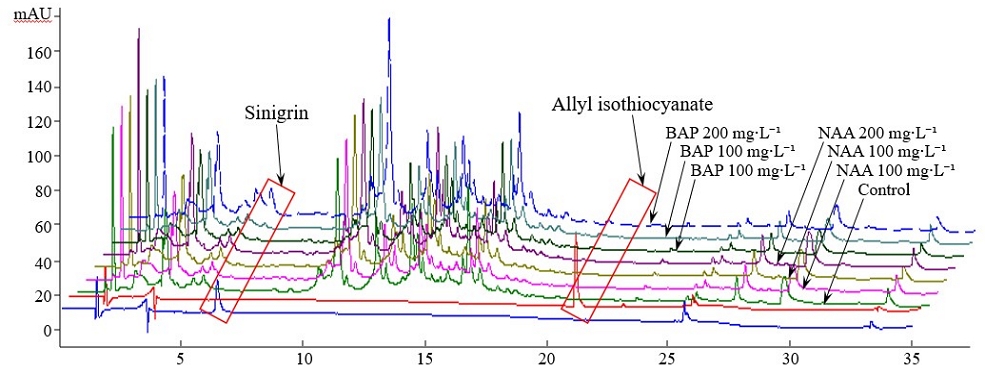
HPLC chromatograms of leaves of the ‘Dalma’ cultivar under different NAA and BAP treatment concentrations. Foliar applications of NAA (0, 50, 100, and 200 mg·L⁻¹) and BAP (50, 100, and 200 mg·L⁻¹) were applied twice at one-month intervals starting two months after germination. Seedlings were harvested five months after germination
Effects of NAA and BAP foliar sprays on sinigrin and allyl isothiocyanate content in leaf, petiole, and root of Wasabia japonica seedlingsz)
Department of Horticultural Bioscience, Pusan National University ywchoi@pusan.ac.kr
Department of Horticultural Bioscience, Pusan National University ypark@pusan.ac.kr
Department of Horticultural Bioscience, Pusan National University mimi2965@naver.com
Department of Horticultural Bioscience, Pusan National University bije@pusan.ac.kr
Department of Horticultural Bioscience, Pusan National University park5520@pusan.ac.kr
Department of Horticultural Bioscience, Pusan National University mhchop0161@naver.com
Department of Horticultural Bioscience, Pusan National University contact@buyangorchid.com
Department of Horticultural Bioscience, Pusan National University 95mainstreet@naver.com
Highland Agricultural Experiment Station, Gangwon State ARES politefrog@korea.kr
Nematode Research Center Pusan National University pns0073@pusan.ac.kr
Department of Horticultural Bioscience, Pusan National University kangjs@pusan.ac.kr
Department of Plant Bioscience, Pusan National University khi@pusan.ac.kr