
바이오차와 미생물제제 복합처리가 고추(Capsicum annuum L.) 포트재배의 토양 이화학성, 생육 및 과실 품질에 미치는 영향
Ⓒ The Korean Environmental Sciences Society. All rights reserved.
This is an Open-Access article distributed under the terms of the Creative Commons Attribution Non-Commercial License (http://creativecommons.org/licenses/by-nc/3.0) which permits unrestricted non-commercial use, distribution, and reproduction in any medium, provided the original work is properly cited.
Abstract
This study compared the effects of biochar (B), microbial inoculant (M), and combined treatment (MB) on soil physicochemical properties, growth, and fruit characteristics in pot-cultivated hot pepper (Capsicum annuum L.) using PLS regression analysis. Biochar significantly increased initial soil temperature, and final soil pH was higher in M than B. MB yielded approximately 3.3 times more fruits than the control, with greater leaf length and width. M contributed to higher initial sugar content, B showed specialized effects on final sugar content, and MB recorded the highest dry weight and overall productivity. PLS regression identified soil pH and N as primary soil variables. The score plot clearly separated treatments, with B associated with fruit quality variables and MB aligned with overall productivity variables. Combined treatment was most effective for improving soil conditions and crop productivity, while biochar alone may serve as a practical alternative when fruit quality is the primary objective. Limitations include unavailability of soil moisture data and controlled pot conditions, necessitating further field validation and rhizosphere microbial community analysis.
Keywords:
Hot pepper, Biochar, Microbial inoculant, Fruit quality, Soil amendment1. 서 론
고추(Capsicum annuum L.)는 우리나라에서 널리 소비되는 주요 채소 작물로, 최근 이상기상과 기후변화의 영향으로 재배면적과 생산량이 감소하는 추세이다(Heo et al., 2013). 국내 고추는 토양재배 중심으로 생산되어 근권 환경변동에 매우 민감하며(Yang et al., 2025), 전통적인 석회・퇴비・화학비료의 지속적 투입은 토양 산성화 및 염류 집적 등의 부작용을 초래할 수 있어(Lee et al., 2006; Oh et al., 2010; Lee et al., 2015) 지속가능한 대안 소재에 대한 관심이 높아지고 있다.
바이오차는 바이오매스를 제한된 산소 조건에서 고온 열분해하여 생산된 탄소 함량이 높은 고형물로, 토양 완충 능력 향상, pH 완충, 양분 유지 및 EC 안정화 등에 효능을 보이며(Bolan et al., 2021; Abdul-Aziz and Uz, 2026), 토양 미생물 서식 기반을 제공한다(Ippolito et al., 2020; Hamidzadeh et al., 2023). 그러나 단독 처리 시 초기 양분 공급 능력이 제한적일 수 있어(Song et al., 2025), 미생물제제와의 병용을 통한 복합적 접근이 주목받고 있다. 바이오차의 공극 구조는 방출되는 무기양분・유기탄소를 매개로 길항미생물의 활성을 촉진하며(Wang et al., 2026), 실제로 바이오차와 길항균(Trichoderma brevicompactum)의 복합처리는 근권 미생물 군집 개선을 통해 고추 역병에 대해 단독 처리보다 우수한 방제 효과를 보인 바 있다(Zhou et al., 2026). Song et al.(2025)은 103편의 메타분석을 통해 바이오차・미생물 복합 처리(BCM)가 지상부 건조중량 51.79%, 토양 유기탄소 49.38%, 토양 세균 풍부도 71.9% 향상을 확인하였으며, 이는 고추 재배에도 유효하게 적용될 수 있을 것으로 기대된다.
고추는 뿌리가 토양 표층부에 집중적으로 발달하는 천근성 작물로, 근권 토양의 물리화학적・생물학적 상태 변화에 크게 의존한다(Grasso et al., 2020). 그러나 바이오차 단독 처리는 물리화학적 완충 기능은 우수하나 초기 활성 양분 공급이 제한적이며, 미생물제제 단독 처리는 토양 내 정착・생존율이 낮아 효과가 일시적인 한계를 가진다. 이에 바이오차의 다공성 구조가 미생물의 서식 기반이자 보호처로 기능하고, 미생물이 바이오차의 양분 공급 한계를 생물학적으로 보완하는 상호보완적 관계가 주목받고 있다. 선행연구에서 Lee et al.(2018)은 건조 스트레스와 기온 상승 복합 조건에서 고추 광합성속도가 최대 60% 감소함을 보고하였고, Wi et al.(2020)은 저온・저일조가 초기 생육을 저해하나 적절한 관리로 수량 회복이 가능함을 확인하였으며, Kwon et al.(2020)은 상토 환경 개선이 초기 생육 촉진에 효과적임을 제시하였다. 그러나 바이오차와 미생물 복합 처리가 토양 이화학성 및 생육・과실 특성에 미치는 통합적 영향을 분석한 연구는 미흡한 실정이다.
따라서 본 연구는 고추 포트재배 조건에서 바이오차와 미생물제제의 단독 및 복합 처리가 토양 이화학성, 생육 및 과실 품질에 미치는 영향을 비교하고, PLS 회귀분석을 통해 토양환경 요인과 작물 반응 간의 통합적 관계를 평가함으로써 지속가능한 토양개량 기반 고추 생산관리의 기초자료를 제공하고자 하였다.
2. 연구방법
2.1. 연구대상지
본 연구는 2025년 5월부터 9월까지 충북 충주시 건국대학교 글로컬캠퍼스 내 유리온실에서 수행하였으며, 모든 처리구의 환경조건은 동일하였다(Fig. 1).
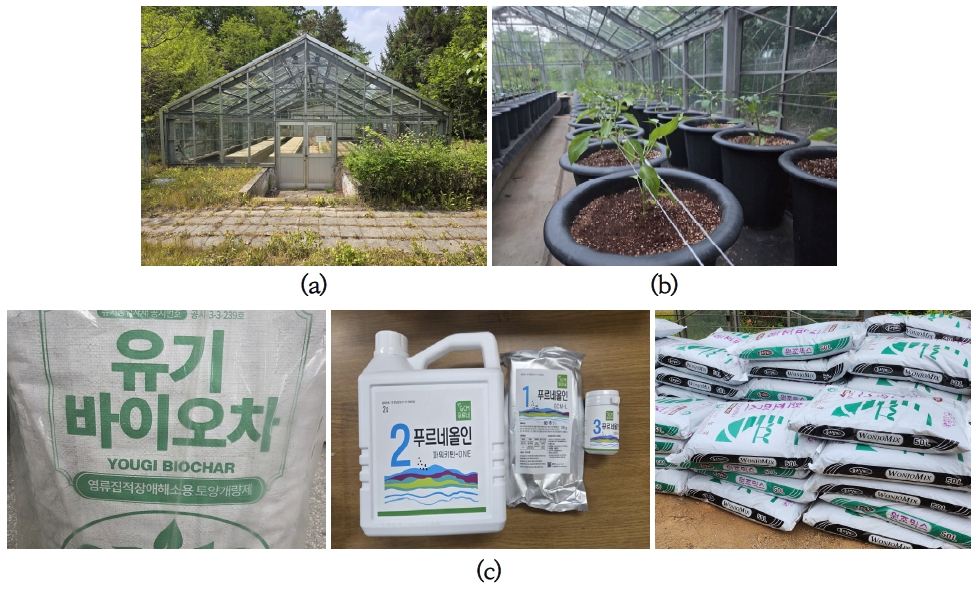
Experimental materials used in this study. (a) Research site, (b) experimental plants, and (c) experimental materials including biochar, microbial inoculant, and experimental soil.
2.2. 공시재료
본 연구에서 사용된 고추는 유묘를 구매하여 사용하였으며, 공시토양은 상업용 배합토 농경 원조믹스(㈜농경, Korea)를 사용하였다. 미생물은 생육촉진에 효과적인 푸르네 올인(㈜푸르네, Korea)을 사용하였다. 바이오차는 유기 바이오차(㈜유기산업, Korea)를 배합토와 부피비 1 : 0.02 = 25 : 0.5 (L)(배합토 : 바이오차)를 사용하였다(Fig. 1).
2.3. 처리구 조성
처리구는 무처리구(Cont.), 미생물(M), 바이오차(B), 복합처리(MB)로 구분하여 각 처리구 당 12주씩 총 48주를 35×36 cm 플라스틱 포트에 완전임의배치법으로 구성하였다. 미생물은 정제수 100배 희석 후 관주하였으며, 바이오차는 배합토와 부피비 1 : 0.02로 혼합하여 포트에 채워넣었다. 모든 포트 바닥에는 배수성 향상을 위해 펄라이트(뉴 펄샤인 1호, ㈜지에프씨, Korea)를 5 cm 높이로 채워넣었다(Fig. 2).
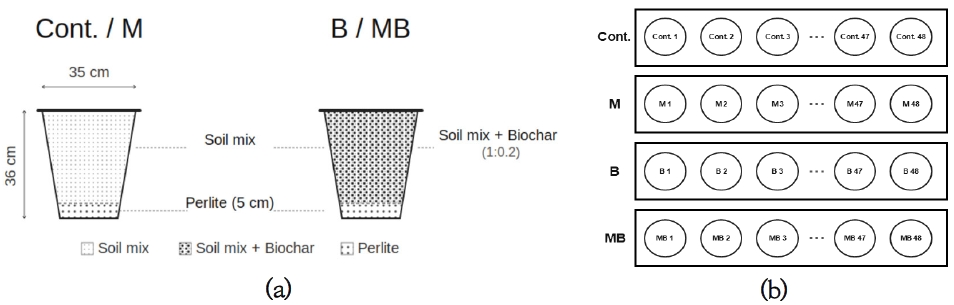
Experimental design. (a) Composition of treatments and (b) arrangement of experimental plots. Cont., Control; M, Microbial inoculant; B, Biochar; MB, Microbial inoculant + Biochar combined treatment.
2.4. 측정 및 분석방법
고추 생육(초장, 엽장, 엽폭, 줄기직경, 착과수)은 총 3회, 과실 특성(과실장, 과실경, 생체중, 당도(°Brix), 과피두께, 건물중)은 총 2회 조사하였다. 측정 도구는 30 cm 자와 디지털 캘리퍼스(ABSOLUTE Digimatic Caliper Series 500, Mitutoyo, Japan), 줄자를 사용하였으며, 건물중은 열풍건조기(C-DF, Changshin Sci Co, Korea)로 70℃에서 48시간 건조 후 측정하였다.
토양 이화학성은 총 2회 조사하였으며, 휴대용 토양 복합 측정기(SOIL6C, TESTAUTION CO., Limited, China)를 이용하여 가용성 질소(N), 인산(P), 칼륨(K), 토양산도(pH), 전기전도도(EC), 지온(TEMP)을 현장에서 직접 측정하였다.
모든 통계분석은 R version 4.6.0 (R Core Team, 2026)을 Google Colaboratory 환경에서 실행하였다. 처리구 간 평균 비교는 one-way ANOVA 후 Tukey HSD를 실시하였으며, 등분산 및 정규성은 Levene 검정과 Shapiro-Wilk 검정으로 확인하였다(rstatix 패키지; Kassambara, 2023). 생육 특성의 시간적 변화는 RM-ANOVA로 분석하였으며, 구형성 위반 시 Greenhouse-Geisser 보정을 적용하였다(multcomp View 패키지; Graves et al., 2019). 토양 이화학성과 생육・과실 변수 간 관계는 처리구 평균(n=4) 기반 PLS 회귀분석으로 수행하였으며(mix Omics 패키지; Rohart et al., 2017), VIP > 1.0인 변수를 주요 영향 인자로 판단하였다(Chong and Jun, 2005). 코드 작성 보조 도구로 Claude Sonnet 4.6(Anthropic, 2026)을 활용하였다.
3. 결과 및 고찰
3.1. 처리구별 토양 이화학적 특성
처리 후 약 2주 시점의 토양 분석 결과(Table 1), 질소(N) 함량은 복합처리(MB)(20.44 mg/kg)가 나머지 처리구보다 유의하게 낮았으며, 칼륨(K)은 복합처리(MB)(63.67 mg/kg)가 바이오차(B)(79.22 mg/kg)에 비해 유의하게 낮았다(p<0.05). 인산(P)・토양산도(pH)・전기전도도(EC)는 처리구 간 유의한 차이가 없었다. 지온(TEMP)은 복합처리(MB) (30.66℃) > 바이오차(B) (29.64℃) > 무처리구(Cont.)=미생물(M)(약 28℃) 순으로 바이오차 처리구에서 유의하게 높게 나타났으며, 이는 바이오차의 흑색 특성으로 인한 태양열 흡수 증가에 기인한 것으로 해석된다(Bilias et al., 2023).

Soil physicochemical properties at initial survey
최종 토양 분석 결과, 질소(N)・인산(P)・칼륨(K)・지온(TEMP)・전기전도도(EC)는 처리구 간 유의한 차이가 없었으며(Table 2), 재배 기간 동안 작물 흡수 및 토양 내 순환을 통해 양분 차이가 균일화된 것으로 해석된다. 토양산도(pH)는 미생물(M)(6.41)이 바이오차(B)(6.24)보다 유의하게 높았는데, 바이오차는 중성 범위 토양에서 토양산도(pH) 상승 효과가 제한적일 수 있는 반면(Song et al., 2025), 미생물 처리는 근권 미생물 활성화를 통해 토양산도(pH) 상승에 기여한 것으로 판단된다(Kaushal et al., 2019). 한편 복합처리(MB) 처리구는 초기 전질소 함량이 가장 낮았음에도 생육・과실 전반에서 가장 높은 생산성을 나타냈다. 이는 미생물의 유기태 질소 무기화 촉진(Kaushal et al., 2019), 바이오차의 근권 미생물 서식 기반 제공(Parasar and Agarwala, 2025; Song et al., 2025), CEC 향상에 따른 양분 보유력 증가(Wu et al., 2024)가 복합적으로 작용한 결과로 판단된다.
Soil physicochemical properties at final survey
3.2. 처리구별 생육 특성
처리구별 생육 특성의 시간적 변화를 RM-ANOVA로 분석한 결과(Table 3), 처리구 효과는 엽장・엽폭・줄기직경・과실수에서 유의하였으며, 처리구×시간 상호작용은 초장・엽장・엽폭・과실수에서 유의하게 나타나 처리구에 따라 시간적 생육 패턴이 다르게 전개됨을 확인하였다. 초장은 재배 후기(3차 조사)에 미생물(M)(79.58 cm)・바이오차(B)(81.75 cm)가 대조구(93.75 cm)보다 유의하게 작았으나(p<0.01), 이는 착과 수 증가에 따른 동화산물 재분배의 결과로 해석된다. 반면 착과수가 가장 많았던 복합처리(MB)(87.50 cm)는 대조구와 유의한 차이를 보이지 않았는데, 이는 바이오차와 미생물의 복합적 작용으로 양분・수분 이용 효율이 개선되어 과실 발달과 영양생장이 동시에 유지될 수 있었기 때문으로 판단된다. 모든 처리구에서 대조구보다 고추의 엽장, 엽폭 등 생육이 좋았으며, 특히 3차 조사에서 복합처리(MB)의 엽장(10.97 cm)과 엽폭(4.81 cm)이 가장 우수하였다. 과실수는 복합처리(MB) (19.00개/포트) > 바이오차(B)(12.25개/포트) > 미생물(M)(9.58개/포트) > 무처리구(Cont.) (5.75개/포트) 순으로, 복합처리(MB)가 대조구 대비 약 330%에 달하였다.
Growth characteristics of Capsicum annuum L. by treatment and survey period
3.3. 처리구별 과실 특성
초기 과실 조사(정식 후 28일째)에서 당도는 미생물(M)(5.40°Brix)・복합처리(MB)(5.32°Brix)가 무처리구(Cont.)(4.82°Brix)・바이오차(B)(4.82°Brix)에 비해 유의하게 높아 미생물 처리가 초기 당 축적에 기여하는 것으로 나타났다(Table 4). 과실경은 무처리구(Cont.)(20.40 mm)가 바이오차(B)(18.17 mm)에 비해 유의하게 컸으며, 과실장・생체중・과피두께・건물중은 처리구 간 유의한 차이가 확인되지 않았다.
Fruit characteristics at initial survey
최종 과실 조사에서 과실장은 복합처리(MB) (11.23 cm) > 무처리구(Cont.)(10.75 cm) > 미생물(M)(10.06 cm) > 바이오차(B)(9.59 cm) 순으로 나타났다(Table 5). 생체중은 무처리구(Cont.) (9.84 g)가 미생물(M)(7.74 g)・바이오차(B)(7.72 g) 에 비해 유의하게 높았으며, 이는 착과 수가 많은 처리구에서 동화산물 공급이 분산된 결과로 판단된다. 당도는 바이오차(B)(6.06°Brix)・복합처리(MB)(6.12°Brix)가 무처리구(Cont.)(5.06°Brix) ・미생물(M)(5.53°Brix)보다 유의하게 높았으며, 건물중은 복합처리(MB)(1.065 g)가 모든 처리구 중 가장 높았다. 복합처리(MB)의 생체중(8.96 g)이 무처리구(9.84 g)와 유의한 차이가 없었음에도 건물중이 가장 높게 나타난 것은 과실 내 건물 함량이 상대적으로 높았음을 의미하며, 이는 바이오차와 미생물의 복합적 작용으로 광합성 산물의 전류 및 과실로의 분배 효율이 향상되어 단위 생체중당 고형물 축적이 증가한 결과로 사료된다.
Fruit characteristics at final survey
3.4. 토양-생육・과실 통합 관계 분석 (PLS 회귀분석)
처리구 간 평균 비교만으로는 어떤 토양 변수가 생육・과실 특성에 실질적으로 영향을 미치는지 파악하기 어려우므로, 토양 이화학성과 생육・과실 특성 간의 정량적 관계를 규명하기 위해 회귀분석을 실시하였다. PLS 회귀분석은 다중공선성이 존재하고 관측수가 변수 수보다 적은 조건에서도 안정적으로 X-Y 관계를 분석할 수 있는 방법으로(Zou et al., 2024), 토양 양분 변수 간 강한 공선성(N・P・K・EC 간 r=0.93~0.99)이 존재하는 본 연구에 적합하다. Score plot(Fig. 3a)은 처리구별 종합 특성 차이를, Loading plot(Fig. 3b)은 각 변수와 처리구 간 연관성을, VIP 그래프(Fig. 3c)는 토양 변수의 생육・과실 특성에 대한 기여도를 나타낸다.
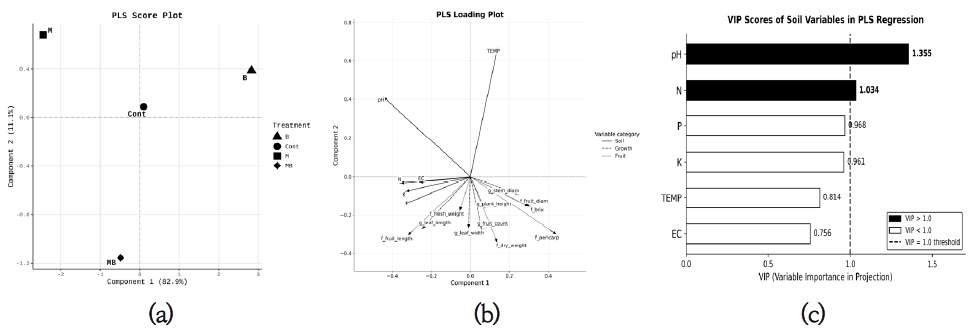
PLS regression analysis results. (a) Score plot, (b) loading plot, and (c) VIP scores of soil variables in PLS regression.
2개 성분이 토양 변수 분산의 94.0%, 생육・과실 변수 분산의 76.5%를 설명하였다. VIP 분석에서 토양산도(pH)(1.355)와 질소(N)(1.034)가 주요 변수로 확인되었으며, 질소(N)・인산(P)・칼륨(K)・전기전도도(EC) 간 강한 공선성에도 질소(N)만 VIP > 1.0을 충족한 것은 PLS가 공선성을 효과적으로 처리하여 대표 변수에 설명력을 집중시킨 결과로 해석된다.
Score plot에서 네 처리구는 서로 다른 사분면에 명확히 분리되었다. 바이오차(B) 처리구는 1사분면에서 당도・과실경・줄기직경・과피두께와 방향이 일치해 과실 품질 향상에 특화된 효과를 시사하며, 미생물(M) 처리구는 2사분면에서 질소(N)・인산(P)・칼륨(K)・전기전도도(EC) 양분 변수군과 일치하였다. 복합처리(MB) 처리구는 component 2 음의 방향으로 독립적으로 분리되어 과실수・엽장・엽폭・건물중・신선중 등 생육・과실 전반의 변수와 방향이 일치하였다.
이상의 결과를 종합하면, 바이오차 처리는 과실 품질, 미생물 처리는 초기 생육 촉진 및 당도 향상에 특화된 효과를 나타냈으며, 복합처리(MB)는 생육・과실 전반에서 가장 높은 생산성을 보였으며, 과실수는 대조구 대비 약 330%, 건물중은 약 53.6% 증가하였다. 복합처리는 추가 비용이 발생하나 높은 과실수와 건물중을 고려할 때 수익성이 우수하며 처리가 간단하여 노동 부담도 크지 않다. 본 연구에서 사용한 상업용 배합토는 이미 양분・수분 보유력이 우수하도록 조성된 자재이므로, 바이오차에 의한 양분 보유력 개선 효과가 상대적으로 제한적으로 나타났을 가능성이 있다. 따라서 보수력・보비력이 낮은 노지 사질 토양에서는 복합처리의 효과가 본 연구보다 더 크게 나타날 가능성이 있다(Bilias et al., 2023).
4. 결 론
본 연구는 고추(Capsicum annuum L.) 포트재배 조건에서 바이오차와 미생물제제의 단독 및 복합 처리가 토양 이화학성, 생육 및 과실 품질에 미치는 영향을 평가하였다. 복합처리는 엽장, 엽폭, 과실수 및 건물중 등 생산성 관련 지표에서 가장 우수한 경향을 보였으며, 바이오차 단독 처리는 최종 당도와 과실 품질 관련 변수와 높은 연관성을 나타냈다. PLS 회귀분석 결과, 토양산도(pH)와 질소(N)가 생육 및 과실 특성과 관련된 주요 토양 변수로 확인되었다. 본 연구 결과는 고추 포트재배에서 바이오차와 미생물제제의 복합처리가 단일 처리보다 생육 및 생산성 향상에 효과적일 수 있음을 보여준다. 특히 복합처리는 최종 토양 양분 농도의 유의한 증가 없이도 과실수와 건물중을 증가시켜, 단순 양분 공급보다는 근권환경 개선과 양분 이용성 향상이 주요 작용기작일 가능성을 시사하였다. 본 연구는 몇 가지 한계점을 지닌다. 토양 이화학성 측정에는 휴대용 토양 복합 측정기를 사용하였는데, 이는 절대적 정밀 분석값 도출보다는 처리구 간 상대적 변화 경향을 파악하는 데 목적을 두었기 때문이며, 향후 표준 실험실 분석법과의 교차검증이 필요하다. 또한 본 연구에서는 토양수분을 직접 측정하지 않아, 처리구 간 수분 보유력 차이가 생육・과실 특성에 미쳤을 잠재적 영향을 통제하지 못했다는 한계가 있다. 아울러 본 연구에서는 시판 유묘를 구매하여 사용함에 따라 품종을 특정하지 않아, 처리 효과가 품종 간 유전적 특성에 따라 달라질 가능성을 배제할 수 없다. 따라서 향후 노지 조건, 다양한 토성, 토양수분 조건 및 근권 미생물 군집 분석을 포함한 검증 연구가 필요하다.
REFERENCES
-
Abdul-Aziz, A. L., Uz, I., 2026, Biochar from agricultural waste enhances rhizosphere microbial activity over bulk soil, J. Soil Sci. Plant Nutr., 26, 2614-2627.
[https://doi.org/10.1007/s42729-026-03018-w]

- Anthropic, 2026, Claude Sonnet 4.6, Anthropic, https://www.anthropic.com
-
Bilias, F., Kalderis, D., Richardson, C., Barbayiannis, N., Gasparatos, D., 2023, Biochar application as a soil potassium management strategy: A Review, Sci. Total Environ., 858, 159782.
[https://doi.org/10.1016/j.scitotenv.2022.159782]
-
Bolan, N., Hoang, S. A., Beiyuan, J., Gupta, S., Hou, D., Karakoti, A., Joseph, S., Jung, S., Kim, K. H., Kirkham, M. B., Kua, H. W., Kumar, M., Kwon, E. E., Ok, Y. S., Perera, V., Rinklebe, J., Shaheen, S. M., Sarkar, B., Sarmah, A. K., Singh, B. P., Singh, G., Tsang, D. C. W., Vikrant, K., Vithanage, M., Vinu, A., Wang, H., Wijesekara, H., Yan, Y., Younis, S. A., Van Zwieten, L., 2021, Multifunctional applications of biochar beyond carbon storage, Int. Mater. Rev., 67(2), 150-200.
[https://doi.org/10.1080/09506608.2021.1922047]
-
Chong, I. G., Jun, C. H., 2005, Performance of some variable selection methods when multicollinearity is present, Chemom. Intell. Lab. Syst., 78, 103-112.
[https://doi.org/10.1016/j.chemolab.2004.12.011]
-
Grasso, R., de Souza, R., Peña-Fleitas, M. T., Gallardo, M., Thompson, R. B., Padilla, F. M., 2020, Root and crop responses of sweet pepper (Capsicum annuum) to increasing N fertilization, Sci. Hortic., 273, 109645.
[https://doi.org/10.1016/j.scienta.2020.109645]
- Graves, S., Piepho, H. P., Selzer, L., Dorai-Raj, S., 2019, multcompView: Visualizations of paired comparisons, R package version 0.1-12, https://CRAN.R-project.org/package=multcompView
-
Hamidzadeh, Z., Ghorbannezhad, P., Ketabchi, M. R., Yeganeh, B., 2023, Biomass-derived biochar and its application in agriculture, Fuel, 341, 127701.
[https://doi.org/10.1016/j.fuel.2023.127701]
- Heo, Y., Kim, S. H., Park, E. G., Son, B. G., Choi, Y. W., Lee, Y. J., Park, Y. H., Suh, J. M., Cho, J. H., Hong, C. O., Lee, S. G., Kang, J. S., 2013, The influence of abnormally high temperatures on growth and yield of hot pepper (Capsicum annum L.), J. Agric. Life Sci., 47(2), 9-15.
-
Ippolito, J. A., Cui, L., Kammann, C., Wrage-Mönnig, N., Estavillo, J. M., Fuertes-Mendizabal, T., Cayuela, M. L., Sigua, G., Novak, J., Spokas, K., Borchard, N., 2020, Feedstock choice, pyrolysis temperature and type influence biochar characteristics: A Comprehensive meta-data analysis review, Biochar, 2, 421-438.
[https://doi.org/10.1007/s42773-020-00067-x]
- Kassambara, A., 2023, rstatix: pipe-friendly framework for basic statistical tests, R package version 1.1.0, https://CRAN.R-project.org/package=rstatix
-
Kaushal, M., Mandyal, P., Kaushal, R., 2019, Field based assessment of Capsicum annuum performance with inoculation of rhizobacterial consortia, Microorganisms, 7(3), 89.
[https://doi.org/10.3390/microorganisms7030089]
-
Kwon, S. M., Lee, Y. E., Park, Y. M., Kim, D. W., Park, J. S., Oh, E. J., Yoo, J., Chung, K. Y., 2020, Evaluation of phosphorus acid treatment as a growth stimulant for red pepper (Capsicum annuum L.), cucumber (Cucumis sativus L.), and kimchi cabbage (Brassica campestris L. ssp. pekinensis) in the bed soil environment, J. Environ. Sci. Int., 29(3), 229-240.
[https://doi.org/10.5322/JESI.2020.29.3.229]
- Lee, C. K., Ahn, B. K., Kim, K. C., Ko, D. Y., Kim, J. Y., Jeong, S. S., 2015, Effects of red pepper growth and soil properties according to the maturity degree of compost, Proc. Korean Soc. Soil Sci. Fert. Spring Conf., 188.
- Lee, J. T., Lee, G. J., Zhang, Y. S., Hwang, S. W., Im, S. J., Kim, C. B., Mun, Y. H., 2006, Status of fertilizer application and soil management for major vegetable crops in farmers' fields of alpine area, Korean J. Soil Sci. Fert., 39(6), 357-365, https://koreascience.kr/article/JAKO200628066505716.page?&lang=ko
-
Lee, S. G., Lee, H. J., Kim, S. K., Mun, B. H., Lee, J. H., Lee, H. S., Do, K. R., 2018, Influence of drought and high temperature on the physiological response and yield in hot pepper, J. Environ. Sci. Int., 27(4), 251-259.
[https://doi.org/10.5322/JESI.2018.27.4.251]
- Oh, S. E., Son, J. S., Ok, Y. S., Joo, J. H., 2010, A Modified methodology of salt removal through flooding and drainage in a plastic film house soil, Korean J. Soil Sci. Fert., 43(5), 565-571, https://koreascience.kr/article/JAKO201020842653549.page?&lang=ko
-
Parasar, B. J., Agarwala, N., 2025, Unravelling the role of biochar-microbe-soil tripartite interaction in regulating soil carbon and nitrogen budget: A Panacea to soil sustainability, Biochar, 7, 37.
[https://doi.org/10.1007/s42773-024-00411-5]
- R Core Team, 2026, R: A Language and environment for statistical computing (version 4.6.0), R Foundation for Statistical Computing, Vienna, Austria, https://www.R-project.org/
-
Rohart, F., Gautier, B., Singh, A., Lê Cao, K. A., 2017, mixOmics: An R package for 'omics feature selection and multiple data integration, PLoS Comput. Biol., 13(11), e1005752.
[https://doi.org/10.1371/journal.pcbi.1005752]
-
Song, S., Ren, K., Zhang, W., Song, P., 2025, Biochar and microorganisms combined enhance crop growth and soil properties: Evidence from meta-analysis, Agric. Water Manage., 321, 1-15.
[https://doi.org/10.1016/j.agwat.2025.109908]
-
Wang, G., Ji, J., Lu, C., Ma, Y., Li, G., Zhang, J., 2026, Particle size influences biochar-mediated control of pepper Phytophthora blight: Linking released compounds to soil microbial disease suppression, Biochar, 8, 44.
[https://doi.org/10.1007/s42773-025-00566-9]
-
Wi, S. H., Lee, H. J., Yu, I. H., Jang, Y. A., Yeo, K. H., An, S. W., Lee, J. H., Kim, S. K., 2020, Effects of low air temperature and low radiation conditions on yield and quality of hot pepper at the early growth stage, J. Environ. Sci. Int., 29(10), 989-996.
[https://doi.org/10.5322/JESI.2020.29.10.989]
-
Wu, C. Y., Sun, Q. Y., Ren, Z. Y., Xia, N., Wang, Z., Sun, H., Wang, W., 2024, Combined effects of nitrogen fertilizer and biochar on the growth, yield, and quality of pepper, Open Life Sci., 19(1), 20220882.
[https://doi.org/10.1515/biol-2022-0882]
-
Yang, E. Y., Kwon, D. H., Kim, J. J., Ahn, Y. K., Cho, M. C., 2025, Productivity enhancement in pepper cultivation using an AI-based remote assistant smart-farming system, J. Pract. Agric. Fish. Res., 27(4), 196-208.
[https://doi.org/10.23097/JPAF:2025.27(4).196]
-
Zhou, J., Liang, J., Zhang, X., Luo, Y., Qu, Z., Gao, T., Yao, Y., Wang, F., 2026, Effects of biochar combined with Trichoderma brevicompactum 6311 on pepper phytophthora blight and pepper growth, Ind. Crops Prod., 240, 122667.
[https://doi.org/10.1016/j.indcrop.2026.122667]
-
Zou, Q. M., Zhao, L. Y., Guan, L. R., Chen, P., Zhao, J., Zhao, Y. Y., Du, Y. L., Xie, Y., 2024, The synergistic interaction effect between biochar and plant growth-promoting rhizobacteria on beneficial microbial communities in soil, Front. Plant Sci., 15, 1501400.
[https://doi.org/10.3389/fpls.2024.1501400]
Department of Green Technology Convergence, Graduate School of Konkuk Universitypjm6045@kku.ac.kr
Department of Green Technology Convergence, Graduate School of Konkuk Universitytlsdlqtod2233@kku.ac.kr
Department of Green Technology Convergence, Graduate School of Konkuk Universityseokjun24@naver.com
Department of Green Technology Convergence, Graduate School of Konkuk University speedrunner@naver.com
Department of Green Technology Convergence, College of Science Technology, Konkuk Universityhwankr87@naver.com
Department of Green Technology Convergence, College of Science Technology, Konkuk Universityjjhkkc@kku.ac.kr
Department of Green Technology Convergence, College of Science Technology, Konkuk Universityyonghan7204@kku.ac.kr
Department of Forest Bio Resource, National Institure of Forest Sciencejh2344@korea.kr