
Rethinking Herbal Medicine Waste: Upcycling Strategies for a Circular Bioeconomy
Ⓒ The Korean Environmental Sciences Society. All rights reserved.
This is an Open-Access article distributed under the terms of the Creative Commons Attribution Non-Commercial License (http://creativecommons.org/licenses/by-nc/3.0) which permits unrestricted non-commercial use, distribution, and reproduction in any medium, provided the original work is properly cited.
Abstract
The increasing generation of herbal medicine waste (HMW) has led to growing environmental concerns while simultaneously presenting opportunities for sustainable resource utilization. Traditionally, HMW has been disposed of through incineration or landfilling, resulting in resource loss and environmental burden. Unlike conventional biomass residues, HMW retains considerable amounts of lignocellulosic biomass and residual bioactive compounds, making it an attractive feedstock for environmental upcycling. This review provides an integrated overview of the characteristics of HMW, along with recent advances in upcycling technologies and their environmental significance within the framework of a circular bioeconomy. Current upcycling strategies include recovering bioactive compounds, developing biomaterials, generating biochar, producing renewable energy, and composting through cascading utilization approaches that maximize resource efficiency and value creation. These technologies not only reduce waste generation but also contribute to greenhouse gas mitigation, carbon sequestration, fossil resource substitution, and sustainable resource management. Furthermore, life cycle assessment, integrated biorefinery concepts, and circular bioeconomy principles are discussed as key approaches for improving the environmental and economic performance of HMW valorization. Despite significant progress in waste recycling, several challenges such as feedstock variability, standardization, supply chain management, commercialization, and regulatory barriers remain to be overcome. Future research should focus on integrated upcycling systems, standardized environmental evaluation methods, and emerging digital technologies to facilitate industrial implementation. Overall, this review highlights that HMW should no longer be regarded as waste requiring disposal but as a strategic biomass resource capable of supporting environmental sustainability, a circular bioeconomy, and the transition toward a low-carbon biobased society.
Keywords:
Herbal medicine waste, Upcycling; Circular bioeconomy, Biomass valorization, Carbon neutrality, Life cycle assessment, Biorefinery1. Introduction
The global transition toward carbon neutrality and circular bioeconomy has accelerated the development of sustainable strategies for converting biomass waste into value-added products (Vasileiadou, 2024). Among various biomass resources, herbal medicine waste (HMW) has recently attracted increasing attention because it contains not only lignocellulosic biomass but also residual bioactive compounds that remain after extraction (Maina et al., 2017; Wu et al., 2025b). These unique characteristics make HMW a promising feedstock for environmental upcycling and sustainable resource utilization.
The global use of herbal medicines has increased substantially due to growing interest in natural products and traditional medicine (Wu et al., 2025b). In China alone, more than 30 million tons of herbal medicine residues are estimated to be generated annually, and the continuous expansion of the herbal medicine industry is expected to further increase this volume (Long et al., 2023). In contrast, comprehensive national statistics on the generation of herbal medicine waste remain limited in many other countries, including Korea, making it difficult to accurately evaluate the scale of this biomass resource and develop evidence-based management strategies. Consequently, large quantities of HMW are generated during cultivation, processing, extraction, and manufacturing. Most of these residues are still disposed of through incineration or landfilling, leading to environmental burdens and the loss of potentially valuable biomass resources (Tripathi et al., 2019; Long et al., 2023). Unlike most agricultural biomass residues, which are primarily utilized for lignocellulosic biomass, HMW possesses a unique dual-resource characteristic by simultaneously containing structural biomass and residual phytochemicals (Hou et al., 2022; Long et al., 2023). Accordingly, HMW retains various phytochemicals, including polyphenols, flavonoids, alkaloids, polysaccharides, and saponins, providing additional opportunities for high-value resource recovery.
Recent studies have explored diverse upcycling technologies for HMW, including the recovery of bioactive compounds, production of biochar and bioenergy, composting, and the development of adsorbents and functional biomaterials (Hou et al., 2022). Rather than following a single utilization pathway, these technologies can be integrated into cascading upcycling systems that maximize resource recovery through sequential production of multiple value-added products (Hou et al., 2022; Wu et al., 2025a). These approaches not only reduce waste generation but also contribute to greenhouse gas mitigation, carbon sequestration, renewable resource substitution, and improved resource efficiency. Accordingly, HMW is increasingly recognized as a strategic biomass resource that can support circular bioeconomy and sustainable environmental management.
Although previous reviews have summarized individual utilization technologies, comprehensive discussions integrating HMW upcycling with environmental sustainability, carbon reduction, and circular bioeconomy remain limited. Recent reviews have primarily focused on resource utilization technologies and high-value industrial applications of HMW, including functional foods, pharmaceuticals, and cosmetics, whereas environmental sustainability and circular bioeconomy perspectives have received comparatively less attention (Lim and Park, 2025). Moreover, comparative evaluations of different upcycling technologies from environmental and industrial perspectives remain scarce, limiting the identification of sustainable utilization pathways for HMW. Therefore, this review provides an integrated overview of the characteristics of HMW, recent advances in upcycling technologies, their environmental benefits, and future opportunities and challenges for sustainable industrial applications. In addition, this review highlights current knowledge gaps, including the limited availability of standardized national statistics on HMW generation outside China, and discusses the need for comprehensive resource inventories to support future environmental assessment and sustainable policy development. By integrating technological advances with environmental sustainability and circular bioeconomy concepts, this review aims to provide a comprehensive framework for promoting HMW as a strategic biomass resource for future sustainable industries. The currently available information on HMW generation in major East Asian countries is summarized in Table 1, highlighting the limited availability of standardized national statistics outside China.

Comparative overview of current knowledge on herbal medicine waste (HMW) generation and major upcycling technologies
2. Herbal Medicine Waste: Characteristics and Upcycling Potential
2.1. Generation and sources of herbal medicine waste
HMW is generated throughout the entire production chain of herbal medicines, including cultivation, harvesting, preprocessing, extraction, manufacturing, and clinical use (Wu et al., 2025b). Among these processes, post-extraction residues produced after decoction or industrial extraction account for the largest proportion of HMW (Long et al., 2023; Wu et al., 2025b). Although target compounds are removed during extraction, substantial amounts of organic biomass and residual phytochemicals remain in the solid residues. Recent reports indicate that more than 30 million tons of herbal medicine residues are generated annually in China alone, and this amount is expected to increase continuously with the rapid expansion of the herbal medicine and formula granule industries (Meng et al., 2017; Zhao et al., 2018; Ma et al., 2021; Hou et al., 2022; Wu et al., 2025b). As the global demand for herbal medicines continues to increase, particularly in East Asian countries such as China, Korea, and Japan, the generation of HMW has increased accordingly. This growing volume of biomass waste has raised environmental concerns regarding collection, transportation, storage, and disposal, highlighting the need for sustainable resource management and valorization (Long et al., 2023). Therefore, the efficient utilization of HMW has become an important issue for both environmental protection and the sustainable development of the herbal medicine industry.
2.2. Physicochemical characteristics of herbal medicine waste
HMW is a lignocellulosic biomass mainly composed of cellulose, hemicellulose, and lignin, together with proteins, minerals, lipids, and residual nutrients (Cheng and Liu, 2010; Akash et al., 2023). More importantly, unlike conventional agricultural residues, HMW retains considerable amounts of bioactive compounds after extraction, including polyphenols, flavonoids, alkaloids, terpenoids, saponins, and polysaccharides (Wei et al., 2021). This unique coexistence of structural biomass and residual phytochemicals gives HMW a dual-resource characteristic, allowing it to serve as both a source of functional bioactive ingredients and a renewable biomass feedstock (Wei et al., 2021; Wu et al., 2025b). The coexistence of structural biomass and residual phytochemicals distinguishes HMW from many other biomass resources and provides opportunities for both material recovery and biomass conversion. Consequently, HMW possesses greater resource utilization potential than many conventional biomass wastes, which are generally exploited only for their lignocellulosic components. However, its chemical composition varies depending on plant species, cultivation conditions, extraction methods, and processing technologies, which can influence the efficiency and reproducibility of subsequent utilization processes.
2.3. Upcycling potential of herbal medicine waste
The unique composition of HMW makes it an attractive feedstock for environmental upcycling. Residual bioactive compounds can be recovered as high-value functional ingredients before the remaining lignocellulosic biomass is further utilized for the production of biochar, bioenergy, compost, adsorbents, and other bio-based materials (Tripathi et al., 2019; Ma et al., 2021). This sequential utilization, known as cascading upcycling, enables multiple value-added products to be generated from a single biomass resource while minimizing waste generation. This cascading utilization strategy maximizes resource efficiency while minimizing waste generation, thereby supporting the principles of circular bioeconomy. Compared with conventional biomass utilization, integrated upcycling strategies can simultaneously improve environmental performance, economic value, and resource efficiency, making HMW an attractive feedstock for sustainable industrial applications (Li et al., 2026). Nevertheless, challenges such as feedstock heterogeneity, variable moisture content, and inconsistent chemical composition remain important barriers to large-scale industrial implementation. Therefore, accurate characterization and standardized management of HMW are essential for establishing sustainable and economically viable upcycling systems. The major upcycling technologies currently applied to HMW differ in their technical characteristics, environmental benefits, economic potential, and industrial applicability. A comparative overview of these technologies is summarized in Table 2. Overall, HMW should be regarded not merely as a waste requiring disposal but as a strategic biomass resource capable of generating environmental, economic, and industrial value through integrated upcycling technologies.
Comparison of major herbal medicine waste upcycling technologies in terms of technical characteristics, environmental benefits, and industrial potential
3. Upcycling Technologies for Herbal Medicine Waste
3.1. Bioactive compound recovery technologies
The recovery of residual bioactive compounds represents the first and highest-value step in the upcycling of HMW. Although conventional extraction removes the major active ingredients, considerable amounts of polyphenols, flavonoids, alkaloids, terpenoids, saponins, and polysaccharides remain in the residual biomass (Vasileiadou, 2024). Various extraction technologies, including solvent extraction, ultrasound-assisted extraction, microwave-assisted extraction, enzyme-assisted extraction, and supercritical fluid extraction, have been applied to improve the recovery efficiency of these residual phytochemicals (Vasileiadou, 2024). The selection of extraction technology depends on the physicochemical properties of the target compounds and directly influences extraction yield, purity, and processing cost. The recovered bioactive compounds can subsequently be utilized in pharmaceutical, cosmetic, nutraceutical, and functional food industries, thereby maximizing the economic value of HMW before biomass conversion. Consequently, bioactive compound recovery represents the initial stage of cascading upcycling and integrated biorefinery systems.
3.2. Biomaterial fabrication technologies
Following the recovery of bioactive compounds, the remaining biomass can be converted into a variety of functional biomaterials through physical, chemical, and thermochemical modification processes (Vallejo et al., 2025). Common fabrication technologies include carbonization, chemical activation, hydrothermal treatment, and surface functionalization, which improve surface area, pore structure, and surface functional groups (Lv et al., 2020; Vallejo et al., 2025). These modifications enable the production of activated carbon, engineered biochar, adsorbents, membranes, and biomass-based composites with excellent adsorption performance (Lin et al., 2023). HMW-derived biomaterials have demonstrated considerable potential for removing heavy metals, dyes, antibiotics, pesticides, and other emerging contaminants from water and soil environments (Shang et al., 2016; Lin et al., 2023). Compared with conventional adsorbents, biomass-derived materials offer low production costs, renewability, and environmental compatibility, making them attractive materials for environmental remediation.
3.3. Thermochemical conversion for biochar production
Thermochemical conversion is one of the most widely adopted technologies for the valorization of HMW. Among these technologies, pyrolysis is the primary process for producing biochar under oxygen-limited conditions (Bhaskar et al., 2011). The physicochemical properties of biochar are strongly influenced by process parameters such as pyrolysis temperature, heating rate, residence time, and feedstock composition (Bhaskar et al., 2011; Damartzis and Zabaniotou, 2011). These parameters determine carbon stability, pore structure, surface area, and the abundance of oxygen-containing functional groups (Damartzis and Zabaniotou, 2011). Consequently, HMW-derived biochar can be applied in soil amendment, carbon sequestration, water purification, and environmental remediation. Furthermore, modified biochar prepared through physical or chemical activation has shown enhanced adsorption capacity toward various environmental pollutants, expanding its potential applications beyond conventional agricultural uses.
3.4. Biochemical conversion for bioenergy production
The high lignocellulosic content of HMW makes it a suitable feedstock for renewable bioenergy production through biochemical and thermochemical conversion technologies (Wang et al., 2017; Osman et al., 2024). Anaerobic digestion converts biodegradable organic matter into biogas, whereas microbial fermentation produces bioethanol and other biofuels following the hydrolysis of structural carbohydrates (Akash et al., 2023). Alternatively, gasification and pyrolysis generate syngas and bio-oil through thermochemical conversion. The selection of conversion technology depends on biomass composition, moisture content, and desired energy products (Akash et al., 2023). These renewable energy carriers can partially replace fossil fuels while recovering the remaining energy stored in biomass, thereby improving overall resource utilization efficiency and reducing greenhouse gas emissions.
3.5. Biological conversion for composting and agricultural applications
Biological conversion through aerobic composting remains one of the simplest and most mature technologies for HMW utilization. During composting, microorganisms decompose organic matter and transform herbal residues into stabilized compost rich in humic substances and plant nutrients (Jeevahan et al., 2021). The resulting organic fertilizer improves soil fertility, water-holding capacity, nutrient availability, and microbial diversity (Jeevahan et al., 2021; Long et al., 2023). Although composting generally produces lower economic value than other upcycling technologies, it requires relatively simple processing and can effectively recycle nutrients back into agricultural systems (Wu et al., 2025b). Therefore, composting remains an important biological conversion pathway, particularly for biomass residues that are unsuitable for high-value material recovery.
3.6. Integrated biorefinery and cascading upcycling
Recent developments in biomass utilization have shifted from single-product conversion toward integrated biorefinery systems based on cascading upcycling (Lu and Li, 2021). Rather than applying a single conversion technology, cascading utilization sequentially recovers bioactive compounds, followed by the production of biomaterials, biochar, renewable energy, and compost from the remaining biomass (Tao et al., 2021; Chen et al., 2024; Wu et al., 2025b). This integrated strategy maximizes resource efficiency, minimizes waste generation, and improves the overall environmental and economic performance of biomass utilization systems. Consequently, HMW should be regarded not as a waste requiring disposal but as a multifunctional biomass resource capable of supporting circular bioeconomy, carbon neutrality, and sustainable industrial development.
4. Environmental Benefits of Herbal Medicine Waste Upcycling
4.1. Greenhouse gas reduction
Compared with conventional disposal methods such as landfilling and incineration, the upcycling of HMW significantly reduces greenhouse gas (GHG) emissions by diverting biomass from waste disposal and converting it into value-added products (Cheng and Liu, 2010). Landfilling of organic biomass generates methane through anaerobic decomposition, whereas incineration releases large amounts of carbon dioxide (Wang et al., 2018). By recovering valuable resources before disposal, HMW upcycling minimizes these emissions while simultaneously reducing the environmental burden associated with waste management (Wang et al., 2018). Furthermore, biomass-derived products can partially replace fossil-based materials and fuels, contributing to lower life-cycle carbon emissions and supporting climate change mitigation.
4.2. Carbon eequestration and resource efficiency
Among various upcycling technologies, biochar production represents one of the most effective approaches for long-term carbon sequestration (Elkhlifi et al., 2023; Lin et al., 2023). During pyrolysis, biomass carbon is converted into chemically stable carbon structures that can remain in soil for decades or even centuries while improving soil fertility, nutrient retention, and water-holding capacity (Elkhlifi et al., 2023). Beyond carbon storage, cascading utilization of HMW-including bioactive compound recovery, biomaterial production, renewable energy generation, and composting-maximizes resource efficiency by generating multiple value-added products from a single biomass source (Elkhlifi et al., 2023). Such integrated utilization minimizes waste generation while promoting the sustainable circulation of biological resources.
4.3. Life cycle assessment and environmental performance
Life cycle assessment (LCA) has become an essential tool for evaluating the environmental sustainability of biomass utilization systems (Mishra et al., 2023). Although comprehensive LCA studies specifically targeting herbal medicine waste remain limited, recent studies on biomass valorization and biochar production have demonstrated that resource recovery pathways generally exhibit lower environmental impacts than conventional disposal methods, including landfilling and incineration (Barjoveanu et al., 2020; Mishra et al., 2023; Brás et al., 2024). For example, the utilization of 1 m³ of Dillenia excelsa wood waste for biochar production has been reported to reduce CO₂ emissions by approximately 1,687 kg compared with conventional disposal, illustrating the potential contribution of biomass valorization to climate change mitigation (Mishra et al., 2023). However, direct quantitative comparisons among published studies remain difficult because environmental performance varies depending on feedstock characteristics, system boundaries, functional units, and conversion technologies. By comparing upcycling pathways with conventional disposal scenarios, LCA can quantify greenhouse gas emissions, fossil resource consumption, energy demand, and other environmental impacts throughout the entire product life cycle (Mishra et al., 2023). Therefore, future studies should establish standardized LCA methodologies and functional units to enable more reliable quantitative comparisons among different HMW upcycling technologies. Future studies should further integrate carbon footprint analysis and environmental impact assessment to support evidence-based decision-making.
4.4. Environmental perspectives
The environmental value of HMW extends beyond simple waste reduction. Through carbon reduction, carbon sequestration, renewable resource substitution, pollution remediation, and improved resource efficiency, HMW upcycling contributes directly to low-carbon production systems and sustainable environmental management (Lv et al., 2020). As environmental regulations become increasingly stringent, HMW is expected to play an important role in supporting carbon neutrality and climate-resilient resource management strategies.
5. Circular Bioeconomy and Sustainable Industrial Applications
5.1. Circular bioeconomy through cascading upcycling
The circular bioeconomy promotes the continuous utilization of renewable biological resources through recovery, reuse, and regeneration rather than linear disposal (Castro-Alves and Prado, 2025; Wu et al., 2025a). Within this framework, HMW can be transformed into multiple value-added products through cascading upcycling, where bioactive compounds are first recovered before the remaining biomass is sequentially converted into biomaterials, biochar, bioenergy, and compost (Castro-Alves and Prado, 2025; Xu et al., 2026). This integrated biorefinery concept maximizes both resource utilization and economic value while minimizing waste generation.
5.2. Industrial applications and ESG perspectives
The upcycling of HMW provides environmental, social, and economic benefits that align closely with environmental, social, and governance (ESG) principles (Marques et al., 2025). Environmentally, HMW utilization reduces greenhouse gas emissions, fossil resource consumption, and waste generation (Grossarth, 2025). Socially, it creates new opportunities for rural development, biomass collection, and green employment (Grossarth, 2025; Munonye and Munonye, 2025; Taheri Hosseinkhani, 2025). From a governance perspective, standardized quality control, waste classification, traceability, and regulatory frameworks are essential for ensuring the commercialization and safe utilization of HMW-derived products.
5.3. Policy implications and sustainable development goals
The successful industrial implementation of HMW upcycling requires supportive policy frameworks that encourage biomass utilization and circular resource management (Long and Gui, 2024). Government incentives, green procurement programs, carbon credit mechanisms, sustainability certification, and research investment can accelerate industrial adoption of HMW upcycling technologies. Moreover, HMW valorization contributes directly to several united Nations Sustainable Development Goals (SDGs), including SDG 7 (affordable and clean energy), SDG 9 (industry, innovation and infrastructure), SDG 12 (responsible consumption and production), and SDG 13 (climate Action) (Araujo-Morera et al., 2021; Hatayama, 2022).
5.4. Future industrial perspectives
Future HMW management is expected to evolve from conventional waste treatment toward intelligent and integrated biorefinery systems. Emerging technologies such as artificial intelligence, digital traceability, smart resource management, carbon accounting, and precision biorefinery are expected to optimize biomass utilization and improve environmental performance. The integration of these technologies with circular bioeconomy principles will accelerate the transition toward sustainable manufacturing and low-carbon industrial systems.
6. Challenges and Future Perspectives
6.1. Feedstock variability and standardization
The heterogeneous nature of HMW remains one of the major barriers to large-scale upcycling. Variations in plant species, cultivation conditions, extraction methods, and storage practices influence biomass composition and residual bioactive compounds, affecting process efficiency and product quality. Therefore, standardized classification systems, characterization methods, and quality control protocols are essential for ensuring consistent industrial utilization.
6.2. Supply chain, commercialization, and regulatory challenges
Efficient collection, transportation, and storage systems are critical for the commercialization of HMW. However, geographically dispersed waste sources, high moisture content, and transportation costs limit large-scale implementation. In addition, commercialization requires supportive regulatory frameworks, environmental safety assessments, and techno-economic evaluations to improve market competitiveness and ensure the safe utilization of biomass-derived products.
6.3. Integrated biorefinery and emerging technologies
Future HMW management should move beyond single conversion technologies toward integrated biorefinery systems based on cascading utilization. Recovering high-value bioactive compounds before converting the remaining biomass into biochar, bioenergy, biomaterials, or compost can maximize resource efficiency and economic value. Emerging digital technologies may provide practical tools for overcoming the heterogeneity and supply-chain complexity of HMW. Artificial intelligence and machine learning can be applied to classify HMW according to plant species, moisture content, chemical composition, and residual bioactive compounds, thereby supporting the selection of appropriate upcycling pathways. For example, AI-assisted decision models could help determine whether a specific HMW stream is more suitable for bioactive compound recovery, biochar production, composting, or bioenergy conversion. Digital traceability systems can also be used to track the origin, processing history, storage conditions, and safety-related information of HMW, which is particularly important for ensuring quality control and regulatory compliance. In addition, precision biorefinery approaches may enable the design of feedstock-specific conversion processes that maximize resource recovery while minimizing environmental burdens. Therefore, AI-assisted resource classification, digital traceability, and precision biorefinery systems should be further developed as enabling technologies for the industrial implementation of HMW upcycling.
6.4. Future perspectives
Future research should prioritize standardized environmental assessment methods, LCA, carbon footprint analysis, and integrated resource management strategies to provide quantitative evidence supporting HMW upcycling. Particular emphasis should be placed on establishing standardized functional units, system boundaries, and assessment frameworks to enable robust quantitative comparisons among different HMW upcycling pathways. Future efforts should also focus on establishing standardized national inventories and reporting systems for HMW generation, particularly in countries where comprehensive statistics are currently unavailable. Such databases would facilitate resource assessment, policy development, and comparative environmental analyses. Strengthening collaboration among academia, industry, and policymakers will be essential for translating laboratory-scale technologies into commercially viable and environmentally sustainable biomass utilization systems.
Herbal medicine waste contains two major resource fractions: residual bioactive compounds and lignocellulosic biomass. Residual bioactive compounds can be recovered using various extraction technologies, including solvent extraction, ultrasound-assisted extraction, microwave-assisted extraction, and enzyme-assisted extraction, for applications in pharmaceuticals, cosmetics, nutraceuticals, and functional foods. The remaining lignocellulosic biomass can be converted through thermochemical, biochemical, biological, and chemical activation processes into biomaterials, biochar, bioenergy, and compost. The sequential recovery of high-value bioactive compounds followed by biomass conversion represents a cascading upcycling strategy that maximizes resource utilization and supports the transition toward a circular bioeconomy, carbon neutrality, and environmental sustainability.
7. Conclusions
HMW, once regarded simply as a by-product of herbal medicine production, is increasingly being recognized as a valuable biomass resource for sustainable environmental management (Fig. 1). Owing to its unique combination of lignocellulosic biomass and residual bioactive compounds, HMW offers diverse opportunities for value-added utilization through the recovery of functional ingredients, production of biomaterials, biochar, renewable energy, and compost. These upcycling strategies not only reduce waste generation but also improve resource efficiency and contribute to greenhouse gas mitigation, carbon sequestration, and the substitution of fossil-based resources.
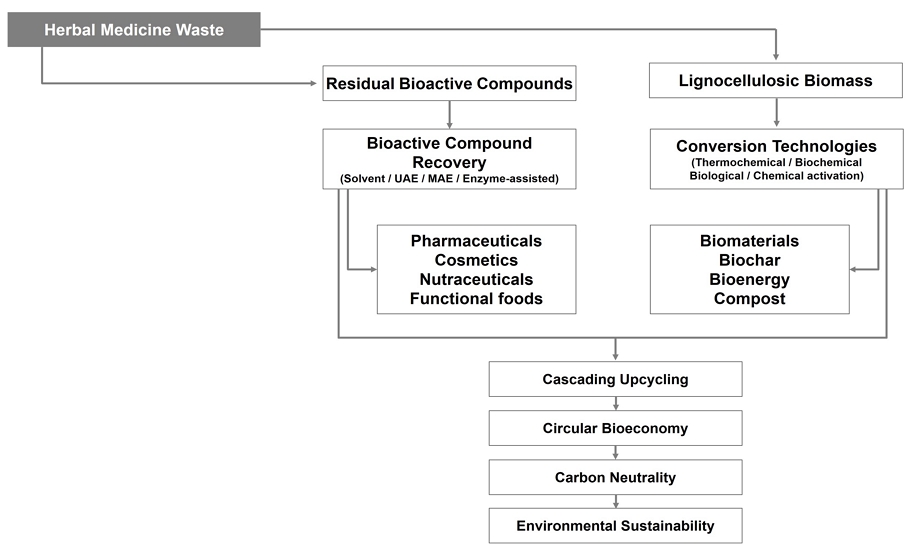
Schematic illustration of cascading upcycling pathways for herbal medicine waste.
The sustainable utilization of HMW extends beyond conventional waste management by supporting the principles of circular bioeconomy through cascading resource recovery and integrated biorefinery systems. Nevertheless, several challenges, including feedstock variability, supply chain management, economic feasibility, standardization, and regulatory frameworks, must be addressed to facilitate large-scale industrial implementation. Future efforts should therefore focus on optimizing upcycling technologies, establishing standardized evaluation methods, conducting comprehensive LCA and carbon footprint analyses, and strengthening collaboration among academia, industry, and policymakers.
Importantly, the future value of HMW lies not in a single utilization pathway but in integrated cascading upcycling systems that sequentially recover multiple value-added products from a single biomass resource. Such integrated approaches maximize environmental, economic, and resource efficiencies while supporting carbon neutrality and circular bioeconomy.
Ultimately, HMW should no longer be regarded as waste requiring disposal but as a strategic biomass resource capable of supporting sustainable resource management, low-carbon industrial development, and the transition toward a circular bioeconomy. With continued advances in environmental technologies, integrated biorefinery systems, and supportive policy frameworks, HMW has the potential to become an important renewable resource contributing to future sustainable industries and global environmental sustainability.
Acknowledgments
This work was supported by a grant on the Development of an Upcycling Platform Technology for Food Waste Utilization (KSN2512040) from the Korea Institute of Oriental Medicine, and by the Jeonnam Green Environment Center, designated by the Ministry of Environment, Republic of Korea, through the research project High-Value Material Development through Resource Circulation and Bioactivity Evaluation of Agricultural Processing Residues in Jeollanam-do: Bioactivity Screening and Upcycling Model Development (2026 Project No. JNGEC/R-26-04-50-54-06; JNGEC Research Report No. 267).
REFERENCES
-
Akash, S., Sivaprakash, B., Rajamohan, N., Vo, D. V. N., 2023, Biotechnology to convert carbon dioxide into biogas, bioethanol, bioplastic and succinic acid using algae, bacteria and yeast: A Review, Environ. Chem. Lett., 21(3), 1477-1497.
[https://doi.org/10.1007/s10311-023-01569-3]

-
Araujo-Morera, J., Verdejo, R., López-Manchado, M. A., Santana, M. H., 2021, Sustainable mobility: The route of tires through the circular economy model, Waste Manag., 126, 309-322.
[https://doi.org/10.1016/j.wasman.2021.03.025]
-
Barjoveanu, G., Pătrăuțanu, O. A., Teodosiu, C., Volf, I., 2020, Life cycle assessment of polyphenols extraction processes from waste biomass, Sci. Rep., 10(1), 13632.
[https://doi.org/10.1038/s41598-020-70587-w]
-
Bhaskar, T., Bhavya, B., Singh, R., Naik, D. V., Kumar, A., Goyal, H. B., 2011, Thermochemical conversion of biomass to biofuels, in: Pandey, A. (ed.), Biofuels, 1st ed., Academic Press, Amsterdam, 51-77.
[https://doi.org/10.1016/B978-0-12-385099-7.00003-6]
-
Brás, I., Silva, E., Raimondo, R., Saetta, R., Mignano, V., Fabbricino, M., Ferreira, J., 2024, Valorisation of forest and agriculture residual biomass-The application of life cycle assessment to analyse composting, mulching, and energetic valorisation strategies, Sustainability, 16(2), 630.
[https://doi.org/10.3390/su16020630]
-
Castro-Alves, V., Prado, S., 2025, Upcycling agro-industrial biomass into bioactive oligosaccharides for the circular bioeconomy: Beyond the prebiotic effects with a focus on receptor interactions, ACS Food Sci. Technol., 5(11), 4078-4092.
[https://doi.org/10.1021/acsfoodscitech.5c00914]
-
Chen, C., Yang, L., Zhang, X., Zhao, C., Sun, J., Li, G., Shi, H., 2024, Advances and prospects of multifunctional biochar-based materials from organic solid waste of traditional Chinese medicine: A Review, Biomass Bioenergy, 187, 107296.
[https://doi.org/10.1016/j.biombioe.2024.107296]
-
Cheng, X. Y., Liu, C. Z., 2010, Enhanced biogas production from herbal‐extraction process residues by microwave‐assisted alkaline pretreatment, J. Chem. Technol. Biotechnol., 85(1), 127-131.
[https://doi.org/10.1002/jctb.2278]
-
Damartzis, T., Zabaniotou, A., 2011, Thermochemical conversion of biomass to second generation biofuels through integrated process design-A Review, Renew. Sustain. Energy Rev., 15(1), 366-378.
[https://doi.org/10.1016/j.rser.2010.08.003]
-
Elkhlifi, Z., Iftikhar, J., Sarraf, M., Ali, B., Saleem, M. H., Ibranshahib, I., Bispo, M. D., Meili, L., Ercisli, S., Torun Kayabasi, E., 2023, Potential role of biochar on capturing soil nutrients, carbon sequestration and managing environmental challenges: A Review, Sustainability, 15(3), 2527.
[https://doi.org/10.3390/su15032527]
-
Grossarth, J., 2025, Circular bioeconomy of buildings: Holistic perspectives, bioeconomy of buildings: From resource flows to meanings, Springer, 205-216.
[https://doi.org/10.1007/978-3-031-84014-2_7]
-
Hatayama, H., 2022, The metals industry and the sustainable development goals: The relationship explored based on SDG reporting, Resour. Conserv. Recycl., 178, 106081.
[https://doi.org/10.1016/j.resconrec.2021.106081]
-
Hou, X., Deng, Y., Dai, M., Jiang, X., Li, S., Fu, H., Peng, C., 2022, Migration and transformation of heavy metals in Chinese medicine residues during the process of traditional pyrolysis and solar pyrolysis, Chemosphere, 293, 133658.
[https://doi.org/10.1016/j.chemosphere.2022.133658]
-
Jeevahan, J., Anderson, A., Sriram, V., Durairaj, R., Britto Joseph, G., Mageshwaran, G., 2021, Waste into energy conversion technologies and conversion of food wastes into the potential products: A Review, Int. J. Ambient Energy, 42(9), 1083-1101.
[https://doi.org/10.1080/01430750.2018.1537939]
-
Li, J., Chen, J., Zhang, Y., Wang, L., Gao, P., Yang, J., 2026, Bridging green chemistry and circular economy: A Pathway to sustainable polyester plastics through feedstock, Synthesis, and Waste Upcycling, Adv. Sci., 13(11), e21680.
[https://doi.org/10.1002/advs.202521680]
-
Lin, M., Li, F., Li, X., Rong, X., Oh, K., 2023, Biochar-clay, biochar-microorganism and biochar-enzyme composites for environmental remediation: A review, Environ. Chem. Lett. 21(3), 1837-1862.
[https://doi.org/10.1007/s10311-023-01582-6]
-
Lim, H. S., Park, G., 2025, Biorecycling and Valorization Strategies of Herbal Medicine Waste: Convergent Approaches for the Functional Food, Pharmaceutical, and Cosmetic Industries, J. Environ. Sci. Int. 34(6), 333-347.
[https://doi.org/10.5322/JESI.2025.34.6.333]
-
Long, X., Lu, Y. L., Guo, H., Tang, Y. P., 2023, Recent advances in solid residues resource utilization in traditional Chinese medicine, ChemistrySelect, 8(13), e202300383.
[https://doi.org/10.1002/slct.202300383]
-
Long, X., Gui, L., 2024, Waste not want not? The environmental implications of quick response and upcycling, Manuf. Serv. Oper. Manag., 26(2), 612-631.
[https://doi.org/10.1287/msom.2022.0040]
-
Lu, Q., Li, C., 2021, Comprehensive utilization of Chinese medicine residues for industry and environment protection: Turning waste into treasure, J. Clean. Prod., 279, 123856.
[https://doi.org/10.1016/j.jclepro.2020.123856]
-
Lv, M., Li, J., Zhang, W., Zhou, B., Dai, J., Zhang, C., 2020, Microbial activity was greater in soils added with herb residue vermicompost than chemical fertilizer, Soil Ecol. Lett., 2(3), 209-219.
[https://doi.org/10.1007/s42832-020-0034-6]
-
Ma, J., Chen, Y., Wang, K., Huang, Y., Wang, H., 2021, Re-utilization of Chinese medicinal herbal residues improved soil fertility and maintained maize yield under chemical fertilizer reduction, Chemosphere, 283, 131262.
[https://doi.org/10.1016/j.chemosphere.2021.131262]
-
Maina, S., Kachrimanidou, V., Koutinas, A., 2017, A Roadmap towards a circular and sustainable bioeconomy through waste valorization, Curr. Opin. Green Sustain. Chem., 8, 18-23.
[https://doi.org/10.1016/j.cogsc.2017.07.007]
-
Marques, C., Güneş, S., Vilela, A., Gomes, R., 2025, Life-cycle assessment in agri-food systems and the wine industry-A Circular economy perspective, Foods, 14(9), 1553.
[https://doi.org/10.3390/foods14091553]
-
Meng, F., Yang, S., Wang, X., Chen, T., Wang, X., Tang, X., Zhang, R., Shen, L., 2017, Reclamation of Chinese herb residues using probiotics and evaluation of their beneficial effect on pathogen infection, J. Infect. Public Health, 10(6), 749-754.
[https://doi.org/10.1016/j.jiph.2016.11.013]
-
Mishra, R. K., Kumar, D. J. P., Narula, A., Chistie, S. M., Naik, S. U., 2023, Production and beneficial impact of biochar for environmental application: A Review on types of feedstocks, chemical compositions, operating parameters, techno-economic study, and life cycle assessment, Fuel, 343, 127968.
[https://doi.org/10.1016/j.fuel.2023.127968]
-
Munonye, W. C., Munonye, D. I., 2025, Beyond greenwashing: How circular economy metrics could revolutionize ESG investing, Front. Sustain., 6, 1588374.
[https://doi.org/10.3389/frsus.2025.1588374]
-
Osman, A. I., Fang, B., Zhang, Y., Liu, Y., Yu, J., Farghali, M., Rashwan, A. K., Chen, Z., Chen, L., Ihara, I., 2024, Life cycle assessment and techno-economic analysis of sustainable bioenergy production: A Review, Environ. Chem. Lett., 22(3), 1115-1154.
[https://doi.org/10.1007/s10311-023-01694-z]
-
Shang, J., Pi, J., Zong, M., Wang, Y., Li, W., Liao, Q., 2016, Chromium removal using magnetic biochar derived from herb-residue, J. Taiwan Inst. Chem. Eng., 68, 289-294.
[https://doi.org/10.1016/j.jtice.2016.09.012]
-
Taheri Hosseinkhani, N., 2025, Green finance and the circular economy transition: Policy frameworks, financial instruments, and impact metrics, SSRN, 181.
[https://doi.org/10.2139/ssrn.5448317]
-
Tao, W., Jin, J., Zheng, Y., Li, S., 2021, Current advances of resource utilization of herbal extraction residues in China, Waste. Biomass. Valor., 12(11), 5853-5868.
[https://doi.org/10.1007/s12649-021-01428-8]
-
Tripathi, N., Hills, C. D., Singh, R. S., Atkinson, C. J., 2019, Biomass waste utilisation in low-carbon products: Harnessing a major potential resource, npj Clim. Atmos. Sci., 2(1), 35.
[https://doi.org/10.1038/s41612-019-0093-5]
-
Vallejo, F., Yánez, D., Díaz-Robles, L., Oyaneder, M., Alejandro-Martín, S., Zalakeviciute, R., Romero, T., 2025, Valorizing biomass waste: Hydrothermal carbonization and chemical activation for activated carbon production, Biomass, 5(3), 45.
[https://doi.org/10.3390/biomass5030045]
-
Vasileiadou, A., 2024, From organic wastes to bioenergy, biofuels, and value-added products for urban sustainability and circular economy: A Review, Urban Sci., 8(3), 121.
[https://doi.org/10.3390/urbansci8030121]
-
Wang, C., Su, X., Sun, W., Zhou, S., Zheng, J., Zhang, M., Sun, M., Xue, J., Liu, X., Xing, J., 2018, Efficient production of succinic acid from herbal extraction residue hydrolysate, Bioresour. Technol., 265, 443-449.
[https://doi.org/10.1016/j.biortech.2018.06.041]
-
Wang, M., Zhang, Y., Yan, S., Yi, B., Niu, W., Yuan, Q., 2017, Enhanced biogas yield of chinese herbal medicine extraction residue by hydrothermal pretreatment, BioResources, 12(3), 4627-4638.
[https://doi.org/10.15376/biores.12.3.4627-4638]
-
Wei, S., Wang, Y., Tang, Z., Xu, H., Wang, Z., Yang, T., Zou, T., 2021, A Novel green synthesis of silver nanoparticles by the residues of Chinese herbal medicine and their biological activities, RSC Adv., 11(3), 1411-1419.
[https://doi.org/10.1039/D0RA08287B]
-
Wu, G., Chong, J. W. R., Khoo, K. S., Tang, D. Y. Y., Show, P. L., 2025a, Upcycling food waste for microalgae cultivation toward lipid production in a closed-loop and system-integrated circular bioeconomy, Biotechnol. Biofuels Bioprod., 18(1), 74.
[https://doi.org/10.1186/s13068-025-02679-6]
-
Wu, X., Dai, D., Li, N., Zheng, H., Wang, C., Lin, W., Liu, L., Zhang, Z., Rinklebe, J., Lin, C. S. K., 2025b, Recycling traditional Chinese medicine residues: A Review, Environ. Chem. Lett., 23(4), 977-997.
[https://doi.org/10.1007/s10311-025-01837-4]
-
Xu, W., Zhou, B., Liu, W., 2026, Valorization of waste biomass in the circular bioeconomy: Advances in pretreatment and catalytic conversion technologies in modern biorefineries, Curr. Opin. Biotechnol., 99, 103501.
[https://doi.org/10.1016/j.copbio.2026.103501]
-
Zhao, X., Chen, T., Meng, F., Wang, H., Tian, P., Tang, X., Wang, X., Wang, X., Xin, H., Wei, H., 2018, Therapeutic effect of herb residue fermentation supernatant on spleen‑deficient mice, Mol. Med. Rep., 17(2), 2764-2770.
[https://doi.org/10.3892/mmr.2017.8150]
Principal Researcher, Herbal Medicine Resources Research Center, Korea Institute of Oriental Medicineqp1015@kiom.re.kr
Principal Researcher, Herbal Medicine Resources Research Center, Korea Institute of Oriental Medicine gpark@kiom.re.kr