
Growth and Yield Responses of Eggplant (Solanum melongena L.) to Reused Coir Substrates in Solid Substrate Hydroponics
Ⓒ The Korean Environmental Sciences Society. All rights reserved.
This is an Open-Access article distributed under the terms of the Creative Commons Attribution Non-Commercial License (http://creativecommons.org/licenses/by-nc/3.0) which permits unrestricted non-commercial use, distribution, and reproduction in any medium, provided the original work is properly cited.
Abstract
This study evaluated the effects of coir substrate reuse on substrate physicochemical properties, vegetative growth, biomass accumulation, and fruit yield of eggplant (Solanum melongena L. ‘Otoking’) grown in a coir slab-based solid substrate hydroponic system. The two substrate conditions compared were new coir substrate and reused coir substrate that had previously been used for one year in eggplant cultivation without structural reprocessing. Substrate reuse changed the physical and chemical properties of the coir substrate. Compared with the new substrate, the reused substrate showed lower container capacity and total porosity, decreasing from 74.17% to 57.32% and from 76.34% to 59.92%, respectively. In contrast, pH and electrical conductivity increased from 5.21 to 6.13 and from 4.12 to 6.94 dS·m−1, respectively, indicating salt accumulation and altered root-zone conditions. Vegetative growth and biomass accumulation were generally reduced in the reused substrate. At the final harvest, reused substrate decreased leaf number, leaf area, and total dry weight, whereas fruit fresh weight and fruit dry weight were not significantly affected. Average fruit weight increased from 259.8 to 285.5 g in the reused substrate, while cumulative fruit number decreased from 89.3 to 74.7 fruits per plant. Consequently, cumulative yield decreased from 23,211.7 to 21,316.6 g·plant−1. However, marketable fruit percentage was not significantly affected by substrate reuse. These results indicate that reused coir substrate may limit vegetative growth and total yield compared with new substrate, but fruit development and marketable fruit percentage were relatively maintained. Therefore, reused coir substrate could be used as a resource-saving substrate for hydroponic eggplant production if pore structure changes and salt accumulation are properly managed through leaching, buffering, EC adjustment, and hygienic control.
Keywords:
Biomass accumulation, Electrical conductivity, Fruit productivity, Root-zone environment, Substrate reuse1. Introduction
The increasing severity of climate change, agricultural water scarcity, continuous cropping obstacles, and agricultural waste accumulation has intensified the need for sustainable horticultural production systems. Hydroponic cultivation, which enables precise delivery of water and mineral nutrients without the use of soil, has been recognized as an effective cultivation strategy for improving crop productivity, ensuring product uniformity, and enhancing resource-use efficiency (Sonneveld and Voogt, 2009). In protected horticulture, the integration of hydroponic systems with environmental control technologies facilitates year-round production, reduces soil-borne diseases, and lowers labor requirements, leading to a continuous expansion of hydroponic cultivation worldwide.
Eggplant (Solanum melongena L.) is one of the most important solanaceous vegetable crops and is widely appreciated for its nutritional and functional properties. The fruit contains dietary fiber, potassium, folate, vitamins, and bioactive compounds such as nasunin and chlorogenic acid, which contribute to its antioxidant activity and potential health benefits (McCullough et al., 2002; Stommel and Whitaker, 2003). Owing to its prolonged fruiting habit and high yield potential, eggplant is an economically valuable greenhouse crop. However, vegetative growth, flowering, fruit set, and fruit enlargement are highly sensitive to environmental conditions, including temperature, radiation, water availability, and nutrient status, resulting in considerable variations in productivity and fruit quality depending on cultivation practices.
In Korea, the cultivation area of eggplant is approximately 263 ha, of which only about 38% is managed under hydroponic systems (KOSIS, 2022; Jeong et al., 2026). Conventional soil cultivation frequently suffers from soil-borne pathogen accumulation and salinity buildup caused by continuous cropping, both of which are major constraints limiting productivity (Jeong et al., 2026). Consequently, the adoption of hydroponic production systems has been proposed as an effective alternative to overcome these challenges. Nevertheless, compared with other greenhouse fruit vegetables such as tomato and sweet pepper, relatively limited research has been conducted on hydroponic cultivation techniques for eggplant (Choi et al., 2001; Kim et al., 2004).
In substrate-based hydroponic systems, the growing medium plays a critical role in determining root-zone conditions by providing physical support for plant growth while simultaneously regulating water retention, aeration, and nutrient buffering capacity. Physical properties such as total porosity, container capacity, air-filled porosity, and bulk density, together with chemical characteristics, directly influence root development, water and nutrient uptake, and oxygen availability, ultimately affecting plant growth and yield formation (Gruda, 2012; Júnior et al., 2014; Lee et al., 2024).
Among various horticultural substrates, coir has become one of the most widely used organic growing media due to its favorable physical and chemical properties. Derived from coconut husk residues, coir exhibits high water-holding capacity, adequate aeration, substantial cation exchange capacity, and excellent structural stability, making it suitable for greenhouse vegetable production (Shin et al., 2012; Kim et al., 2014; Song et al., 2016). Furthermore, as a renewable organic resource, coir is considered environmentally sustainable and its utilization has steadily increased in commercial hydroponic production systems. Despite these advantages, large quantities of spent coir substrate are generated after cultivation cycles, resulting in disposal costs and environmental burdens. Therefore, strategies to extend the useful life of coir substrates have attracted increasing attention from both economic and environmental perspectives.
The growing emphasis on carbon neutrality and circular agriculture has further accelerated interest in substrate reuse within hydroponic production systems. Reusing substrates can reduce production costs, minimize agricultural waste, and improve resource-use efficiency (Lee et al., 2017; Jeong et al., 2026). However, repeated use may alter substrate physical structure and chemical properties, leading to salinity accumulation, reduced aeration, pore-space degradation, and proliferation of pathogenic microorganisms, all of which may negatively affect crop productivity (Jeong, 2000; Raviv et al., 2004). Conversely, several studies have reported that reused substrates subjected to appropriate washing, buffering, or disinfection treatments can maintain crop growth and yield at levels comparable to those obtained with new substrates (Urrestarazu et al., 2008; Lee et al., 2016, 2017).
The feasibility of reusing coir and rockwool substrates has been investigated in several greenhouse crops, including tomato, sweet pepper, cucumber, and strawberry (Gruda, 2012; Lee et al., 2017; Shin et al., 2022). However, information regarding substrate reuse in eggplant production remains limited. In particular, quantitative evaluations of the effects of reused coir substrate on plant growth, biomass accumulation, yield components, and marketable fruit production during long-term greenhouse cultivation are scarce.
Because repeated cultivation may modify the pore structure and increase salt accumulation within coir substrates, reused coir is unlikely to perform identically to newly supplied substrate. Nevertheless, if reused coir can sustain acceptable levels of fruit growth, marketable yield, and overall productivity, it may represent a practical resource-saving alternative when combined with appropriate management practices such as leaching, buffering, disinfection, and electrical conductivity control. Therefore, a comprehensive assessment is needed to determine the extent to which crop performance is maintained or reduced in reused coir relative to new substrate, and to identify the factors requiring management for successful substrate recycling.
Accordingly, the objectives of this study were to compare the physical and chemical properties of new and reused coir slabs in a substrate-based hydroponic system and to quantitatively evaluate the effects of substrate reuse on plant growth, biomass accumulation, yield components, total yield, and marketable fruit production of greenhouse-grown eggplant. The findings of this study will contribute to assessing the direct applicability of reused coir substrate and provide practical guidelines for the sustainable and stable reuse of coir in hydroponic vegetable production systems.
2. Materials and Methods
2.1. Plant material and growing conditions
The experiment was conducted to evaluate the effects of reused coir substrate on the growth and yield of eggplant grown in a substrate-based hydroponic system. Seeds of eggplant (Solanum melongena L. ‘Otoking’; Sakata Seed Co., Yokohama, Japan) were sown in 40-cell plug trays filled with a commercial horticultural growing medium and raised for 40 d in a nursery greenhouse. Uniform seedlings with three to four fully expanded true leaves were selected for transplanting.
Seedlings were transplanted on 21 Mar. 2024 into coir slab substrates at a plant spacing of 30 cm. The experiment was conducted in a glasshouse located at the Gyeongnam Smart Farm Innovation Valley, Miryang, Republic of Korea. Plants were grown under natural solar radiation, and environmental conditions were controlled using an integrated greenhouse climate-control system.
Plants were trained using a two-stem training system and managed according to standard commercial greenhouse eggplant production practices. Pruning, pest and disease management, and irrigation scheduling were performed uniformly throughout the experiment.
The nutrient solution contained (mmol·L−1): 0.7 NH₄+, 15.5 NO₃−, 1.25 PO₄3−, 6.0 K+, 3.75 Ca2+, 2.75 Mg2+, and 1.55 SO₄2−. Micronutrients were supplied at concentrations (μmol·L⁻¹) of 15 Fe, 35 B, 10 Mn, 5 Zn, 0.75 Cu, and 0.5 Mo. The nutrient solution pH and electrical conductivity (EC) were maintained at 5.6–5.8 and 2.0–3.0 dS·m−1, respectively.
Irrigation was supplied through a drip irrigation system. The frequency of irrigation events ranged from three to twenty times per day depending on solar radiation, substrate moisture status, and plant growth stage. The volume applied per irrigation event ranged from 50 to 150 mL. Total daily irrigation volume was adjusted according to crop developmental stage, ranging from 200–800 mL·plant−1·d−1 during the early vegetative stage, 1,000–1,500 mL·plant−1·d−1 during flowering and fruit set, and 2,000–3,000 mL·plant−1·d−1 during the harvesting period. Drainage was maintained at approximately 15%–25% to ensure stable root-zone conditions, and the final irrigation event was terminated 2–3 h before sunset to prevent excessive nighttime moisture accumulation.
Greenhouse environmental conditions were monitored and controlled using a commercial greenhouse management software package (Magma GreenCS, Damyang, Korea).
2.2. New and reused coir substrates
Two substrate treatments were evaluated: a new coir substrate and a reused coir substrate. Both treatments consisted of commercially available slab-type coir substrate (100 × 15 × 10 cm; coir:perlite = 7:3, (v/v); Daeyoung GS Co., Ltd., Daegu, Korea). The reused substrate had previously been used for one production cycle of hydroponic eggplant cultivation for approximately one year. After completion of the previous crop, the slabs were retained and reused without dismantling, reprocessing, or replacement of substrate materials. The new substrate consisted of unused coir slabs supplied directly from the manufacturer.
2.3. Physical and chemical properties of substrates
To compare substrate characteristics between treatments, physical properties including total porosity, container capacity, air-filled porosity, and bulk density were determined. Substrate physical properties were measured using the container-capacity method and analyzed using a substrate characterization system (ioCrops Co., Ltd., Seoul, Korea). Calculations were performed according to the procedures described by Fonteno(1996) and Bilderback et al.(2005).
Substrate samples were first saturated with water and weighed to obtain wet weight. Samples were then allowed to drain freely until gravitational water was removed, and the weight after drainage was recorded. Subsequently, samples were oven-dried at 105°C until constant weight was achieved to determine dry weight. Three replicate samples were analyzed for each treatment.
The following equations were used:
- Total porosity (%) = [(Wet weight - Dry weight) / Container volume] × 100
- Container capacity (%) = [(Weight after drainage - Dry weight)/Container volume] × 100
- Air-filled porosity (%) = Total porosity - Container capacity
- Bulk density (g·cm−3) = Dry weight / Container volume
Chemical analyses included pH, EC, total nitrogen (T-N), carbon-to-nitrogen ratio (C/N), phosphorus (P), potassium (K), calcium (Ca), magnesium (Mg), and sodium (Na). Prior to analysis, substrate samples were thoroughly homogenized. For carbon determination, samples were oven-dried at 110°C for 1 h and subsequently ashed at 550°C for 4 h in a muffle furnace. Total nitrogen content was determined using the Kjeldahl digestion and distillation method. Phosphorus concentration was quantified colorimetrically using a spectrophotometer at 470 nm. Concentrations of Ca, K, Mg, and Na were measured using an atomic absorption spectrophotometer.
2.4. Growth measurements and biomass analysis
Vegetative growth measurements were conducted at 2-week intervals from 4 to 20 weeks after transplanting (WAT). Stem diameter was measured at a fixed position above the substrate surface using a digital caliper (DC150P; Bluetec, China; accuracy ±0.01 mm). Plant height was measured from the substrate surface to the apical meristem, and node number was determined by counting nodes along the main stem. Leaf length and leaf width were measured on representative fully expanded leaves. Leaf length was defined as the distance from the petiole insertion point to the leaf apex, whereas leaf width was measured at the widest portion of the leaf blade. Non-destructive growth measurements were conducted using three biological replicates per treatment. Final growth measurements were performed at 21 WAT. Three plants per replicate were destructively harvested to determine leaf number, leaf area, leaf fresh weight, fruit fresh weight, shoot fresh weight, total aboveground fresh weight, leaf dry weight, fruit dry weight, shoot dry weight, total aboveground dry weight, and fruit number. Leaf area was measured using a leaf area meter (LI-3000; LI-COR Biosciences, Lincoln, NE, USA). Total aboveground fresh weight included leaves, stems, and fruits. Dry weights were determined after oven-drying samples at 70°C for 72 h to constant weight.
2.5. Yield and fruit quality assessment
Harvesting was conducted weekly from 5 to 20 WAT, resulting in a total of 16 harvests during the experimental period. Cumulative fruit number was calculated as the total number of harvested fruits per plant at each sampling date. Cumulative yield was expressed as the cumulative fresh weight of harvested fruits per plant. Fruit length was measured from the calyx attachment point to the distal end of the fruit. Fruits were classified as marketable or non-marketable according to Korean commercial grading standards. Fruits weighing ≥150 g with a fruit length of 20–22 cm were considered marketable. Fruits weighing <100 g or exhibiting blossom-end rot, disease symptoms, deformities, or other defects were classified as non-marketable. Marketable fruit percentage was calculated as the ratio of marketable fruits to the total number of harvested fruits and expressed as a percentage.
2.6. Experimental design and statistical analysis
The experiment was arranged in a completely randomized design consisting of two substrate treatments (new and reused coir substrates). All collected data were analyzed using SAS statistical software (Version 9.4; SAS Institute Inc., Cary, NC, USA). Differences between treatments were evaluated by analysis of variance (ANOVA). When significant treatment effects were detected, mean separation was performed using Duncan’s multiple range test (DMRT) at P ≤ 0.05. Data are presented as mean values in tables and means ± standard error (SE) in figures. Figures were generated using SigmaPlot Version 12 (Systat Software Inc., San Jose, CA, USA).
3. Results and Discussion
3.1. Changes in physical and chemical properties of new and reused coir substrates
The reuse of coir slabs significantly altered several physical properties of the substrate (Table 1). Compared with the new substrate, the reused coir substrate exhibited significantly lower container capacity and total porosity. Container capacity decreased from 74.17% in the new substrate to 57.32% in the reused substrate, while total porosity decreased from 76.34% to 59.92%. In substrate-based hydroponic systems, physical substrate characteristics are critical determinants of root-zone water and air balance. Parameters such as pore structure, container capacity, air-filled porosity, and bulk density directly influence water retention, oxygen diffusion, and root activity (de Boodt and Verdonck, 1972; Kang and Kim, 2004; Shin et al., 2022). Therefore, the reductions in container capacity and total porosity observed in the reused substrate suggest that structural modifications occurred during the previous cultivation cycle. These changes were likely associated with particle degradation, accumulation of fine particles, and gradual substrate compaction, resulting in reduced water-holding capacity and altered pore distribution.

Physical properties of new and reused coir substrates used for hydroponic cultivation of eggplant in a smart greenhouse
Organic substrates such as coir are known to undergo physical deterioration during repeated use, including particle breakdown and pore-space reorganization, which can subsequently affect substrate hydraulic properties and aeration status (Raviv et al., 2004). The results of the present study are consistent with these observations and indicate that long-term use of coir substrate may modify the physical environment surrounding plant roots. In contrast, air-filled porosity did not differ significantly between treatments, averaging 2.17% and 2.60% in the new and reused substrates, respectively. Similarly, bulk density remained unchanged at 0.12 g·cm−3in both treatments. These results suggest that substrate reuse did not substantially alter the overall mass-to-volume relationship of the substrate. Rather, the primary physical changes occurred within the internal pore structure, resulting in reduced water-storage capacity without a measurable increase in substrate density.
Alterations in pore distribution and water-retention characteristics can affect water movement, oxygen availability, and nutrient transport within the root zone, potentially limiting plant growth and productivity during long-term cultivation (Sonneveld and Voogt, 2009). Consequently, the observed reductions in container capacity and total porosity may represent important constraints to the successful reuse of coir substrates in hydroponic production systems. Significant changes were also observed in the chemical properties of the reused substrate (Table 2). The pH increased from 5.21 in the new substrate to 6.13 in the reused substrate, while EC increased from 4.12 to 6.94 dS·m−1. The physicochemical properties of substrate media play a central role in determining root-zone conditions and directly affect nutrient availability, water uptake, and crop productivity (Nelson, 1991; Kang and Kim, 2004; Lee et al., 2016; Shin et al., 2022; Jeong et al., 2026).
Chemical properties of new and reused coir substrates used for hydroponic cultivation of eggplant in a smart greenhouse
The increases in pH and EC observed in the reused substrate were likely caused by the accumulation of soluble salts and basic cations during repeated fertigation and evapotranspiration processes throughout the previous cultivation cycle. Coir substrates may contain or accumulate substantial concentrations of soluble ions such as Na⁺, K⁺, and Cl⁻ during production and cultivation. Elevated EC levels increase the osmotic potential of the root zone, thereby reducing the ability of plants to absorb water and nutrients efficiently (Raviv et al., 2004; Sonneveld and Voogt, 2009). Maintaining a low and stable initial EC is considered a critical requirement for high-quality coir substrates. Excessive concentrations of soluble salts may adversely affect root-zone osmotic conditions and reduce crop performance, particularly during the early stages of crop establishment (Sonneveld and Voogt, 2009). Furthermore, because salts continuously accumulate through nutrient solution application during hydroponic cultivation, the initial chemical status of the substrate is an important factor influencing root-zone stability and nutrient management efficiency (Raviv et al., 2004). The total nitrogen (T-N) concentration decreased from 0.32% in the new substrate to 0.23% in the reused substrate, whereas the C/N ratio increased from 224.5 to 320.0. These results indicate that nitrogen was depleted during the previous cultivation cycle through plant uptake and leaching losses, resulting in a relatively greater proportion of carbon within the substrate. The elevated C/N ratio further suggests that substrate organic matter dynamics and nutrient availability were altered during reuse, which may subsequently influence microbial activity and nutrient cycling within the root zone. Changes in mineral composition were also evident. Concentrations of P, Ca, Mg, and Na were significantly higher in the reused substrate than in the new substrate, whereas K concentration increased numerically but did not differ significantly between treatments. The accumulation of Na is particularly noteworthy because excessive sodium concentrations can induce osmotic stress and ionic imbalance, thereby restricting water uptake and plant growth (Sonneveld and Voogt, 2009). The increased Na concentration, together with the elevated EC observed in the reused substrate, indicates that salt accumulation was a major factor contributing to changes in root-zone chemical conditions. Collectively, substrate reuse reduced container capacity and total porosity while increasing pH, EC, and the accumulation of several mineral ions. These changes resulted in a root-zone environment that differed substantially from that of the new substrate. Reduced water-holding capacity combined with elevated salinity may negatively affect root function, nutrient uptake, and plant establishment, thereby limiting crop performance if reused substrates are applied without appropriate pretreatment.
Therefore, effective management practices are required before reusing coir substrates in hydroponic production systems. In particular, leaching procedures should be implemented to remove accumulated salts, while buffering treatments may help restore chemical balance within the substrate. In addition, disinfection measures should be considered to minimize potential pathogen carryover between cropping cycles. Such management strategies may improve the feasibility of coir substrate reuse and contribute to the development of more sustainable and resource-efficient hydroponic production systems.
3.2. Effects of reused coir substrate on vegetative growth during the growing period
The reuse of coir substrate influenced the vegetative growth of eggplant throughout the cultivation period, although the magnitude of the response varied depending on growth stage and measured parameter (Table 3). Overall, plants grown in the reused substrate exhibited lower values for most growth characteristics than those grown in the new substrate. During the early vegetative stage (4–8 weeks after transplanting, WAT), plants cultivated in the reused substrate tended to show reduced stem diameter, node number, and leaf development. At 6 WAT, stem diameter and node number in the reused substrate were 5.77 mm and 2.71, respectively, compared with 6.27 mm and 3.00 in the new substrate. Leaf length and leaf width also tended to be lower in the reused substrate. These results suggest that differences in substrate condition affected seedling establishment and early shoot growth following transplanting.
Effects of reused substrate on vegetative growth parameters of hydroponically grown eggplant at different growth stages in a smart greenhouse
In hydroponic cultivation systems, substrate pore structure and water-holding characteristics strongly influence root-zone aeration, water availability, and nutrient uptake efficiency. Consequently, alterations in substrate physical properties may directly affect early plant growth and establishment (Raviv et al., 2004; Gruda, 2012). As demonstrated in Section 3.1, the reused substrate exhibited reduced container capacity and total porosity compared with the new substrate, potentially restricting root activity during the establishment phase. The tendency toward reduced vegetative growth persisted during the mid-growth stage (10–14 WAT). Plant height, node number, and several leaf growth parameters remained lower in plants grown in the reused substrate. At 14 WAT, plant height reached 115.90 cm in the reused substrate compared with 131.69 cm in the new substrate. Similarly, node number was reduced from 8.88 in the new substrate to 7.88 in the reused substrate.
This growth stage is particularly important because rapid vegetative development establishes the photosynthetic framework and potential fruit-bearing capacity of the crop. Therefore, reductions in plant height and node formation during this period may influence subsequent reproductive growth and yield formation. The observed growth suppression is likely associated with the altered physical and chemical properties of the reused substrate identified in Section 3.1, including reduced water-holding capacity, lower total porosity, and elevated EC. Changes in substrate pore structure and salinity can limit oxygen diffusion, water uptake, and nutrient acquisition by roots, thereby reducing stem elongation and leaf expansion (Sonneveld and Voogt, 2009; Savvas and Gruda, 2018). During the late growth stage (16–20 WAT), plants grown in the reused substrate continued to exhibit lower plant height, node number, leaf length, and leaf width than those grown in the new substrate. At 20 WAT, plant height was 168.01 cm in the reused substrate and 191.07 cm in the new substrate, while node number was 11.22 and 12.44, respectively. These findings indicate that shoot growth and node formation remained somewhat restricted throughout the cultivation period when plants were grown in the reused substrate. Interestingly, stem diameter was not significantly affected by substrate reuse during the later growth stage. At 20 WAT, stem diameter was 6.90 mm in the reused substrate and 6.01 mm in the new substrate, with no significant difference between treatments. This result suggests that the influence of substrate reuse was not uniform across all vegetative growth parameters. Rather, the effects were more pronounced in traits associated with canopy expansion and shoot elongation, such as plant height, node formation, and leaf development, than in stem thickening. The differential response among growth parameters may reflect the adaptive capacity of eggplant to moderate root-zone stress. Under conditions of reduced substrate water availability and elevated salinity, plants often prioritize maintenance of structural tissues while reducing leaf expansion and shoot elongation to minimize transpiration demand and maintain physiological balance. Similar growth responses have been reported in greenhouse vegetable crops exposed to suboptimal root-zone environments (Sonneveld and Voogt, 2009; Savvas and Gruda, 2018). Overall, the reused coir substrate moderately reduced vegetative growth relative to the new substrate, particularly in plant height, node development, and leaf expansion. Nevertheless, plants grown in the reused substrate maintained continuous growth throughout the entire cultivation period, and some parameters, such as stem diameter, were not significantly affected. These findings indicate that the effects of substrate reuse are growth-parameter dependent rather than universally inhibitory. Although the altered physical and chemical properties of the reused substrate reduced vegetative vigor, the degree of growth suppression was relatively moderate, suggesting that eggplant possesses a certain level of tolerance to changes in root-zone conditions associated with coir substrate reuse.
3.3. Effects of reused coir substrate on yield development during the growing period
The reuse of coir substrate affected yield development throughout the cultivation period, resulting in lower cumulative fruit number and cumulative yield compared with the new substrate, although fruit production was continuously maintained throughout the growing season (Fig. 1). Differences in cumulative fruit number between treatments were relatively small during the initial harvesting period but became increasingly evident after 8 weeks after transplanting (WAT). At the final harvest, plants grown in the reused substrate produced 72.7 fruits plant−1, whereas those grown in the new substrate produced 88.3 fruits plant−1. The reduction in cumulative fruit number is likely associated with the lower vegetative growth observed in the reused substrate, particularly reduced plant height, node formation, and leaf expansion (Table 3). Because node development directly determines the number of potential flowering and fruiting sites in continuously fruiting crops such as eggplant, reductions in vegetative growth may ultimately limit fruit production capacity.
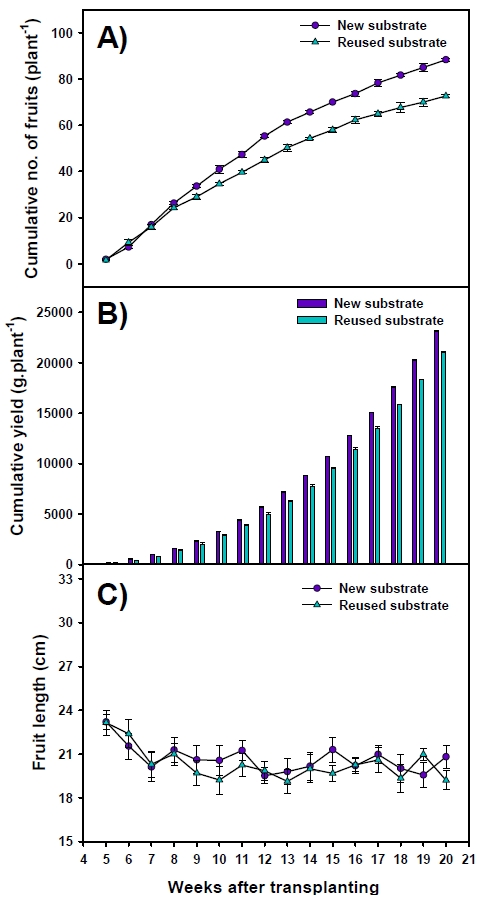
Changes in (A) cumulative number of fruits, (B) cumulative yield and (C) fruit length of eggplant at different growth stages after transplanting as affected by substrate condition (new vs. reused substrate) in a coir slab-based hydroponic system in greenhouse. Error bars represent SE (n = 3).
Similarly, cumulative yield remained consistently lower in plants grown in the reused substrate. At 20 WAT, cumulative yield reached 2,696.6 g·plant−1 in the reused substrate compared with 2,891.9 g·plant−1 in the new substrate, representing a reduction of approximately 6.8% (Fig. 1). The decline in yield appeared to be primarily attributable to reduced fruit number rather than impaired fruit growth. Substrate physical and chemical properties strongly influence root-zone water availability, oxygen supply, and nutrient uptake, all of which affect vegetative development and the maintenance of reproductive growth (Raviv et al., 2004; Sonneveld and Voogt, 2009; Savvas and Gruda, 2018). Therefore, the reduced container capacity and total porosity, together with the elevated EC observed in the reused substrate, likely contributed to less favorable root-zone conditions and consequently reduced fruit set and cumulative yield. In contrast, fruit length was generally unaffected by substrate treatment throughout the cultivation period. The absence of significant differences in fruit length suggests that substrate reuse had relatively little influence on the external morphological development of individual fruits. Although cumulative fruit number and total yield were reduced, the maintenance of fruit length indicates that fruits that successfully developed under the reused substrate were able to sustain relatively normal growth. These results demonstrate that the primary effect of substrate reuse was associated with the number of fruits produced rather than with the growth of individual fruits. Thus, reused coir substrate acted as a moderate constraint on yield formation by reducing fruit production capacity while having comparatively little effect on fruit size characteristics.
Overall, the reused substrate reduced cumulative fruit number and cumulative yield compared with the new substrate. Nevertheless, fruit production continued throughout the cultivation period, and fruit length remained relatively stable. These findings suggest that substrate reuse did not severely impair fruit development but rather limited yield formation primarily through reductions in fruit set and cumulative fruit production.
3.4. Effects of reused coir substrate on final plant growth and biomass accumulation
The effects of substrate reuse on plant growth and biomass accumulation were further evaluated at the final harvest (21 WAT). Plants grown in the reused substrate exhibited lower leaf number, leaf area, and aboveground biomass than those grown in the new substrate (Fig. 2; Table 4). Leaf number decreased from 165.0 leaves plant−1 in the new substrate to 161.0 leaves plant−1 in the reused substrate, while leaf area was also reduced (Fig. 2B). These results are consistent with the reduced plant height, node number, and leaf expansion observed throughout the cultivation period (Table 3), indicating that the effects of substrate reuse persisted until the final harvest stage.
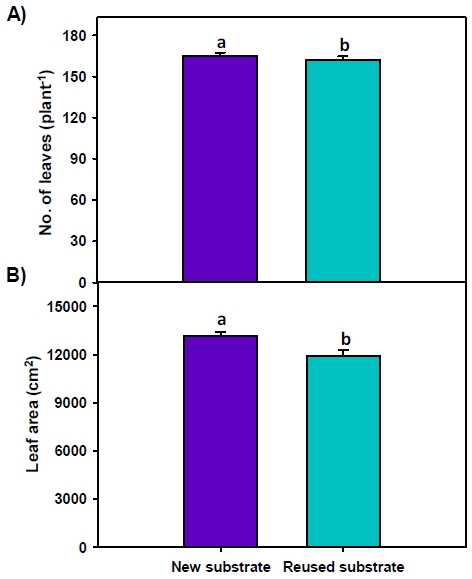
Effect of substrate condition on eggplant growth at 21 weeks after transplanting in a coir slab-based hydroponic system. (A) Number of leaves per plant and (B) leaf area. New substrate produced higher values than reused substrate for both traits. Different letters above the bars indicate significant differences between treatments, and error bars represent SE (n = 3).
Effects of new and reused coir substrates on growth and biomass of hydroponically grown eggplant at 21 weeks after transplanting
Differences in fresh biomass accumulation were also evident (Table 4). Leaf fresh weight and stem fresh weight in the reused substrate were 340.0 and 570.0 g plant−1, respectively, compared with 380.0 and 650.0 g·plant−1 in the new substrate. Consequently, total aboveground fresh weight decreased from 1,335.8 g·plant−1 in the new substrate to 1,224.2 g·plant−1 in the reused substrate. Visual observations of representative plants at the final harvest supported these quantitative findings (Fig. 3). Plants grown in the reused substrate exhibited somewhat reduced canopy development and overall vigor compared with those grown in the new substrate, although fruit production was maintained. These observations correspond well with the reductions in leaf and stem biomass shown in Table 4, suggesting that substrate reuse primarily affected vegetative growth rather than reproductive development.
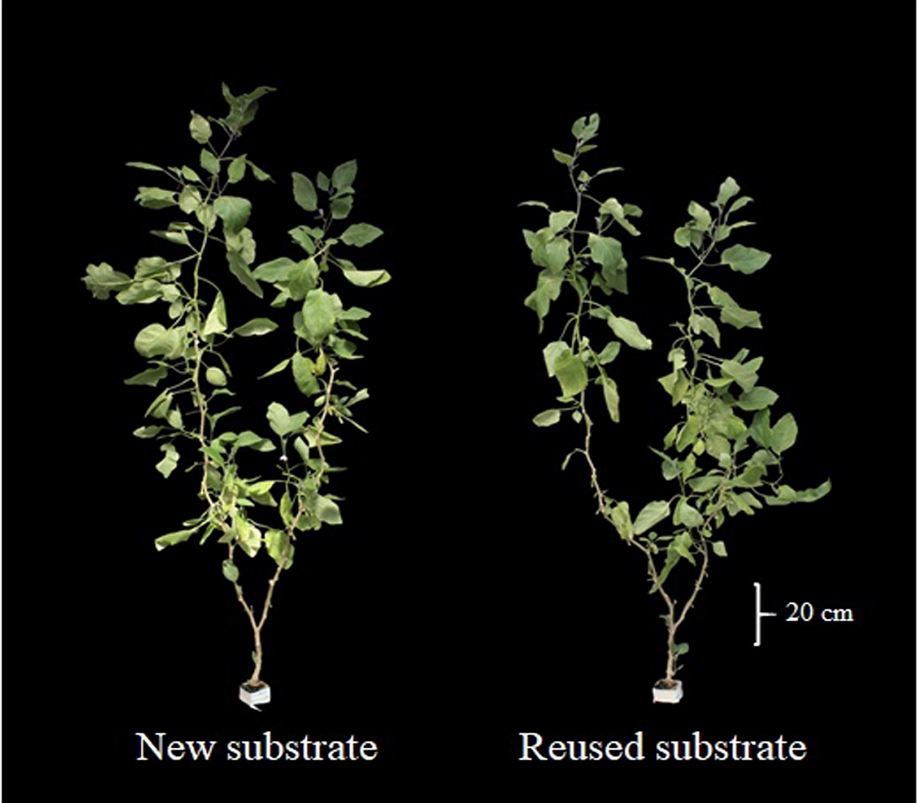
Representative plant morphology of eggplant at 21 weeks after transplanting as affected by substrate condition in a coir slab-based hydroponic system. New substrate and reused substrate treatments are shown to visually compare plant vigor and canopy development at the final harvest stage. Reused substrate refers to coir substrate previously used for one year in eggplant hydroponic cultivation and reused without structural reprocessing.
Dry matter accumulation showed trends similar to those observed for fresh biomass. Leaf dry weight and stem dry weight were lower in the reused substrate, reaching 45.3 and 129.6 g·plant−1, respectively. Consequently, total aboveground dry weight decreased from 219.0 g·plant−1 in the new substrate to 194.2 g·plant−1 in the reused substrate. The physical and chemical changes observed in the reused substrate, including lower container capacity, reduced total porosity, and higher EC, may have restricted water and nutrient uptake, thereby limiting canopy development and dry matter production (Raviv et al., 2004; Sonneveld and Voogt, 2009; Savvas and Gruda, 2018). Reduced leaf area and biomass accumulation likely lowered the overall photosynthetic capacity of the plants, contributing to diminished vegetative growth.
Interestingly, fruit fresh weight and fruit dry weight did not differ significantly between treatments. Fruit fresh weight was 305.8 g·plant−1 in the new substrate and 314.2 g·plant−1 in the reused substrate, whereas fruit dry weight was 17.7 and 19.3 g·plant−1, respectively. These results indicate that although vegetative biomass accumulation was reduced, fruit growth and dry matter deposition within individual fruits were largely maintained under substrate reuse conditions. This response may be explained by source–sink relationships in fruiting vegetable crops. Marcelis(1996) reported that fruits act as dominant sink organs, preferentially attracting assimilates when source availability becomes limiting. In the present study, despite reductions in vegetative growth and total biomass production, fruit biomass accumulation was maintained, suggesting that assimilates were preferentially allocated to reproductive organs. Consequently, the effects of substrate reuse were more pronounced in vegetative tissues than in fruits.
Overall, reused coir substrate reduced leaf development, aboveground biomass accumulation, and total dry matter production, indicating moderate limitations on vegetative growth. However, fruit biomass accumulation remained relatively stable, suggesting that reproductive sinks were maintained despite reductions in overall plant vigor.
3.5. Effects of reused coir substrate on yield components and marketable fruit production
Substrate reuse significantly influenced several yield components at the final harvest (Table 5). Interestingly, average fruit weight was significantly greater in the reused substrate than in the new substrate, whereas cumulative fruit number and total yield were reduced.
Effects of new and reused coir substrates on yield components and marketable fruit percentage of hydroponically grown eggplant at 21 weeks after transplanting
Average fruit weight increased from 259.8 g in the new substrate to 285.5 g in the reused substrate. This increase was likely associated with the reduced fruit number observed under substrate reuse conditions. When fewer fruits are present on a plant, competition among fruits for assimilates is reduced, allowing a greater proportion of photosynthates to be allocated to individual fruits.
In contrast, cumulative fruit number decreased from 89.3 fruits plant⁻¹ in the new substrate to 74.7 fruits plant⁻¹ in the reused substrate. This reduction is consistent with the lower plant height, node number, leaf area, and vegetative biomass observed in previous sections. In continuously fruiting crops such as eggplant, node formation and canopy development determine both flowering potential and assimilate supply capacity. Therefore, reductions in vegetative growth likely contributed directly to reduced fruit production.
Final cumulative yield was also lower in the reused substrate, reaching 21,316.6 g·plant−1 compared with 23,211.7 g·plant−1 in the new substrate. Although individual fruit weight increased under substrate reuse conditions, the reduction in fruit number had a greater influence on total yield. This finding agrees with the source–sink theory proposed by Marcelis (1993), which suggests that fruit number and individual fruit growth often exhibit compensatory relationships under conditions of limited assimilate availability.
Despite reductions in fruit number and total yield, marketable fruit percentage was not significantly affected by substrate reuse. Marketable fruit percentage was 96.6% in the new substrate and 95.3% in the reused substrate. These results indicate that while substrate reuse reduced overall productivity, it had little effect on fruit quality and marketability.
Therefore, the principal effect of substrate reuse was a reduction in fruit production capacity rather than deterioration of fruit quality. The high marketable fruit percentage observed in both treatments suggests that reused coir substrate can maintain acceptable fruit quality even when some reduction in yield occurs.
Collectively, these findings demonstrate that substrate reuse moderately reduced vegetative growth, fruit number, and total yield, but did not substantially impair individual fruit growth or marketable fruit production. Consequently, with appropriate management practices to mitigate the physical and chemical limitations identified in reused substrates, coir reuse may represent a feasible strategy for improving the sustainability and resource-use efficiency of hydroponic eggplant production.
4. Conclusions
This study evaluated the effects of coir substrate reuse on substrate properties, plant growth, biomass accumulation, and yield performance of eggplant (Solanum melongena L. ‘Otoking’) grown in a coir slab-based hydroponic system. Reused coir substrate exhibited lower container capacity and total porosity, accompanied by increased pH and electrical conductivity (EC), indicating that repeated use altered both the physical and chemical characteristics of the root-zone environment. Compared with the new substrate, the reused substrate reduced plant height, node number, leaf number, leaf area, and total dry matter accumulation, suggesting moderate limitations on vegetative growth and biomass production. In terms of yield performance, cumulative fruit number and total cumulative yield were reduced under substrate reuse conditions, whereas average fruit weight increased. Notably, marketable fruit percentage was not significantly affected by substrate reuse, indicating that fruit quality and marketability were largely maintained despite reductions in overall productivity. These findings suggest that although reused coir substrate may not provide growth and yield performance equivalent to that of new substrate, it can sustain acceptable levels of fruit production and marketable yield in hydroponic eggplant cultivation. The primary limitations associated with substrate reuse were related to changes in pore structure and salt accumulation, which adversely affected root-zone conditions and vegetative growth.
Therefore, appropriate management practices, including leaching, buffering, EC adjustment, and sanitation treatments, are essential for improving the performance of reused coir substrates. When such measures are properly implemented, reused coir substrate has the potential to serve as a resource-efficient and environmentally sustainable alternative in hydroponic eggplant production, contributing to reduced substrate costs and improved circular utilization of horticultural growing media.
Future studies should evaluate changes in substrate porosity and salinity over multiple reuse cycles, establish practical threshold values for substrate replacement, optimize nutrient-solution management according to substrate EC, and determine the economically optimal duration of coir substrate reuse.
Acknowledgments
This work was carried out with the support of “Cooperative Research Program for Agriculture Science and Technology Development (Project No. RS-2025-02303116)”, Rural Development Administration, Korea.
REFERENCES
-
Bilderback, T. E., Warren, S. L., Owen Jr., J. S., Albano, J. P., 2005, Healthy substrates need physicals too!, HortTechnology, 15(4), 747-751.
[https://doi.org/10.21273/HORTTECH.15.4.0747]

- Choi, G. Y., Kang, M. J., Lee, Y. B., Yoo, S. O., Bae, J. H., 2001, Development of optimum nutrient solution for sweet pepper substrate culture in closed system, Hortic. Environ. Biotechnol., 42(6), 513-518.
-
de Boodt, M., Verdonck, O., 1972, The physical properties of the substrates in horticulture, Acta Hortic., 26, 37-44.
[https://doi.org/10.17660/ActaHortic.1972.26.5]
- Fonteno, W. C., 1996, Growing media: Types and physical and chemical properties, Water, Media, and Nutrition for Greenhouse Crops, Ball Publishing, Batavia, IL, USA, 93-122.
-
Gruda, N., 2012, Sustainable peat alternative growing media, Acta Hortic., 927, 973-980.
[https://doi.org/10.17660/ActaHortic.2012.927.120]
- Jeong, B. R., 2000, Current status and perspective of horticultural medium reuse, Hortic. Sci. Technol., 18(6), 876-883.
-
Jeong, J., Yoon, S. A., Ko, B. U., Bae, H. J., Kim, H. C., Ku, Y. G., An, S. W., Kim, C. M., Bae, J. H., 2026, Eggplant (Solanum melongena L.) growth and physicochemical characteristics of coir substrates used for hydroponic cultivation, Hortic. Sci. Technol., 44(2), 266-278.
[https://doi.org/10.7235/HORT.20250058]
-
Júnior, J. A. S., Gheyi, H. R., Silva, D. N., Araujo, D. L., Guedes Filho, D. H., 2014, Substrates and different concentrations of nutrient solution prepared in wastewater on growth in the sunflower, Rev. Cienc. Agron., 45(4), 696-707.
[https://doi.org/10.1590/S1806-66902014000400007]
- Kang, J. Y., Kim, K. H., 2004, Determination of physical and chemical properties of organic and inorganic substrates for horticulture by European standard method, Korean J. Soil Sci. Fert., 37(3), 143-148.
-
Kim, C. H., Lee, C. H., Kweon, O. Y., An, C. G., 2014, Effect of transplanting methods on growth and yield of paprika in coir culture, Prot. Hortic. Plant Fact., 23(4), 281-287.
[https://doi.org/10.12791/KSBEC.2014.23.4.281]
- Kim, J., Jeon, H. K., Kim, C. S., Jang, I., Jeong, J. S., Choi, J. S., Bae, J. H., 2004, Effect of electric conductivity on the growth and yield in eggplant hydroponics, J. Bio-Environ. Control, 13(4), 196-203.
- KOSIS (Korean Satistical Information Service), 2022, Daejeon, Korea, http://kosis.kr
-
Lee, G. B., Park, E. J., Yeo, K. H., Rhee, H. C., Kang, J. S., 2016, Effect of used coir organic substrates on vegetable crop growth, J. Environ. Sci. Int., 25(10), 1077-1085.
[https://doi.org/10.5322/JESI.2016.25.8.1077]
-
Lee, S. H., Park, B. K., Choi, S. T., Yoon, H. S., 2024, Growth and yield of eggplant ‘TNA-114’ as affected by planting density and coir substrate volume in hydroponics, J. Bio-Environ. Control, 33(4), 397-402.
[https://doi.org/10.12791/KSBEC.2024.33.4.397]
-
Lee, Y. B., Park, Y. H., Choi, Y. W., Son, B. G., Kim, J. Y., Kang, N. J., Kang, J. S., 2017, A Study on the possibility of recycling coir organic substrates for using strawberry hydroponics media, J. Korea Soc. Waste Manag., 34(2), 205-213.
[https://doi.org/10.9786/kswm.2017.34.2.205]
-
Marcelis, L. F. M., 1996, Sink strength as a determinant of dry matter partitioning in the whole plant, J. Exp. Bot., 47(special_issue), 1281-1291.
[https://doi.org/10.1093/jxb/47.Special_Issue.1281]
-
McCullough, M. L., Feskanich, D., Stampfer, M. J., Giovannucci, E. L., Rimm, E. B., Hu, F. B., Spiegelman, D., Hunter, D. J., Colditz, G. A., Willett, W. C., 2002, Diet quality and major chronic disease risk in men and women: Moving toward improveddietary guidance, Am. J. Clin. Nutr., 76(6), 1261-1271.
[https://doi.org/10.1093/ajcn/76.6.1261]
- Nelson, P. V., 1991, Greenhouse operation and management, 4th ed., Prentice Hall, Englewood Cliffs, NJ, USA, 150-175.
-
Raviv, M., Wallach, R., Blom, T. J., 2004, The effect of physical properties of soilless media on plant performance-A Review, Acta Hortic., 644, 251-259.
[https://doi.org/10.17660/ActaHortic.2004.644.34]
-
Savvas, D., Gruda, N., 2018, Application of soilless culture technologies in the modern greenhouse industry, Eur. J. Hortic. Sci., 83(5), 280-293.
[https://doi.org/10.17660/eJHS.2018/83.5.2]
-
Shin, B. K., Son, J. E., Choi, J. M., 2012, Physico-chemical properties of peatmoss and coir dust currently used as root medium components for crop production in Korean plant factories, J. Bio-Environ. Control, 21(4), 362-371.
[https://doi.org/10.12791/KSBEC.2012.21.4.362]
-
Shin, M. J., Jeong, H. J., Roh, M. Y., Kim, J. H., Song, K. J., 2022, Growth and yield response of perilla plants grown under different substrates in hydroponic system, J. Bio-Environ. Control, 31(4), 292-299.
[https://doi.org/10.12791/KSBEC.2022.31.4.292]
-
Song, S. G., Lee, K., Lee, D. S., Rhie, J. H., Hong, B. D., Bae, H., Seo, I. H., Chung, D. Y., 2016, Changes in physical and chemical properties of coir used as the bag culture substrate of greenhouse tomatoes for three years, Korean J. Soil Sci. Fert., 49(5), 503-509.
[https://doi.org/10.7745/KJSSF.2016.49.5.503]
-
Sonneveld, C., Voogt, W., 2009, Plant nutrition of greenhouse crops, 1st ed., Springer, Dordrecht, Netherlands, 257-275.
[https://doi.org/10.1007/978-90-481-2532-6_12]
-
Stommel, J. R., Whitaker, B. D., 2003, Phenolic acid content and composition of eggplant fruit in a germplasm core subset, J. Am. Soc. Hortic. Sci., 128(5), 704-710.
[https://doi.org/10.21273/JASHS.128.5.704]
-
Urrestarazu, M., Mazuela, P. C., Martínez, G. A., 2008, Effect of substrate reutilization on yield and properties of melon and tomato crops, J. Plant Nutr., 31(11), 2031-2043.
[https://doi.org/10.1080/01904160802405420]
Department of Horticultural Bioscience, Pusan National Universitykangjs@pusan.ac.kr
Department of Horticultural Bioscience, Pusan National Universitywittyguy010@naver.com
Department of Horticultural Bioscience, Pusan National Universitymdfaraazbio1803@gmail.com
Department of Horticultural Bioscience, Pusan National Universitytkdflajaid@naver.com
Department of Horticultural Bioscience, Pusan National University dlwlrn15@naver.com
Department of Horticultural Bioscience, Pusan National Universitymcchryl@gmail.com
Department of Horticultural Bioscience, Pusan National Universitymg6188@naver.com
Department of Horticultural Bioscience, Pusan National Universitydaegeunjeong99@gmail.com
Department of Horticultural Bioscience, Pusan National Universityatom0821@pusan.ac.kr
Department of Horticultural Bioscience, Pusan National Universityrobie5631@naver.com