
Research Trends and Thematic Evolution of Environmental Robotics: A Bibliometric Analysis and Topic Modeling Approach
Ⓒ The Korean Environmental Sciences Society. All rights reserved.
This is an Open-Access article distributed under the terms of the Creative Commons Attribution Non-Commercial License (http://creativecommons.org/licenses/by-nc/3.0) which permits unrestricted non-commercial use, distribution, and reproduction in any medium, provided the original work is properly cited.
Abstract
This study analyzes research trends and the thematic evolution of environmental robotics by combining bibliometric analysis and latent Dirichlet allocation (LDA) topic modeling. A total of 1,246 journal articles published between 2016 and 2025 were collected from Scopus. The results showed rapid growth, increasing from 30 in 2016 to 210 publications in 2025, at a compound annual growth rate of 24.1%, while citations rose sharply in the later period. The journal analysis found that research was distributed widely across 240 journals rather than concentrated in a few; the center of the field moved from engineering-focused journals to environment, sustainability, and marine journals. The country analysis revealed a division of strengths: Asian countries such as China led productivity, while European countries such as the United Kingdom, Germany, and Italy held high centrality and a bridging role in the international collaboration network, which grew quickly over the period. LDA topic modeling identified five themes: service and human–robot interaction; sensor- and arm-based operation; underwater robot control and motion; industrial and energy optimization; and algorithms and bio-inspired robotics. Over time, the share of the algorithm-centered theme decreased, whereas that of underwater robot control increased. These findings suggest that environmental robotics is emerging as an interdisciplinary research area for solving environmental problems. Based on the results, this study offers practical implications for supporting convergence research, balancing application areas, expanding international collaboration, and integrating artificial intelligence and data-driven technologies.
Keywords:
Environmental robotics, Bibliometric analysis, LDA topic modeling, International collaboration, Sustainability, Research trends1. Introduction
As environmental problems such as climate change, pollution, and ecosystem degradation grow more complex, and as society places greater demands on sustainability, robotics has quickly become important in the environmental field (Mazzolai et al., 2025). In areas that are difficult or dangerous for humans to access directly, such as water quality monitoring, marine surveys, air quality measurement, waste treatment, disaster response, and smart agriculture, robotics serves as a key tool. Environmental robotics addresses the spatial limitations of fixed sensors by enabling environmental observation across wide areas and supporting responses to a range of environmental problems (Dunbabin and Marques, 2012; Li and Li, 2025).
Driven by this need, environmental robotics research has grown rapidly in recent years. Autonomous systems such as unmanned aerial vehicles (UAVs), unmanned ground vehicles (UGVs), and autonomous underwater vehicles (AUVs) have been widely adopted in environmental monitoring (Tokekar et al., 2016; Munasinghe et al., 2024), and the integration of artificial intelligence and data-driven decision-making has moved the field beyond simple detection toward intelligent systems capable of autonomous analysis and decision support (Sung et al., 2023; Mazzolai et al., 2025). As a result, environmental robotics has expanded into an interdisciplinary domain that combines engineering, environmental science, marine engineering, ecology, and data science.
To date, however, most studies have focused on specific technical components or individual application areas. Several reviews have addressed particular domains, such as marine robotics or forest robotics (Oliveira et al., 2021), but they tend to treat these domains separately rather than as one integrated field. More recently, some studies have applied bibliometric analysis or systematic literature review, yet these have also been confined to specific application areas such as swarm robotics or agricultural robots (Martin et al., 2022; Khaldi et al., 2025).
As a result, there is still little research that comprehensively shows how the field as a whole is structured, how its main themes have changed over time, and how international collaboration is organized. To address this gap, the present study analyzes the research structure and thematic evolution of environmental robotics by combining and Latent Dirichlet allocation (LDA) topic modeling, using literature published between 2016 and 2025.
The contribution of this study to the existing literature is threefold. First, whereas previous bibliometric studies and systematic reviews have been confined to specific application areas or robot types, such as swarm robotics, nuclear plant robots, offshore wind energy, coral reef monitoring, indoor air quality, and agricultural robots (Martin et al., 2022; Cardenas et al., 2024; Khaldi et al., 2025), this study treats environmental robotics as one integrated field and provides a field-level overview that has not been available so far. Second, this study combines bibliometric indicators, a country-level collaboration network, and LDA topic modeling within a single framework, so that the structure of the research ecosystem, the pattern of international collaboration, and the composition of research themes can be examined together rather than separately. Third, by dividing the ten-year period into an earlier and a later period, this study traces not only the current state of the field but also how its thematic focus and collaboration structure have shifted over time. Through this design, the study offers an empirical basis for understanding where environmental robotics stands as a field and where it is heading, which individual technology studies and domain-specific reviews have not been able to provide. The study is guided by the following research questions.
- (1) What growth and publication structure does environmental robotics research show?
- (2) What are the characteristics of national research activity and collaboration?
- (3) How are the main research themes composed?
- (4) How have these themes changed over time?
The remainder of the paper is organized as follows. Section 2 reviews the concept of environmental robotics and related research. Section 3 describes the data and analytical methods. Section 4 presents the results of the analysis. Section 5 discusses the findings, their implications, and the limitations of the study, and Section 6 concludes.
2. Theoretical Background and Literature Review
2.1. The concept, characteristics, and research areas of environmental robotics
Environmental robotics refers broadly to the various robotic systems used to collect and manage environmental information or to address environmental problems. These include underwater and surface robotics, mobile ground robotics, unmanned aerial vehicles (UAVs), autonomous underwater vehicles (AUVs), and fixed automation devices (Dunbabin and Marques, 2012; Mazzolai et al., 2025). Because these systems can obtain data through sensors and move and carry out tasks on their own, they are designed to operate reliably even in environments that are difficult for humans to access.
The characteristics of environmental robotics can be summarized as follows. First, a high level of adaptability and autonomy is required. In unstructured spaces such as oceans, forests, disaster sites, the deep sea, and polar regions, constraints such as limited communication, low visibility, and complex terrain are common, so reliable autonomous operation is essential (Wong et al., 2018; Wijayathunga et al., 2023). Second, the field is strongly interdisciplinary. Environmental robotics has developed into a convergent field that draws not only on robotics engineering but also on environmental science, ecology, marine engineering, data science, and artificial intelligence, and machine learning and probabilistic decision-making methods have become increasingly important in collecting, analyzing, and predicting environmental data (Sung et al., 2023; Mazzolai et al., 2025). Third, the field has strong public value and social impact. Because it is directly connected to public goals such as pollution monitoring, disaster response, climate change monitoring, and ecosystem conservation, it has strong potential to link with policy and industry. Fourth, recent environmental robotics has moved beyond simple detection and data collection toward intelligent systems with autonomous analysis and decision-making capabilities (Das et al., 2015; Tokekar et al., 2016; Munasinghe et al., 2024).
The research areas of environmental robotics are broadly distributed according to the operating environment and robot type. In the marine and underwater domain, marine ecosystem monitoring and data-driven sampling using autonomous underwater vehicles are representative (Das et al., 2015; Cardenas et al., 2024), while in agriculture, precision agriculture data collection based on cooperation between UAVs and UGVs has been actively studied (Tokekar et al., 2016; Munasinghe et al., 2024). In forestry, robotic applications for tree exploration and ecological monitoring have been addressed (Oliveira et al., 2021; Angelini et al., 2023), and the scope continues to expand into areas such as water quality monitoring, air quality measurement, waste treatment, and disaster response. In this way, environmental robotics has been discussed in the literature not as a single technical area but as a convergent research field spanning multiple application areas and robot types.
In this study, the term environmental robotics is used in two senses that should be kept distinct. Analytically, it serves as an umbrella category defined a priori to integrate application areas that previous research has treated separately, and this definition determines the scope of the dataset described in Section 3.2. Whether environmental robotics also behaves empirically as a distinct interdisciplinary research field, with its own growth pattern, publication venues, collaboration structure, and thematic identity, is treated as an empirical question to be answered by the analyses, not as an assumption.
2.2. Review of related studies
Prior research on environmental robotics can be broadly divided into studies centered on individual technologies and applications, and studies that quantitatively analyze research trends.
Regarding studies centered on individual technologies and applications, this stream focuses on the functional implementation of robotic systems, such as sensor technology, autonomous mobility, environmental perception, path planning, and data collection algorithms, or on the feasibility of robotics in specific areas such as marine exploration, precision agriculture, and disaster response. For example, Sung et al.(2023) systematically analyzed decision-based approaches in environmental monitoring robotics, while Das et al.(2015) and Tokekar et al.(2016) presented concrete application cases in marine ecosystem monitoring and precision agriculture, respectively. Dunbabin and Marques(2012) also provided an integrated overview of robotics technologies and applications for environmental monitoring. However, because such research is limited to improving the performance of individual technologies or to specific application areas, it is limited in showing the overall research trends and thematic structure of environmental robotics.
Regarding studies that quantitatively analyze research trends, some research in the environmental and robotics fields has used bibliometric analysis and systematic literature review. Among bibliometric studies, Khaldi et al. (2025) analyzed trends in applying swarm robotics to UAV, AUV, and unmanned surface vehicle (USV) based environmental monitoring, ecological restoration, agricultural management, and disaster response, and Zhang et al.(2025) identified four core research clusters in nuclear power plant mobile robot research: design, protection, perception, and path planning. Pussaignolli de Paula et al.(2025) used Scopus to classify research applying artificial intelligence and robotics to offshore wind energy into eight clusters. Among systematic literature reviews, Cardenas et al.(2024) examined the potential of robots, artificial intelligence, and autonomous underwater vehicles for coral reef conservation and restoration, Saini et al.(2025) followed the PRISMA procedure to analyze ground robot systems for indoor air quality measurement, and Martin et al.(2022) comprehensively analyzed how the introduction of agricultural robots affects labor and farm structure.
As shown above, bibliometric analysis and systematic literature review have already been used to identify research trends in the environmental and robotics fields. However, the studies reviewed here share two limitations. First, each of them covers only a specific application area or robot type, such as swarm robots, nuclear plant mobile robots, offshore wind energy, coral reef monitoring, indoor air quality, or agricultural robots, so their findings cannot be combined into a picture of environmental robotics as a whole. Second, few of them trace how research themes change over time, since most provide a cross-sectional map of one area at one point in time. These two limitations define the gap identified in Section 1 and lead directly to the four research questions of this study, which concern the overall structure of the field (RQ1), national research activity and collaboration (RQ2), and the composition (RQ3) and temporal change (RQ4) of its main research themes.
3. Materials and Methods
3.1. Research framework
This study designed a research framework that combines bibliometric analysis and LDA topic modeling to analyze the publication structure, international collaboration, and thematic evolution of environmental robotics research together. The two methods address different aspects in a complementary way. Bibliometric analysis is used to quantitatively capture the structural characteristics of the research ecosystem, such as publication output, citation patterns, journal distribution, and international collaboration networks (Donthu et al., 2021), while LDA topic modeling is used to extract latent research themes from a large body of literature and to examine how they change (Blei et al., 2003).
Through this combined approach, this study analyzes the publication structure and international collaboration of the field using bibliometric analysis, and the composition and change of the main themes using LDA topic modeling. The overall research process is shown in Fig. 1.
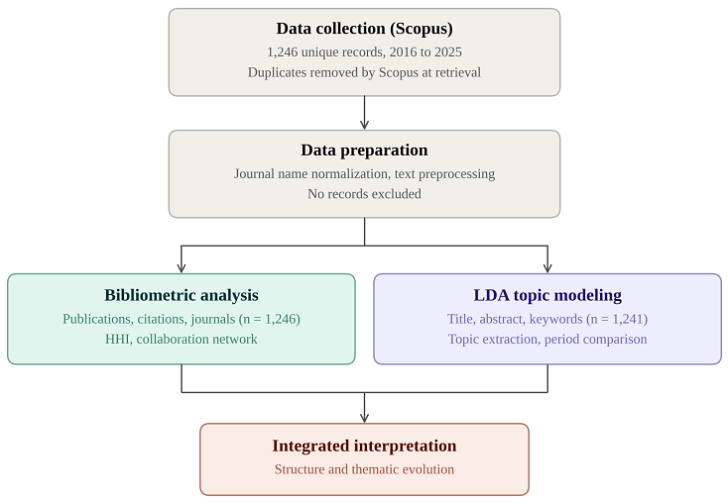
Overall research process.
3.2. Data collection
The data were collected from Scopus on April 15, 2026, and the analysis period was set from 2016 to 2025. Scopus was selected as the single data source for three reasons. First, Scopus provides broader journal coverage than Web of Science, particularly in engineering and the environmental sciences, and nearly all journals indexed in Web of Science are also indexed in Scopus, so the risk of missing literature covered by the other major citation database is limited (Mongeon and Paul-Hus, 2016; Singh et al., 2021). Second, Scopus provides standardized bibliographic fields for authors, affiliations, and citations, which supports the consistent construction of country-level collaboration networks and citation indicators. Third, relying on a single database avoids the record-matching and duplicate-handling errors that arise when records from databases with different field structures are merged, which improves the transparency and reproducibility of the analysis (Donthu et al., 2021).
To clearly capture robotics-related research, the search targeted documents whose titles contain robot*. To limit the scope to environmental research, the Scopus subject area was restricted to Environmental Science. To limit the dataset to peer-reviewed research outputs, the document type was restricted to journal articles, and the language was limited to English. The search query was as follows.
TITLE(robot*) AND (LIMIT-TO(SUBJAREA, "ENVI")) AND (LIMIT-TO(DOCTYPE, "ar")) AND (LIMIT-TO (LANGUAGE, "English"))
The search strategy was designed to capture research in which robotics is the primary subject and which is classified within environmental science. Restricting robot* to article titles ensures that robotics is the central topic of each retrieved study rather than an incidental mention, and restricting the subject area to Environmental Science limits the dataset to research positioned within the environmental science literature. This operationalization deliberately trades recall for precision: studies on platforms such as UAVs, AUVs, or drones that are indexed only under Engineering or Computer Science, or that mention robotics only in abstracts or keywords, fall outside the scope of this study. The findings should therefore be read as describing environmental robotics research as it is represented in the environmental science literature, rather than the entire technical literature on robotic platforms.
The starting point of 2016 was chosen because, around this time, artificial intelligence technologies such as deep learning began to be adopted in robotics in earnest, which substantially improved the autonomy and data-processing capabilities of robots. Around 2015 and 2016, the robotics community began to embrace deep learning as a core tool (Sünderhauf et al., 2018), and this technological advance also influenced the expansion of environmental robotics research.
The query, together with the built-in Scopus restrictions to journal articles written in English within the Environmental Science subject area, returned 1,246 unique records; duplicate records are removed automatically by Scopus at retrieval. All retrieved records were retained and no additional manual exclusion was applied, so the final dataset comprises the 1,246 retrieved articles. The inclusion criteria are therefore fully operationalized by the query itself: robot* in the article title, the Environmental Science subject area, the journal-article document type, and the English language.
For the period comparison, the ten-year window was divided a priori into two equal five-year periods, an earlier period (2016 to 2020) and a later period (2021 to 2025). This split was specified as a design choice before the analyses were conducted, in order to compare the first and second halves of the window with equal length, and was not selected post hoc from the data. Descriptively, the boundary also coincides with the point from which Descriptively, annual output ranged from 30 to 104 papers in the earlier period and from 136 to 210 papers in the later period.
All bibliometric analyses in Sections 4.1 to 4.4 (publication and citation trends, journal distribution, country patterns, and collaboration networks) are based on the full dataset of 1,246 articles. The LDA analyses in Section 4.2, including the comparison of topic proportions between periods, are based on 1,241 articles after excluding five records without abstracts; of these, 353 belong to the earlier period and 888 to the later period.
3.3. Bibliometric analysis
In the bibliometric analysis, the following indicators were used to analyze the quantitative scale and academic structure of environmental robotics research. First, the annual numbers of publications and citations were used to examine research productivity and academic influence. The journal distribution shows which journals the research is published in and was used to understand the structure of the research ecosystem and the pattern of research diffusion (Donthu et al., 2021). Annual citation counts denote the number of citations received in each calendar year by the papers in the dataset, as recorded in the Scopus citation overview at the time of data collection; the yearly counts sum to the 16,070 citations accumulated by the 1,246 papers.
Journal concentration was measured with the Herfindahl-Hirschman Index (HHI), a classical measure of how unevenly a quantity is distributed across the elements of a system (Hirschman, 1964). After normalizing journal names, the index was computed as the sum of squared percentage shares, HHI = Σ sᵢ², where sᵢ is the percentage share of journal i in total publications or, alternatively, in total citations. On this scale the index ranges from a theoretical minimum of 10,000/n under perfect dispersion (about 41.7 for the 240 journals in this dataset) to 10,000 when all papers are concentrated in a single journal. Following the benchmark thresholds commonly applied to the index, values below 1,500 indicate an unconcentrated distribution, values between 1,500 and 2,500 moderate concentration, and values above 2,500 high concentration (U.S. Department of Justice and Federal Trade Commission, 2010). This study computed the HHI based on both publication counts and citation counts, so that the quantitative and qualitative aspects of the journal distribution could be read together. In addition, citations per publication (CPP) and the H-index were used to compare the influence of individual journals.
To analyze national research activity and the structure of international collaboration, a country-level co-authorship network was constructed. To understand the position and role of each country within the collaboration structure, four network centrality indicators were used (Börner et al., 2003). Degree centrality measures the number of countries a given country is directly connected to. Betweenness centrality measures the extent to which a country acts as a bridge along collaboration paths. Closeness centrality measures the average proximity of a country to all others. Eigenvector centrality measures the degree of connection to influential countries. These indicators have been widely used in science mapping research to analyze the structural characteristics of research ecosystems (Zupic and Čater, 2015; Aria and Cuccurullo, 2017).
3.4. LDA topic modeling
To analyze the main thematic structure of environmental robotics research, LDA (Latent Dirichlet Allocation) based topic modeling was performed. LDA is a probabilistic technique that assumes each document is a mixture of latent topics and derives the hidden thematic structure of documents through the probability distribution of the words that make up each topic (Blei et al., 2003).
The titles, abstracts, and keywords of the papers were used in the analysis. In the preprocessing stage, stopwords were removed and terms were normalized, and the LDA model was then applied to derive the main topics. The optimal number of topics was selected by comparing model fit based on the coherence score, together with the distinguishability of topics and the clarity of their interpretation (Röder et al., 2015). Each derived topic was interpreted around the core keywords that compose it, and topic distributions were compared between the earlier and later periods.
The LDA model was estimated with Gensim, using 20 passes over the corpus, 400 iterations per document chunk, a chunk size of 50, priors learned from the data (alpha and eta set to auto), and a fixed random seed of 42 for reproducibility. A single LDA model was fitted to the entire corpus of 1,241 documents, and the average topic proportions of the documents published in each period (353 in the earlier period and 888 in the later period) were then compared. The period comparison is therefore described throughout as differences in topic proportions between the two periods, rather than as differences between separately fitted models.
All data preprocessing and analyses were conducted in a Python environment. All analytical decisions, including the search strategy, the selection of bibliometric indicators, the specification of the collaboration network, and the choice of the number of topics, were made by the authors. The generative artificial intelligence Claude Opus 4.8 (Anthropic) was used to assist in drafting the Python code for the bibliometric indicators, the collaboration network construction, and the LDA pipeline, and in formatting the tables of results. All code was reviewed, executed, and verified by the authors, and the interpretation and validation of every analytical result were carried out solely by the authors.
4. Results
4.1. Publication and citation trends
An analysis of the annual number of publications in environmental robotics research shows that it grew from 30 papers in 2016 to 210 papers in 2025, an increase of about seven times. The total number of papers over the analysis period is 1,246, and more than 100 papers have been published each year since 2020. The compound annual growth rate (CAGR) was 24.1% over the entire period, 36.4% in the earlier period (2016 to 2020), and 11.5% in the later period (2021 to 2025). This shows that the research base formed quickly at first, and then, while the absolute scale kept growing, the pace of growth gradually stabilized in the later period (Fig. 2).
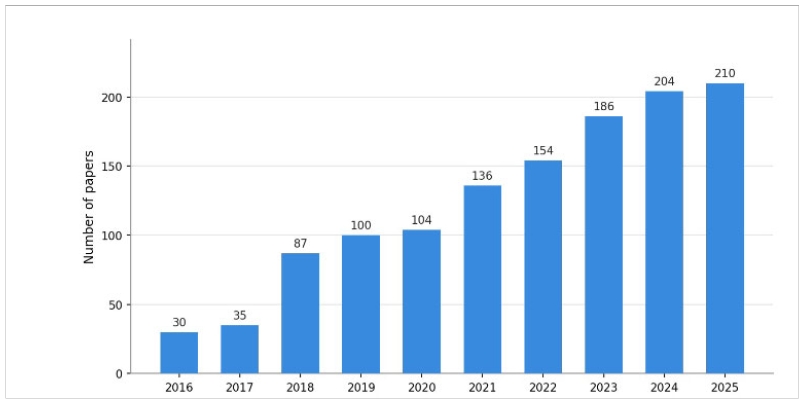
Annual number of publications (2016-2025).
An analysis of the annual number of citations shows that the academic influence of environmental robotics research has steadily expanded.
The number of citations received per year by the papers in the dataset increased from 5 in 2016 to 5,668 in 2025, with a marked rise after 2020 (Fig. 3).
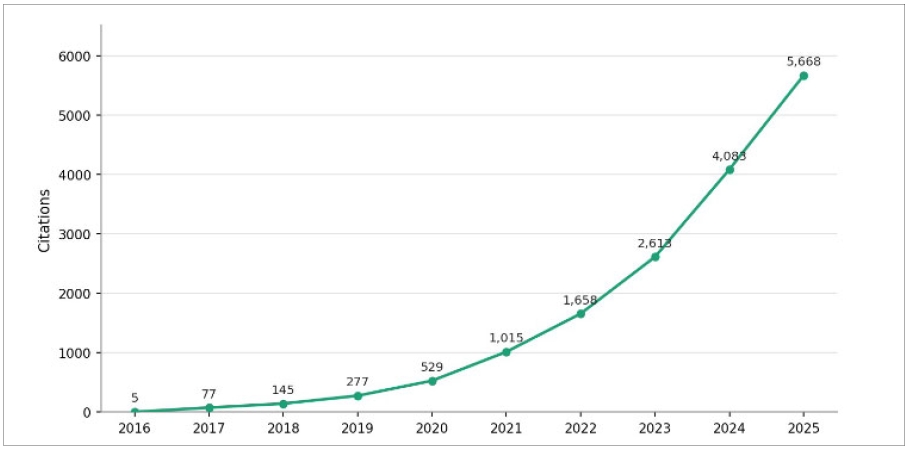
Annual number of citations received by the papers in the dataset (2016-2025).
4.2. Journal distribution and changes between periods
Environmental robotics research was published across a total of 240 journals. The Herfindahl-Hirschman Index was 505.61 based on publication counts and 790.42 based on citation counts. Both values are far below the 1,500 threshold for an unconcentrated distribution and close to the dispersed end of the scale, which means that the research is not concentrated in a few journals but is published widely across many journals.
The top 10 journals by publication count are shown in Table 1. Among the journals that are high in both publication output and citation influence, Sustainability ranks first in the number of papers (175), the number of citations (3,023), and the H-index (30), making it a leading journal with both productivity and influence. Ocean Engineering (155 papers) and Journal of Marine Science and Engineering (94 papers) also rank high in both publications and citations, leading the accumulation of research in marine and underwater robotics. The International Journal of Environmental Research and Public Health (66 papers) has a high number of citations per publication (21.4) and shows strong influence in the environmental and public health area, while the Journal of Cleaner Production has the highest CPP among the top 10 journals at 45.2, showing strong influence in the cleaner production and sustainability area.

Major journals in environmental robotics research (top 10 by publication)
Taken together, the topics of the top 10 journals show that environmental robotics research is concentrated in three areas. The first is the environment and sustainability area, centered on Sustainability and the Journal of Cleaner Production. The second is the marine and underwater robotics area, centered on Ocean Engineering and the Journal of Marine Science and Engineering. The third is the engineering area, which includes journals such as SN Applied Sciences and the Chemical Engineering Journal. This shows that environmental robotics research is formed around three axes: environment and sustainability, marine and underwater, and engineering.
A comparison of the two periods shows a clear shift in the central topics of the research. The number of journals grew from 86 in the earlier period (2016 to 2020) to 198 in the later period (2021 to 2025), and the number of papers grew from 356 to 890, so the research spread into a wider range of academic areas. Citations also rose from 5,889 in the earlier period to 10,181 in the later period, showing that academic influence grew along with the quantitative growth.
In the earlier period, research was centered on engineering-based journals such as the International Journal of Engineering and Technology (UAE) (46 papers) and the International Journal of Engineering and Advanced Technology (31 papers), which reflects the stage that built the technical foundation of environmental robotics. At the same time, Sustainability (CPP 28.2) and Ocean Engineering (CPP 49.8) had a small number of papers but high citations per publication, and the basis for influence in the environmental and marine areas began to form.
In the later period, journals in the environment, sustainability, and marine areas came to lead the research. Sustainability (141 papers), Ocean Engineering (134 papers), Journal of Marine Science and Engineering (85 papers), and the International Journal of Environmental Research and Public Health (52 papers) took the top positions, and they showed strong results not only in publication count but also in citations and H-index. In particular, the H-index of Sustainability rose from 18 in the earlier period to 23 in the later period, and that of Ocean Engineering rose from 17 to 21, indicating stronger influence. This shift shows that the central topics moved from engineering-based technical implementation toward environmental management, sustainability, and marine and underwater applications, and that environmental robotics research has grown beyond its technical foundation into interdisciplinary research spanning the environment, sustainability, and marine areas (Table 2, Table 3).
Top 5 journals by publication (2016 to 2020)
Top 5 journals by publication (2021 to 2025)
4.3. National publication and citation patterns
A total of 92 countries and territories, counted as recorded in the Scopus affiliation data (Hong Kong, Macao, and Taiwan are counted separately), published environmental robotics research over the analysis period. The top five countries by publication count are China (437 papers, 35.1%), India (114 papers, 9.1%), the United States (98 papers, 7.9%), South Korea (81 papers, 6.5%), and the United Kingdom (72 papers, 5.8%). China stands out among them, as it ranks first not only in the number of publications but also in citations (5,877) and H-index (38), which means it leads both research output and cumulative influence. The United States, South Korea, and the United Kingdom pair a solid publication volume with a high number of citations per publication (CPP) of 17.7, 18.7, and 20.6, so they hold a good balance between productivity and influence.
Several countries outside the top five also show clear strengths. Italy and Spain have a smaller publication volume, but their CPP values of 22.0 and 20.8 are higher than those of some top-five countries, which shows strong academic impact from a limited number of papers. Germany has a stable research base with 47 papers and an H-index of 16, and Japan shows steady performance with a CPP of 12.5.
These patterns become clearer when the countries are grouped by continent. Asian countries are strong in publication volume, as China, India, South Korea, Japan, and Malaysia all appear in the upper ranks and drive the quantitative growth of the field. European countries are strong in influence per paper, as the United Kingdom, Spain, Italy, and Germany lead in CPP. In North America, the United States stays in the top ranks for both publications and citations, which keeps it balanced across the two measures (Table 4).
Top 10 countries by publication (2016 to 2025)
The picture also changes over time. In the earlier period (2016 to 2020), the top five countries by publication count were India (72 papers), China (47 papers), the United States (35 papers), South Korea (30 papers), and Malaysia (24 papers). China, South Korea, and the United States already showed high influence per paper in this period, with CPP values of 28.0, 24.7, and 20.9, so they laid a strong research base early on. In the later period (2021 to 2025), the top five were China (390 papers), the United States (63 papers), the United Kingdom (58 papers), South Korea (51 papers), and India (42 papers). China moved into a clear leading position in both quantity and influence, accounting for 43.8% of publications and 44.8% of citations, while the United Kingdom newly entered the top ranks and kept a high CPP of 18.7.
The continental pattern shifts in a similar way. Asian countries led the top ranks in the earlier period, and in the later period China drove the growth of Asia while North American and European countries such as the United States and the United Kingdom remained steady in the upper ranks. The number of publishing countries also grew from 61 in the earlier period to 87 in the later period, so more countries came to take part in environmental robotics research over time (Table 5, Table 6).
Top 5 countries by publication (2016 to 2020)
Top 5 countries by publication (2021 to 2025)
4.4. International collaboration network
A collaboration network based on co-authorship between countries was constructed to analyze the international collaboration structure of environmental robotics research. The co-authorship network comprises 83 countries (network nodes) and 644 collaboration links. Of the 92 publishing countries and territories, 83 published at least one internationally co-authored paper during the full period and therefore appear as nodes in the overall collaboration network; the remaining nine published only single-country papers and have no collaboration links. The period networks introduced below include only the countries with at least one international collaboration link within the respective period, which yields 46 countries in the earlier period and 81 in the later period. The overall structure of the network is shown in Fig. 4.
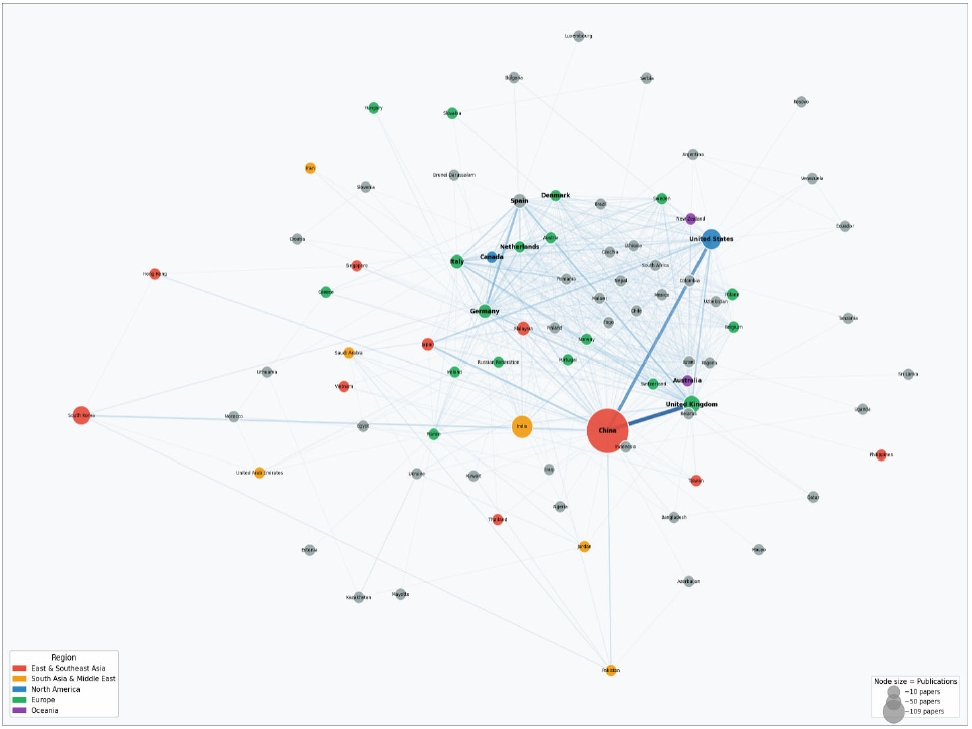
International collaboration network (2016-2025).Nodes represent countries: node size is proportional to the number of publications, and node color indicates the region (East and Southeast Asia, South Asia and the Middle East, North America, Europe, and Oceania; gray denotes other regions). Edge thickness is proportional to the number of co-authored papers between two countries. The layout is force-directed, so spatial proximity reflects the intensity of collaboration rather than geographic location.
In Fig. 4, node size is proportional to each country’s number of publications, node color indicates its region, edge thickness is proportional to the number of co-authored papers, and countries that collaborate intensively are placed closer together by the force-directed layout.
China appears as the largest node and is joined to the United States and the United Kingdom by thick links, which shows that it carries out active joint research. European countries such as Germany, Italy, Spain, and the Netherlands are densely connected at the center of the network, which shows that Europe forms the core of international collaboration.
To understand the position and role of each country within the collaboration structure, four network centrality measures were analyzed. By degree centrality, China (0.561) and the United Kingdom (0.561) were the highest, and Germany (0.549) and Italy (0.537), which are outside the top five by publication count, also showed high centrality. This shows that the United Kingdom, Germany, and Italy are core countries that collaborate directly with many partners, beyond what their publication volume alone would suggest.
By betweenness centrality, China (0.123) was followed by Germany (0.101) and Italy (0.095). Betweenness centrality reflects how much a country acts as a bridge that connects different countries, so these results show that the European countries serve as hubs that link many partners in international joint research. By closeness centrality, the United Kingdom (0.685), China (0.679), and Germany (0.679) were high, which means they are on average close to other countries. By eigenvector centrality, the United Kingdom (0.355) and China (0.338) were high, which means they are closely connected to influential countries (Table 7).
Top 10 countries by degree centrality (2016 to 2025)
The change in the collaboration network over time shows both a growth in scale and a change in the central countries. In terms of scale, the co-authorship network grew quickly, from 46 countries and 78 links in the earlier period to 81 countries and 615 links in the later period, an increase of about eight times in the number of links. This shows that international joint research in environmental robotics became much more active in the later period.
Because the two period networks differ substantially in size and density, centrality values are not directly comparable across periods, and they are interpreted here as the relative structural positions of countries within each period rather than as absolute quantities. To characterize the growth of the network itself, network-level indicators were computed: network density rose from 0.075 in the earlier period to 0.190 in the later period, and the average degree rose from 3.4 to 15.2 collaboration partners per country (full-period network: density 0.189, average degree 15.5). The roughly eightfold growth in links therefore reflects both the entry of new countries into the network and a marked densification of collaboration among existing participants, and the changes in country rankings below should be read against this background of overall network growth.
The set of central countries also changed across the different centrality measures. In the earlier period, the United Kingdom led in degree centrality (0.289), followed by Italy, China, Germany, and the United States. In the same period, betweenness centrality was highest for the United Kingdom (0.270), China (0.268), and the United States (0.260), and eigenvector centrality was led by Italy (0.438) and the United Kingdom (0.436), so European countries together with China formed the center of the early collaboration network (Table 8). In the later period, China (0.550) and the United Kingdom (0.550) rose to a shared first place in degree centrality, followed by the United States, Germany, and Italy. China also recorded the highest betweenness centrality (0.185), while the United Kingdom led in closeness (0.667) and eigenvector centrality (0.336), which shows that China became a strong direct collaborator and bridge, and that the United Kingdom remained closely tied to influential partners (Table 9). Overall, the United States moved up from fifth to third in degree centrality, and China rose from third to a shared first, securing a core position in the collaboration network as well as in productivity, while the United Kingdom stayed at the top across both periods.
Top 5 countries by degree centrality (2016 to 2020)
Top 5 countries by degree centrality (2021 to 2025)
4.5. Major research topics of environmental robotics
LDA topic modeling was performed to identify the main thematic structure of environmental robotics research. Because topic modeling relies on abstracts as a key input, the analysis was conducted on 1,241 papers, after excluding 5 of the 1,246 retrieved records that did not provide an abstract. To determine the number of topics (K), coherence scores (C_v) were compared over a range from K = 2 to K = 12 (Fig. 5). The raw coherence score was highest at K = 3 (0.4677) and K = 2 (0.4608), but inspection of these solutions showed that they merge clearly distinct application areas, such as underwater control, bio-inspired robotics, and sensing, into a small number of overly broad topics, a known tendency of coherence measures at very small K. Among the models with adequate granularity (K = 4 to 12), the coherence score was highest at K = 5 (0.3836), and this solution also separated the five application-oriented themes most clearly, so five topics were adopted. A solution was regarded as distinguishable when every topic could be labeled by a distinct application area and no core keyword was shared across topics. At K = 4, the bio-inspired and sensing themes merged and the algorithm and energy themes merged, whereas K = 5 was the smallest solution in which all themes were fully separated. The stability of the five-topic solution was assessed by re-estimating the model with ten different random seeds: the coherence score averaged 0.363 (SD 0.027), and the three most stable themes (service and human-robot interaction, underwater robot control, and industrial and energy optimization) reappeared in most runs, while the word composition of the two smaller themes varied across runs, reflecting the stochastic nature of LDA. The reported solution is fully reproducible with the fixed random seed. The five topics and their core keywords are shown in Table 10.
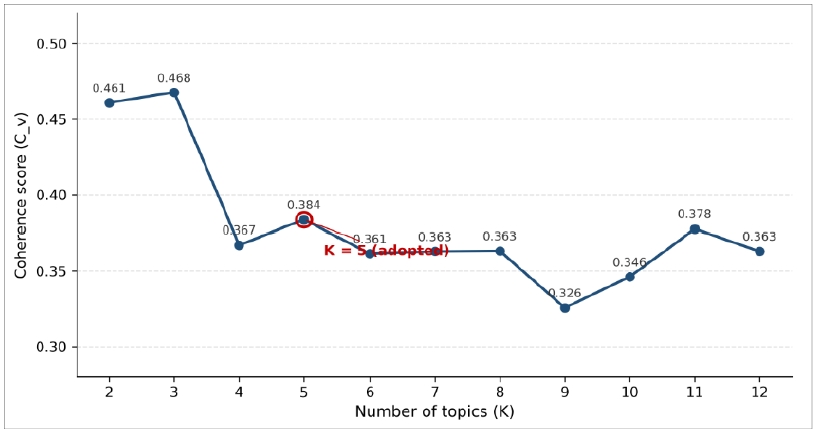
Coherence score for selecting the number of topics (K).
Five major research topics derived from LDA topic modeling
By overall proportion, T5 is the largest at 27.8%, followed by T1 (19.5%), T3 (18.6%), T4 (17.8%), and T2 (16.3%). Each topic can be read from the perspective of environmental robotics as follows.
T1 (service and human-robot interaction) has the core keywords service, human, and technology, and the keyword sustainable is also included, so it covers sustainable robot services and the interactions involved in settings where people and robots act together. Research on robots that cooperate with people and perform services in living spaces and urban environments belongs here.
T2 (sensor- and arm-based operation) has the core keywords sensor and arm, and the keyword monitoring is included, so it covers technology that collects information from the surroundings through sensors and carries out precise tasks with robotic arms. It connects to applications that collect data and perform tasks at monitoring sites, such as pollution measurement, sample collection, and field inspection.
T3 (underwater robot control and motion) has the core keywords control, underwater, and motion, and dynamic and trajectory are also included, so it covers the trajectory control and dynamics-based motion control of autonomous underwater vehicles (AUVs) used in marine exploration. The focus is on technology that allows robots to move reliably and carry out environmental observation and ecosystem surveys in marine and underwater settings where communication and observation are limited, so this topic is the most closely tied to marine and underwater environmental research within environmental robotics. The weight of control (0.050) is clearly higher than the core keywords of the other topics, which shows that control technology forms the center of this theme.
T4 (industrial and energy optimization) has the core keywords energy, industrial, and mobile, and environmental and autonomous are also included, so it covers research that optimizes robot task allocation and energy efficiency in industrial settings. Research that improves the efficiency of robot operation within limited energy and resources belongs here, and it also connects to efficient operation that reduces environmental burden.
T5 (algorithms and bio-inspired robotics) has the core keywords algorithm, time, and fish, and design and environment are also included, so it covers bio-inspired robots that imitate the movement of natural organisms and the algorithms that control them. A representative example is an underwater robot modeled on a fish, designed to move and observe efficiently while adapting to the natural environment.
In this way, environmental robotics research is formed across five thematic areas: service, sensor-based operation, underwater exploration, industry and energy, and algorithms. In particular, keywords directly tied to the environment appear across several topics, such as sustainable in T1, monitoring in T2, environmental in T4, and environment in T5, which shows that environmental robotics is not a single technology but a convergent research field that combines several application areas and technical elements for solving environmental problems.
A comparison of topic proportions between the earlier period (2016 to 2020) and the later period (2021 to 2025) shows clear differences in topic proportions between the two periods.
In the earlier period, T5 (algorithms and bio-inspired robotics) had the largest share at 33.1%, which shows that early research focused on developing robot control algorithms and foundational technologies. In the later period, the share of T5 fell to 25.7%, while the share of T3 (underwater robot control and motion) grew sharply from 12.7% to 20.9%. T4 (industrial and energy optimization) also rose from 15.3% to 18.8%, while T1 (20.4% to 19.1%) and T2 (18.4% to 15.4%) declined slightly. In other words, interest moved beyond the early stage of foundational algorithms and technologies toward research that applies them in real environments. In particular, as research on marine exploration and environmental monitoring increased, the share of the underwater robotics area grew, which shows that environmental robotics research is expanding from foundational technology development toward application research based on marine and underwater environments (Fig. 6).
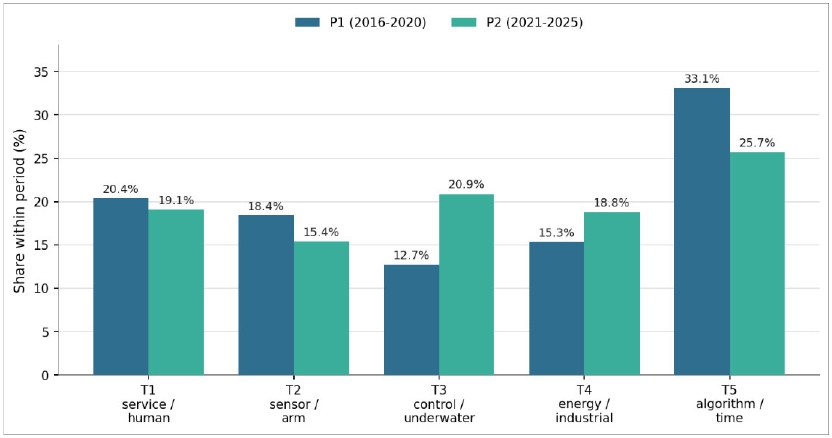
Comparison of topic shares by period (2016-2020 vs 2021-2025).
5. Discussion
5.1. Summary and interpretation of the findings
This study analyzed the research structure and thematic evolution of environmental robotics research by combining bibliometric analysis and LDA topic modeling, using 1,246 papers published between 2016 and 2025. The main findings are organized below according to the research questions, along with a discussion of what they mean.
First, environmental robotics research showed both rapid quantitative growth and expanding academic influence over the analysis period. The number of papers grew about sevenfold, from 30 in 2016 to 210 in 2025, with a compound annual growth rate of 24.1%. Citations also rose steadily and expanded sharply in the later period. This growth aligns with the development of artificial intelligence, which improved the autonomy and data-processing capabilities of robots and widened their range of applications into areas such as environmental monitoring and marine exploration. Beyond the technological driver, this growth also reflects the demand side. As climate change, pollution, and ecosystem degradation have moved up policy agendas, sustained environmental observation has become a public requirement rather than a purely scientific interest, and robotics offers one of the few scalable means of meeting it (Mazzolai et al., 2025). The growth of the field is therefore best read as the joint product of a maturing technology and an expanding societal demand.
Second, the journal analysis showed that environmental robotics research is published widely across many journals rather than being concentrated in a few. The HHI values based on both publication and citation counts were low, which confirms a dispersed research ecosystem, while a few core journals such as Sustainability and Ocean Engineering led the field with high publication volume and influence. In particular, the period comparison showed that the center of the research moved from engineering-focused journals toward journals in the environment, sustainability, and marine areas. This shows that environmental robotics is moving beyond its early stage of technical validation toward interdisciplinary research aimed at solving environmental problems. This movement can be understood as a change in the questions the field asks. In the earlier period, the main question was whether robotic systems could operate reliably in natural environments, so research was validated and published mainly in engineering journals. As the underlying technologies matured, the main question shifted to what environmental problems robots can solve, and the natural outlets for such problem-oriented research are journals in the environment, sustainability, and marine areas. This trajectory, in which a field moves from developing its methods toward applying them to substantive problems, is consistent with stage models of how scientific disciplines evolve (Shneider, 2009). The change in journal distribution therefore reflects not a migration of authors but a maturation of the field from technology validation toward problem solving.
Third, the country analysis revealed different patterns of strength in research productivity and international collaboration. Asian countries such as China and India were strong in publication volume, and China in particular led the field in quantity, accounting for 43.8% of all publications in the later period. European countries such as the United Kingdom, Germany, and Italy had a smaller publication volume but a higher influence per paper, and they showed high centrality and a bridging role in the collaboration network. In other words, a division of roles appears in which Asia drives productivity while Europe serves as a bridge in international collaboration. The collaboration network also grew quickly, from 46 countries and 78 links in the earlier period to 81 countries and 615 links in the later period, which shows that environmental robotics research is increasingly developing on a foundation of global collaboration. This division of roles is consistent with the different ways in which research systems are organized. The strong productivity of China and other Asian countries reflects sustained national investment in robotics and artificial intelligence and the resulting scale of their research communities: China has been the world’s largest market for industrial robots since the mid-2010s, supported by government subsidies and successive national plans for robotics and intelligent manufacturing (Cheng et al., 2019). The bridging position of the United Kingdom, Germany, and Italy is consistent with the structure of European research funding, in which the EU Framework Programmes explicitly aim to create cross-country research networks and fund research through multinational consortia (Balland et al., 2019). The two patterns are complementary rather than competing: highly productive countries supply the volume of research, and highly central countries provide the channels through which methods and results circulate internationally. These changes in centrality rankings describe the relative positions of countries within networks of very different size and density, so they indicate shifts in relative structural roles rather than absolute changes in collaboration intensity.
Fourth, the LDA topic modeling showed that environmental robotics research is made up of five themes: service and human-robot interaction, sensor- and arm-based operation, underwater robot control and motion, industrial and energy optimization, and algorithms and bio-inspired robotics. Environment-related keywords such as sustainable, monitoring, environmental, and environment appeared across several topics, which shows that environmental concerns are broadly embedded throughout the research. In the period comparison, the algorithm-centered topic (T5), which had the largest share in the earlier period, declined somewhat in the later period, while the underwater robot control topic (T3) rose from 12.7% to 20.9%. This indicates that research dealing with marine and underwater environments is growing in share, a tendency similar to the rise of marine journals observed in the journal distribution.
The rapid rise of marine and underwater robotics, which appears consistently in the journal distribution and in the topic analysis, can be explained by three converging drivers. At the policy level, the United Nations Decade of Ocean Science for Sustainable Development (2021 to 2030) called for a substantial expansion of ocean observation and science-based ocean management, which raised the demand for autonomous observing platforms that can cover wide areas of the ocean at reasonable cost (Ryabinin et al., 2019). At the technological level, the adoption of deep learning improved underwater perception, navigation, and control (Sünderhauf et al., 2018), and decision-theoretic planning extended the ability of autonomous underwater vehicles to adapt their missions to changing conditions (Sung et al., 2023), which made reliable operation possible in environments where communication and visibility are severely limited. At the application level, marine environments are among the most difficult and costly for humans to access directly, so robots hold a clear comparative advantage there, as shown in coral reef monitoring and marine ecosystem sampling (Das et al., 2015; Cardenas et al., 2024). These drivers coincide with the later period of this study, and their combined effect is consistent with the growth of the underwater robot control topic (T3) from 12.7% to 20.9% and with the rise of marine journals such as Ocean Engineering and the Journal of Marine Science and Engineering during the same period.
The remaining topic movements can be explained in the same way. The decline of T5 (algorithms and bio-inspired robotics) from 33.1% to 25.7% is a relative change rather than an absolute contraction: the volume of research in this theme continued to grow, but more slowly than the field as a whole. This pattern is typical of a maturing field, in which foundational methods cease to be independent research subjects and become embedded components of application research, and the control and learning algorithms developed in the earlier period now underpin the underwater, industrial, and service applications that expanded in the later period (Shneider, 2009; Sünderhauf et al., 2018). The rise of T4 (industrial and energy optimization) from 15.3% to 18.8% parallels the policy environment of the later period, in which more than one hundred countries announced or considered net-zero emission targets around 2020 and 2021 (van Soest et al., 2021), which raised the value of research that reduces the energy use and environmental burden of robot operation in industrial settings. The slight declines of T1 (service and human-robot interaction, from 20.4% to 19.1%) and T2 (sensor- and arm-based operation, from 18.4% to 15.4%) are also relative: both themes kept growing in absolute terms but at a slower pace than the marine and energy themes, so their shares were diluted by faster growth elsewhere. Taken together, the five movements describe one coherent process, in which the foundational layer of the field has matured and growth is now concentrated where environmental demand is strongest, namely the ocean and energy.
Taken together, environmental robotics research shows meaningful change in its research structure and themes alongside its quantitative growth. Starting from early research centered on engineering-based technology, it has gradually expanded into interdisciplinary research connected with the environment, sustainability, and marine areas, and international collaboration has also grown quickly. These results suggest that environmental robotics is developing toward a more coherent interdisciplinary research domain for solving environmental problems, beyond a single technical area.
5.2. Practical implications
The findings of this study offer the following practical implications for the development of environmental robotics research.
First, convergence research with environmental science, policy, and data analysis should be actively supported. The journal analysis showed that the center of the research moved from engineering toward the environment, sustainability, and marine areas, and the topic analysis also showed environment-related keywords across several themes. Research funding and interdisciplinary research programs should therefore be designed in connection with solving environmental problems.
Second, a research environment should be built so that the various application areas develop in a balanced way. The topic analysis showed that environmental robotics research spans five themes: service, sensor-based operation, underwater robot control, industrial and energy optimization, and algorithms and bio-inspired robotics. Research support and workforce training should cover the full range of application areas so that the field does not become concentrated in a single technology.
Third, participation in international joint research should be expanded. The collaboration network grew quickly from 46 countries in the earlier period to 81 in the later period, and European countries such as the United Kingdom, Germany, and Italy served as bridges in collaboration. It is therefore important to increase participation in international joint projects and to strengthen ties with the countries and institutions at the center of the collaboration network.
Fourth, the integration with artificial intelligence and data-driven technologies should be strengthened. The growth of environmental robotics is linked to improvements in the autonomy and data-processing capabilities of robots, and the topic analysis also identified keywords such as algorithm and autonomous. Research and development that combines autonomous operation, data analysis, and decision support with environmental robotics should be given priority.
Fifth, collaboration that draws on the strengths of each country should be promoted. The analysis showed that Asian countries are strong in research productivity, while European countries are strong in influence per paper and in collaboration network centrality. Because research results can spread effectively when highly productive countries connect with countries at the center of the collaboration network, this kind of complementary collaboration should be encouraged.
5.3. Limitations and directions for future research
This study has the following limitations, which point to directions for future research.
First, the dataset was defined by a single database and a precision-oriented search strategy. Although Scopus offers broad coverage of engineering and environmental science journals, literature indexed only in other databases, such as Web of Science, IEEE Xplore, or regional databases, and non-English publications were not included. In addition, because the search required robot* in article titles and the Environmental Science subject area, relevant studies indexed only under Engineering or Computer Science were not captured, and the dataset represents environmental robotics research as classified within the environmental science literature. Future research could broaden the query to keywords and adjacent subject areas, combine multiple databases, and compare the resulting structures.
Second, the analysis remained at the level of individual countries and did not extend to comparisons between groups of countries. This study analyzed the productivity and collaboration of individual countries, but it did not carry out group-level comparisons, such as differences across continents or between OECD member and non-member countries. Future research could group countries by region or economic level and compare them, which would allow a more multidimensional analysis of the global structure and gaps in environmental robotics research.
Third, this study focused on quantitative analysis through topic modeling and did not carry out a systematic literature review alongside it. The study used LDA topic modeling to identify the main thematic structure and its change, but it did not perform a systematic literature review that examines the content of individual studies in depth. Future research could combine quantitative topic analysis with a qualitative literature review to provide a richer analysis of the specific content and development of the main themes.
Fourth, this study did not address the development paths of specific application areas. It analyzed the overall structure and thematic change of environmental robotics research, but it did not sufficiently examine how specific application areas, such as marine and underwater robotics, environmental monitoring, and disaster response, have each developed. Future research could carry out in-depth analysis focused on specific areas to clarify the technological development and diffusion process of each application area.
6. Conclusions
This study leads to one central conclusion: environmental robotics, which has largely been studied as a set of separate technical areas, is developing toward a more coherent interdisciplinary research domain organized around the goal of solving environmental problems. Four findings support this claim. The field grew rapidly, with publications increasing about sevenfold between 2016 and 2025 and citations expanding sharply in the later period. Its publication base moved from engineering-centered journals toward journals in the environment, sustainability, and marine areas. Its international structure developed into a global division of roles, in which Asian countries drive productivity while European countries connect the collaboration network. Its thematic focus shifted from foundational algorithms toward application research in marine and underwater environments. In other words, what this study defined analytically as one umbrella category is shown, empirically, to be emerging as an interdisciplinary research area with increasing coherence, although the present analyses do not by themselves establish it as a distinct, independent research field.
The primary message of this study is that the center of gravity of environmental robotics has moved from demonstrating what robots can do toward deploying robots for what the environment needs. For researchers, this points to convergence research that links robotics with environmental science, policy, and data analysis. For policymakers and funding agencies, it points to programs that support the full range of application areas, strengthen participation in international collaboration, and accelerate the integration of artificial intelligence and data-driven technologies. By providing an integrated map of the structure, collaboration, and thematic evolution of environmental robotics, this study offers a reference point for both research planning and policy design in the field.
Acknowledgments
This research was supported by funding from the DIPS Project (Robotics and Advanced Manufacturing Sector), carried out by the Global Commercialization Center (GCC) at the Korea Advanced Institute of Science and Technology (KAIST).
REFERENCES
-
Angelini, F., Angelini, P., Angiolini, C., Bagella, S., Bonomo, F., Caccianiga, M., Della Santina, C., Gigante, D., Hutter, M., Nanayakkara, T., Remagnino, P., Torricelli, D., Garabini, M., 2023, Robotic monitoring of habitats: The natural intelligence approach, IEEE Access, 11, 72575-72591.
[https://doi.org/10.1109/ACCESS.2023.3294276]

-
Aria, M., Cuccurullo, C., 2017, bibliometrix: An R-tool for comprehensive science mapping analysis, J. Informetr., 11(4), 959-975.
[https://doi.org/10.1016/j.joi.2017.08.007]
-
Balland, P. A., Boschma, R., Ravet, J., 2019, Network dynamics in collaborative research in the EU, 2003-2017, Eur. Plan. Stud., 27(9), 1811-1837.
[https://doi.org/10.1080/09654313.2019.1641187]
- Blei, D. M., Ng, A. Y., Jordan, M. I., 2003, Latent dirichlet allocation, J. Mach. Learn. Res., 3, 993-1022.
-
Börner, K., Chen, C., Boyack, K. W., 2003, Visualizing knowledge domains, Annu. Rev. Inf. Sci. Technol., 37(1), 179-255.
[https://doi.org/10.1002/aris.1440370106]
-
Cardenas, J. A., Samadikhoshkho, Z., Rehman, A. U., Valle-Pérez, A. U., de León, E. H.-P., Hauser, C. A. E., Feron, E. M., Ahmad, R., 2024, A systematic review of robotic efficacy in coral reef monitoring techniques, Mar. Pollut. Bull., 202, 116273.
[https://doi.org/10.1016/j.marpolbul.2024.116273]
-
Cheng, H., Jia, R., Li, D., Li, H., 2019, The rise of robots in China, J. Econ. Perspect., 33(2), 71-88.
[https://doi.org/10.1257/jep.33.2.71]
-
Das, J., Py, F., Harvey, J. B. J., Ryan, J. P., Gellene, A., Graham, R., Caron, D. A., Rajan, K., Sukhatme, G. S., 2015, Data-driven robotic sampling for marine ecosystem monitoring, Int. J. Robot. Res., 34(12), 1435-1452.
[https://doi.org/10.1177/0278364915587723]
-
Donthu, N., Kumar, S., Mukherjee, D., Pandey, N., Lim, W. M., 2021, How to conduct a bibliometric analysis: An overview and guidelines, J. Bus. Res., 133, 285-296.
[https://doi.org/10.1016/j.jbusres.2021.04.070]
-
Dunbabin, M., Marques, L., 2012, Robots for environmental monitoring: Significant advancements and applications, IEEE Robot. Autom. Mag., 19(1), 24-39.
[https://doi.org/10.1109/MRA.2011.2181683]
- Hirschman, A. O., 1964, The paternity of an index, Am. Econ. Rev., 54(5), 761-762.
-
Khaldi, B., Harrou, F., Sun, Y., 2025, Collaborative swarm robotics for sustainable environment monitoring and exploration: Emerging trends and research progress, Energy Nexus, 17, 100365.
[https://doi.org/10.1016/j.nexus.2025.100365]
-
Li, Y., Li, X.-Z., 2025, Utilizing unmanned aerial vehicle technology for environmental monitoring: Future trends, methods, and applications, Internet Technol. Lett., 8(1), e526.
[https://doi.org/10.1002/itl2.526]
-
Martin, T., Gasselin, P., Hostiou, N., Feron, G., Laurens, L., Purseigle, F., Ollivier, G., 2022, Robots and transformations of work in farm: A Systematic review of the literature and a research agenda, Agron. Sustain. Dev., 42(4), 66.
[https://doi.org/10.1007/s13593-022-00796-2]
-
Mazzolai, B., Laschi, C., Margheri, L., 2025, Environmental intelligence and ecorobotics: Toward environmental sustainability, Annu. Rev. Control Robot. Auton. Syst., 8(1), 25-47.
[https://doi.org/10.1146/annurev-control-030123-014212]
-
Mongeon, P., Paul-Hus, A., 2016, The journal coverage of Web of Science and Scopus: A Comparative analysis, Scientometrics, 106(1), 213-228.
[https://doi.org/10.1007/s11192-015-1765-5]
-
Munasinghe, I., Perera, A., Deo, R. C., 2024, A comprehensive review of UAV-UGV collaboration: Advancements and challenges, J. Sens. Actuator Netw., 13(6), 81.
[https://doi.org/10.3390/jsan13060081]
-
Oliveira, L. F. P., Moreira, A. P., Silva, M. F., 2021, Advances in forest robotics: A State-of-the-art survey, Robotics, 10(2), 53.
[https://doi.org/10.3390/robotics10020053]
-
Pussaignolli de Paula, M., Noronha, M., Garcia Valente, U., Inacio Domingues, B. R., Jahn Souza, L., 2025, Mapping of artificial intelligence and robotics technologies applied to offshore wind energy, J. Sustain. Compet. Intell., 15, e0474.
[https://doi.org/10.24883/eagleSustainable.v15i.474]
-
Röder, M., Both, A., Hinneburg, A., 2015, Exploring the space of topic coherence measures, Proceedings of the Eighth ACM International Conference on Web Search and Data Mining, New York, 399-408.
[https://doi.org/10.1145/2684822.2685324]
-
Ryabinin, V., Barbière, J., Haugan, P., Kullenberg, G., Smith, N., McLean, C., Troisi, A., Fischer, A., Aricò, S., Aarup, T., Pissierssens, P., Visbeck, M., Enevoldsen, H. O., Rigaud, J., 2019, The UN decade of ocean science for sustainable development, Front. Mar. Sci., 6, 470.
[https://doi.org/10.3389/fmars.2019.00470]
-
Saini, J., Dutta, M., Marques, G., 2025, Robot-assisted indoor air quality monitoring and assessment: A Systematic review, Int. J. Environ. Sci. Technol., 22(3), 1921-1936.
[https://doi.org/10.1007/s13762-024-05845-9]
-
Shneider, A. M., 2009, Four stages of a scientific discipline; four types of scientist, Trends Biochem. Sci., 34(5), 217-223.
[https://doi.org/10.1016/j.tibs.2009.02.002]
-
Singh, V. K., Singh, P., Karmakar, M., Leta, J., Mayr, P., 2021, The journal coverage of Web of Science, Scopus and Dimensions: A Comparative analysis, Scientometrics, 126(6), 5113-5142.
[https://doi.org/10.1007/s11192-021-03948-5]
-
Sung, Y., Chen, Z., Das, J., Tokekar, P., 2023, A survey of decision-theoretic approaches for robotic environmental monitoring, Found. Trends Robot., 11(4), 225-315.
[https://doi.org/10.1561/2300000073]
-
Sünderhauf, N., Brock, O., Scheirer, W., Hadsell, R., Fox, D., Leitner, J., Upcroft, B., Abbeel, P., Burgard, W., Milford, M., Corke, P., 2018, The limits and potentials of deep learning for robotics, Int. J. Robot. Res., 37(4-5), 405-420.
[https://doi.org/10.1177/0278364918770733]
-
Tokekar, P., Vander Hook, J., Mulla, D., Isler, V., 2016, Sensor planning for a symbiotic UAV and UGV system for precision agriculture, IEEE Trans. Robot., 32(6), 1498-1511.
[https://doi.org/10.1109/TRO.2016.2603528]
- U.S. Department of Justice, Federal Trade Commission, 2010, Horizontal merger guidelines, U.S. Department of Justice, Washington, D.C., https://www.justice.gov/atr/horizontal-merger-guidelines-08192010
-
van Soest, H. L., den Elzen, M. G. J., van Vuuren, D. P., 2021, Net-zero emission targets for major emitting countries consistent with the Paris Agreement, Nat. Commun., 12(1), 2140.
[https://doi.org/10.1038/s41467-021-22294-x]
-
Wijayathunga, L., Rassau, A., Chai, D., 2023, Challenges and solutions for autonomous ground robot scene understanding and navigation in unstructured outdoor environments: A Review, Appl. Sci., 13(17), 9877.
[https://doi.org/10.3390/app13179877]
-
Wong, C., Yang, E., Yan, X.-T., Gu, D., 2018, Autonomous robots for harsh environments: A Holistic overview of current solutions and ongoing challenges, Syst. Sci. Control Eng., 6(1), 213-219.
[https://doi.org/10.1080/21642583.2018.1477634]
-
Zhang, D., Jiang, Y., Liu, J., Xiong, G., Zou, S., 2025, Design, protection, perception and planning of mobile robots in nuclear power plants, Prog. Nucl. Energy, 186, 105821.
[https://doi.org/10.1016/j.pnucene.2025.105821]
-
Zupic, I., Čater, T., 2015, Bibliometric methods in management and organization, Organ. Res. Methods, 18(3), 429-472.
[https://doi.org/10.1177/1094428114562629]
Global Commercialization Center, KAIST jhpark00@kaist.ac.kr
Global Commercialization Center, KAISTjuyikwon@kaist.ac.kr
ICT Strategy Research Institute, Electronics and Telecommunications Research Institute (ETRI)wisemkkim@naver.com
Global Commercialization Center, KAISTfrv0906@kaist.ac.kr