
갈색거저리 유충을 우분에 첨가 시 pH와 유기물 함량에 미치는 영향
Ⓒ The Korean Environmental Sciences Society. All rights reserved.
This is an Open-Access article distributed under the terms of the Creative Commons Attribution Non-Commercial License (http://creativecommons.org/licenses/by-nc/3.0) which permits unrestricted non-commercial use, distribution, and reproduction in any medium, provided the original work is properly cited.
Abstract
This study evaluate the effects of adding Tenebrio molitor (TM) larvae at different developmental stages to cow manure on its pH and organic matter content over time. Two treatments were established: T1, consisting of 500 g of cow manure and 50 g of third-instar of TM larvae, and T2, consisting of 500 g of cow manure and 50 g of fourth-instar of TM larvae. Cow manure treated with fourth-instar larvae had a higher pH than manure treated with third-instar larvae. To improve suitability of cow manure for composting, its pH must be lowered, indicating a need to incorporate additional materials that can reduce its pH. Likewise pH values, organic matter content followed a similar pattern, with higher values in manure treated with fourth-instar group. Research on the effects of TM larvae on the organic matter content of cow manure and compost-based fertilizers remains limited, highlighting the need for further studies.
Keywords:
Composting, Cow manure, pH, Organic matter, Tenebrio molitor1. 서 론
음식물 쓰레기와 축분 등의 유기성 폐기물의 발생은 기술적 비효율성으로 인해 부적절하게 처리되고 있어 수질, 대기 오염 및 공중 보건 문제를 일으켜 환경과 인간 건강에 크게 영향을 미치게 된다(Kanhai et al., 2021). 특히, 축분의 적절한 처리는 퇴비와 액비와 같은 유용한 유기질 비료로서의 가치가 높다. 이러한 유기질 비료는 토양과 작물이 요구하는 N, P, K 비료 성분과 유기물이 풍부하여 작물의 생산성과 토양의 물리・화학적 성상을 개선한다(Lee et al., 2021). 현재 국내 축분 관련 정책 방향도 이와 보조를 맞추어 최대한 퇴비화나 액비화 방법으로 적용한 뒤 효율적으로 토양에 환원하는 경축순환법으로 활용되고 있다는 점이다(Jeong et al., 2017). 그러나 우리나라의 경우, 축산농장과 인근지역이 너무 가까워 환경민원이 발생되었기 때문에 축분 처리에서 많은 연구와 기술투자가 이루어졌다. 현재의 국내 기술수준을 고려할 때, 축분의 에너지화 방법인 바이오가스화와 고체연료화 기술이 개발되어 이용되고 있지만 상용화되는 까지는 더 많은 연구가 필요한 상황이다(Jeong et al., 2017). 더욱이 이러한 방법은 소규모 축산농장의 경우에는 고비용의 특수시설이 요구되어 실제 적용하기에 어렵다. 따라서 이를 대체할 방안으로 적절한 것이 곤충을 활용한 축분을 처리하는 것이다. 예를 들면, 갈색거저리(Tenebrio molitor) 유충은 식품 및 동물사료의 단백질 공급원으로 가장 일반적으로 사육되는 곤충 중 하나로 보고되고 있다(Coudron et al., 2022). 초기에는 해충 관련 연구의 모델 생물로 사용되었으며(Coudron et al., 2022), 이후에는 잠재적인 대체 단백질공급원 뿐만 아니라 환경정화 곤충으로써 플라스틱과 축분 분해로 주목을 받고 있다(Brandon et al., 2018; Jang and Choi, 2024; Chung, 2025). 최근에 보고된 축분의 적절한 관리에는 퇴비화, 매립, 무단 투기, 소각, 동물 사료로의 전환 등이 있지만(Surendra et al., 2020), 퇴비화가 가장 유용한 방법으로 알려져 있다(Kim et al., 2006). 이러한 축분의 퇴비화 과정에서 pH와 유기물의 변화는 미생물의 변화와 퇴비 부숙 정도를 나타내는 지표로 매우 중요하다(Park et al., 2021). 그러므로 축분에 갈색거저리 유충 처리는 소규모 농장에서의 환경문제를 감소시키고 환경정화 곤충으로서의 역할을 기대할 수 있다. 본 연구는 우분에 갈색거저리의 성장 단계별 유충을 첨가하여 일정시간에 따라 pH와 유기물 함량에 미치는 영향을 조사하여 우분의 퇴비화를 평가하였다.
2. 재료 및 방법
본 공시 곤충은 갈색거저리 3령과 4령 유충으로 울산광역시 울주군 위치한 ㈜Modnilove로부터 공급받아 중부대학교 동물사양학 실험실에서 30일간 수행하였다. 우분은 경상북도 영주의 육우농장으로부터 공급받아 곤충시험에 사용하였다. 실험기간 동안 갈색거저리 유충은 15 cm × 10 cm × 15 cm 크기로 된 정사각형 모양의 투명 플라스틱 상자에서 사육되었으며, 온도 24±1℃, 상대습도 55±5%, 광주기 16L:8D로 설정하여 사육조건을 유지하였다. 특히 유충의 원활한 호흡을 위해 용기 뚜껑 4면에 드릴을 이용하여 구멍을 뚫었다. 실험처리구는 다음과 같이 제시하였다.
- T1 = 500 g of cow manure + 50 g of 3rd instar of TM larvae
- T2 = 500 g of cow manure + 50 g of 4th instar of TM larvae
샘플은 10일 간격으로 각 처리구로부터 약 50g씩 채취하여 즉시 pH와 유기물 분석에 활용하였다. 먼저 pH 분석을 위해 샘플과 증류수의 비율을 1:10(w/v)으로 혼합하여 섞은 후 2시간 정도의 원심분리과정을 거친 상태에서 상층 부분을 pH meter (Mettler Toledo Co., MP230, Küsnacht, Switzerland)로 측정하였다. 유기물(organic matter) 함량은 Kim et al.(2006) 방법에 준하여 회화로 550℃에서 4시간 회화 후 작열손실량으로 계산되었다. 모든 샘플은 3반복으로 분석되었다. 통계분석은 SAS (Version 9.4) package program을 활용하여 완전임의배치법으로 설계되었다. 처리구 간 평균은 T-test로 실시하여 95% 수준에서 유의성을 검정하였다.
3. 결과 및 고찰
Fig. 1은 갈색거저리 3령과 4령 유충을 우분에 첨가 시 pH에 대한 결과를 제시하였다. 실험기간 동안 결과를 보면 두 처리구 간에 pH는 통계적 유의성이 관측되지 않았다(p>0.05). 특히, 갈색거저리 4령 유충 처리구(T2)가 갈색거저리 3령 유충 처리구(T1)보다 우분의 pH가 높았다. 이는 유충의 성장의 차이로 4령의 경우 우분을 먹이로 섭취하여 배설물이 우분과 함께 혼합되어 유기물로서 빠르게 분해되면서 pH와 암모니아 발생에 영향을 주었기 때문이라 추측할 수 있다(Lee et al., 2005; Mari et al., 2005). 일반적으로 우분의 pH는 신선한 상태인지, 발효 퇴비에 따라 차이가 있지만, 우리의 결과는 퇴비화 과정이므로 pH 범위가 9.07-9.45로 Joo et al.(2022) 연구와 비슷한 수준이었다. 비료법상 가축분뇨가 들어가는 비료인 부숙유기질비료로 pH 범위가 pH 7.5-9.0 내외로 알려져 있다. 또한, Miller and Metting(1992)은 pH가 부숙 과정에서 간접적 지표로 이용되는 요인이며 미생물 활성을 위한 최적범위는 약 pH 6-9 정도로 보고하였다. 결과적으로 유기질 비료로의 가치를 높이기 위해서는 우분의 pH를 감소시킬 필요성이 있어 우분에 첨가될 수 있는 부자재(sub-materials) 선정과 갈색거저리 유충 성장에 대한 연구가 필요하다.
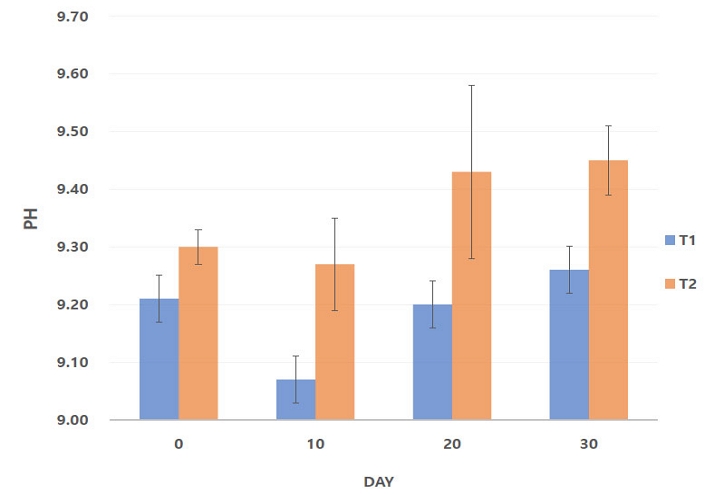
Effects of third and fourth instar of TM larvae on pH values of cow manure as a function of time. Treatments consisted of two groups: T1 = 500 g of cow manure + 50 g of third instar of TM larvae; T2 = 500 g of cow manure + 50 g of fourth instar of TM larvae. Values are expressed as mean± the standard error of the mean (SEM).
Fig. 2는 갈색거저리 3령과 4령 유충을 우분에 첨가 시 유기물 함량에 미치는 영향을 나타내었다. 건물 기준으로 유기물은 두 처리구 간에 30일의 결과를 제외하고 나머지 기간에는 통계적 유의성이 인정되지 않았다(p>0.05). pH 결과와 마찬가지로 갈색거저리 4령 유충 처리구가 3령 처리구보다 유기물 함량이 높아 비슷한 패턴을 보였다. 이러한 결과는 4령 유충에서 우분에 충분한 영양분을 섭취하여 성장 속도가 빨라져 유기물을 분해한 결과로 해석되며 최종 부산물인 우분 퇴비화 과정에 결정적인 영향을 미칠 것으로 판단된다. 일반적으로 축분에서 유기물의 역할은 미생물 활동을 향상시키고 식물 성장을 촉진하는데 필요한 영양소를 제공한다는 점이다(Tiwari et al., 1989; Chauhan et al., 2012). 그러나 현재까지 곤충을 활용한 우분의 유기물 함량에 대한 기준과 퇴비 비료의 유기물 함량을 비교한 연구가 없어 우리의 결과에 대한 정확한 설명은 어렵다.
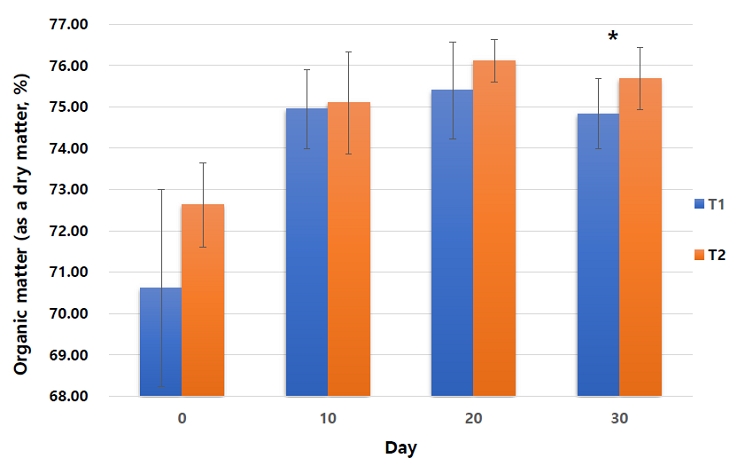
Effects of third and fourth instar of TM larvae on organic matter contents of cow manure as a function of time (*p<0.05). Treatments consisted of two groups: T1 = 500 g of cow manure + 50 g of third instar of TM larvae; T2 = 500 g of cow manure + 50 g of fourth instar of TM larvae. Values are expressed as mean± the standard error of the mean (SEM).
4. 결 론
본 연구는 갈색거저리 성장 단계별 유충을 우분에 첨가하여 일정시간에 따라 pH와 유기물 함량에 미치는 영향을 조사하여 우분의 퇴비화를 평가하는 데 있다. pH의 경우, 갈색거저리 4령 유충 처리구가 갈색거저리 3령 유충 처리구보다 우분의 pH 값이 높게 나타났다. 따라서 퇴비 비료로의 가치를 높이기 위해서는 우분의 pH를 감소시켜야 하며, 이에 따라 우분에 첨가 가능한 부자재가 필요하다는 것을 시사한다. 유기물 함량의 결과는 3령 처리구보다 갈색거저리 4령 유충 처리구가 높아 pH 함량과 비슷한 패턴을 보였다. 그렇지만 곤충을 활용한 우분의 유기물 함량 및 유기질 퇴비와 비료에 관한 자료와 연구가 없어 추가적인 연구가 필요하다.
REFERENCES
-
Brandon, A. M., Gao, S. H., Tian, R., Ning, D., Yang, S. S., Zhou, J., Wu, W. M., Criddle, C. S., 2018, Biodegradation of polyethylene and plastic mixtures in mealworms (Larvae of Tenebrio molitor) and effects on the gut microbiome, Environ. Sci. Technol., 52(11), 6526-6533.
[https://doi.org/10.1021/acs.est.8b02301]

-
Chauhan, B. S., Singh, R. G., Mahajan, G., 2012, Ecology and management of weeds under conservation agriculture: A Review, Crop Prot., 38, 57-65.
[https://doi.org/10.1016/j.cropro.2012.03.010]
-
Chung, T. H., 2025, Evaluation of environmental control ability of Tenebrio molitor larvae on laying hens' manure, J. Environ. Sci. Int., 34(4), 249-252.
[https://doi.org/10.5322/JESI.2025.34.4.249]
-
Coudron, C. L., Deruytter, D., Claeys, J., 2022, The influence of wet feed pH on the growth of Tenebrio molitor larvae, Sustainability, 14(13), 7841.
[https://doi.org/10.3390/su14137841]
-
Jang, W. W., Choi, I. H., 2024, Effect of treating environmental purification insect larvae to pig manure on crude ash content and ammonia production, J. Environ. Sci. Int., 33(2), 187-191.
[https://doi.org/10.5322/JESI.2024.33.2.187]
- Jeong, K. H., Kim, J. K., Lee, D. J., 2017, Feasibility test for solidified fuel with cow manure, J. Soil Groundwater Environ., 22(6), 112-119.
-
Joo, Y. H., Seo, M. J., Jeong, S. M., Kim, J. Y., Kim, S. C., 2022, Effects of microbial additives on the chemical characteristics, microbes, gas emissions, and compost maturity of hanwoo steer manure, J. Kor. Grassl. Forage. Sci., 42(4), 264-269.
[https://doi.org/10.5333/KGFS.2022.42.4.264]
-
Kanhai, G., Agyei-Mensah, S., Mudu, P., 2021, Population awareness and attitudes toward waste-related health risks in Accra, Ghana, Int. J. Environ. Health Res., 31(6), 670-686.
[https://doi.org/10.1080/09603123.2019.1680818]
-
Kim, K. Y., Choi, H. L., Ko, H. J., Kim, C. N., 2006, Estimation of ammonia emission during composting livestock manure based on the degree of compost maturity, J. Anim. Sci. Technol. (Kor.), 48(1), 123-130.
[https://doi.org/10.5187/JAST.2006.48.1.123]
- Lee, J. E., Hong, J. H., Chang, K. W., Hwang, J. Y., 2005, Effect of pyroligneous acid liquor on the maturity of pig manure compost, Korean J. Soil Sci. Fert., 38(2), 101-107.
-
Lee, Y. H., Park, S. J., Shim, J. H., Kwon, S. I., Kim, S. H., 2021, Effect of livestock manure composts application on yield, soil chemical properties and carbon sequestration of maize cropping for five years, Korean J. Soil Sci. Fert., 54(4), 636-642.
[https://doi.org/10.7745/KJSSF.2021.54.4.636]
-
Mari, I., Ehaliotis, C., Kotsou, M., Chatzipavlidis, I., Georgakakis, D., 2005, Use of sulfur to control pH in composts derived from olive processing by-products, Compost Sci. Util., 13(4), 281-287.
[https://doi.org/10.1080/1065657X.2005.10702252]
- Miller, F., Metting Jr., F., 1992, Composting as a process based on the control of ecologically selective factors, in: Metting Jr., F. B. (Ed.), Soil Microbial Ecology: Applications in Agricultural and Environmental Management, Marcel Dekker, Inc., New York, 515-544.
-
Park, H. M., Jeong, K. H., Lee, D. J., Lee, D. H., Kim, J. K., 2021, Effect of different aeration methods on pig manure aerated static compost pile, J. Korean Soc. Int. Agric., 33(4), 355-361.
[https://doi.org/10.12719/KSIA.2021.33.4.355]
-
Surendra, K. C., Tomberlin, J. K., van Huis, A., Cammack, J. A., Heckmann, L. H. L., Khanal, S. K., 2020, Rethinking organic wastes bioconversion: Evaluating the potential of the black soldier fly (Hermetia illucens (L.)) (Diptera: Stratiomyidae) (BSF), Waste Manag., 117, 58-80.
[https://doi.org/10.1016/j.wasman.2020.07.050]
-
Tiwari, S. C., Tiwari, B. K., Mishra, R. R., 1989, Microbial populations, enzyme activities and nitrogen-phosphorus-potassium enrichment in earthworm casts and in the surrounding soil of a pineapple plantation, Biol. Fert. Soils., 8(2), 178-182.
[https://doi.org/10.1007/BF00257763]
Division of Pet & Companion Animal Science, Joongbu Universityanimalscience@naver.com